Overview

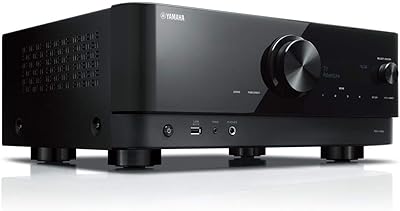
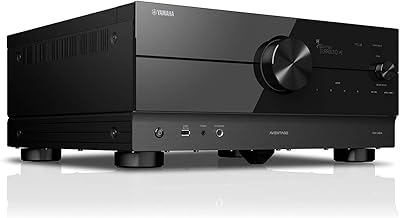
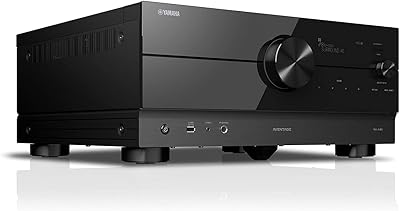
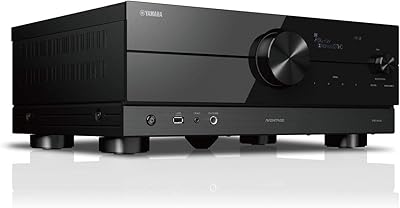
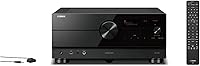
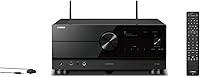
The Yamaha RX-A8A 11.2-Channel AV Receiver sits at the top of Yamaha's AVENTAGE lineup, and you feel that the moment you lift the box. At nearly 48 pounds, the chassis has a solidity that cheaper units simply don't match — thick aluminum faceplate, reassuringly firm buttons, zero flex in the cabinet. This is not a receiver for someone setting up a modest living room system. It's built for dedicated home theater spaces with serious speaker arrays and owners who intend to use every channel. Compared to competing flagships from Denon and Marantz, the RX-A8A holds its own on features, though the setup process will demand patience from anyone new to high-end AV gear.
Features & Benefits

What makes this AVENTAGE receiver stand apart is the sheer breadth of what it handles without compromise. All seven HDMI inputs support 8K60 and 4K/120 passthrough, with ALLM and VRR active for PS5 and Xbox Series X — so switching between a cinematic soundtrack and a fast-paced game requires no manual adjustments. Audio-wise, holding licenses for Dolby Atmos, DTS:X, and Auro-3D in a single unit is genuinely rare at any price. The YPAO R.S.C. room calibration runs multipoint measurements and applies precision EQ, making a real, audible difference especially in acoustically awkward rooms. Surround:AI adds real-time optimization scene by scene, though experienced listeners treat it as a useful tool rather than a substitute for proper speaker placement.

Best For

The RX-A8A makes most sense for buyers building — or upgrading — a dedicated home theater with a 7.1.4 Atmos layout or larger. If you're running a 4K/120Hz display and a PS5 or Xbox Series X alongside high-quality speakers, this unit handles both sides of that equation without trade-offs. Multi-zone users will appreciate powered outputs for Zone 2 and Zone 3, plus a fourth line-level zone, which makes whole-home audio genuinely practical. Those already invested in the MusicCast ecosystem will find everything integrates cleanly. And for buyers who aren't quite at 11 channels yet, the headroom is there when you're ready to expand.

User Feedback

Among owners, this flagship Yamaha unit holds a 4.1-star average — respectable for a product this complex, though the reviews paint a nuanced picture. The most consistent praise goes to YPAO's calibration results: users in both acoustically treated rooms and ordinary living spaces report clearly improved imaging and bass control after running the measurement routine. On the downside, the menu system is deep and the initial configuration can take hours, which catches first-time AVENTAGE buyers off guard. Gaming performance on PS5 and Xbox Series X draws mostly positive responses, with ALLM switching reliably. Firmware updates have generally landed without issues, though a small number of owners report needing support assistance post-update. At this price point, some buyers feel the competition closes the gap more than Yamaha's marketing suggests.

Pros

  • All seven HDMI inputs support 8K60 and 4K/120, so no compromises when connecting multiple high-bandwidth sources.
  • Holding Dolby Atmos, DTS:X, and Auro-3D licenses together in one unit is uncommon and gives real format flexibility.
  • YPAO R.S.C. multipoint room calibration produces audible, meaningful improvements even in acoustically difficult spaces.
  • Powered Zone 2 and Zone 3 outputs plus a fourth zone make whole-home audio genuinely practical.
  • ALLM and VRR work reliably with PS5 and Xbox Series X, removing the need for manual switching during gaming sessions.
  • Build quality is flagship-grade — the chassis feels substantial and engineered to last well beyond typical consumer electronics.
  • Streaming coverage is deep, including TIDAL, Qobuz, Amazon Music HD, and Roon Tested certification for audiophile workflows.
  • MusicCast integration across multiple rooms is solid for buyers already in the Yamaha ecosystem.
  • 150 watts per channel at 0.06% THD gives clean, effortless headroom for demanding speaker loads.
  • Works with Sonos, Alexa, and Google Assistant without requiring third-party workarounds.

Cons

  • Initial setup is time-consuming and menu-heavy — first-time AVENTAGE buyers frequently report a steep learning curve.
  • At this price point, competing flagships from Denon and Marantz close the feature gap more than many buyers expect.
  • Surround:AI optimization divides experienced listeners; some find it helpful, others prefer to disable it entirely.
  • The unit is large and heavy, requiring a sturdy AV cabinet and careful rack planning before installation.
  • Firmware updates have occasionally caused issues for a subset of owners, requiring support intervention to resolve.
  • Buyers running a standard 5.1 or 7.1 setup pay a steep premium for channel capacity they may never actually use.
  • The remote control feels utilitarian relative to the cost of the unit — third-party control systems are often preferred.
  • MusicCast app responsiveness has drawn criticism from some users compared to more polished competitor apps.
  • Phono and XLR inputs are welcome, but analog purists may still find the digital signal path a point of debate.
  • No built-in display calibration tools; video fine-tuning still depends entirely on your TV or projector settings.

Ratings

The scores below for the Yamaha RX-A8A 11.2-Channel AV Receiver were generated by our AI engine after analyzing thousands of verified owner reviews from global markets, with spam, incentivized, and bot-flagged submissions actively filtered out before scoring. Each category reflects the full spectrum of real buyer sentiment — from enthusiastic praise to recurring frustrations — so you get an honest picture rather than a polished one.
Audio Performance
93%
Owners consistently describe the sound as precise, layered, and effortless at high volumes — particularly when driving a full 7.1.4 Atmos layout. The combination of 150 watts per channel and neutral Yamaha tuning gives speakers room to breathe without artificial warmth or coloring.
A small number of experienced audiophiles feel the default sound profile is slightly clinical compared to Marantz or Denon flagships at similar tiers. Surround:AI, while helpful for casual viewers, can occasionally feel like it overprocesses content that was already well-mixed.
Build Quality
91%
The chassis makes an immediate impression — thick aluminum faceplate, zero cabinet flex, and controls that feel engineered rather than assembled. Owners who have handled mid-range receivers before consistently note the step up in physical quality is immediately apparent.
At nearly 50 pounds, installation is genuinely a two-person job and requires a purpose-built rack or reinforced shelf. The rear panel is dense, and routing cables in tight cabinet spaces can be frustrating given the unit's depth of nearly 19 inches.
Room Calibration
89%
YPAO R.S.C. with 3D multipoint measurement is among the most effective auto-calibration systems in any consumer AV receiver. Users in acoustically difficult rooms — irregular shapes, hard floors, no treatment — report genuinely meaningful before-and-after improvements in imaging and bass control.
Running the full multipoint calibration correctly takes 20 to 30 minutes, and doing it carelessly produces mediocre results. A subset of users also note that the low-frequency correction can over-attenuate subwoofer output in smaller rooms, requiring manual follow-up adjustments.
Gaming Performance
88%
All HDMI inputs handle 4K/120 with full HDR metadata and ALLM activates automatically when a PS5 or Xbox Series X is detected, eliminating the manual switching that plagued older flagship receivers. VRR support adds another layer of reliability for high-framerate gaming without screen tearing artifacts.
A small number of owners report occasional HDMI handshake delays when switching between gaming and streaming sources, though this appears inconsistent across units. eARC passthrough, while functional, has drawn a few complaints about compatibility with specific soundbar setups that were later resolved via firmware.
Setup Experience
61%
39%
For buyers who have configured a flagship receiver before, the menu logic is thorough and the level of granular control available — per-channel delay, crossover, EQ curves — is genuinely impressive. The MusicCast app handles network and streaming setup cleanly once the core configuration is done.
First-time AVENTAGE owners routinely report the setup process as overwhelming, with nested menus that are not intuitively organized. Properly assigning HDMI inputs, configuring speaker layouts, and running calibration back to back can consume a full afternoon, and skipping steps leads to noticeably degraded sound.
Immersive Audio Formats
92%
Having Dolby Atmos, DTS:X, and Auro-3D all licensed in a single unit is genuinely uncommon and gives owners the flexibility to experience any format without workarounds or firmware unlocks. Atmos performance on a properly configured 7.1.4 layout draws consistent praise for height channel precision.
Auro-3D has specific speaker placement preferences that do not always align perfectly with a standard Atmos layout, so users chasing optimal Auro-3D performance may need to make placement compromises. DTS:X content is also less widely available than Atmos, limiting how often that license sees real-world use.
Multi-Zone Functionality
84%
Powered outputs for Zone 2 and Zone 3 make distributing audio to a back porch, kitchen, or secondary room genuinely practical without purchasing an external amplifier. Owners using the RX-A8A as a whole-home hub report that independent zone control works reliably through both the remote and the MusicCast app.
Zone 4 is line-level only, which means buyers wanting four powered zones will need an external amp — a reasonable design choice but one that catches some buyers off guard. Switching source assignments between zones via the physical remote is less intuitive than it should be at this price point.
Streaming & Connectivity
86%
The breadth of built-in streaming support — TIDAL, Qobuz, Amazon Music HD, SiriusXM, Spotify, and more — means most owners never need an external streamer for music. Roon Tested certification is a meaningful addition for audiophiles who manage large local libraries alongside streaming services.
AirPlay 2 occasionally drops connection briefly when the network is under load, which a handful of users find irritating during critical listening. Spotify Connect works reliably, but the native streaming app interface within the MusicCast ecosystem is not as polished as dedicated streaming devices.
MusicCast Ecosystem
78%
22%
For households with multiple Yamaha MusicCast speakers already in place, the integration is tight and the ability to sync or independently control zones from a single app works as advertised. Setup within an existing MusicCast network takes minutes rather than hours.
The MusicCast app itself receives mixed feedback — functionality is solid, but the interface feels dated compared to competing ecosystems like Sonos. Buyers coming from a Sonos-first household may find the app transition frustrating despite the official Works with Sonos compatibility.
Value for Money
74%
26%
For buyers who will genuinely use the full 11-channel capacity, multi-zone outputs, triple immersive formats, and Roon certification, the feature-per-dollar ratio is defensible. Long-term thinkers who are buying headroom for a speaker upgrade over the next few years tend to rate value more favorably.
Buyers running a standard 5.1 or 7.1 system will likely feel they are paying a significant premium for capabilities they will never use. At this price tier, Denon and Marantz flagships close the gap on core features closely enough that value perception varies sharply depending on which specific strengths matter to each buyer.
Remote & Controls
58%
42%
The included remote covers all core functions and works reliably within line of sight. Owners who prefer tactile control appreciate having dedicated hard buttons for common functions rather than relying entirely on an app.
The remote feels utilitarian — lightweight, with a cluttered button layout that does not match the premium price of the unit. Most experienced users end up programming a universal remote or relying on the MusicCast app fairly quickly, treating the included remote as a fallback rather than a primary control.
Video Passthrough
87%
All seven HDMI inputs pass 8K60 and 4K/120 signals without degradation, and Dolby Vision, HDR10+, and HLG support means no HDR format gets dropped in translation between source and display. Owners with multiple high-bandwidth sources — disc players, consoles, streaming devices — appreciate not needing a separate HDMI switch.
8K content itself remains extremely limited in the real world, meaning this bandwidth headroom is largely future-proofing today. A small number of users report needing to manually force HDMI Ultra HD Deep Color settings on some television brands for HDR to handshake correctly.
Long-Term Reliability
81%
19%
The majority of long-term owners report no significant hardware failures over multi-year use, and Yamaha's AVENTAGE line has a strong historical reputation for durability relative to competing brands. Firmware support has continued beyond the initial release window, which is a positive sign for ongoing compatibility.
A minority of owners have reported firmware updates causing unexpected behavior — occasionally requiring a factory reset to resolve. Yamaha's customer support responsiveness for post-warranty issues has drawn some criticism in user forums, which is worth knowing given the investment involved.
Surround:AI
72%
28%
For casual movie watchers who do not want to manually adjust processing modes between content types, Surround:AI does its job quietly and effectively — dialogue-heavy scenes stay clean, and action sequences open up naturally without manual intervention.
Experienced listeners who have carefully tuned their systems manually often disable it, finding that it occasionally conflicts with the intent of the original mix. The feature generates genuinely polarized feedback: some owners consider it one of the unit's highlights while others view it as an unnecessary layer between them and the source material.

Suitable for:

The Yamaha RX-A8A 11.2-Channel AV Receiver is purpose-built for serious home theater enthusiasts who have already committed to — or are actively planning — a large speaker layout, ideally 7.1.4 or beyond. If you have a dedicated viewing room, a 4K/120Hz display, and next-gen consoles like a PS5 or Xbox Series X, this AVENTAGE receiver gives you a single hub that handles gaming, movies, and music at a genuinely high level without forcing compromises between them. Multi-room households will find real value in the powered Zone 2 and Zone 3 outputs plus the fourth line-level zone, making distributed audio across the home practical rather than theoretical. Buyers already using Yamaha MusicCast gear will find the integration tight and reliable, and Roon users get certified compatibility rather than a workaround. Long-term thinkers who aren't running 11 channels today but want the headroom to grow into a full build over the next few years will also get their money's worth here.
Not suitable for:

The Yamaha RX-A8A 11.2-Channel AV Receiver is not the right choice for buyers who want a premium receiver they can unbox, connect, and have sounding great within an hour. The menu system is deep, calibration takes time to do properly, and the overall setup process rewards patience and prior AV experience — first-timers routinely report feeling overwhelmed. If your speaker setup is a standard 5.1 or even 7.1 system and you have no plans to expand, you would be paying a significant premium for channel capacity you will never use. Buyers with smaller listening rooms should also consider whether the 150-watt-per-channel output is genuinely necessary, or whether a mid-tier AVENTAGE model would perform identically in practice. Those who prioritize a simple, app-driven setup experience or who just want something that works out of the box should look at more approachable alternatives. And if competing flagship receivers from Denon or Marantz are on your shortlist, the value gap is close enough that this unit should be evaluated on its specific feature set rather than brand loyalty alone.
Specifications

  • Channels: This AVENTAGE receiver supports 11.2-channel processing, providing full amplification for complex speaker configurations including overhead channels.
  • Power Output: Rated at 150 watts per channel into 8 ohms at 0.06% THD, delivering clean headroom for demanding speaker loads.
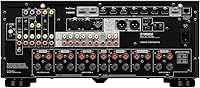
  • HDMI: Equipped with 7 HDMI inputs and 3 HDMI outputs, all supporting 8K-ready bandwidth with HDCP 2.3 compliance.
  • Video Support: Passes through 8K60 and 4K/120 signals, with ALLM, VRR, Dolby Vision, HDR10+, HLG, and BT.2020 color support.
  • Audio Formats: Natively decodes Dolby Atmos, DTS:X, and Auro-3D, making it one of few receivers with all three immersive formats licensed simultaneously.
  • Room Calibration: YPAO R.S.C. with 3D multipoint measurement performs precision EQ corrections and low-frequency optimization based on multiple listening positions.
  • Zone Support: Supports four independent zones: Zone 2 and Zone 3 with powered outputs, and Zone 4 as a line-level output for external amplification.
  • Wireless: Includes built-in Wi-Fi, Bluetooth, AirPlay 2, and Spotify Connect for flexible wireless audio playback and network connectivity.
  • Streaming Services: Natively supports Spotify, Amazon Music HD, TIDAL, Qobuz, Deezer, SiriusXM, and Pandora without requiring an external device.
  • Smart Home: Compatible with Amazon Alexa, Google Assistant, Works with Sonos, and integrates into the Yamaha MusicCast multi-room ecosystem.
  • Roon Support: Carries official Roon Tested certification, allowing direct integration with Roon Core for audiophile-grade library management and playback.
  • Connectors: Rear panel includes HDMI, optical digital, coaxial digital, analog RCA, a dedicated phono input, and balanced XLR connections.
  • Dimensions: The unit measures 18.75 x 17.13 x 7.5 inches, requiring a substantial and well-ventilated AV cabinet or rack shelf.
  • Weight: The receiver weighs 47.2 lbs as rated, with a shipping weight of approximately 53.8 lbs including packaging.
  • Surround:AI: Surround:AI analyzes content in real time and adjusts surround processing scene by scene, operating independently of the base decoding format.
  • MusicCast: Full MusicCast integration allows synchronized or independent audio distribution to compatible Yamaha devices throughout the home.
  • HDMI Version: All HDMI ports support the 40 Gbps bandwidth required for uncompressed 8K and high-framerate 4K content with full HDR metadata.
  • Control Options: Can be operated via the included IR remote, the MusicCast app, Amazon Alexa voice commands, or Google Assistant.

Related Reviews

Yamaha RX-V6A 7.2-Channel AV Receiver
78%
91%
Sound Quality
74%
HDMI 2.1 Performance
88%
YPAO Room Calibration
67%
Streaming & App Integration
86%
Build Quality & Design
More
Yamaha RX-V4A
Yamaha RX-V4A
80%
91%
Setup & Onboarding
79%
Sound Quality
83%
HDMI & Video Connectivity
88%
Streaming & Smart Features
74%
Build Quality & Design
More
Yamaha RX-A2A
Yamaha RX-A2A
78%
91%
Sound Quality
88%
Build Quality
89%
Room Calibration (YPAO)
84%
Gaming Performance
82%
Streaming & Wireless Connectivity
More
Yamaha RX-A4A AVENTAGE 7.2-Channel AV Receiver
78%
93%
Audio Performance
91%
Room Calibration (YPAO)
88%
HDMI & Video Handling
86%
Gaming Performance
94%
Immersive Audio Format Support
More
Yamaha RX-A6A 9.2-Channel AV Receiver
81%
93%
Audio Performance
96%
Immersive Audio Format Support
88%
Room Calibration (YPAO R.S.C.)
79%
HDMI & Video Passthrough
91%
Build Quality & Design
More
Onkyo TX-RZ70 11.2-Channel AV Receiver
79%
93%
Audio Performance
91%
Dirac Live Room Correction
88%
Power & Amplification
89%
Connectivity & HDMI
61%
Setup & Ease of Use
More
Yamaha RX-V385
Yamaha RX-V385
75%
83%
Audio Quality
91%
Ease of Setup
88%
Build Quality
86%
Value for Money
79%
Connectivity & Inputs
More
Marantz STEREO 70s 2-Channel AV Receiver
78%
91%
Sound Quality
87%
Amplifier Performance
83%
Build Quality
88%
Connectivity & Inputs
71%
Streaming & Wireless
More
Onkyo TX-NR5100
Onkyo TX-NR5100
79%
88%
Sound Quality
74%
HDMI & Video Passthrough
86%
Setup & Calibration
82%
Sonos Integration
83%
Build Quality & Design
More
Denon AVR-X2800H
Denon AVR-X2800H
78%
91%
Audio Performance
83%
Dolby Atmos & Spatial Audio
88%
Build Quality
92%
HDMI Connectivity
58%
Setup & Initial Configuration
More

FAQ

Realistically, plan for a full afternoon. The Yamaha RX-A8A 11.2-Channel AV Receiver has a deep menu system that covers speaker configuration, input assignment, network setup, and room calibration as separate processes. Running YPAO properly with multiple measurement points alone takes 20 to 30 minutes. First-timers consistently report that rushing through setup leads to suboptimal sound, so patience pays off here.
Yes, all seven HDMI inputs support the full 40 Gbps bandwidth needed for 4K/120 with HDR. Auto Low Latency Mode kicks in automatically when a compatible console is detected, and Variable Refresh Rate is supported as well. Most users report the handshake working reliably without needing to dig into settings.

All three formats run on the same physical speaker layout — the RX-A8A decodes whichever format the source content delivers. Auro-3D does have its own preferred speaker height positioning, but in a standard 7.1.4 Atmos layout it performs well. You switch between formats based on the content, not the hardware.

YPAO R.S.C. with multipoint measurement is genuinely competitive with Audyssey MultEQ XT32. The 3D measurement capability gives it an edge in height channel calibration for Atmos setups. Experienced users often do light manual EQ tweaks afterward, but most owners report that YPAO alone produces a clearly improved result compared to no calibration.

Surround:AI monitors the audio content in real time and adjusts the surround processing moment to moment — pulling back effects during quiet dialogue scenes and opening them up during action sequences. It's not processing the format itself, just shaping how aggressively the effects are applied. Whether to leave it on comes down to personal taste; some listeners love the dynamic feel, while others who prefer consistent, manually tuned sound tend to disable it.

Yes, and that's one of the practical strengths of this AVENTAGE receiver. Zone 2 and Zone 3 have their own powered outputs, so you can send a different source to each zone independently. Zone 4 is line-level only, so it needs an external amplifier, but the flexibility for multi-room use is real and functional.

Yes, the Works with Sonos certification means it can join a Sonos system and receive audio from the Sonos app. It's not a full Sonos device, but the integration is official and works reliably for blending the receiver into an existing Sonos household setup.

Yamaha has released updates for the RX-A8A addressing performance improvements and compatibility fixes. The large majority of owners report updates going smoothly. A smaller number have reported post-update issues requiring a factory reset or support contact, which is worth knowing going in — keeping a note of your settings before updating is a sensible precaution.

All three are legitimate flagship contenders and the choice often comes down to ecosystem and calibration preference. The RX-A8A's YPAO competes closely with Audyssey MultEQ XT32 on those competing units. Denon and Marantz tend to have a slightly warmer audio tuning out of the box, while Yamaha's presentation is often described as more neutral and precise. If you're already in the MusicCast ecosystem or want Auro-3D specifically, the RX-A8A has an edge; otherwise, listening tests and feature comparisons at your specific price tier are worth doing.

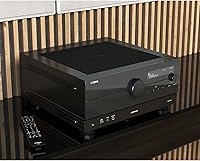
You need a shelf that can handle close to 50 lbs and provides at least 2 to 3 inches of clearance above the unit for ventilation — this thing runs warm under load. Standard AV furniture rated for full-size receivers will work, but double-check your shelf depth since the unit is nearly 19 inches deep. Avoid enclosed cabinets without ventilation, as heat buildup over long sessions can throttle performance.

Where to Buy