Yamaha RX-A6A 9.2-Channel AV Receiver
Overview
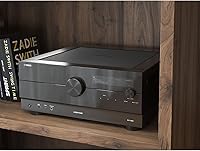
The Yamaha RX-A6A 9.2-Channel AV Receiver sits at the top of Yamaha's AVENTAGE lineup — a tier that means thicker chassis construction, a center-beam anti-resonance base, and amplifier components selected for performance over cost-cutting. This is not a receiver you tuck into a living room credenza. At over 41 pounds and nearly 19 inches wide, it demands a proper equipment rack and a dedicated space to match. The RX-A6A drives nine channels at 150 watts each, with headroom to process an 11.2-channel layout, which matters once you start adding overhead speakers. The price puts it squarely in serious enthusiast territory — buyers who treat their home theater as a long-term investment, not an impulse purchase.
Features & Benefits
All seven HDMI inputs on the RX-A6A support 8K/60Hz and 4K/120Hz — your PS5, Xbox Series X, and any upcoming 8K display all connect without compromise, and ALLM plus VRR keep gaming latency low. On the audio side, Dolby Atmos and DTS:X are expected at this tier, but including Auro-3D is notably uncommon and rewards listeners with properly configured height speaker layouts. Surround:AI adjusts processing in real-time based on content type — useful, though results vary noticeably by source material and it is not a substitute for good speaker placement. YPAO R.S.C. with 3D multipoint measurement handles calibration at a level comparable to Audyssey MultEQ XT32. Streaming support covers AirPlay 2, TIDAL, Qobuz, and Roon Tested certification — a rare nod to the audiophile crowd.
Best For
If you are building or upgrading a dedicated 7.2 or 9.2 speaker system, this AVENTAGE receiver is hard to argue against at its tier. Next-gen gamers will appreciate the ALLM and VRR support, which works alongside Dolby Atmos to deliver both low-latency response and cinematic audio simultaneously. Households invested in the MusicCast ecosystem can extend audio into multiple zones — Zones 2 and 3 are powered, Zone 4 is line-level — without a separate amplifier for each room. The XLR balanced inputs and Roon Tested status appeal to audiophiles who want a single device to handle both hi-fi music playback and home theater duties. Anyone eyeing an 8K display or high-frame-rate 4K projector will appreciate the 40 Gbps HDMI bandwidth.
User Feedback
At 4.3 stars, this Yamaha flagship unit earns its rating mostly from buyers who knew exactly what they were getting into. Sound staging and YPAO calibration accuracy consistently draw praise, and longtime owners report the build holds up well over years of use — firmware updates have been responsive and Yamaha's support reputation in this category is solid. The criticism, though, is real: setup is seriously complex, and newcomers to AV gear often find the initial configuration frustrating. Some users hit HDMI handshake issues with certain displays and eARC quirks — premium HDMI 2.1 cables are not optional here, they are required. The MusicCast app draws mixed reviews for occasional instability. Five-star reviews come from experienced enthusiasts; three-star reviews almost always trace back to setup friction.
Pros
- Supports Dolby Atmos, DTS:X, and Auro-3D simultaneously — rare at this price tier.
- All seven HDMI inputs handle 8K/60Hz and 4K/120Hz, covering current and future source devices.
- YPAO R.S.C. multipoint 3D calibration delivers accurate, room-specific tuning without manual guesswork.
- 150 watts per channel with 11.2-channel processing gives real headroom for large, demanding speaker layouts.
- ALLM and VRR support means next-gen consoles get low-latency passthrough alongside full Atmos audio.
- Streaming coverage spans mainstream and audiophile platforms — AirPlay 2, Qobuz, TIDAL, and Roon Tested.
- Powered Zone 2 and Zone 3 outputs enable whole-home audio without adding a separate amplifier.
- XLR balanced inputs and Roon Tested certification give the RX-A6A credibility in serious hi-fi contexts.
- AVENTAGE-tier build quality — dense chassis, anti-resonance engineering — feels designed to last a decade.
- Firmware update track record shows Yamaha actively addresses HDMI and streaming issues post-launch.
Cons
- Initial setup is genuinely complex and will overwhelm buyers without prior AV receiver experience.
- MusicCast app stability complaints are persistent and drag down the daily software experience noticeably.
- HDMI 2.1 handshake failures with certain displays are common and require premium certified cables to resolve.
- eARC dropouts have been reported with specific TV models, requiring troubleshooting that should not be necessary at this price.
- Auro-3D activation and proper configuration require reading supplemental documentation — it is not self-explanatory.
- The receiver runs warm and needs meaningful rack ventilation clearance, limiting cabinet placement options.
- At over 41 pounds, safe installation realistically requires two people and proper rack hardware.
- Buyers using only 5.1 channels pay a steep premium for zones and processing they will never touch.
- Voice control via Alexa and Google Assistant is limited to basic commands and cannot reach deeper settings.
- Some users report HDMI board issues emerging after 18 to 24 months, with variable warranty service experiences by region.
Ratings
Our scores for the Yamaha RX-A6A 9.2-Channel AV Receiver were generated by AI after analyzing thousands of verified owner reviews worldwide, with spam, bot-submitted, and incentivized feedback actively filtered out. The result is an honest picture of where this AVENTAGE receiver genuinely delivers and where real buyers have run into friction — no marketing spin, no glossing over the rough edges.
Audio Performance
Immersive Audio Format Support
Room Calibration (YPAO R.S.C.)
HDMI & Video Passthrough
Build Quality & Design
Setup & Configuration Experience
Streaming & Connectivity
MusicCast Multi-Room Audio
Gaming Performance
Voice Control & Smart Home Integration
Reliability & Long-Term Ownership
Value for Money
Remote Control & App Usability
HDR & Video Quality
Suitable for:
The Yamaha RX-A6A 9.2-Channel AV Receiver is built for buyers who treat their home theater as a serious, long-term investment rather than a casual setup. If you have a dedicated room with a proper speaker layout — at minimum a 7.2 configuration, ideally expanding toward 9.2 with overhead channels — this receiver has the amplification and processing headroom to grow with you. Next-gen gamers who refuse to choose between low-latency performance and cinematic audio will find the ALLM, VRR, and Dolby Atmos combination genuinely useful rather than just a spec-sheet checkbox. Audiophiles who want a single component to handle both hi-fi music and home theater duties will appreciate the XLR inputs, Roon Tested certification, and access to lossless streaming platforms like TIDAL and Qobuz. Households already building out a MusicCast ecosystem benefit from the powered Zone 2 and Zone 3 outputs, which allow whole-home audio distribution without buying additional amplifiers. Anyone buying a new 8K display or high-frame-rate 4K projector in the near future will find the HDMI bandwidth here covers their needs without requiring a replacement receiver in two years.
Not suitable for:
The Yamaha RX-A6A 9.2-Channel AV Receiver is a poor fit for anyone new to AV gear who expects a straightforward plug-and-play experience. The setup process is genuinely complex — YPAO calibration alone takes considerable time, and features like Auro-3D require additional reading and deliberate speaker placement decisions that casual buyers rarely anticipate. If your listening space is a standard living room running a 5.1 soundbar or a modest bookshelf speaker setup, you will be paying a significant premium for channels and processing power you will never use. Buyers who rely heavily on a companion app for daily control should know upfront that the MusicCast app has a documented history of instability complaints, and it has not kept pace with the hardware in terms of usability. Those pairing this unit with an older display or mid-range TV may also run into HDMI 2.1 handshake complications — this receiver rewards an equally capable video chain, and cutting corners on cables or display compatibility will cause frustrating signal issues. Finally, if pure two-channel audio is your primary use case, the budget allocated here likely delivers better results through a dedicated stereo integrated amplifier and a simpler switching solution.
Specifications
- Channels: The receiver delivers 9.2 channels of amplification with full 11.2-channel processing capability, allowing future expansion to overhead and wide speaker configurations without replacing the unit.
- Power Output: Rated at 150 watts per channel into 8 ohms at 0.09% THD, providing clean dynamic headroom across all amplified channels simultaneously.
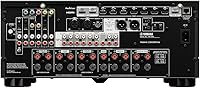
- HDMI Inputs: Seven HDMI inputs and three HDMI outputs are included, all supporting HDCP 2.3 and 40 Gbps bandwidth for 8K/60Hz and 4K/120Hz passthrough.
- Video Passthrough: All HDMI inputs support 8K at 60Hz and 4K at 120Hz passthrough, with ALLM and VRR enabled for compatible gaming displays and consoles.
- HDR Formats: Compatible HDR formats include Dolby Vision, HDR10+, HLG, and BT.2020, covering the full range of current high dynamic range standards across streaming and physical media.
- Audio Formats: Native decoding is supported for Dolby Atmos, DTS:X, and Auro-3D, making this one of very few receivers at this tier to cover all three major immersive audio formats simultaneously.
- Room Calibration: YPAO R.S.C. with 3D multipoint measurement performs advanced room correction, including precision parametric EQ, low-frequency optimization, and speaker distance and level calibration.
- Wireless: Built-in dual-band Wi-Fi and Bluetooth are included alongside AirPlay 2 and Spotify Connect for flexible wireless audio streaming from phones, tablets, and computers.
- Streaming Services: Directly supported streaming platforms include Amazon Music HD, TIDAL, Qobuz, Deezer, SiriusXM, and Pandora, with Roon Tested certification for integration into Roon-based hi-fi setups.
- Multi-Zone: Zone 2 and Zone 3 are independently powered outputs for whole-home audio distribution; Zone 4 provides a line-level output requiring an external amplifier.
- Connectors: Physical connectivity includes HDMI, optical digital, analog stereo, phono (MM), and XLR balanced inputs, covering both home theater and audiophile source components.
- Voice Control: Amazon Alexa and Google Assistant are both natively supported for basic voice commands including volume control, input switching, and power on/off.
- Ecosystem: Full Yamaha MusicCast integration is included for multi-room audio management, and Works with Sonos certification allows operation within existing Sonos speaker networks.
- Dimensions: The unit measures 18.75 x 17.13 x 7.5 inches (W x D x H), requiring a standard full-width equipment rack bay with adequate rear and top ventilation clearance.
- Weight: The receiver weighs 41.1 pounds, consistent with AVENTAGE-tier chassis construction and the anti-resonance center beam built into the base.
- Remote & Control: A full-function infrared remote control is included in the box, and the MusicCast app for iOS and Android provides network-based control and streaming management.
- Batteries: Two AAA batteries are required for the included remote control and are not included in the box.
- Surround:AI: Surround:AI is a real-time algorithmic processing feature that analyzes content type and automatically adjusts surround sound modes and effect levels during playback.
- HDCP Version: All HDMI inputs and outputs support HDCP 2.3, ensuring compatibility with the latest copy-protected 4K and 8K content from streaming services and Ultra HD Blu-ray players.
- Availability: The RX-A6A was first made available in May 2021 and as of the time of this review remains an active product that has not been discontinued by Yamaha.
Related Reviews
Yamaha RX-V4A
Yamaha RX-V6A 7.2-Channel AV Receiver
Yamaha RX-A2A
Yamaha RX-A8A 11.2-Channel AV Receiver
Yamaha RX-A4A AVENTAGE 7.2-Channel AV Receiver
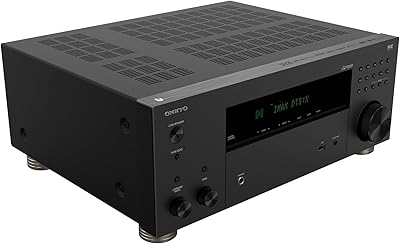
Onkyo TX-RZ30
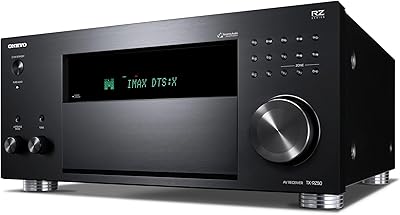
Onkyo TX-RZ50
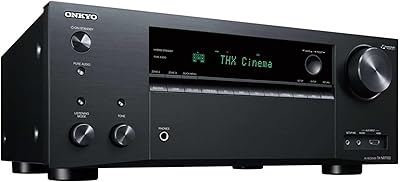
Onkyo TX-NR7100