Onkyo TX-NR5100

Overview
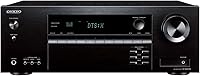
The Onkyo TX-NR5100 arrived in 2021 as a serious mid-range contender in a segment packed with capable but forgettable boxes. At over 18 pounds, it carries the kind of heft that suggests real engineering inside rather than hollow promises. Onkyo's seven decades in audio give the brand genuine credibility here, and this receiver earns its place by offering HDMI 2.1 connectivity and 8K passthrough at a price point where that combination remains genuinely uncommon. The Works with Sonos Certified status adds another layer of appeal — a rare spec at this tier and a meaningful differentiator for buyers already invested in the Sonos ecosystem.
Features & Benefits
What stands out most practically is the 4K/120 and 8K/60 passthrough, which means PS5 and Xbox Series X owners can push everything through this AV receiver without sacrificing frame rates or resolution. Dolby Atmos and DTS:X decoding are expected at this level, but the Height Virtualizer earns its keep for anyone without ceiling speakers, creating a convincing overhead effect from a conventional layout. AccuEQ handles room calibration automatically, measuring distances and crossover points so initial setup is far less daunting than it used to be. Built-in streaming from Spotify, TIDAL, and others eliminates the need for a separate device just to play music, and DTS Play-Fi extends audio across compatible whole-home systems.
Best For
This AV receiver makes the most sense for people building or upgrading a home theater who want Dolby Atmos without a complex custom installation. Gamers running a PS5 or Xbox Series X will find the 4K/120 support a real functional advantage rather than a spec sheet checkbox. Sonos households will appreciate the integration, though it's worth noting that pairing requires a separate Sonos Port, which adds to the total investment. It also suits anyone still on a 5.1 setup who wants expandable 7.2-channel headroom for the future. Music listeners benefit from native streaming and multi-room capability without relying on additional smart speakers or streaming sticks.
User Feedback
Among verified buyers, sound quality for the price and the straightforward AccuEQ calibration process come up repeatedly as genuine strengths. Sonos integration draws consistent praise for reliability once configured. On the flip side, a notable share of users report HDMI handshake problems with specific displays, and the companion app can behave inconsistently. The included remote feels dated relative to the receiver's overall capability — functional, but underwhelming. Fan noise under load gets occasional mentions as well. It's reasonable to assume some negative experiences reflect particular firmware versions or unit variance rather than a systemic issue, so filtering reviews by recency gives a more accurate picture of current performance.
Pros
- HDMI 2.1 with 4K/120 support is a real advantage for PS5 and Xbox Series X gamers.
- AccuEQ calibration makes initial speaker setup fast and surprisingly accurate for first-timers.
- Works with Sonos Certified integration is rare at this price tier and works reliably once configured.
- Built-in streaming from Spotify, TIDAL, and others removes the need for a separate music device.
- Dolby Atmos Height Virtualizer delivers a convincing overhead effect without ceiling speakers.
- 7.2-channel layout gives meaningful room to expand a speaker system over time.
- Solid, heavyweight chassis feels appropriately substantial for a mid-range home theater component.
- DTS Play-Fi enables multi-room audio synchronization across compatible Wi-Fi connected devices.
- Sound quality for the price draws consistent praise, especially with cinematic and gaming content.
- eARC support simplifies audio return from compatible TVs without needing a separate optical cable.
Cons
- HDMI handshake failures with certain TV brands are a frequently reported and genuinely frustrating issue.
- The companion app is unreliable enough that it cannot be counted on as a primary daily control method.
- Sonos integration requires purchasing a separate Sonos Port, adding unexpected cost to the total setup.
- The included remote feels outdated and is not ergonomically comfortable for extended daily use.
- Fan noise under sustained high-volume load can become audible during quiet passages of content.
- Driving all seven channels at once in larger rooms can push the amplifier close to its limits.
- Onscreen menu navigation is cumbersome compared to competing receivers in the same price range.
- App updates and firmware changes have occasionally disrupted previously working Sonos pairings.
- Published wattage figures are inconsistent across official materials, making power output hard to verify.
- Network audio performance can degrade on congested Wi-Fi networks, causing playback interruptions.
Ratings
The Onkyo TX-NR5100 has been scored by our AI system after processing verified buyer reviews from multiple global markets, with spam, incentivized posts, and bot activity actively filtered out. The result reflects a balanced picture — where this AV receiver genuinely delivers and where real owners have run into friction. Both sides are represented honestly in the scores below.
Sound Quality
HDMI & Video Passthrough
Setup & Calibration
Sonos Integration
Build Quality & Design
Gaming Performance
Streaming & Connectivity
Dolby Atmos & Surround Decoding
Value for Money
Network Audio & Multi-Room
Remote & App Control
Fan & Thermal Management
Channel Configuration & Expandability
Compatibility & Ecosystem
Suitable for:
The Onkyo TX-NR5100 is a strong fit for anyone building or upgrading a home theater setup who wants genuine Dolby Atmos capability without the cost of a high-end separates system. Console gamers running a PS5 or Xbox Series X will get direct value from the 4K/120 passthrough, which allows next-gen gaming to run at full speed without video quality compromises. Buyers already using Sonos throughout their home will find the Works with Sonos Certified integration a practical bridge — though it does require a separate Sonos Port to function, so budget accordingly. Anyone stepping up from an older 5.1 receiver will appreciate the 7.2-channel headroom, giving room to expand the speaker layout over time rather than hitting a ceiling immediately. Music listeners who want built-in streaming from services like Spotify or TIDAL without adding another device to the rack will also feel well served by this AV receiver.
Not suitable for:
Buyers who expect a completely plug-and-play experience with zero troubleshooting may want to think carefully before committing to the Onkyo TX-NR5100, since HDMI handshake problems with certain TV brands are a real and recurring complaint rather than a rare edge case. Dedicated audiophiles or critical listeners who prioritize two-channel stereo performance above all else will likely find more purpose-built options at this price point. Anyone setting up a large room and planning to drive all seven channels at high volume simultaneously may find the amplifier section working harder than ideal — a more powerful receiver would be a safer long-term investment in that scenario. Buyers who rely heavily on a companion app for daily control will find the Onkyo ecosystem frustrating, as app reliability has been a consistent weak point. If your existing TV or display is older and lacks HDMI 2.1 ports, some of the headline features simply will not be usable, reducing the practical value of the hardware you are paying for.
Specifications
- Channel Configuration: The receiver supports a 7.2-channel surround sound layout, meaning it can drive seven speakers and two subwoofers simultaneously.
- Power Output: Onkyo rates the amplifier at up to 150 watts per channel, though published figures vary across official materials and should be treated as a general guideline rather than a guaranteed measurement.
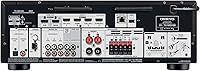
- HDMI Ports: Four HDMI ports are included in total, all supporting the HDMI 2.1 specification with 8K/60 and 4K/120 passthrough capability.
- HDMI Features: HDMI 2.1 support includes eARC, Dynamic HDR formats, and Variable Refresh Rate compatibility for connected displays and consoles.
- Surround Decoding: The unit decodes Dolby Atmos, DTS:X, and includes the Dolby Atmos Height Virtualizer for systems without dedicated height or ceiling speakers.
- Room Calibration: AccuEQ automatic calibration measures speaker distance, adjusts sound pressure levels, and sets crossover points using an included measurement microphone.
- Sonos Compatibility: The receiver carries Works with Sonos Certified status, enabling volume passthrough and input switching via the Sonos app when paired with a separately purchased Sonos Port.
- Network Audio: DTS Play-Fi is built in, supporting whole-home synchronized audio playback over Wi-Fi across compatible third-party speaker systems.
- Built-in Streaming: Native access to Spotify, TIDAL, Deezer, TuneIn, and Pandora is included without requiring an external streaming device or app casting.
- Wireless Connectivity: Both Wi-Fi and Bluetooth are built into the receiver, supporting wireless audio playback and network streaming without additional adapters.
- Special Modes: A dedicated Klipsch Optimize Mode provides a tailored EQ profile specifically tuned for use with Klipsch speaker systems.
- Dimensions: The unit measures 12.9 x 17.13 x 6.3 inches (W x D x H), requiring adequate rack or shelf depth for proper ventilation clearance.
- Weight: The receiver weighs 18.52 lbs, reflecting a substantial internal power supply and component build rather than a lightweight budget chassis.
- Remote Control: A physical remote control is included and requires two AAA batteries, covering all core functions including input selection and volume.
- Compatible Devices: The receiver is designed for use with game consoles, televisions, and passive speaker systems across a broad range of brands and configurations.
- Audio Encoding: DTS is the primary supported audio encoding standard alongside Dolby formats, covering both legacy and current-generation disc and streaming audio tracks.
- Availability: The TX-NR5100 was first made available in July 2021 and is listed as not discontinued by the manufacturer as of the time of this review.
Related Reviews
Onkyo TX-NR6100
Onkyo TX-8220 Stereo Receiver
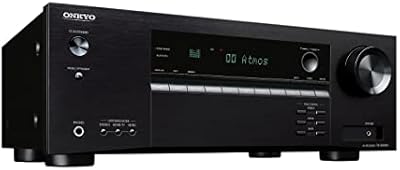
Onkyo TX-SR494 AV Receiver
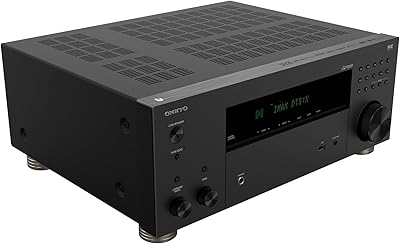
Onkyo TX-RZ30
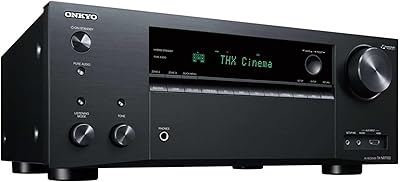
Onkyo TX-NR7100
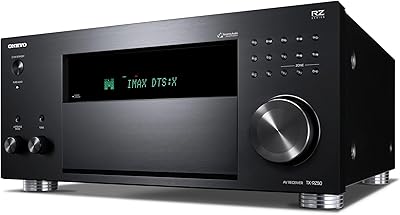
Onkyo TX-RZ50
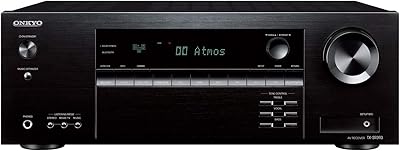
Onkyo TX-SR393
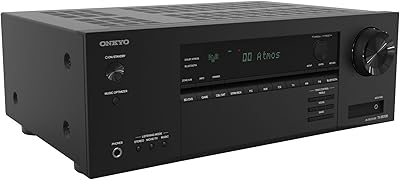
Onkyo TX-SR3100
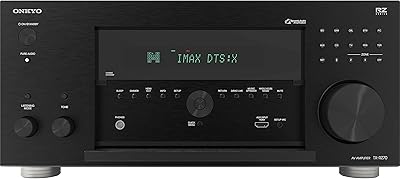
Onkyo TX-RZ70 11.2-Channel AV Receiver