Overview

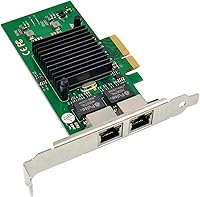
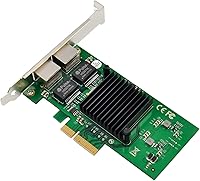
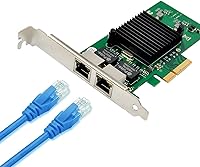
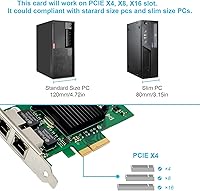
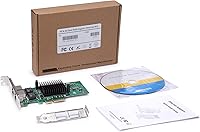
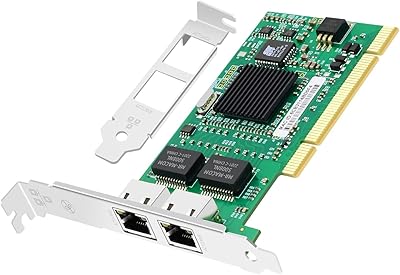
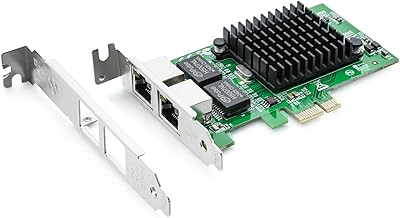
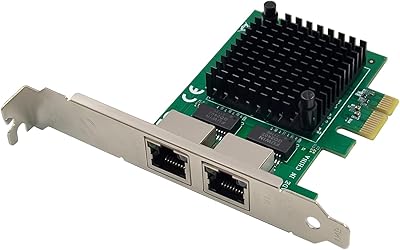
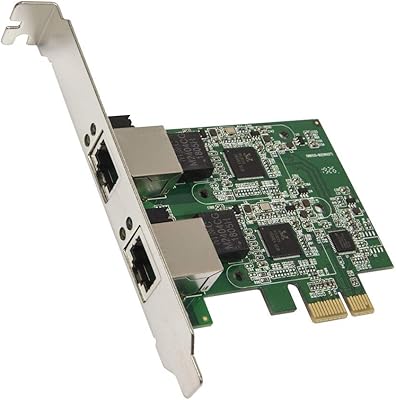
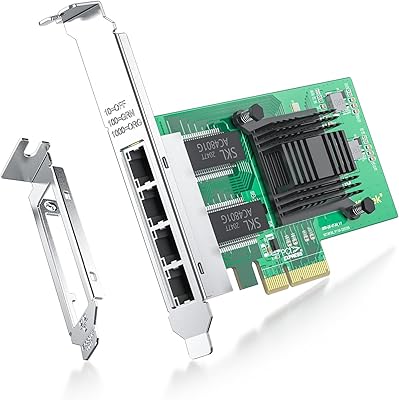
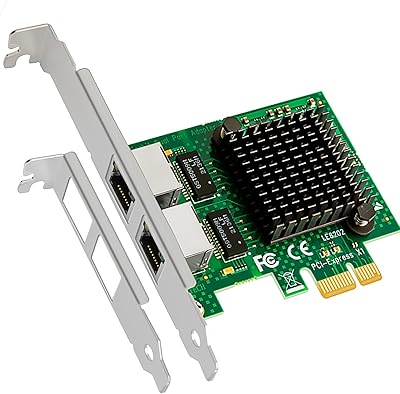
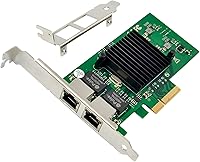
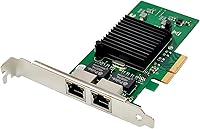
The ULANSeN Intel 82576 Dual-Port Gigabit Network Card is a straightforward, no-frills NIC aimed squarely at home lab builders and small server deployments. Built on Intel's 82576EB chipset — a workhorse trusted in server environments for years — it slots into any PCIe x4, x8, or x16 slot and ships with both standard and low-profile brackets, which matters if you're working inside a compact chassis. The OS support list is genuinely broad: Windows, Linux, FreeBSD, DOS, and even Solaris x86 are all covered. An imported alloy heatsink is fitted to help manage chip temperatures during continuous operation, though whether it holds up under heavy sustained load is worth keeping in mind.
Features & Benefits

The feature that makes this Intel 82576 network card stand out in its price range is SR-IOV support, which lets hypervisors like Proxmox or ESXi 6.x assign virtual NICs directly to guest VMs — no software bridge required. PXE boot works reliably for diskless setups, and iSCSI boot plus Wake-on-LAN round out the remote management toolkit for headless servers. VLAN filtering and SNMP/RMON support are present too, making this gigabit adapter credible in lightly managed network segments. One firm limitation to flag upfront: VMware ESXi 7.0 and above are not supported. If your virtualization stack is current, that is a dealbreaker worth knowing before you buy.

Best For

This dual-port NIC hits a sweet spot for a specific type of buyer. If you are running Proxmox or TrueNAS on bare metal and need two gigabit ports without spending enterprise money, it is a logical choice. The low-profile bracket makes it viable in mini-ITX or 1U rackmount builds where card height is a real constraint. Network admins who rely on PXE boot for diskless workstation rollouts will find this gigabit adapter functional out of the box on most Linux distributions. It is less suited to anyone running a current VMware stack, and those expecting 2.5GbE or 10GbE speeds should look elsewhere — this is strictly a gigabit-only solution for users where 1Gbps per port is genuinely enough.

User Feedback

Buyer feedback for this dual-port NIC is relatively limited in volume, so take patterns with appropriate weight. On the positive side, driver installation on Linux and Windows Server is frequently cited as painless — the Intel 82576 chipset has mature kernel support, which helps considerably. Several users report solid throughput consistency during iSCSI and large file transfers. On the downside, a handful of buyers mention concerns about heatsink fitment and overall build quality feeling less refined than the chipset reputation might suggest. DOA reports exist but are not disproportionate for this price tier. The low-profile bracket, according to multiple buyers, ships separately in the box rather than pre-installed — worth noting before slotting it into a compact build.

Pros

  • Mature Intel 82576EB chipset means reliable, well-supported drivers on Linux and FreeBSD without extra effort.
  • SR-IOV support enables direct NIC passthrough to virtual machines on Proxmox and ESXi 6.x platforms.
  • Ships with both standard and low-profile brackets, covering full-size tower and compact server builds alike.
  • PXE boot works reliably for diskless workstation and network-boot server configurations.
  • iSCSI boot and Wake-on-LAN support add meaningful remote management options for headless deployments.
  • VLAN filtering and SNMP/RMON make this dual-port NIC usable in lightly managed network environments.
  • Passive alloy heatsink helps manage chip temperatures in always-on server conditions without added fan noise.
  • Broad OS support including Windows, Linux, FreeBSD, DOS, and Solaris x86 is uncommon at this price tier.
  • Accessible price point makes dual-port gigabit connectivity realistic for home labs and small offices.
  • Compact physical footprint fits easily in tight PCIe slots without blocking adjacent expansion cards.

Cons

  • No support for VMware ESXi 7.0 or above — a hard block for users on current VMware infrastructure.
  • Build quality and heatsink fitment have drawn criticism from some buyers, feeling inconsistent with the chipset pedigree.
  • Low-profile bracket ships separately in the box rather than pre-installed, which can cause confusion on first install.
  • Gigabit-only throughput means this card offers no upgrade path for networks moving to 2.5GbE or beyond.
  • User review volume is relatively thin, making it harder to assess long-term reliability with confidence.
  • A small number of buyers have reported DOA units, suggesting quality control is not perfectly consistent.
  • Real-world chip temperatures under sustained heavy load, such as continuous iSCSI transfers, remain underreported by buyers.
  • Not a fit for modern virtualization stacks, limiting its lifespan in environments likely to upgrade hypervisor versions soon.

Ratings

The scores below reflect an AI-assisted analysis of verified global buyer reviews for the ULANSeN Intel 82576 Dual-Port Gigabit Network Card, with spam, bot-generated, and incentivized feedback actively filtered out before scoring. Each category captures both what this dual-port NIC does well and where real users have run into friction. Nothing has been softened — the pain points are reflected as clearly as the strengths.

Driver Compatibility
91%
On Linux, the native igb kernel driver picks up both ports without any manual intervention in most distributions, and FreeBSD users running TrueNAS or bare-metal setups consistently report clean detection. Windows Server installs are similarly low-friction, which is a genuine advantage for mixed-OS home labs.
A small subset of users on less common Linux distributions or older Windows builds have reported needing to manually source drivers. The explicit lack of support for VMware ESXi 7.0 and above is a hard compatibility wall that catches buyers off guard if they did not read the fine print.
Virtualization Support
84%
SR-IOV is a standout capability at this price tier, and Proxmox users in particular report that virtual function creation works reliably with standard KVM configuration steps. For home lab builds where NIC passthrough to guest VMs is a priority, this gigabit adapter punches above its weight class.
The ESXi 7.0 ceiling is a recurring frustration for buyers who upgraded their VMware stack after purchasing. ESXi 6.x works, but that version is aging, and users planning any VMware upgrade path will find this card becomes a liability sooner rather than later.
Value for Money
88%
Two gigabit ports, SR-IOV, PXE boot, iSCSI boot, and Wake-on-LAN in a single card at this price point is difficult to argue with for home lab and small office use cases. Buyers who need dual-port connectivity without an enterprise NIC budget consistently rate this as one of the more cost-effective options available.
A handful of buyers feel the build quality does not fully justify even the modest asking price, particularly when compared to used enterprise NICs available on the secondary market for similar money. For buyers who prioritize physical robustness, the value proposition becomes less clear-cut.
Throughput Performance
79%
21%
Under typical NAS workloads and iSCSI transfers, the Intel 82576 chipset delivers consistent gigabit throughput without notable bottlenecking. Users running dual-port bonding configurations on TrueNAS report stable aggregate throughput that meets expectations for a 1 Gbps card.
There are limited independent benchmarks specific to this vendor implementation, so sustained peak performance under extended heavy load is not as well-documented as it is for branded enterprise NICs. A small number of users noted occasional throughput inconsistency in high-packet-rate scenarios.
Build Quality
63%
37%
The PCB layout is functional and the card seats cleanly in PCIe slots without physical fit issues. The alloy heatsink adds a degree of material credibility compared to bare-chipset budget cards, and most users report the card feeling adequately constructed for server installation.
Heatsink fitment quality has been called out as inconsistent across units — some buyers received cards where the heatsink appeared loosely bonded. A non-trivial number of reviews flag the overall finish as noticeably below what the Intel chipset brand might lead buyers to expect.
Thermal Management
72%
28%
The passive alloy heatsink does its job adequately in well-ventilated server chassis, keeping the 82576EB chipset within safe operating temperatures during moderate continuous workloads. Users running the card in open-frame lab builds or cases with active airflow have reported no thermal issues.
Passive cooling has natural limits, and in enclosed, poorly ventilated mini-ITX cases running 24/7 heavy iSCSI workloads, chip temperatures can climb more than expected. Real-world thermal data from users under sustained maximum load is sparse, making it hard to assess long-term reliability in worst-case conditions.
PXE Boot Reliability
86%
Network administrators setting up diskless workstation environments have reported that PXE boot works reliably across multiple tested deployments on both Windows and Linux DHCP/TFTP server setups. The feature works as advertised without requiring non-standard configuration.
A minority of users noted occasional PXE timing issues on specific motherboard and switch combinations, which required adjusting PXE timeout settings rather than indicating a card defect. Documentation for troubleshooting edge cases is thin from the manufacturer.
Low-Profile Compatibility
81%
19%
The inclusion of both brackets in the box is a practical decision that most buyers appreciate — it removes the frustrating situation of buying a card and discovering the wrong bracket is installed. The low-profile bracket fits cleanly in tested 1U and mini-ITX chassis.
The low-profile bracket ships loose in the box rather than pre-installed, which has confused a number of buyers who assumed the card was full-height only. For first-time builders, the swap process is simple but the packaging could communicate this more clearly.
OS Ecosystem Breadth
93%
Support for Windows, Linux, FreeBSD, DOS, Solaris x86, and Novell Netware in a single card at this tier is genuinely uncommon. For mixed-environment labs or legacy system administrators who need one NIC type that works across diverse platforms, this Intel 82576 network card covers ground that many alternatives do not.
While the OS list is broad, some of the listed platforms such as DOS, SCO OpenServer, and older Novell Netware are niche enough that practical compatibility verification by real users is nearly nonexistent in available feedback. Buyers targeting modern platforms will not feel this gap.
Installation Experience
87%
Most users describe the physical installation as clean and uncomplicated — the card seats firmly, the brackets swap easily, and the OS handles driver loading without intervention on mainstream platforms. For experienced builders, the entire process from box to detected interface takes minutes.
Less experienced buyers have occasionally struggled with the bracket swap or with identifying the correct driver source for non-mainstream OS builds. The included documentation is minimal, which is acceptable for the target audience but does leave newer builders without much guidance.
VLAN and Management Features
76%
24%
VLAN filtering and SNMP/RMON support give this gigabit adapter credibility in small managed network deployments beyond a simple unmanaged home lab. Network admins who need basic traffic segmentation at the NIC level find these features genuinely useful for a card at this price.
Advanced users running complex VLAN configurations in enterprise-adjacent environments have noted that the management feature set, while present, is not as mature or well-documented as what you get from dedicated enterprise NICs. It covers common use cases but has edges that are not well tested in user feedback.
Wake-on-LAN Reliability
82%
18%
WoL works consistently on tested Linux and Windows Server configurations according to buyer feedback, which makes remote power management of headless servers practical without additional hardware. Users managing home lab servers remotely cite this as a quietly useful feature.
WoL reliability can be influenced by motherboard BIOS settings and switch configurations, and a small portion of buyers reported needing to troubleshoot their broader system setup before WoL functioned correctly — though this is a common challenge with WoL across all NIC brands.
Longevity and Reliability
68%
32%
The Intel 82576 chipset itself has a long track record in production server environments, and buyers who have been running these cards for a year or more in home lab settings generally report stable continuous operation without failure.
The quality control of this specific vendor implementation introduces uncertainty about long-term reliability that the underlying chipset pedigree alone cannot resolve. The DOA rate, while not alarming, is present in reviews, and the heatsink bonding consistency raises questions about durability under sustained thermal cycling.

Suitable for:

The ULANSeN Intel 82576 Dual-Port Gigabit Network Card is a practical fit for technically minded users who need two gigabit ports without paying enterprise prices. Home lab builders running Proxmox, TrueNAS, or similar bare-metal platforms will get genuine value here, particularly because the Intel 82576EB chipset has well-established driver support across Linux and FreeBSD distributions — no hunting for obscure kernel modules. Network administrators who rely on PXE boot for diskless workstation deployments will find the card functional on most modern Linux setups right out of the box. The included low-profile bracket also makes it a realistic option for compact or mini-ITX chassis where card height rules out many alternatives. Small offices needing basic dual-path or dual-segment connectivity on a tower server can put this to work without overcomplicating the budget.
Not suitable for:

Buyers running VMware ESXi 7.0 or a newer version should stop here — this gigabit adapter explicitly does not support that platform, and there is no practical workaround for production environments that depend on it. Anyone expecting 2.5GbE, 10GbE, or multi-gigabit throughput will also be disappointed, as this is a strictly gigabit-only card with no upgrade path in that direction. Users who prioritize build quality and want a card that feels robustly constructed may find the hardware finishing underwhelming given the chipset's reputation. Those building a fresh virtualization stack on current VMware infrastructure should budget for a supported alternative rather than working backward around this limitation. Finally, buyers who need out-of-the-box support for VMware ESXi 7.0 in a production environment should treat the compatibility ceiling as a hard disqualifier, not a minor footnote.

Specifications

  • Chipset: Powered by the Intel 82576EB controller, a well-regarded gigabit Ethernet chipset with broad OS driver support.
  • Ports: Provides two RJ-45 Gigabit Ethernet ports, each capable of 1000 Mbps full-duplex throughput.
  • Interface: Uses a PCI Express 2.0 x4 edge connector, physically compatible with x4, x8, and x16 PCIe slots.
  • Speed: Each port operates at up to 1 Gbps (1000 Mbps), with auto-negotiation down to 100 Mbps and 10 Mbps.
  • Form Factor: Ships with both a standard full-height bracket and a low-profile bracket for compact chassis compatibility.
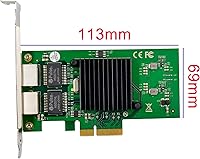
  • Dimensions: The card measures 4.45 x 2.72 x 0.71 inches, making it a compact fit for most PCIe slots.
  • Weight: The card weighs 5.3 ounces (approximately 0.15 kg) including the heatsink assembly.
  • Cooling: An imported passive alloy heatsink is fitted directly to the chipset to dissipate heat during continuous operation.
  • SR-IOV: Single Root I/O Virtualization is supported, enabling direct NIC passthrough to virtual machines in compatible hypervisors.
  • PXE Boot: Remote boot via PXE is supported, allowing network-based OS deployment and diskless workstation configurations.
  • Wake-on-LAN: Wake-on-LAN is supported, permitting remote power-on of the host system over the network.
  • iSCSI Boot: iSCSI boot is supported, enabling the host system to boot directly from a network-attached storage target.
  • VLAN Support: Hardware-level VLAN filtering is supported per IEEE 802.3 standards, allowing traffic segmentation at the NIC level.
  • Management: Supports SNMP network management protocol and RMON remote monitoring, useful in lightly managed server environments.
  • OS Support: Compatible with Windows 7 through Server 2012, Linux, FreeBSD 7.x or later, DOS, Solaris x86, and Novell Netware 5.x/6.x.
  • VMware Support: Compatible with VMware ESX and ESXi versions up to 6.x only; ESXi 7.0 and above are explicitly not supported.
  • Protocol Compliance: Compliant with IEEE 802.3, 802.3u (Fast Ethernet), 802.3x (flow control), and 802.3ab (Gigabit Ethernet over copper).
  • IPMI Support: Compatible with IPMI pass-through via SMBus or NC-SI, supporting out-of-band server management integrations.

Related Reviews

Jeirdus Intel 82546 Dual-Port Gigabit NIC
76%
93%
Driver Compatibility
88%
Value for Money
79%
PCI Bus Compatibility
67%
Build Quality
91%
Bracket Inclusion & Flexibility
More
H!Fiber.com 82576-2T-X1 Dual-Port Gigabit Network Card
81%
93%
Value for Money
91%
Linux Compatibility
78%
Installation Ease
71%
Virtualization Support
74%
Build Quality
More
StarTech ST1000SPEXI PCIe Gigabit Network Card
82%
94%
Driver Stability & OS Compatibility
92%
Connection Reliability & Uptime
91%
Installation Ease
67%
Value for Money
96%
Chipset Quality
More
ULANSeN Dual I226-V 2.5GbE PCIe Network Card
82%
88%
Chipset Reliability
91%
Installation Ease
86%
OS & Platform Compatibility
71%
Thermal Performance
89%
Value for Money
More
IO Crest Syba Dual 2.5 Gigabit Ethernet PCI-E Network Card
82%
88%
Performance
93%
Ease of Installation
85%
Speed & Reliability
75%
Compatibility
80%
VLAN Support
More
IO CREST AQC113 10Gbps PCIe Network Card
79%
83%
Real-World Transfer Speed
89%
Chipset Reliability
78%
Installation & Driver Setup
86%
Multi-Gig Auto-Negotiation
91%
Case & Bracket Compatibility
More
ipolex I350-T4 Quad-Port Gigabit Network Card
83%
93%
Driver Compatibility
91%
Value for Money
82%
Build Quality
88%
OS Compatibility Range
84%
Thermal & Power Efficiency
More
StarTech ST1000SPEX2L 1-Port PCIe Network Card
82%
91%
Ease of Installation
88%
Connection Stability
93%
Low-Profile Compatibility
82%
OS & Driver Compatibility
94%
Value for Money
More
GLOTRENDS LE8202 2-Port Gigabit PCIe Network Card
82%
88%
Driver Compatibility
91%
Ease of Installation
94%
Value for Money
86%
OS & Platform Coverage
79%
Build Quality
More
10Gtek X540-10G-2T Dual-Port 10GbE Network Card
83%
91%
Driver Compatibility
88%
Value for Money
93%
Controller Chip Quality
74%
Installation Experience
67%
Thermal Performance
More

FAQ

Yes, for most Proxmox installations it works out of the box. The Intel 82576EB chipset is natively supported by the igb driver in the Linux kernel, so Proxmox typically detects both ports automatically on first boot without any manual driver installation.

No, and this is probably the most important compatibility note to be aware of. The ULANSeN Intel 82576 Dual-Port Gigabit Network Card only supports VMware ESXi up to version 6.x. If your environment runs ESXi 7.0 or above, this card will not work and you will need a different NIC.
No, it ships separately inside the box. You will need to swap it yourself by removing the standard bracket and attaching the low-profile one, which is a straightforward process requiring just a screwdriver.

Yes, SR-IOV is supported and the Intel 82576 chipset handles VF (virtual function) creation well under KVM-based hypervisors. You will need to enable SR-IOV in your BIOS and configure the VFs in the OS, but the chipset supports up to 7 virtual functions per port.

The card performs consistently under sustained throughput in most reported use cases. The passive alloy heatsink helps manage chip temperatures, though in poorly ventilated chassis or 24/7 high-load environments it is worth monitoring thermals, as passive cooling has natural limits.

Yes. TrueNAS runs on FreeBSD, and the Intel 82576 chipset has mature em driver support in FreeBSD 7.x and later. Most users report clean detection and stable operation on both TrueNAS CORE and TrueNAS SCALE.

Absolutely. The two ports operate independently, so you can plug into just one and leave the other unused. There is no requirement to use both simultaneously, and the OS will simply treat the unused port as an inactive interface.

It depends on your chassis. The included low-profile bracket makes it physically compatible with low-profile PCIe slots found in many 1U servers and mini-ITX cases, but you should verify your chassis has a low-profile PCIe x4 or wider slot available before purchasing.

The Intel 82576 chipset supports IEEE 802.3ad link aggregation (LACP) at the hardware level, but actual bonding or teaming functionality depends on your OS and switch configuration. Linux bonding and 802.3ad teaming both work well with this chipset in practice.

First, reseat the card firmly in the PCIe slot and confirm your motherboard BIOS has the slot enabled. On Linux, running lspci should reveal the device even before drivers load. If it still does not appear, try a different PCIe slot. A small number of buyers have reported DOA units, so if the card remains undetected across multiple slots and systems, a return or replacement is the practical next step.