Overview

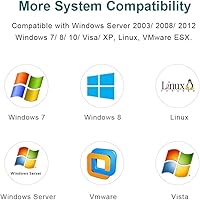
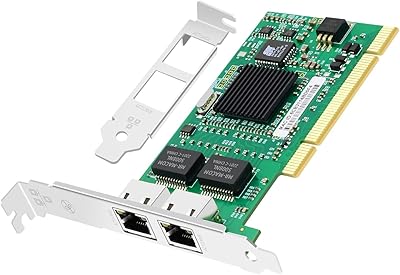
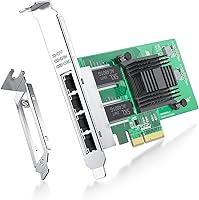
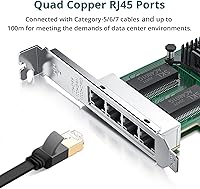
The ipolex I350-T4 Quad-Port Gigabit Network Card is a practical, no-nonsense option for anyone who needs multiple Ethernet ports without spending enterprise money. Built around the Intel I350-AM4 controller — the same silicon found in far pricier branded cards — this quad-port NIC connects via PCIe 2.1 x4 and delivers four RJ45 gigabit ports in a compact package. It has been on the market since late 2016 and currently sits at #55 in Internal Networking Cards, which says something about its staying power. OS compatibility spans Windows XP through Server 2016, Linux, and VMware ESXi, making it genuinely versatile across different environments.
Features & Benefits

The I350-AM4 chip is the real reason this card holds up — Intel drivers are stable, well-maintained, and natively recognized by most hypervisors and Linux distros without extra configuration. Each of the four RJ45 ports runs at up to 1 Gbps, which is plenty for VM network isolation, NAS multi-homing, or building a software router. Energy Efficient Ethernet and DMA Coalescing keep power draw and CPU overhead low in always-on setups, a detail that matters in a home lab running 24/7. Jumbo frames up to 9.5 KB help iSCSI and NAS workloads move data more efficiently. Both low-profile and full-height brackets are included, so it fits mini-ITX builds and standard tower servers alike.

Best For

This Intel-based network adapter is an especially strong fit for home lab builders running pfSense, OPNsense, or Proxmox — platforms where driver compatibility and stability matter more than raw specs. VMware ESXi users in particular will appreciate that the I350-AM4 is on the ESXi compatibility list, avoiding the driver headaches that plague cheaper, lesser-known controllers. NAS builders who want iSCSI or link aggregation without sourcing sketchy used enterprise hardware will find it hits the right balance. Small IT teams stretching a tight budget across multiple server ports, or admins supporting a wide range of Windows Server versions, will also get solid mileage from the I350-T4 card.

User Feedback

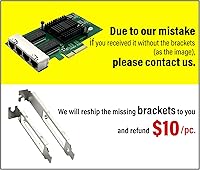
Across 164 ratings, this quad-port NIC holds a 4.6-star average, and the consistency of that score reflects genuine satisfaction rather than a handful of outliers. Buyers frequently praise how quickly it gets recognized in ESXi and Linux — often without touching a driver manually. Windows 10 teaming support also comes up as a practical win. That said, a few buyers have reported receiving packages without both brackets included; the seller flags this themselves and offers to resolve it, but it is worth checking your shipment immediately. One firm caveat: Mac OS is not supported, and some negative reviews stem simply from buyers who missed that detail before purchasing.

Pros

  • Intel I350-AM4 controller is natively recognized by VMware ESXi, Proxmox, and major Linux distros out of the box.
  • Four gigabit RJ45 ports cover VM isolation, NAS multi-homing, and software routing without needing multiple cards.
  • Broad OS compatibility spans Windows XP through Server 2016, Linux, and VMware ESX/ESXi — rare at this price tier.
  • Jumbo frame support up to 9.5 KB measurably improves iSCSI and large NAS file transfer efficiency.
  • Both low-profile and standard brackets are included, covering mini-ITX and full tower server builds without extras.
  • Energy Efficient Ethernet keeps the card cool and CPU overhead low in always-on home lab and NAS deployments.
  • Windows 10 NIC teaming is supported, enabling basic link aggregation or failover without managed switch dependency.
  • The card has held a top-55 ranking in its category since 2016, signaling consistent real-world performance across thousands of buyers.
  • Solid build quality for the price — ports feel firm, PCB shows no obvious cost-cutting that affects reliability.

Cons

  • Some shipments arrive missing one of the two brackets — inspect the package immediately and contact the seller if incomplete.
  • No meaningful printed documentation is included, leaving less experienced users to piece together ESXi or Linux setup steps from forums.
  • Mac OS is entirely unsupported, with no driver path available regardless of OS version or workarounds attempted.
  • Throughput is capped at 1 Gbps per port — inadequate for high-density VM storage or 10 GbE-dependent workloads.
  • ipolex carries no OEM vendor warranty or Intel direct support channel, which matters when deploying at scale or in compliance-sensitive environments.
  • NIC teaming configuration can require switch-side LACP setup that is not documented anywhere in the product packaging.
  • Jumbo frames require consistent configuration across all devices in the network path — mismatches cause silent throughput problems that are tricky to diagnose.
  • Driver installation for specific ESXi sub-versions occasionally requires a manual VIB file, catching unprepared admins mid-deployment.

Ratings

The ipolex I350-T4 Quad-Port Gigabit Network Card has been evaluated using AI-assisted analysis of verified global buyer reviews, with spam, bot-generated, and incentivized feedback actively filtered out. The scores below reflect real-world usage patterns across home labs, small business server rooms, and virtualization environments. Both the card's genuine strengths and its recurring friction points are represented transparently.
Driver Compatibility
93%
Users running VMware ESXi, Proxmox, and mainstream Linux distributions consistently report that the I350-AM4 controller gets recognized without any manual driver installation. This is a major time-saver for IT admins who need a card to just work on first boot, especially when deploying across multiple hosts.
A small number of users on older or niche Linux kernel builds have reported needing to compile drivers manually. VMware ESXi version mismatches occasionally require a specific VIB install, which can catch less experienced users off guard.
Value for Money
91%
For a quad-port gigabit NIC built on genuine Intel silicon, the price point consistently surprises buyers in the best way. Home lab builders in particular note that getting four stable, well-supported ports for this cost would have required sourcing used enterprise hardware just a few years ago.
A handful of buyers who compared it against OEM Intel-branded equivalents felt the ipolex branding added slight uncertainty around long-term support. For large-scale deployments where vendor accountability matters, the savings may feel less compelling than for individual builders.
Build Quality
82%
18%
Most buyers describe the card as solidly constructed with no obvious flex or cheap-feeling components. The PCB feels substantial for its price tier, and the RJ45 ports click in with the kind of tactile firmness that suggests they will hold up through repeated cable swaps in a server environment.
A few reviewers noted that the bracket attachment hardware felt slightly loose out of the box. Nothing that caused functional issues, but it is the one area where the cost savings over a fully OEM product are perceptible in hand.
OS Compatibility Range
88%
The breadth of supported operating systems is one of this card's most practical advantages. Coverage from Windows XP through Windows Server 2016, plus Linux and VMware ESX/ESXi, means it serves as a reliable choice for admins managing mixed or legacy environments without needing different NICs for different hosts.
Mac OS is explicitly unsupported, and this catches some buyers off guard if they skim the listing. A few negative reviews on record appear to stem entirely from this omission rather than any actual defect, which skews the perception of the card unfairly.
Thermal & Power Efficiency
84%
Energy Efficient Ethernet and DMA Coalescing make a real difference in always-on setups. Users running NAS boxes or pfSense routers 24/7 report the card runs cool to the touch even under sustained multi-port load, with no active cooling required.
In dense server builds with limited airflow, a couple of users noted slightly elevated temperatures under full four-port saturation. It is not a heat problem per se, but worth factoring in if the card is going into a tightly packed 1U chassis with poor ventilation.
Plug-and-Play Experience
89%
The out-of-box experience is consistently praised across Windows 10 and major Linux distributions, where the card enumerates immediately and pulls correct drivers automatically. For non-technical small business users who just need more ports on a Windows server, this simplicity is genuinely valued.
Occasionally, Windows Server environments with aggressive Group Policy restrictions required a manual driver confirmation step. Not a real flaw, but worth noting for IT admins in locked-down enterprise environments where unsigned driver prompts can cause delays.
Form Factor Flexibility
86%
Including both low-profile and standard-height brackets in the box is a practical touch that saves buyers from a frustrating compatibility surprise. Users fitting this into mini-ITX home lab builds and standard tower servers alike report a clean, no-compromise installation with no extra parts needed.
A recurring complaint, flagged even in the seller's own listing, is that some shipments arrive with only one bracket. Buyers should inspect the package immediately and contact customer service if both are not present, which adds a small but annoying friction point to the unboxing experience.
Network Performance Stability
87%
Under sustained multi-port traffic — iSCSI backups running on two ports while VM traffic flows on a third — buyers report no dropped packets or link renegotiations. The I350-AM4 handles multi-stream workloads with the kind of quiet reliability that earns trust in production-adjacent environments.
As a 1 GbE card, throughput is capped at gigabit speeds per port. Buyers who need 10 GbE for high-density VM storage workloads will hit this ceiling fast, and a few reviews reflect mild disappointment from users who did not fully clarify their bandwidth requirements before purchasing.
Jumbo Frame Support
83%
Jumbo frame support up to 9.5 KB delivers a meaningful throughput improvement for iSCSI and NAS workloads, where reducing packet overhead translates directly to faster large-file transfers. Buyers using this in TrueNAS or Synology iSCSI setups specifically call out this feature as a reason they chose this card over cheaper alternatives.
Enabling jumbo frames requires consistent configuration across all network devices in the path, and a few buyers ran into issues when their switches were not set to match. This is a network topology concern rather than a card defect, but it does generate occasional troubleshooting friction for less experienced users.
iSCSI & SAN Suitability
79%
21%
For small-scale SAN connectivity on a tight budget, the I350-T4 card handles iSCSI initiator workloads reliably. Home lab users building software-defined storage stacks report consistent connectivity and acceptable latency for non-mission-critical storage tasks like VM disk images and backup targets.
In environments with high iSCSI queue depths or parallel storage sessions, the card shows its consumer-oriented limits. It is not a replacement for a dedicated HBA or a proper 10 GbE iSCSI card in any serious production storage scenario, and buyers expecting enterprise-tier SAN performance will be disappointed.
Windows 10 Teaming
81%
19%
Support for Windows 10 NIC teaming is a frequently cited practical benefit, particularly for small office environments looking to combine two ports for increased throughput or basic failover without investing in managed switch infrastructure. Several reviewers set this up without referencing external guides.
NIC teaming behavior can be inconsistent depending on the Windows build version and teaming mode selected. A couple of users reported that LACP-style teaming required switch-side configuration that was not immediately obvious, leading to a period of troubleshooting before achieving expected behavior.
Seller & Shipping Experience
72%
28%
Most buyers report receiving the card well-packaged and promptly. The seller appears responsive to issues, and the bracket-omission problem — when it occurs — seems to get resolved via customer service without major escalation, based on review follow-ups.
The bracket inconsistency is a recurring and avoidable frustration. For buyers who need to rack a card immediately without waiting for a replacement part, a missing low-profile bracket means the install grinds to a halt. Tighter quality control on packing would eliminate most of the negative feedback tied to fulfillment.
Documentation & Setup Guidance
63%
37%
For experienced IT users, the lack of detailed documentation is a non-issue — the card installs itself and driver sources are well known. Buyers coming from a networking background report zero friction getting the card configured exactly as needed.
Buyers who are newer to multi-port NICs or hypervisor networking found the included documentation thin to nonexistent. There is no quick-start guide covering VMware VIB installation or Linux driver verification steps, which leads to forum-searching that a simple printed insert could have prevented.
Long-Term Reliability
85%
Given that this card has been available since 2016 and still holds a top-tier ranking in its category, the long-term track record is reassuring. Multiple reviewers mention using the card continuously for two or more years without a failure, which is meaningful for a product in this price range.
Because ipolex is not an OEM vendor, buyers do not benefit from Intel's direct warranty or enterprise support channels. If a card fails outside the return window, the resolution path is less clear than it would be with a fully Intel-branded product, which matters more as deployment scale grows.

Suitable for:

The ipolex I350-T4 Quad-Port Gigabit Network Card is purpose-built for the kind of buyer who needs multiple reliable Ethernet ports without a procurement budget to match. Home lab enthusiasts running pfSense, OPNsense, or Proxmox will find it particularly well-suited, since the Intel I350-AM4 controller is natively recognized by all three platforms with zero driver drama. VMware ESXi administrators who need a cost-effective quad-port NIC that appears on the compatibility list — without paying OEM Intel prices — will get strong mileage here. NAS builders looking to enable iSCSI connectivity or experiment with link aggregation will also benefit from the jumbo frame support and stable multi-port throughput. Small IT teams managing mixed Windows environments, including older Server builds, can lean on its unusually broad OS coverage to standardize on a single NIC model across heterogeneous hosts. The included low-profile and full-height brackets mean it drops into both compact mini-ITX cases and standard tower servers without any extra hardware sourcing.
Not suitable for:

There are real scenarios where the ipolex I350-T4 Quad-Port Gigabit Network Card is simply the wrong tool, and knowing them upfront saves a painful return process. Anyone on a Mac should stop here — Mac OS is explicitly unsupported, and no amount of driver hunting will change that. Buyers who need 10 Gigabit throughput for high-density VM storage, video production network shares, or fast backup pipelines will hit the 1 GbE ceiling quickly; this is a gigabit card, full stop. Enterprises or organizations that require OEM vendor accountability, direct Intel support contracts, or validated hardware for compliance purposes may not be comfortable with a third-party brand, even one using genuine Intel silicon. Buyers expecting a polished unboxing with detailed setup documentation will be underwhelmed — the card ships with minimal printed guidance, which can frustrate anyone not already comfortable with NIC configuration in a server OS. Finally, if your use case demands high-queue-depth iSCSI in a production storage environment, a purpose-built HBA or a 10 GbE card is a more appropriate investment.
Specifications

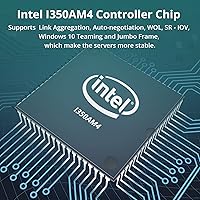
  • Controller: Powered by the Intel I350-AM4 chip, a widely supported and enterprise-proven gigabit Ethernet controller known for stable drivers and hypervisor compatibility.
  • Port Count: Features four RJ45 Ethernet ports, each capable of operating independently at 10, 100, or 1000 Mbps.
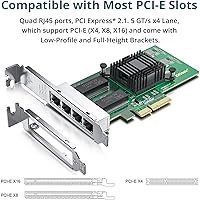
  • Interface: Connects to the host system via a PCIe Gen 2.1 x4 slot, providing sufficient bandwidth headroom for simultaneous multi-port gigabit traffic.
  • Max Speed: Each port supports a maximum throughput of 1 Gbps; this is a gigabit card and does not support 10 GbE speeds.
  • Jumbo Frames: Supports jumbo frames up to 9.5 KB, which reduces packet overhead and improves efficiency in iSCSI and large-file NAS transfer workloads.
  • OS Support: Compatible with Windows XP, Vista, 7, 8, 10, Windows Server 2003 through 2016, major Linux distributions, and VMware ESX/ESXi.
  • Unsupported OS: Mac OS is explicitly not supported; no driver path exists for Apple operating systems regardless of version.
  • NIC Teaming: Windows 10 NIC teaming is supported natively, enabling link aggregation or basic failover configurations without third-party software.
  • Power Features: Implements Energy Efficient Ethernet (EEE) and DMA Coalescing (DMAC) to reduce idle power draw and lower CPU overhead during sustained network activity.
  • Virtualization: Supports flexible I/O virtualization for port partitioning, making it suitable for assigning individual ports to separate virtual machines or network segments.
  • iSCSI Support: Provides hardware-level iSCSI initiator support for cost-effective SAN connectivity in small business and home lab storage environments.
  • Form Factor: Ships with both a low-profile and a standard full-height bracket, allowing installation in mini-ITX compact cases and standard ATX tower servers alike.
  • Dimensions: The card measures 8.94 x 6.06 x 1.26 inches, fitting within the physical envelope of a standard half-height PCIe add-in card.
  • Weight: Weighs 6.4 oz, consistent with a quad-port NIC carrying four magnetics and a full-length PCB.
  • Manufacturer: Made by ipolex, a third-party networking hardware brand that sources genuine Intel controller silicon rather than designing its own Ethernet chipset.
  • ASIN: Listed on Amazon under ASIN B01MXJA7M8 and has been available since November 2016 with no discontinuation announced by the manufacturer.
  • Market Rank: Ranked #55 in the Internal Computer Networking Cards category on Amazon, reflecting sustained buyer demand over multiple years.
  • Halogen-Free: The RJ45 port connectors are specified as halogen-free, reducing the release of toxic gases in the event of overheating or fire.

Related Reviews
ULANSeN Intel 82576 Dual-Port Gigabit Network Card
81%
91%
Driver Compatibility
84%
Virtualization Support
88%
Value for Money
79%
Throughput Performance
63%
Build Quality
More
StarTech ST1000SPEXI PCIe Gigabit Network Card
82%
94%
Driver Stability & OS Compatibility
92%
Connection Reliability & Uptime
91%
Installation Ease
67%
Value for Money
96%
Chipset Quality
More
IO CREST AQC113 10Gbps PCIe Network Card
79%
83%
Real-World Transfer Speed
89%
Chipset Reliability
78%
Installation & Driver Setup
86%
Multi-Gig Auto-Negotiation
91%
Case & Bracket Compatibility
More
Jeirdus Intel 82546 Dual-Port Gigabit NIC
76%
93%
Driver Compatibility
88%
Value for Money
79%
PCI Bus Compatibility
67%
Build Quality
91%
Bracket Inclusion & Flexibility
More
StarTech ST1000SPEX2L 1-Port PCIe Network Card
82%
91%
Ease of Installation
88%
Connection Stability
93%
Low-Profile Compatibility
82%
OS & Driver Compatibility
94%
Value for Money
More
GLOTRENDS LE8202 2-Port Gigabit PCIe Network Card
82%
88%
Driver Compatibility
91%
Ease of Installation
94%
Value for Money
86%
OS & Platform Coverage
79%
Build Quality
More
GLOTRENDS ST7315 1-Port 10Gb SFP+ Ethernet Network Card
84%
91%
Performance
88%
Compatibility
84%
Ease of Installation
92%
Value for Money
70%
Driver Support
More
StarTech PEXUSB3S3GE USB 3.0 PCIe Card

75%
83%
Ease of Installation
78%
USB Port Performance
57%
Ethernet Reliability
61%
Build Quality
68%
Value for Money
More
Euqvos PCIe Ethernet Network Card X710-DA4 10Gb 4 Port SFP+
85%
92%
Performance
89%
Value for Money
80%
Compatibility with Operating Systems
87%
Heat Dissipation
85%
Ease of Installation
More
TP-Link Festa FS328G 28-Port Gigabit Smart Managed Network Switch
84%
88%
Ease of Setup
85%
Performance and Reliability
91%
Cloud Management Features
80%
Build Quality
87%
Value for Money
More

FAQ

In most cases, yes. The Intel I350-AM4 controller is on VMware's hardware compatibility list, and ESXi versions 5.x through 7.x typically recognize the card automatically at boot. For some specific ESXi sub-versions, you may need to install a VIB driver package manually, but this is well-documented in the VMware community and takes only a few minutes once you know what to look for.

Absolutely — this is one of the most popular use cases for the I350-T4 card. Both pfSense and OPNsense are built on FreeBSD, which has had native Intel I350 driver support for years. You get four independent gigabit interfaces for WAN, LAN, DMZ, and guest network segments without any driver configuration required.

Windows 11 was not listed at the time of the product's original release, but since Intel maintains the I350-AM4 driver family through Windows Update, most users report it working fine on Windows 11 by installing the standard Intel I350 drivers. That said, Windows 11 is not an officially listed supported OS, so treat it as likely-compatible rather than guaranteed.

It should not be. The listing specifies that both a low-profile and a full-height bracket are included. The seller themselves flag this as an occasional shipping inconsistency and explicitly ask buyers to contact customer service if one bracket is missing. Check the box carefully when it arrives and reach out immediately if anything is absent — most buyers report the issue gets resolved quickly.

It is neither an OEM Intel-branded card nor a counterfeit. ipolex is a legitimate third-party manufacturer that uses genuine Intel I350-AM4 controller chips on their own PCB design. Think of it like a motherboard maker using an Intel chipset — the core silicon is real Intel, but the board and branding are the manufacturer's own. Driver behavior is identical to a full OEM Intel NIC.

Yes, the PCIe 2.1 x4 interface provides roughly 16 Gbps of theoretical bandwidth, which is more than enough headroom to saturate all four 1 Gbps ports at the same time without the slot becoming the bottleneck. Real-world multi-port throughput is solid under sustained iSCSI and VM traffic loads based on user testing reports.

Yes, Linux bonding and LACP are both supported at the OS level using the standard Intel igb driver. You configure teaming or bonding through your Linux network manager or systemd-networkd just as you would with any supported NIC. Note that LACP requires your switch to be configured for 802.3ad as well — the card alone cannot make LACP work without matching switch-side setup.

The card uses a PCIe x4 connector, but PCIe slots are backward compatible by size. You can physically insert the card into an x8 or x16 slot and it will run at x4 speeds, which is all it needs. Just make sure the slot is open-ended or physically long enough to accept the x4 card edge connector.

Yes, this is a well-suited use case. The card supports hardware iSCSI and jumbo frames up to 9.5 KB, both of which improve performance when connecting to Synology or QNAP devices over iSCSI. Make sure jumbo frames are enabled consistently on the NAS, the switch, and the card — mismatches on any one device will silently degrade performance.

No. Mac OS is explicitly unsupported and there are no Intel I350 drivers available for macOS. This is not a workaround situation — Apple does not expose the necessary kernel interfaces for third-party PCIe Ethernet cards of this type, and no community driver exists. If you need a multi-port NIC for a Mac, you will need to look at Thunderbolt-based solutions instead.