Overview

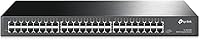
The TP-Link TL-SG1048 48-Port Gigabit Network Switch is exactly what its name implies: a no-frills, high-port-count unmanaged switch built for small businesses and home labs that need reliable connectivity without the headache of configuration. It slots into a standard 19-inch rack as a 1U rackmount unit, making it a clean fit for anyone with an existing rack or planning to build one. Having been on the market since 2011 and holding a consistent bestseller position in its category, it has earned its reputation through longevity rather than marketing. The fanless passive design means it runs completely silently. Just know upfront: unmanaged means plug-in-and-go, with zero options for VLANs, monitoring, or traffic control.
Features & Benefits

All 48 ports run at full gigabit speeds with Auto-MDI/MDIX, so you can use straight-through or crossover cables interchangeably — a small but genuinely useful detail when you are cabling in a hurry. The 96Gbps non-blocking switching fabric means every port gets its full share of bandwidth simultaneously, with no artificial bottleneck forcing traffic to queue. An 8K MAC address table handles sizable networks without the switch losing track of devices. Power consumption scales based on actual link activity and cable length, which helps modestly on electricity over time. The metal chassis with shielded ports feels built to outlast a few office renovations, and the included rackmount hardware means you are not hunting for extra parts on day one.

Best For

This unmanaged gigabit switch hits its stride in environments where simplicity is the priority. Small and mid-sized offices that need more ports — not more complexity — will find it fits naturally. Home lab builders get rack-grade hardware without paying for managed features they will never use. Schools, community centers, and similar organizations with flat networks and limited IT budgets can rely on it without ongoing maintenance concerns. It also works well anywhere silence matters: a recording studio, a library, an open-plan office where fan noise would be a constant irritant. Worth stating plainly: if your upstream network already has a router or managed switch handling the smart work, the TL-SG1048 slots in as pure port expansion with no friction.

User Feedback

Long-term owners are the strongest advocates for this 48-port switch, with many reporting years of continuous uptime without a single port failure. The silent operation earns repeated praise from users who have deployed it in noise-sensitive spaces. On the critical side, the most common complaint is predictable: without VLAN or QoS support, the switch becomes a limiting factor for anyone whose network needs to grow beyond a flat topology. A smaller number of users mention that the port LEDs can be hard to read under bright ambient lighting. The packaging is consistently described as thorough, with all mounting hardware included. The 3-year warranty and accessible weekday phone support give buyers added confidence for a hardware purchase meant to last.

Pros

  • All 48 ports deliver full gigabit speeds with no shared bandwidth bottlenecks across the switching fabric.
  • The fanless design runs completely silently, making it genuinely practical in noise-sensitive environments.
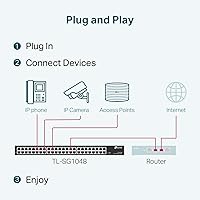
  • Plug-and-play setup means the switch is operational within minutes, no IT expertise required.
  • The all-metal chassis with shielded ports feels built to survive years of continuous rack use.
  • Auto-MDI/MDIX on every port eliminates cable type headaches during rushed deployments.
  • Rackmount hardware and rubber feet are included in the box, so nothing extra needs to be sourced.
  • The 8K MAC address table handles large device counts without the switch becoming a performance bottleneck.
  • A 3-year warranty backed by accessible weekday technical support adds real long-term peace of mind.
  • Energy use scales per port based on actual link activity, keeping idle power draw modest over time.
  • Years of consistent real-world deployments have built a strong reliability track record among long-term users.

Cons

  • No VLAN support means all devices share a single broadcast domain, which limits network segmentation entirely.
  • There is no QoS configuration, so latency-sensitive traffic competes equally with heavy background transfers.
  • Zero monitoring or diagnostic tools — no port mirroring, no SNMP, no traffic visibility whatsoever.
  • Port LEDs can be difficult to read under bright ambient lighting in well-lit server rooms or offices.
  • No link aggregation support limits uplink bandwidth to a single 1Gbps connection per port.
  • Maximum operating temperature of 40 degrees Celsius may be restrictive in poorly ventilated or warm environments.
  • Flat network architecture enforced by this unmanaged switch may require a full hardware swap as complexity grows.
  • No console access or web interface means troubleshooting is limited to physical port status indicators only.

Ratings

Our AI rating system analyzed thousands of verified global user reviews for the TP-Link TL-SG1048 48-Port Gigabit Network Switch, actively filtering out incentivized, bot-generated, and duplicate submissions to surface what real buyers consistently experience. The scores below reflect both the genuine strengths that keep this switch at the top of its category and the honest pain points that matter depending on your specific network needs. Nothing has been softened or inflated — what you see is a transparent summary of long-term, real-world feedback.

Reliability & Uptime
94%
Users who have run this 48-port switch continuously for three, four, even five years report no port failures and zero unexpected reboots. In small business environments where a switch outage means a full office goes offline, that kind of quiet dependability is exactly what buyers pay for.
A small number of users reported units arriving with one or two dead ports out of the box, though this appears to be a minority manufacturing variance rather than a systemic issue. TP-Link warranty coverage handles these cases, but it does create a minor initial setup headache.
Noise Level
96%
The completely fanless design earns near-universal praise from users in noise-sensitive environments. Recording studios, library server closets, and open-plan offices consistently call this out as the primary reason they chose the TL-SG1048 over competing products with active cooling.
There are essentially no user complaints about noise, since there is nothing to complain about. The only theoretical concern is that passive cooling means heat must dissipate naturally, which matters if your rack environment is already warm or poorly ventilated.
Ease of Setup
93%
Buyers who have never touched a network switch in their lives report having all 48 ports live within minutes of opening the box. There is no firmware to update, no browser interface to navigate, and no configuration decisions to make — which is exactly the point for this category of device.
The simplicity is also the ceiling. Users who assumed they could access some basic settings after installation were caught off guard by the complete absence of any management interface. The product does not hide this fact, but buyers who skim listings sometimes miss it.
Port Performance
91%
All 48 ports consistently deliver full gigabit throughput without any perceptible bottleneck, even in environments where many ports are simultaneously active. IT generalists running NAS backups, VoIP, and general office traffic at the same time report no congestion or slowdown.
There is no 10-gigabit uplink option, which means the switch is limited to 1Gbps on every port including any uplink to a router or core switch. For most small business deployments this is fine today, but it could become a constraint as network demands grow.
Build Quality
88%
The all-metal chassis feels noticeably more solid than plastic-bodied alternatives in the same price range. Shielded ports add a layer of protection against electrical interference, and the overall fit and finish suggests a unit that will survive years of rack life without physical degradation.
The chassis, while sturdy, does get noticeably warm to the touch during extended operation since all heat must exit passively. A small number of users also noted that the port label printing is small and harder to read when cabling in tight rack spaces.
Value for Money
89%
For 48 gigabit ports with a non-blocking switching fabric and a 3-year warranty, the price point sits comfortably below what comparable port density costs from enterprise-focused brands. Home lab users in particular consistently describe it as one of the better value propositions in the rack switch market.
Buyers who later realize they needed VLAN or QoS support feel the purchase was wasted, since moving to a managed switch means starting over. Knowing upfront what you are and are not getting would prevent this, but the value calculus only holds if unmanaged fits your actual use case.
Network Management Features
31%
69%
For buyers who specifically want an unmanaged switch, the complete absence of configuration options is not a drawback — it is the entire design intent. There is nothing to misconfigure, no firmware vulnerabilities to patch, and no complexity to train staff on.
The switch offers zero management capabilities: no VLANs, no QoS, no port mirroring, no SNMP, no traffic monitoring whatsoever. Organizations with any need for network segmentation, traffic shaping, or visibility will find this switch fundamentally unsuitable regardless of its other strengths.
Packaging & Accessories
83%
The box arrives with rackmount brackets, rubber feet, a power cord, and an installation guide — everything needed for both rack and desktop deployment. Users consistently note that unpacking the box feels complete and professional, without the frustration of discovering missing hardware after the fact.
The installation guide is fairly minimal and leans on the assumption that the buyer has at least basic familiarity with rack mounting. First-time rack installers have occasionally noted they had to consult external resources to feel confident with the physical installation process.
Port LED Visibility
61%
39%
Under normal ambient lighting, the port LEDs give a clear enough indication of link status and activity for basic troubleshooting and verification. For most wiring closet and server room environments, they serve their purpose without issue.
In brightly lit rooms or environments with strong overhead lighting, a meaningful number of users report the LEDs are genuinely difficult to read at a glance. This is a real usability frustration during initial cabling or when diagnosing a connectivity issue across 48 ports.
Thermal Management
74%
26%
For the vast majority of deployments in climate-controlled offices and server rooms, passive cooling keeps the unit operating well within its rated temperature range. The lack of fans also means there are no moving parts to fail from heat-related wear over time.
The 40-degree Celsius upper operating limit is tighter than some managed alternatives, and users in warm or unventilated rack enclosures have noted the chassis runs quite hot. Deploying this switch in a sealed or thermally challenged environment without checking ambient temperature first is a risk.
Long-term Durability
91%
The combination of a metal chassis, passive cooling with no mechanical components, and a consistent multi-year reliability track record in real deployments gives this switch strong marks for longevity. Many users are on their second or third year of continuous operation without a single incident.
Because the switch is unmanaged, there is no firmware update path, which means any potential hardware-level vulnerability cannot be patched remotely. For most buyers in low-risk internal network environments this is a non-issue, but it is worth acknowledging as a structural limitation.
Compatibility
87%
Auto-MDI/MDIX on every port and support for 10/100/1000Mbps speeds means the TL-SG1048 works cleanly with virtually any wired device, from aging desktops running 100Mbps cards to modern gigabit workstations, NAS units, and IP phones, all on the same switch without any manual configuration.
The switch has no PoE capability, which immediately disqualifies it for buyers wanting to power access points, IP cameras, or VoIP handsets directly from the switch. This is a hard incompatibility, not something that can be worked around without adding a separate PoE injector per device.
Warranty & Support
79%
21%
A 3-year warranty is better than many competing unmanaged switches in this price tier, and long-term owners report that TP-Link support is reachable and reasonably responsive for hardware replacement cases. It adds a meaningful layer of purchase confidence for a device expected to run continuously.
Support hours are limited to weekday Pacific business hours, which means businesses in other time zones or those experiencing issues over a weekend face a wait. Phone-based support can also have variable hold times depending on call volume, which a small number of users have flagged as frustrating.

Suitable for:

The TP-Link TL-SG1048 48-Port Gigabit Network Switch is a strong fit for anyone who needs a large number of wired ports fast, without the overhead of configuring a managed device. Small business owners who want to expand their office network and have a capable router or firewall already handling traffic management upstream will find this slots in cleanly and reliably. Home lab enthusiasts building out their first rack — or their fifth — appreciate the 1U form factor and the fact that it just works the moment it is powered on. Schools, houses of worship, community centers, and similar organizations with flat, simple networks get enterprise-grade port density without enterprise-grade complexity or cost. It also suits any space where fan noise is genuinely problematic: recording studios, quiet open-plan offices, or library server closets where a spinning fan would be a daily irritant.
Not suitable for:

The TP-Link TL-SG1048 48-Port Gigabit Network Switch is not the right tool if your network requires any form of traffic segmentation, prioritization, or visibility. Without VLAN support, you cannot isolate guest traffic, separate VoIP from data, or create any logical boundaries between devices — everything shares one flat broadcast domain. There is no QoS, so latency-sensitive applications like video conferencing or IP phones compete equally with file transfers and backup jobs. Network administrators who need SNMP monitoring, port mirroring for diagnostics, or link aggregation will need to look at a managed switch instead. Organizations expecting significant network growth, or those moving toward more complex topologies, may find themselves replacing this switch sooner than they planned. If uplink speed beyond 1Gbps matters — for instance, a 10G backbone connection — this switch has no path to support that.

Specifications

  • Port Count: The switch provides 48 RJ45 ports, each supporting 10/100/1000Mbps speeds with Auto Negotiation and Auto MDI/MDIX.
  • Switching Capacity: A 96Gbps non-blocking switching fabric ensures all 48 ports can operate at full wire speed simultaneously without contention.
  • MAC Address Table: An 8K MAC address table allows the switch to track a large number of devices without degrading forwarding performance.
  • Flow Control: IEEE 802.3X flow control is supported to help manage data bursts and reduce packet loss during heavy traffic periods.
  • Cooling: The switch uses entirely passive fanless cooling, producing zero acoustic output during operation.
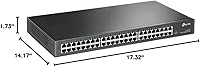
  • Form Factor: The TL-SG1048 is a 1U rackmount unit designed to fit standard 19-inch equipment racks.
  • Dimensions: The unit measures 17.32″ long by 14.17″ wide by 1.73″ high, occupying a single rack unit of vertical space.
  • Weight: The switch weighs 5.1 pounds (2.32 kg), which is manageable for solo rack installation.
  • Chassis Material: The enclosure is constructed from metal with shielded ports, providing physical durability suited to long-term rack deployment.
  • Input Voltage: The switch operates on 110V AC input with a rated current draw of 0.5 amps.
  • Max Temperature: The upper operating temperature rating is 40 degrees Celsius, requiring adequate ambient ventilation in warm environments.
  • Management: The switch is entirely unmanaged, with no web interface, CLI, SNMP, VLAN, or QoS configuration of any kind.
  • Energy Efficiency: Power consumption per port scales based on actual link activity and connected cable length, reducing idle draw modestly.
  • Included Accessories: The package includes the switch unit, an installation guide, a power cord, rackmount kits, and rubber feet.
  • Warranty: TP-Link backs this switch with a 3-year limited warranty and provides free technical support Monday through Friday, 6am to 6pm PST.

Related Reviews
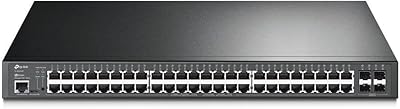
TP-Link TL-SG3452P 48-Port Managed PoE Switch
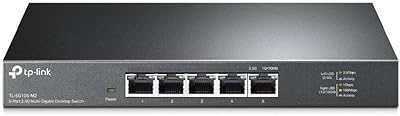
73%
91%
Value for Money
93%
Port Density
67%
PoE Power Budget
82%
Omada SDN Integration
58%
Setup & Configuration
More
TP-Link TL-SG108-M2 8-Port 2.5G Unmanaged Switch
81%
93%
Network Performance
97%
Ease of Setup
89%
Build Quality
74%
Thermal Management
81%
Value for Money
More
TP-Link TL-SG105-M2 5-Port 2.5G Unmanaged Switch
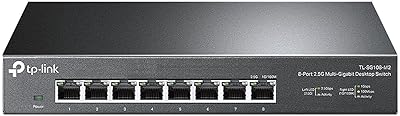
82%
91%
Throughput Performance
96%
Ease of Setup
88%
Build Quality
71%
Thermal Management
63%
Port Count & Expandability
More
TP-Link TL-SG1016DE 16-Port Gigabit Switch
82%
88%
Build Quality
91%
Value for Money
86%
Port Count & Layout
84%
Setup & Installation
63%
Management Interface
More
TP-Link TL-SG3428 24-Port Gigabit Switch
87%
85%
Setup & Installation
92%
Performance & Reliability
91%
Value for Money
80%
Software & Firmware Management
89%
Security Features
More
TP-Link TL-SG1024DE 24-Port Gigabit Switch
82%
91%
Build Quality
93%
Port Performance & Reliability
63%
Management Interface (Web UI)
82%
VLAN Configuration
78%
QoS Effectiveness
More
TP-Link TL-SG1218MPE 16-Port PoE+ Switch
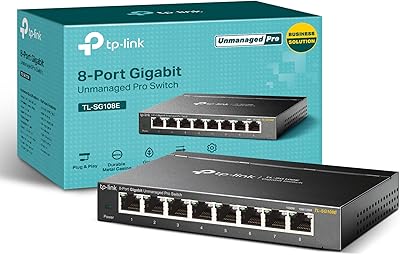
76%
91%
PoE Reliability
68%
PoE Power Budget
88%
Build Quality
63%
Web Management Interface
93%
PoE Auto Recovery
More
TP-Link TL-SG108E 8-Port Gigabit Switch
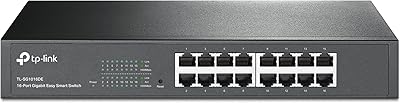
82%
91%
Build Quality
94%
Value for Money
83%
Ease of Setup
61%
Management Software
93%
Long-term Reliability
More
TP-Link TL-SG1005P
TP-Link TL-SG1005P
85%
96%
Ease of Setup
83%
PoE Power Delivery
91%
Build Quality
98%
Noise Level
89%
Gigabit Throughput
More
TP-Link TL-SG1024S 24-Port Gigabit Switch
89%
93%
Build Quality
97%
Ease of Setup
91%
Port Performance
98%
Noise Level
89%
Value for Money
More

FAQ

No, there is nothing to install or configure. You plug in the power, connect your devices with Ethernet cables, and the switch handles everything automatically. It is genuinely plug-and-play in the most literal sense.

No, and this is the most important limitation to understand before buying. The TL-SG1048 is unmanaged, which means there is no VLAN support, no QoS, and no way to segment or prioritize traffic. If your network requires any of that, you need a managed switch instead.

Yes, it runs completely silently. There are no fans at all — cooling is entirely passive. Many buyers specifically choose the TL-SG1048 for noise-sensitive spaces like recording studios, libraries, or open-plan offices where fan hum would be a constant nuisance.

Yes, it is a 1U rackmount unit built for standard 19-inch racks, and the rackmount hardware is included in the box. You do not need to source any extra brackets or hardware to install it.

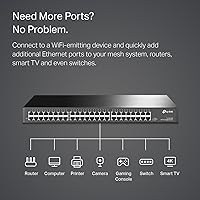
Technically the switch will pass traffic between connected devices without a router, but without a router or gateway upstream, devices will not have internet access or DHCP addressing unless you provide those separately. In most deployments it sits downstream of an existing router or firewall.

No, this switch does not support Power over Ethernet. If you need to power IP cameras, access points, or VoIP phones through the cable, you will need a PoE-capable switch instead. This unit is data-only on all 48 ports.

Each port has an LED indicator that shows link and activity status. One thing to note: some users report the LEDs can be harder to read under very bright ambient lighting, so if your rack room is brightly lit, you may need to look closely.

Yes, you can daisy-chain or uplink this switch to another switch using any of the 48 ports. Since all ports are standard RJ45 with Auto-MDI/MDIX, no special uplink port or crossover cable is needed — just a regular patch cable between units.

Based on long-term user feedback, reliability is one of its strongest points. Many owners report years of continuous uptime without port failures. The metal chassis, passive cooling with no moving parts to wear out, and a 3-year warranty all contribute to a solid long-term track record.

TP-Link offers a 3-year limited warranty on this unit. If something goes wrong, you can contact their technical support team by phone on weekdays during Pacific business hours to initiate a claim. Most users report the support process to be reasonably straightforward for a hardware replacement scenario.

Where to Buy