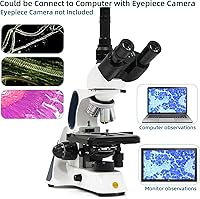
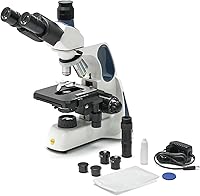
Overview

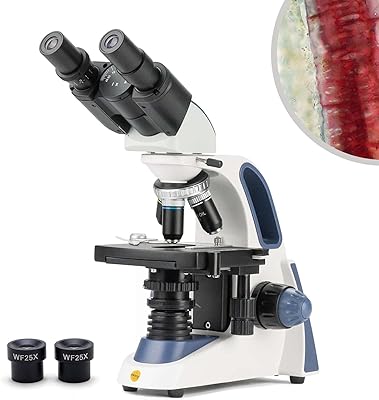
The SWIFT SW400 Trinocular Compound Microscope occupies a genuinely interesting position in the market — it's neither a toy nor a research-grade behemoth, but something more useful for most serious users: a capable, optically honest instrument that punches above what you'd typically expect at this price tier. The standout engineering choice here is infinity-corrected optics, a design usually reserved for considerably more expensive equipment. The trinocular port adds real versatility, letting users attach a camera for documentation or live viewing without sacrificing the eyepiece experience. Launched in late 2024, it has climbed to a top-5 category ranking remarkably quickly. That said, at over 11 pounds and with a 17-inch package footprint, this is strictly a bench instrument — don't expect to move it around.

Features & Benefits

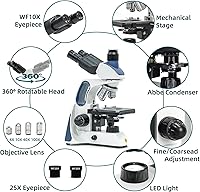
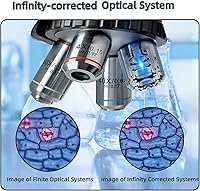
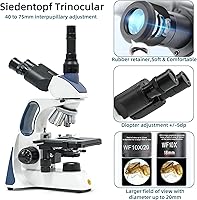
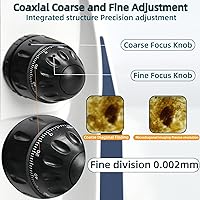
The optical heart of the SW400 is its infinity-corrected system, which keeps light paths parallel between objective and tube lens. In practical terms, this reduces the color fringing and edge distortion that plague cheaper scopes at higher powers — a noticeable difference when you're working at 400X or above. You get six magnification levels (40X through 2500X) by mixing four achromatic objectives with two interchangeable wide-field eyepieces. The Siedentopf head adjusts for interpupillary distance and holds a comfortable 30-degree viewing angle, which matters enormously over a two-hour session. Focusing is handled by coaxial coarse-and-fine knobs with precision gear transmission — smooth and controlled, not jumpy. LED illumination keeps specimens cool and colors consistent. One important note: the camera port is built in, but the camera itself is sold separately.

Best For

This Swift trinocular scope fits a fairly specific kind of buyer, and that's actually a strength — it's not trying to be everything to everyone. It's a natural fit for university biology or microbiology labs that need a shared instrument capable of oil-immersion work. Clinical training programs that rely on image documentation and collaborative review will appreciate the built-in camera port. Independent researchers and advanced hobbyists who want professional optics without the overhead of institutional purchasing will find this hits a useful sweet spot. High-school science teachers building serious lab stations and slide-imaging enthusiasts planning long-term specimen archives also belong in this category. If you need something portable or lightweight, look elsewhere.

User Feedback

This lab-grade microscope has earned a 4.6-out-of-5 rating across nearly 400 reviews — a solid result for a product that only hit the market in late 2024. Most buyers highlight image sharpness at mid-to-high magnifications and the satisfying solidity of the build. The focusing system draws consistent praise: reviewers describe it as smooth and predictable. The more common friction point is the camera situation — several buyers were caught off guard to find no camera included with the trinocular port, so factor that into your budget. On the 2500X maximum figure, opinions are mixed; experienced users tend to treat it as a theoretical ceiling rather than everyday working magnification, noting that 400X to 1000X is where real, reliable detail lives. First-time users generally report a manageable learning curve.

Pros

  • Infinity-corrected optics reduce color fringing noticeably at higher magnifications — a feature rarely found at this price point.
  • The Siedentopf head's interpupillary adjustment and 30-degree viewing angle make long lab sessions genuinely comfortable.
  • Six magnification levels provide real flexibility across a wide range of biological specimen types and workflows.
  • Coaxial coarse-and-fine focusing with precision gear transmission feels controlled and smooth, with minimal frustrating overshoot.
  • The dedicated camera port accepts third-party cameras without adapters, keeping the main optical path fully intact.
  • LED illumination holds specimen temperature steady and avoids the eye fatigue common with older halogen-lit scopes.
  • Nearly 400 reviews and a 4.6-out-of-5 rating for a product barely a year old is a strong real-world confidence signal.
  • Oil-immersion capability via the 100X spring objective makes the SW400 viable for serious bacteriology and pathology slide work.

Cons

  • No camera is included despite the trinocular port being a headline feature — an extra cost many buyers don't anticipate.
  • At over 11 pounds, this Swift trinocular scope needs a permanent, dedicated bench space and isn't realistically portable.
  • The 2500X top magnification is largely theoretical — usable results at that level require expert-level slide preparation.
  • Setup and initial calibration can feel daunting for first-time microscopy users, with a real learning curve before clean results come consistently.
  • Compatible third-party cameras range dramatically in quality and price, making the true total imaging cost hard to predict upfront.
  • Casual or occasional users will find the instrument's size, weight, and complexity far outstrip their actual needs.
  • Consumables like immersion oil and prepared slides aren't included, adding further startup costs for buyers setting up from scratch.

Ratings

The ratings below are generated by our AI after analyzing verified global buyer reviews for the SWIFT SW400 Trinocular Compound Microscope, with spam, bot activity, and incentivized feedback actively filtered out. Each score reflects a measured synthesis of what real users across lab environments, classrooms, and home workspaces reported — including the aspects that drove strong satisfaction and the specific friction points that pulled scores lower. Both sides of the picture are represented transparently in every category below.

Optical Image Quality
91%
Infinity-corrected optics deliver noticeably cleaner images at 400X and 1000X on prepared slides, with most users reporting excellent sharpness and minimal color fringing. Educators and independent researchers working with stained tissue sections and bacterial cultures consistently find the image quality punches above the instrument's price tier.
At the extreme upper end of the magnification range — 2500X — image quality degrades noticeably, requiring near-perfect slide preparation and oil-immersion technique to get anything usable. A small number of reviewers also noted slight chromatic aberration at 100X on particularly demanding specimens, though these reports appear infrequent.
Focusing System
89%
The coaxial coarse-and-fine focusing knobs are consistently among the most praised elements across buyer reviews, described as smooth, controlled, and far less prone to the overshoot frustration common in cheaper scopes. During long slide-scanning sessions, the precision gear transmission means small adjustments land reliably, reducing time spent hunting for focus.
A handful of first-time microscopy users mention that the coarse knob has a steeper throw than they expected, making early sessions feel slightly awkward until technique is established. There are occasional reports of the fine-focus feel becoming subtly looser after extended use, though these represent a clear minority of feedback.
Build Quality
88%
The all-metal body and solid turret assembly draw repeated praise in reviews, with users noting the instrument feels significantly more substantial than competing scopes in a similar price range. Lab technicians and educators who share equipment across multiple users appreciate the sturdy construction, which holds up to regular handling without obvious wear.
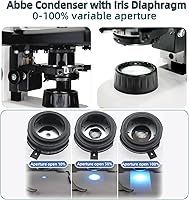
Some buyers note that plastic elements appear in secondary components — such as the condenser adjustment — which feels inconsistent on an otherwise metal-dominant instrument. The 11-pound weight also makes the body imposing for smaller workspaces and impractical to move or store away between sessions.
Objective Lenses
86%
The four achromatic, fully multi-coated objectives cover the full practical range of biological microscopy, from low-power tissue orientation at 4X through to oil-immersion cellular detail at 100X. Most reviewers find the step-up between objectives smooth, with only minor brightness and focus-plane shifts that rarely require a complete refocus.
A small number of reviews note that the 40X spring objective requires a careful approach during slide changes to avoid cover glass contact — something that catches less experienced users off guard. There are also occasional mentions that the 100X objective needs particularly thorough cleaning after oil-immersion sessions to maintain consistent performance.
Ergonomics & Comfort
84%
The Siedentopf head's adjustable interpupillary distance is consistently highlighted as a welcome feature — allowing each user to match the eyepiece width to their own eyes without compromise. The 30-degree viewing angle suits most seated postures well, and users who work long examination sessions report meaningfully less neck and eye strain than with upright-head alternatives.
A few users note that their desk height combined with the 30-degree angle can still cause mild neck tension during very long sessions without an adjustable chair or dedicated lab stand. The eyepiece diopter adjustment requires some patience to lock in precisely and can shift slightly when the scope is relocated between sessions.
Value for Money
83%
Infinity-corrected optics, a Siedentopf head, and a trinocular port at this price point represent strong value — features that would typically cost considerably more on comparable instruments from established lab suppliers. Buyers with a scientific background consistently note how much working capability they're accessing relative to spending, especially when measured against institutional purchasing alternatives.
The camera-not-included reality erodes the value proposition for buyers who purchased primarily for imaging capability — a quality C-mount camera adds a significant and often-unexpected additional cost. Consumables like immersion oil and prepared slides are also extra, meaning total out-of-pocket setup costs can meaningfully exceed what the upfront price suggests.
LED Illumination
82%
18%
The LED light source receives consistent appreciation from users who work with heat-sensitive specimens or spend long hours at the eyepieces — it runs cool, doesn't bleach delicate stained slides, and holds stable color temperature throughout a session. Several reviewers switching from older halogen-lit scopes specifically mention how much more comfortable their eyes feel after extended use.
A few users note that the LED intensity control has limited range at the lower end, making very dim illumination for low-contrast specimens tricky without additional neutral density filters. Brightness calibration for camera-captured images can also require trial and error, particularly when paired with a higher-resolution sensor.
Mechanical Stage
79%
21%
The mechanical stage's X and Y movement controls allow users to scan across a slide systematically without losing their position — something AP biology students and microbiology researchers both mention as a clear workflow improvement over manual-reposition stages. The movement range handles standard glass slides well, and the action is smooth enough for careful, controlled specimen navigation.
A subset of reviews mentions that the stage movement controls feel slightly stiff straight out of the box, requiring a short break-in period before operating at their smoothest. A small number of users also note the stage lacks a tension adjustment, which would help prevent specimen creep at higher magnifications during oil-immersion work.
Eyepiece Quality
78%
22%
The two wide-field glass eyepieces — 10X and 25X — give users meaningful magnification flexibility without purchasing additional optics, and the glass construction provides noticeably better clarity than the plastic eyepieces found on lower-cost scopes. For most users who wear glasses, the eyepiece design accommodates common prescriptions reasonably well.
Several users with significant astigmatism or strong prescriptions report the eyepieces don't fully compensate without removing glasses, which can reduce the effective field of view in practice. Some reviewers also note the eye cups are relatively basic and would benefit from a rubber-fold design for more comfortable glasses-on viewing during extended sessions.
Magnification Versatility
76%
24%
The six-level magnification system covers the full practical range of compound biological microscopy — from orientation views at 40X through mid-range cell work at 400X, up to fine cellular and bacterial resolution at 1000X. The inter-objective focus shift is minor enough that most users can step through magnification levels without a full refocus each time.
The 2500X ceiling figure earns consistent skepticism in reviews from users who have tried it in practice — the resulting image demands pristine slide preparation and controlled conditions that most buyers can't routinely achieve. This makes the upper end of the magnification range aspirational rather than a reliable part of everyday use for the majority of owners.
Setup Experience
73%
27%
Most experienced lab users report the scope arrives well-packaged and pre-assembled enough that getting started is manageable — attaching eyepieces, seating objectives, and adjusting the condenser takes around 30 to 45 minutes for someone with prior microscopy experience. The included manual covers key steps clearly enough for intermediate users to follow without outside help.
First-time compound microscope users frequently describe setup as more involved than expected — particularly around condenser height, diaphragm settings, and achieving Köhler illumination — with several noting they needed online tutorials to supplement the manual. The learning curve for consistently clean images can stretch across multiple sessions for buyers new to this type of instrument.
Camera Integration
69%
31%
The dedicated C-mount trinocular port is a practical asset for users documenting specimens or sharing images in clinical and educational settings — it accepts compatible cameras without eyepiece adapters, preserving image quality and avoiding vignetting. Labs already equipped with a C-mount camera can begin imaging workflows immediately without additional hardware modification.
The most consistent complaint across reviews is that no camera is included despite the trinocular port being a prominently marketed feature — multiple buyers describe feeling caught off guard by the significant additional investment required to actually use the imaging capability. Compatible camera quality and pricing vary considerably, making the true total cost of an imaging setup unclear before purchase.
After-Sale Support
67%
33%
Users who have contacted SWIFT's support team describe response times as adequate and the team as knowledgeable on optical calibration questions specific to their product line. The brand holds a positive general reputation within the educational and prosumer microscopy community, which provides some confidence for buyers investing at this price tier.
A portion of lower-rated reviews cite difficulty finding clear warranty terms or getting timely resolution for hardware issues — the service policy appears to be an area where buyer expectations aren't consistently met. As a product that only launched in late 2024, the long-term support track record is still being established.
Portability
43%
57%
The instrument's dense, sturdy build keeps it stable on the bench with no vibration creep or unintentional movement during use — a meaningful practical benefit for precision specimen examination. The substantial weight reflects quality construction rather than filler material, which users working in permanent lab or classroom stations appreciate.
At over 11 pounds and with a 17-inch packaged footprint, this is a bench instrument in every sense — moving it between rooms or storing it away between sessions are real challenges that users in smaller home labs frequently flag. Anyone without a permanently dedicated workspace should factor this in carefully before buying.

Suitable for:

The SWIFT SW400 Trinocular Compound Microscope is built for buyers who are genuinely serious about what they're looking at — not just curious. University and college biology or microbiology departments will find it a capable shared instrument that handles everything from routine slide review up to oil-immersion work at 1000X. Clinical training environments benefit particularly from the built-in trinocular port, which makes camera-based documentation a practical part of the daily workflow rather than an afterthought. Independent researchers and advanced life-science hobbyists who want professional-grade optics without institutional-level spending will find this scope hits a genuinely useful middle ground. High-school science teachers setting up AP-level microscopy stations, and slide-imaging enthusiasts planning to build a long-term specimen archive, are also well served — the ergonomic head design and smooth focusing system make extended sessions far less physically taxing than cheaper alternatives.

Not suitable for:

The SWIFT SW400 Trinocular Compound Microscope is not the right call if portability or a compact workspace is your primary constraint. At over 11 pounds and arriving in a 17-inch package, this is strictly a bench instrument — moving it around regularly isn't realistic, and cramped surfaces will feel every inch of its footprint. Casual users hoping to occasionally glance at pond water or give young children a first taste of microscopy will find the price and complexity well beyond what the use case demands. Budget-conscious buyers should also know upfront that the trinocular port, for all its potential, requires purchasing a separate compatible camera — an additional cost that varies considerably and isn't trivial. Finally, anyone expecting the 2500X top magnification rating to deliver consistently crisp, usable images will likely be disappointed: at that level, results depend heavily on expert-level slide preparation and controlled conditions most general users won't routinely achieve.

Specifications

  • Microscope Type: Trinocular compound biological microscope designed for transmitted-light examination of prepared specimen slides.
  • Optical System: Infinity-corrected optics maintain parallel light paths between the objective and tube lens, reducing color fringing and distortion, particularly at high magnifications.
  • Objectives: Four infinity achromatic objectives are included: 4X, 10X, 40X (spring-loaded), and 100X (spring-loaded, oil-immersion), all with wide-band, fully multi-layer anti-reflection coatings.
  • Eyepieces: Two interchangeable wide-field glass eyepieces — 10X and 25X — enable six distinct magnification combinations when paired with the four objectives.
  • Magnification Range: Available magnification levels are 40X, 100X, 250X, 400X, 1000X, and 2500X, achieved by combining the four objectives with both eyepieces.
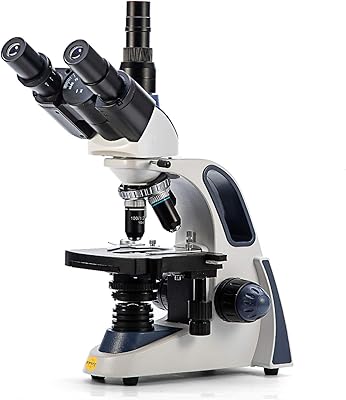
  • Head Design: The Siedentopf trinocular head features a 30-degree inclined viewing angle and adjustable interpupillary distance to accommodate different users comfortably during extended sessions.
  • Camera Port: A dedicated trinocular camera port accepts third-party C-mount microscope cameras for imaging workflows; no camera is included with the instrument.
  • Focusing System: Coaxial coarse-and-fine focusing knobs operate through a precision gear transmission system for controlled, low-overshoot specimen focus adjustment.
  • Stage: The mechanical stage provides precise, repeatable X and Y specimen positioning for systematic slide examination.
  • Illumination: The LED light source delivers consistent, cool illumination that maintains stable specimen temperature and reduces eye fatigue during extended use.
  • Lens Coating: All four objectives are fully multi-coated with wide-band anti-reflection layers to maximize light transmission and maintain high image contrast across magnification levels.
  • Item Weight: The instrument weighs 5.3 kg (11.66 lbs), requiring a stable, dedicated flat bench surface for safe operation.
  • Package Size: The packaged unit measures 17.2 x 14.6 x 10 inches.
  • Brand: The SW400 is manufactured and sold by SWIFT under their own brand.
  • Availability: This model was first made available for purchase in October 2024.

Related Reviews
SWIFT SW350T Trinocular Compound Microscope
79%
91%
Optical Clarity
88%
Build Quality
54%
Camera Quality
57%
Software Usability
86%
Ergonomics
More
Swift SW380T Trinocular Compound Microscope
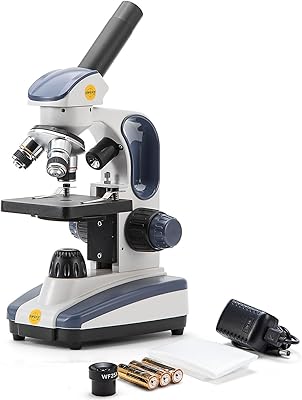
81%
83%
Optical Clarity
89%
Build Quality
81%
Focusing Mechanism
77%
Trinocular Head & Camera Compatibility
86%
Mechanical Stage
More
SWIFT SS121 Compound Monocular Microscope Kit
80%
88%
Build Quality
81%
Optical Clarity
84%
Illumination System
86%
Ease of Use
72%
Magnification Range
More
SWIFT SW200DL Compound Monocular Microscope
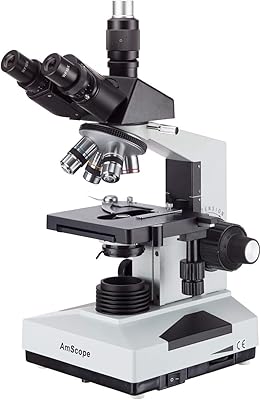
81%
83%
Optical Clarity
78%
Magnification Range
91%
Dual Illumination System
88%
Build Quality & Durability
86%
Fine Focus Mechanism
More
AmScope T490B Compound Trinocular Microscope
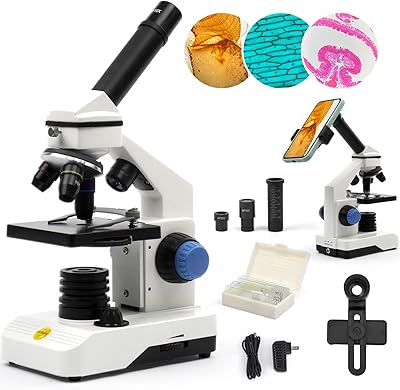
74%
88%
Optical Clarity
91%
Trinocular Head
78%
Camera Integration
86%
Mechanical Stage
89%
Build Quality
More
Poothoh SMXWJ-02 Trinocular Compound Microscope
73%
83%
Optical Clarity
88%
Build Quality
67%
USB Camera Performance
84%
Mechanical Stage
81%
Illumination
More
Swift SW380B Binocular Compound Microscope
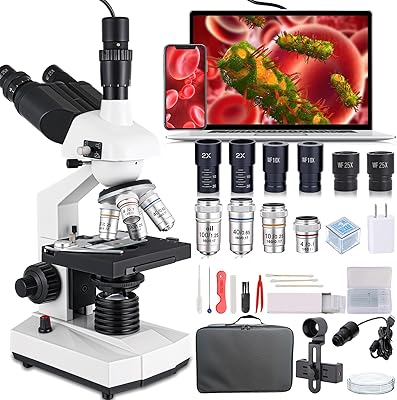
79%
83%
Optical Clarity
88%
Build Quality
86%
Ergonomics & Comfort
79%
Magnification Range & Versatility
81%
Focusing System
More
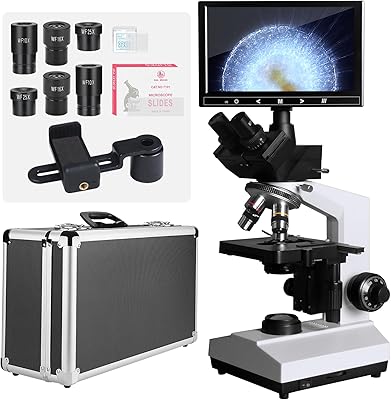
Crspexil 2024 Trinocular Compound Microscope
71%
78%
Optical Clarity
74%
Camera Performance
76%
Build Quality
82%
Value for Money
71%
Ease of Setup
More
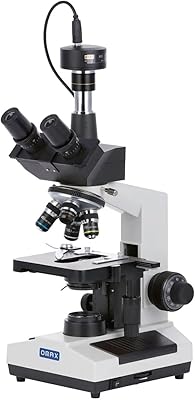
OMAX M837ZL-C100U Trinocular Compound LED Microscope
71%
83%
Optical Clarity
81%
Build Quality
67%
Camera Performance
78%
Stage Precision
76%
Ergonomics
More
OMAX M83ES 40X-2000X Lab Trinocular Biological Compound LED Microscope
84%
91%
Magnification Performance
89%
LED Illumination Quality
87%
Build Quality & Durability
93%
Ease of Setup
85%
Focus Mechanism
More

FAQ

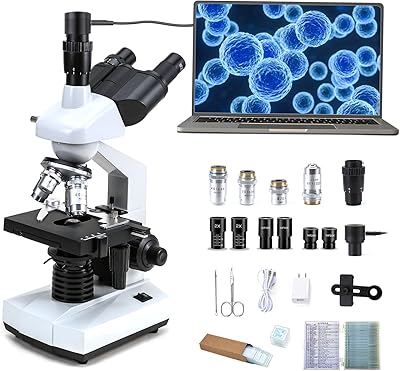
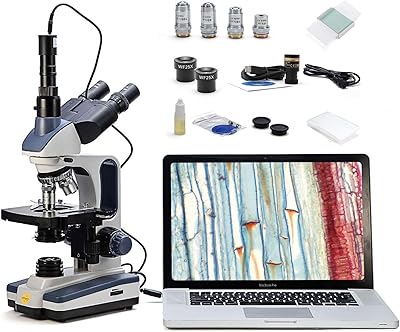
No, and this is worth knowing before you order. The trinocular port is built into the head and accepts standard C-mount microscope cameras, but the box contains only the scope, two eyepieces, and four objectives. If camera imaging is part of your plan, budget for a compatible camera as a completely separate purchase.

The port uses a standard C-mount interface, which is the most widely used in the microscopy industry, so compatible options from many brands are plentiful. Swift's own Swiftcam cameras are a natural pairing, but any C-mount camera rated for compound microscopes will work. Sensor resolution and USB version are the main specs to compare when shopping around.

For most users, 2500X is a rated ceiling rather than a daily working magnification. Achieving usable images at that level requires oil-immersion technique, meticulously prepared slides, and precisely controlled lighting that most general users won't have consistently in place. The realistic sweet spot for biological work — bacteria, tissue sections, blood smears — falls between 400X and 1000X, where this scope performs reliably and sharply.

The SWIFT SW400 Trinocular Compound Microscope ships mostly pre-assembled, so the out-of-box process is reasonably approachable: attach the eyepieces, seat the objectives in the turret, then adjust the condenser height and interpupillary distance. Most experienced lab users report being ready to work in under an hour. First-timers will face a modest learning curve around fine-focus technique and illumination setup, but the precision gear focusing system makes that process noticeably less frustrating than on cheaper instruments.

In a supervised AP biology or science-fair context, yes — the optics and build quality are a meaningful step above typical student-grade scopes. The smooth focusing and stable mechanical stage make detailed specimen work considerably easier, and the overall experience feels genuinely professional. For completely unsupervised or casual use, the complexity and the 11-pound weight may make it more instrument than the situation calls for.

Yes, the 100X objective is a spring-loaded oil-immersion lens, meaning this Swift trinocular scope is fully capable of 1000X oil-immersion work — the technique used in clinical microbiology to resolve bacteria and fine cellular structures. Immersion oil is not included and needs to be sourced separately. Make sure to clean the 100X objective thoroughly after every oil session so residue doesn't harden on the lens surface.

Use only optical-grade lens tissue or a dedicated microfiber cloth — paper towels and regular fabric can scratch the multi-layer coatings over time. For stubborn residue, particularly after oil-immersion use, a small amount of optical-grade isopropyl alcohol applied to the tissue rather than directly to the lens works well. Always blot or drag gently in one direction rather than scrubbing in circles, and keep dust caps on unused objectives and eyepieces when the scope is not in use.

Focus drift is a common complaint with budget scopes, but this lab-grade microscope uses a precision gear transmission in the focusing knobs that holds position reliably under normal working conditions. Most users report the focus stays stable throughout a full session. Minor drift from significant room temperature fluctuations is a physics reality with any compound microscope, but it is not a product defect.

The binocular version dedicates both optical ports to the eyepieces, while this model adds a third port exclusively for a camera attachment. If you plan to photograph specimens, share images for teaching, or archive slide work over time, the trinocular configuration provides that capability without modifying anything or compromising the eyepiece view. If you are strictly an eyepiece-only user with no interest in camera imaging, the binocular model is lighter and typically costs less.

Yes, the mechanical stage accommodates standard glass slides in the common 75 mm x 25 mm format used across most labs and educational settings. The X and Y movement controls let you scan across a slide in a controlled, systematic way, which is especially useful when revisiting specific areas of a specimen during longer examination sessions.