Overview

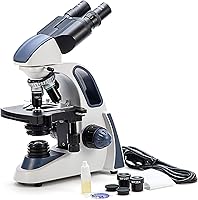
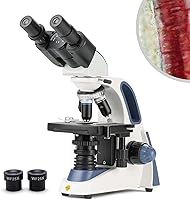
The Swift SW380B Binocular Compound Microscope sits in an interesting middle ground — capable enough for serious scientific work, yet priced within reach of dedicated students and hobbyists. What immediately sets it apart at this tier is the Siedentopf binocular head, a feature you would normally expect on costlier lab equipment. Pick it up and the all-metal construction makes its intentions clear; at just over 11 pounds, this compound scope is not going anywhere on your desk. It covers a wide magnification range, from low-power overview views up to high-power detail work, making it genuinely versatile rather than a one-trick instrument. If you are serious about microscopy, this is where the entry-level ceiling ends.
Features & Benefits

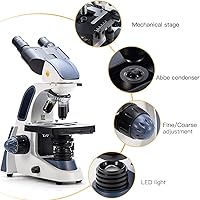
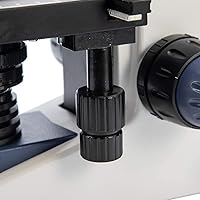
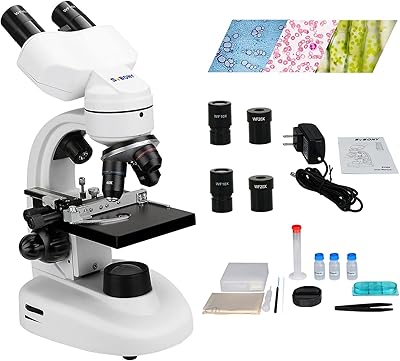
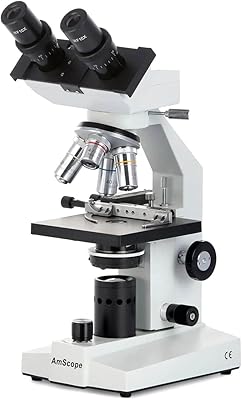
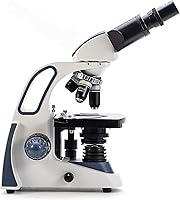
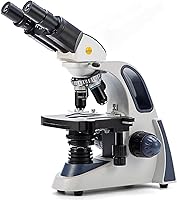
The Siedentopf head rotates a full 360 degrees and adjusts for different interpupillary distances, which matters when multiple people share the scope in a classroom or lab. Two interchangeable wide-field eyepieces — 10X and 25X — ship in the box, so you get genuine flexibility without hunting for aftermarket parts. The four DIN achromatic objectives sit on a smooth revolving turret and deliver solid semi-plan image quality across six distinct magnification steps. Focusing is handled by a dual-knob coarse-and-fine system that feels precise rather than spongy. Below the stage, an Abbe condenser with an adjustable diaphragm pairs with a dimmable LED to give you reliable, even illumination — a bigger practical advantage than many buyers initially expect.

Best For

The SW380B earns its place most naturally in the hands of university science students who need a capable, daily-use scope that will not fall apart by midterm. It is equally well-suited for hobbyists exploring histology, entomology, or water biology at home — people who want real results, not toy-grade optics. Small clinic technicians or independent researchers who need a reliable binocular setup but cannot justify premium pricing will also find it punches well above its weight class. And if you are upgrading from a plastic monocular beginner scope, the jump in image quality and build confidence is significant. Educators running shared lab stations should take note — the all-metal frame handles the wear of multiple student hands better than budget alternatives.

User Feedback

Across several hundred verified ratings, the SW380B holds a strong 4.4 to 4.6 out of 5 — a respectable showing that reflects genuine satisfaction rather than inflated scores. Buyers frequently highlight mid-range optical clarity and the comfort of the binocular head during extended sessions as standout strengths. Build quality also draws consistent praise; people upgrading from cheaper scopes often remark that this compound scope simply feels more serious. That said, two recurring criticisms are worth knowing: a small number of users report stiff focus tension or slight calibration issues straight out of the box, which may require minor adjustment. And while the 2500X maximum looks impressive on paper, real-world usability at extreme magnifications is limited — expect the sharpest results between 100X and 400X.

Pros

  • The all-metal build feels noticeably more solid than plastic-bodied competitors at a similar price point.
  • Siedentopf head adjusts easily for different users, making shared lab or classroom use genuinely practical.
  • Mid-range optical clarity between 100X and 400X consistently earns praise from verified buyers worldwide.
  • Two wide-field eyepieces are included out of the box, so you are not immediately shopping for upgrades.
  • The mechanical stage makes systematic slide scanning far smoother and more precise than clip-style alternatives.
  • Adjustable LED illumination with an Abbe condenser gives real control over specimen lighting — a practical daily advantage.
  • The 30-degree binocular tilt reduces neck and eye fatigue during longer viewing sessions noticeably.
  • Starter slides and accessories included in the box let beginners get hands-on within minutes of unboxing.
  • Holds a strong 4.4 to 4.6 star average across hundreds of verified reviews — a consistently positive signal.

Cons

  • The 2500X maximum magnification is a marketing ceiling; real usable sharpness peaks well below that figure.
  • Focus knob tension varies between units — some arrive stiff or uneven and need adjustment before comfortable use.
  • No built-in camera port means specimen photography requires a separate adapter, adding extra cost and setup effort.
  • The instruction manual is thin on detail, leaving new users to figure out condenser alignment through trial and error.
  • At over 11 pounds with a fixed power cord, moving it between locations regularly is genuinely impractical.
  • Stage clips and diaphragm lever show wear with heavy shared use, and replacement parts are not always easy to source.
  • A small number of buyers report calibration issues out of the box that require contacting customer support to resolve.
  • The 25X eyepieces show more edge distortion than the 10X pair, which becomes noticeable during extended use.

Ratings

The Swift SW380B Binocular Compound Microscope earned its ratings through AI-driven analysis of verified global buyer reviews, with spam, bot-generated, and incentivized submissions actively filtered out before scoring. What follows reflects where this compound scope genuinely excels — and where real users have run into friction — so you can make a confident, well-informed decision before buying.

Optical Clarity
83%
At mid-range magnifications between 100X and 400X, users consistently describe crisp, well-defined images that hold up during extended specimen sessions. The semi-plan achromatic objectives keep subjects sharp across most of the field of view, which is a meaningful advantage over fully budget-tier optics.
Edge softness becomes noticeable at higher power levels, and the advertised 2500X upper limit draws skepticism from experienced users who know that usable resolution on achromatic objectives realistically peaks well below that figure.
Build Quality
88%
The all-metal body is one of the most frequently cited positives across buyer reviews. People upgrading from plastic-bodied scopes remark that the SW380B feels like an instrument built to last — stable on the desk, resistant to minor knocks, and not prone to the flex or wobble common in cheaper models.
A small but consistent group of buyers report that the focus knobs arrive with uneven tension — either too stiff or too loose — requiring adjustment before comfortable use. It is not a widespread defect, but it surfaces often enough to be worth flagging.
Ergonomics & Comfort
86%
The 30-degree binocular tilt and Siedentopf head adjustment genuinely reduce neck and eye strain during longer viewing sessions, something users doing hour-long lab work or evening hobby sessions notice quickly. The ability to share the scope between users with different interpupillary distances adds practical value in classroom settings.
The eyepiece angle and head height work well for average adult users, but taller individuals or those with specific posture needs may find the fixed 30-degree tilt limiting. There is no height-adjustable arm, so desk setup matters more than it might with other instruments.
Magnification Range & Versatility
79%
21%
Six usable magnification levels give students and hobbyists genuine flexibility — from low-power slide surveys at 40X to detailed cellular work around 400X. The included 10X and 25X wide-field eyepieces mean you are not immediately hunting for aftermarket upgrades right out of the box.
The 2500X claim is a marketing ceiling, not a practical working range. At extreme magnification levels, image quality degrades noticeably, and seasoned users regard that number as aspirational rather than functional. Managing buyer expectations around this is important.
Focusing System
81%
19%
The dual coarse-and-fine focus knobs give users good control over specimen depth, and the fine adjustment in particular draws praise for its sensitivity during high-magnification work. Most buyers find the system intuitive within a few uses, even those new to compound microscopy.
Out-of-box focus tension is inconsistent across units — some arrive smooth, others stiff. Users who receive a stiff fine-focus knob sometimes mistake it for a defect, when it may just need breaking in or minor mechanical adjustment.
Illumination Quality
84%
The LED light source paired with the Abbe condenser and adjustable diaphragm gives users real control over specimen lighting. Buyers working with stained slides or transparent specimens appreciate the ability to dial brightness up or down without introducing color distortion from the light source.
The LED illumination is not field-replaceable in any straightforward way for most non-technical users, and a handful of reviews mention the bulb arriving defective. There is no built-in color filter slot, which limits advanced contrast techniques without aftermarket accessories.
Mechanical Stage
82%
18%
The mechanical stage is a genuine upgrade over the clip-style stages found on cheaper microscopes. Users scanning through multiple slides in a systematic way — students working through lab practicals, or hobbyists cataloguing specimens — find the controlled X-Y movement saves significant time and reduces frustration.
The stage travel range is sufficient for standard slides but feels limiting when working with larger or irregularly sized specimens. A few buyers also note that the stage movement becomes slightly gritty after extended use, suggesting the factory lubrication may need refreshing over time.
Assembly & Setup
76%
24%
Most buyers describe the unboxing and initial assembly as straightforward, with the scope arriving largely pre-assembled and ready to use within minutes. The included accessories — prepared slides, eyepieces, dust cover — make the first-use experience accessible even for complete beginners.
The instruction manual receives mixed reviews; some users find it thin on detail for first-time microscope owners. A few buyers needed to seek out online tutorials to understand condenser alignment and proper Kohler-style illumination setup.
Value for Money
85%
Positioned below the threshold of professional lab equipment but well above toy-grade scopes, the SW380B occupies a sweet spot that experienced buyers consistently validate. The combination of a Siedentopf head, mechanical stage, and metal build at this price tier is genuinely hard to replicate from competitors without spending noticeably more.
Budget-conscious buyers occasionally note that similarly priced competitors offer a camera port or trinocular head, which the SW380B does not. For users who plan to photograph specimens or connect to a monitor, the lack of a built-in imaging option is a real gap that may require a separate adapter.
Durability Over Time
78%
22%
Long-term owners — particularly educators who have used the scope across multiple academic years — report that the core optics and metal frame hold up well with normal care. The all-metal construction ages better than polymer-bodied alternatives under regular handling.
Some consumable components, such as the stage clips and condenser diaphragm lever, show wear with heavy shared use. Replacement parts are not always easy to source quickly, which can be a practical inconvenience in an active classroom environment.
Eyepiece Quality
77%
23%
The wide-field 10X eyepieces deliver a noticeably broad viewing area that reduces the tunnel-vision feeling common on narrower eyepieces. Having both 10X and 25X options included means users can switch viewing angles without any additional investment at purchase.
The 25X eyepieces, while useful, show more edge distortion than the 10X pair — a trade-off buyers who rely on them heavily will notice. Eyecup quality is functional but not exceptional; users who wear glasses sometimes find the eye relief less comfortable over extended sessions.
Condenser & Diaphragm Control
74%
26%
The Abbe condenser is a step above what most competing scopes at this price include, and users who take the time to learn proper condenser positioning report a meaningful improvement in image contrast and resolution. It works especially well with stained histology slides.
The iris diaphragm lever can feel imprecise compared to higher-end instruments, and new users often overlook condenser height adjustment entirely because the manual does not emphasize it. Getting the most from this feature requires some self-directed learning.
Portability & Storage
63%
37%
The scope ships with a fitted dust cover, and its compact footprint fits reasonably well on a standard student desk or home workbench without dominating the surface. The stable base reduces the risk of accidental tipping during transport between rooms.
At over 11 pounds, this is not a scope you will move around casually. Users who expected to carry it between locations — home to school, for example — quickly realize it is designed to live in one place. The lack of a carry case in the box is a minor but real inconvenience.
Accessories & Inclusions
71%
29%
Beginners particularly appreciate the starter kit of prepared slides and blank slides included with purchase, which lets new users start exploring immediately. Having two eyepiece options in the box adds genuine value compared to scopes that ship with a single fixed eyepiece.
The blank slides and cover slips included are limited in quantity, so active users will exhaust them quickly. The dust cover is a basic fabric type rather than a hard case, and a few buyers note that the spare bulb — if included at all — is easy to misplace.

Suitable for:

The Swift SW380B Binocular Compound Microscope is the right choice for students at the high school or university level who need a dependable, daily-use instrument that will hold up through an entire academic year without babying. Science hobbyists — whether you are exploring pond water biology, preparing your own histology slides, or cataloguing insect anatomy — will find this compound scope punches well above what entry-level alternatives deliver at a comparable spend. The Siedentopf binocular head makes it particularly practical in shared settings: a classroom, a small teaching lab, or a home setup where more than one person regularly uses the instrument. Small clinic technicians or independent researchers who need reliable binocular optics without committing to professional-grade pricing will also find it covers the fundamentals without major compromise. And if you are currently using a plastic monocular scope and feel limited by its optics or build, the step up to the SW380B will feel immediately and meaningfully different.
Not suitable for:

The Swift SW380B Binocular Compound Microscope is not the right fit for buyers who need imaging capability built in — there is no trinocular port, so connecting a camera for photography, video capture, or display output requires a separate adapter solution that adds cost and complexity. Researchers or advanced users who rely on oil-immersion techniques at very high magnification will find the achromatic objectives reach a practical resolution ceiling before the advertised 2500X figure, and anyone expecting professional-grade optics should look at purpose-built lab instruments in a higher price bracket. This compound scope also weighs over 11 pounds and runs on a fixed 110V AC power supply, so it is not designed for portability or field use — if you need something you can carry to different locations regularly, it will disappoint. Buyers who want plug-and-play simplicity with zero setup learning curve may also find the condenser alignment and illumination optimization require more self-directed research than they anticipated.
Specifications

  • Model: This compound microscope carries the model designation SW380B, manufactured by NJEDU under the Swift brand.
  • Magnification Range: Six magnification levels are available: 40X, 100X, 250X, 400X, 1000X, and 2500X, achieved through a combination of objectives and interchangeable eyepieces.
  • Objectives: Four DIN achromatic objectives are mounted on a revolving turret, delivering semi-plan field image quality across all magnification steps.
  • Eyepieces: Two wide-field eyepieces are included — 10X and 25X — and are interchangeable to adjust total magnification without purchasing additional accessories.
  • Head Type: The Siedentopf binocular head is fully rotatable 360 degrees and adjusts for different interpupillary distances to accommodate multiple users.
  • Viewing Angle: The eyepieces are fixed at a 30-degree ergonomic tilt to reduce neck and eye strain during extended viewing sessions.
  • Focusing System: A dual coarse-and-fine focusing system provides ultra-precise depth adjustment, allowing controlled movement at both broad and extremely fine levels.
  • Stage: A mechanical stage with X-Y directional control enables smooth, repeatable slide positioning for systematic specimen scanning.
  • Condenser: An Abbe condenser with an adjustable iris diaphragm sits below the stage to control light concentration and improve image contrast.
  • Light Source: A built-in LED bulb provides adjustable-brightness transmitted illumination from below, powered via the included AC connection.
  • Voltage: The microscope operates on 110V AC power and is designed for use with a standard North American wall outlet.
  • Construction: The body, arm, and base are constructed from metal, contributing to the instrument's stability and long-term durability under regular use.
  • Dimensions: The unit measures 13.78″ in length, 10.63″ in width, and 17.32″ in height, fitting comfortably on a standard lab bench or home desk.
  • Weight: The microscope weighs 11.02 pounds, reflecting its all-metal build and making it a stationary instrument rather than a portable one.
  • Color: The SW380B is finished in blue with contrasting metal accents, giving it a clean, professional laboratory appearance.
  • Included Accessories: The package includes the two eyepieces, prepared specimen slides, blank slides, cover slips, a dust cover, and immersion oil for use at the highest magnification levels.
  • Best Sellers Rank: The SW380B ranks among the top five in the Lab Compound Binocular Microscopes category on Amazon, reflecting sustained buyer demand since its launch.
  • Date Available: This model first became available for purchase on March 23, 2019, and has not been discontinued by the manufacturer as of the time of this review.

Related Reviews
SWIFT SS121 Compound Monocular Microscope Kit
80%
88%
Build Quality
81%
Optical Clarity
84%
Illumination System
86%
Ease of Use
72%
Magnification Range
More
SWIFT SW200DL Compound Monocular Microscope
81%
83%
Optical Clarity
78%
Magnification Range
91%
Dual Illumination System
88%
Build Quality & Durability
86%
Fine Focus Mechanism
More
SVBONY SV605 Binocular Compound Microscope
85%
90%
Value for Money
88%
Ease of Setup
85%
Build Quality
89%
Optical Performance
91%
Illumination System
More
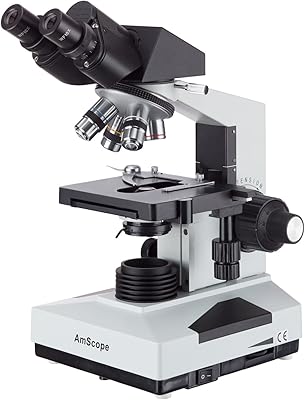
AmScope B490B Compound Binocular Microscope
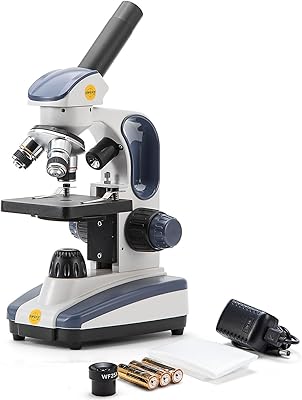
85%
94%
Optical Clarity
90%
Build Quality
85%
Ease of Use
92%
Value for Money
93%
Magnification Range
More
AmScope B100B-MS Compound Binocular Microscope
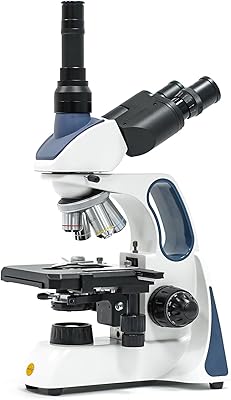
69%
83%
Build Quality
74%
Optical Clarity
61%
Illumination
69%
Magnification Range
71%
Mechanical Stage
More
BOGRINUO RM Binocular Compound Microscope
70%
78%
Optical Clarity (Low-Mid Power)
52%
Optical Clarity (High Power)
81%
Build Quality
83%
Ergonomics & Comfort
76%
Mechanical Stage Quality
More
Swift S306S Binocular Stereo Microscope
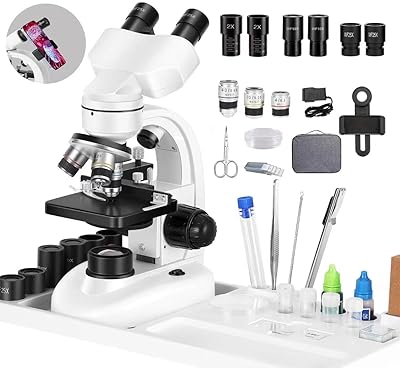
79%
83%
Optical Clarity
79%
Build Quality
88%
Illumination System
71%
Magnification Range
91%
Head Design & Ergonomics
More
SWIFT SW400 Infinity-Corrected Trinocular Compound Microscope
85%
94%
Optical Performance
91%
Build Quality
88%
Ease of Use
89%
Magnification Range
86%
Illumination Quality
More
SWIFT SW350T Trinocular Compound Microscope
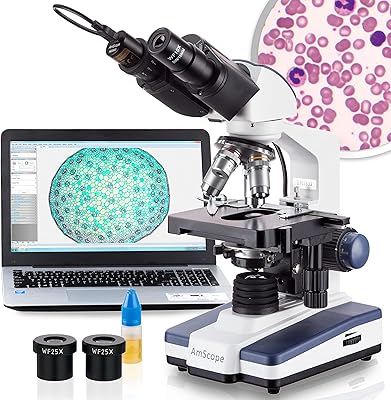
79%
91%
Optical Clarity
88%
Build Quality
54%
Camera Quality
57%
Software Usability
86%
Ergonomics
More
AmScope B120C-E5 Binocular Compound Microscope
78%
88%
Optical Clarity
76%
Build Quality
91%
Illumination Quality
84%
Ergonomics & Comfort
67%
USB Camera Quality
More

FAQ

Yes, for the vast majority of undergraduate biology and microbiology lab work, the SW380B handles standard tasks — cell observation, prepared histology slides, and basic microorganism identification — comfortably. The semi-plan achromatic objectives and mechanical stage meet the practical demands of most university curricula without requiring a more expensive professional instrument.

Most users and optical experts agree that the sweet spot for this binocular microscope sits between 100X and 400X, where image sharpness and contrast are genuinely strong. The 1000X level is usable with proper immersion oil technique, but the advertised 2500X ceiling is largely a theoretical maximum — at that extreme, the achromatic objectives reach the edge of their resolution capacity and the image loses meaningful detail.

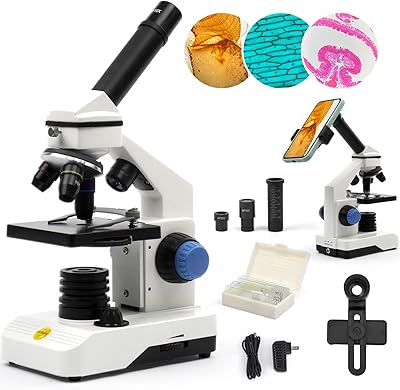
The SW380B does not have a built-in trinocular port, so there is no dedicated camera tube. However, it is possible to use a smartphone adapter or an eyepiece-mount camera attachment to capture images through one of the standard eyepiece openings. Results vary depending on the adapter quality, so this workaround is better suited to casual documentation than precise scientific imaging.

The 30-degree binocular head and interpupillary distance adjustment handle most comfort needs, but for eyeglass wearers, the eye relief on the included eyepieces can feel tight. If you wear glasses for astigmatism correction, you may want to keep them on — the diopter adjustment on one of the eyepieces lets you compensate for minor prescription differences between your two eyes without glasses.

Stiff focus tension is one of the more common out-of-box complaints for this compound scope, and in most cases it is not a defect. The coarse and fine focus knobs can arrive tighter than ideal due to factory lubrication settling during shipping. Working the knobs through their full range a few times often loosens them, and some users apply a small amount of silicone grease to improve smoothness if needed. If the issue persists, Swift customer support is generally responsive.

This is a transmitted-light compound microscope, which means it works with thin, light-permeable specimens on glass slides — think prepared cell slides, blood smears, pond water organisms, plant cross-sections, thin tissue samples, and similar material. It is not designed for viewing solid, opaque objects like coins, insects, or circuit boards, which require a stereo or reflected-light microscope instead.

It is best suited for high school age and above rather than young children. The 30-degree binocular head and mechanical stage require a level of patience and fine motor control that younger kids may find frustrating. For a child under 12 or 13, a simpler monocular scope with fewer adjustments would be a more age-appropriate starting point.

The unit is rated for 110V AC power, which matches standard North American outlets. For use in countries with 220–240V mains power, you would need a step-down voltage converter — just swapping the plug adapter is not enough and could damage the LED circuit. Always verify the converter wattage rating before use abroad.

Use only lens paper or a dedicated optical microfiber cloth — never tissue paper, paper towels, or clothing fabric, which can scratch the objective coatings. For stubborn smears, a small amount of lens cleaning solution applied to the cloth (not directly to the glass) works well. After using immersion oil at 1000X, clean the oil-immersion objective promptly with lens paper to prevent the oil from migrating to adjacent objectives on the turret.

Swift typically offers a limited warranty on this compound scope covering manufacturing defects, though the specific terms are worth confirming directly with the seller or Swift at the time of purchase. Customer support feedback in buyer reviews is generally positive — most users who contacted Swift about calibration or parts issues report receiving helpful responses. Keeping your order confirmation and purchase date on hand speeds up any support interaction significantly.

Where to Buy