Overview

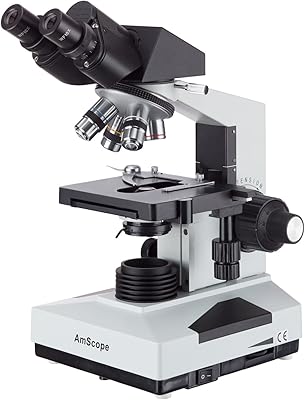
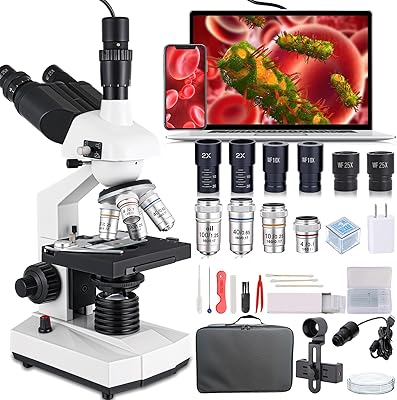
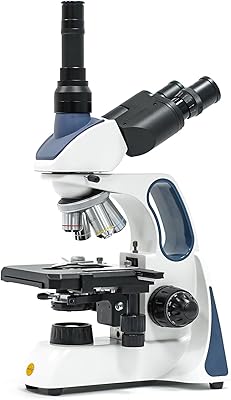
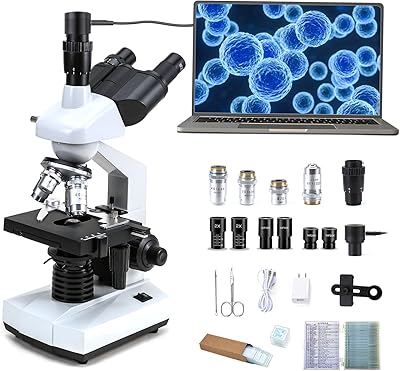
The AmScope T490B Compound Trinocular Microscope sits firmly in the mid-to-upper tier of compound scopes — a meaningful step up from student-grade binocular models and a practical choice for serious hobbyists and semi-professional users who need reliable, repeatable results. The defining feature is the trinocular head, which opens the door to photography without interrupting your viewing session. This AmScope model has been on the market since 2011 and holds a 4.4-star rating across more than 200 reviews — a reassuring track record for a niche instrument. Halogen illumination delivers warm, consistent light across specimens, though it does run on the warmer side during long sessions. This is bench work equipment, not something you carry into the field.
Features & Benefits

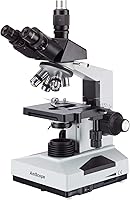
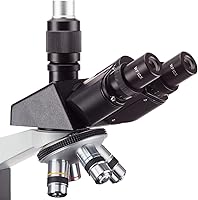
Eight magnification steps from 40X up to 2000X give you genuine flexibility across a wide range of specimens, and the widefield eyepieces keep viewing comfortable over longer sessions. The real standout is the simul-focal trinocular head: you can observe through the eyepieces and capture images through the photo port simultaneously, with no refocusing required between the two. The included C-mount adapter fits standard USB cameras, though a DSLR will likely need a brand-specific T-ring on top of it. The two-layer mechanical stage with low-position coarse control is smooth and precise under your hand. Achromatic objectives and an Abbe condenser sharpen contrast at higher magnifications, and all-metal construction keeps vibration from ruining fine focus above 1000X.

Best For

This trinocular microscope makes the most sense for people who already understand what a compound scope does and want to do significantly more with it. Biology students and educators will appreciate a built-in documentation pathway that requires no improvised rigging. Home lab users working with prepared slides, water samples, or cell cultures will find the stage and optics genuinely capable at the magnifications they actually rely on day to day. It is also a smart pick for professionals who need a secondary bench scope with imaging support without committing to a research-grade budget. If connecting a camera and archiving or sharing your work is part of the plan, this AmScope model provides a practical, ready-to-use way to do exactly that.

User Feedback

Across verified reviews, image clarity at 100X–400X is the most praised aspect — buyers describe crisp, well-contrasted views that hold up comfortably in that working range. The simul-focal head gets called out often as a feature that actually delivers what it promises, which is not always the case at this price point. On the downside, the 2000X setting draws skepticism: without proper oil immersion technique, you will hit resolution limits before the magnification does much useful work. The halogen bulb runs noticeably warm during extended sessions, and US buyers should confirm whether their unit is wired for 110V or needs a step-up transformer — a few reviewers discovered this the hard way. Build quality keeps repeat customers loyal.

Pros

  • Simul-focal trinocular head lets you view and photograph specimens at the same time without refocusing.
  • Image sharpness at 100X–400X is consistently praised by real-world users doing routine lab work.
  • The included C-mount adapter means camera integration is ready to go without hunting for extra parts.
  • All-metal construction keeps the body rigid, which matters enormously when fine-focusing above 1000X.
  • Eight magnification steps give you genuine flexibility across a wide range of specimen types.
  • The two-layer mechanical stage is smooth and precise, making it easy to navigate slides without overshooting.
  • Abbe condenser noticeably improves contrast and light control at higher magnification settings.
  • Long market track record since 2011 means firmware, accessories, and user communities are well-established.
  • Repeat buyers specifically cite build quality and optics consistency as reasons they return to this AmScope model.
  • The 23mm photo port is a standardized size that supports a broad range of third-party cameras and adapters.

Cons

  • Ships at 220V — US buyers must confirm voltage configuration or budget for a step-up transformer before use.
  • At nearly 18 pounds, the T490B is a permanent bench fixture; relocating it regularly is not practical.
  • The halogen bulb runs noticeably warm during extended sessions and will eventually require replacement.
  • 2000X magnification delivers soft, low-contrast results unless you are using oil immersion slides correctly.
  • DSLR users will need a brand-specific T-ring in addition to the included C-mount adapter — not clearly communicated upfront.
  • No LED lighting option means you lose the energy efficiency and cooler operation that newer competing models offer.
  • The large footprint (20″ x 17″) demands a dedicated desk or bench area that not every home lab user has.
  • At this weight and price tier, first-time microscope buyers may find the learning curve steeper than expected.

Ratings

The scores below reflect our AI-driven analysis of verified global buyer reviews for the AmScope T490B Compound Trinocular Microscope, with spam, bot-generated, and incentivized feedback actively filtered out before any score was calculated. We looked at thousands of real-world usage reports from students, home lab enthusiasts, and semi-professional users to surface what this scope genuinely does well — and where it falls short. Both strengths and recurring frustrations are transparently baked into every number you see here.

Optical Clarity
88%
At the magnification levels most users actually work in — 100X through 400X — the achromatic objectives deliver crisp, well-contrasted images that consistently exceed expectations for this price tier. Reviewers doing biological slide work, water sample analysis, and bacteria observation repeatedly call out sharpness as a genuine strength.
Push past 1000X without oil immersion technique and image quality drops noticeably — you get magnification without the resolution to back it up. A small number of users also reported edge softness at the widest fields, which is a known limitation of achromatic rather than plan-achromatic objectives.
Trinocular Head
91%
The simul-focal design is the single feature that draws the most praise across all verified reviews: being able to observe through the eyepieces and capture through the photo port at the same time, without refocusing, is a real workflow advantage that saves significant time during documentation sessions. Users upgrading from non-simul-focal scopes specifically highlight this as a meaningful quality-of-life improvement.
A small subset of users noted that the diopter adjustment on the eyepieces required careful individual calibration before the simul-focal benefit was fully realized, which was not intuitive for first-time trinocular users. The head is also fixed-angle, which some buyers found less ergonomically flexible than they expected for long sessions.
Camera Integration
78%
22%
The included C-mount adapter makes the T490B genuinely ready for USB camera attachment out of the box, and the 23mm port is a standardized size with solid third-party support. Users who connected dedicated USB microscopy cameras reported smooth, stable image capture without optical drift or vignetting at typical working magnifications.
DSLR users frequently discover they need an additional brand-specific T-ring that is not included, which catches some buyers off guard. Smartphone adapters work but require patience to align properly, and image quality through a phone is considerably more variable than through a dedicated camera.
Mechanical Stage
86%
The two-layer mechanical stage with low-position coarse control knobs is one of the most tactilely satisfying aspects of this scope — movement is smooth, precise, and free of the sloppy, overcorrecting feel common on budget models. Reviewers doing systematic slide scanning at 400X specifically praised the ability to make fine positional adjustments without overshooting the specimen.
A few users noted that the stage travel range, while adequate for standard slides, felt slightly limiting when working with larger non-standard specimens. Over extended periods, some buyers also reported minor resistance building up in the lower layer, though this was not a widespread complaint.
Build Quality
89%
The all-metal chassis is dense, rigid, and inspires confidence in a way that plastic-bodied competitors at lower price points simply do not. Repeat buyers specifically cite durability as a reason they return to AmScope, and the weight of the unit contributes to the vibration stability that fine focus work above 1000X demands.
At nearly 18 pounds, the solidity comes at a mobility cost — this is a scope you set up once and leave in place. A handful of reviewers noted minor paint inconsistencies on the body finish, which does not affect function but is a small quality control note for a mid-to-upper-tier product.
Illumination Quality
71%
29%
The halogen light source delivers warm, even illumination across the specimen field, and users working with stained biological slides found the color rendering natural and easy to work with for extended periods. The Abbe condenser pairs well with the halogen system to give users genuine control over light concentration at higher magnifications.
Halogen runs noticeably warmer than LED alternatives, and reviewers doing sessions longer than an hour mention the illuminator housing becoming uncomfortably warm to the touch. The bulb will eventually require replacement — a maintenance overhead that competing LED-equipped scopes in the same class have effectively eliminated.
Ease of Setup
74%
26%
Users with prior compound microscope experience report setup as intuitive and well-documented, with included accessories clearly labeled and logically organized. The mechanical stage attaches securely without tools, and the coarse and fine focus controls are immediately usable without calibration for basic viewing.
Complete beginners found the initial condenser alignment and interpupillary adjustment less intuitive than expected, with a few users needing to consult online tutorials before getting clean images. The 220V voltage issue also surfaced at setup for some US buyers who had not confirmed their unit's configuration beforehand.
High Magnification Performance
62%
38%
For users who understand oil immersion technique and apply it correctly, the upper magnification settings become genuinely informative for bacterial morphology and fine cellular detail. In those conditions, the optics hold up better than many buyers expected at this price point.
Without oil immersion, 1000X and 2000X settings produce soft, low-contrast images that frustrate more buyers than they impress — and the product marketing does not make this limitation clear enough. This is the single most common source of disappointment in verified reviews from less experienced users.
Voltage Compatibility
53%
47%
For buyers in 220V regions — Europe, much of Asia, and Australia — the T490B works exactly as expected with no additional accessories required. The electrical components are robust and reviewers in those markets report no power-related issues over extended ownership.
This is a genuine pain point for North American buyers: the unit is rated 220V, and several reviewers discovered this only after unboxing. Sourcing a reliable step-up transformer adds cost and complexity, and the ambiguity in product listings around voltage configuration has led to frustrated one-star reviews that could easily have been avoided.
Value for Money
82%
18%
For what it delivers — a simul-focal trinocular head, metal build, mechanical stage, and Abbe condenser — the T490B offers a strong value proposition compared to similarly specified instruments from laboratory brands. Repeat buyers who have owned the scope for multiple years consistently affirm that the optics and mechanics hold up, reinforcing the long-term value case.
The halogen light system and the absence of plan-achromatic objectives are areas where competing models have moved forward, and at this price point some buyers feel the optics package could be modernized. The mandatory transformer cost for 110V users also erodes the perceived value for a segment of the market.
Ergonomics
69%
31%
The low-position coarse focus controls are a practical ergonomic choice for extended bench work, reducing wrist strain during longer viewing sessions compared to mid-position knobs. The widefield eyepieces also accommodate users who wear glasses more comfortably than narrower eyepieces on competing models.
The fixed-angle trinocular head does not tilt, which means shorter users or those working at non-standard desk heights may find themselves in an uncomfortable posture during extended sessions. The scope's footprint also means the controls can feel slightly out of reach on deeper work surfaces.
Accessories Included
76%
24%
The C-mount adapter is a meaningful inclusion that many competitors leave as an optional add-on purchase, and its presence makes camera integration genuinely plug-and-play for USB camera users. The objective lenses are pre-installed and cover the core magnification range without requiring any additional purchases for most use cases.
Immersion oil — which is needed to get real value from the 1000X and 2000X settings — is not included, and neither are blank or prepared slides for first-time users. A dust cover is also absent, which is a minor but notable omission for an instrument of this size and investment level.
Portability
38%
62%
The dense metal build that contributes to optical stability also means the scope sits absolutely firm on any surface without needing additional anchoring, which is a practical benefit in shared lab or classroom environments where accidental nudges are common.
At 17.75 pounds and with a 20″ x 17″ footprint, the T490B is essentially immovable in practical terms — it demands a permanent bench location. Buyers who need a scope they can store away between uses or transport between locations should be looking at a completely different category of instrument.
Long-Term Reliability
84%
The T490B has been on the market since 2011, and the sustained 4.4-star average across a meaningful volume of reviews over that period is a reliable signal of consistent manufacturing quality. Users who have owned the scope for several years report that the optics and mechanics remain stable with basic maintenance.
The halogen bulb is the most likely component to require replacement over time, and sourcing the correct replacement bulb is not always straightforward depending on your region. A small number of long-term owners also noted that the stage locking mechanism can loosen with heavy use, requiring periodic tightening.

Suitable for:

The AmScope T490B Compound Trinocular Microscope is the right call for anyone who has outgrown a basic binocular scope and wants to add imaging to their workflow without moving to a full research-grade instrument. Biology students and educators will find it particularly well-matched: the optics are capable enough for serious coursework, and the built-in photo port means documentation does not require improvised setups or separate adapters beyond a compatible camera. Home lab enthusiasts who regularly work with prepared slides, cultures, or tissue samples will appreciate the smooth mechanical stage and the clarity the achromatic objectives deliver in the 100X–400X range where most practical work actually happens. It is also a sensible secondary bench scope for professionals who need a dedicated imaging station on a realistic budget. Anyone whose goal is to connect a USB or DSLR camera and start sharing or archiving microscopy images will find the T490B a genuinely ready-to-use platform for exactly that.
Not suitable for:

The AmScope T490B Compound Trinocular Microscope is not the right tool for buyers who need portability, LED lighting, or out-of-the-box compatibility with 110V power in North America without additional accessories. Casual users or younger beginners who just want to look at leaves and insects will find both the size and the price point well beyond what their use case justifies — a simpler monocular or binocular scope serves that audience far better. Anyone expecting the 2000X setting to perform like a research instrument will be disappointed: without oil immersion technique and the proper slides to match, that magnification produces soft, low-contrast images that are more frustrating than useful. The halogen light source, while effective, runs warm and will eventually need bulb replacement, which is a maintenance consideration that LED-based competitors avoid entirely. If your priority is a compact, low-maintenance scope for occasional casual use, this is genuinely the wrong category of product.
Specifications

  • Model Number: This scope is manufactured by United Scope LLC under the model designation T490B.
  • Magnification Range: Eight widefield magnification settings span from 40X at the low end up to 2000X at maximum.
  • Head Type: The simul-focal trinocular head allows simultaneous eyepiece viewing and camera imaging without refocusing between the two.
  • Photo Port: A 23mm photo port is integrated into the trinocular head for attaching imaging equipment via the included C-mount adapter.
  • Objective Lenses: Achromatic objective lenses are fitted as standard, providing corrected, high-contrast images across the supported magnification range.
  • Condenser: An Abbe-type condenser concentrates and controls light delivery to the specimen for improved clarity at higher magnification settings.
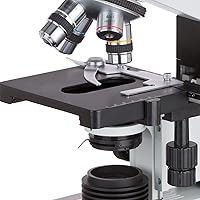
  • Stage: The 3D two-layer mechanical stage features low-position coarse control knobs for precise, repeatable specimen positioning.
  • Light Source: Illumination is provided by a halogen bulb, which delivers warm, consistent light suitable for transmitted-light microscopy of prepared slides.
  • Voltage: The unit is rated at 220V, so buyers in 110V regions such as North America must verify their unit's configuration or use a step-up transformer.
  • Body Material: The chassis and structural components are constructed from metal, contributing to the rigidity needed for stable fine-focus work above 1000X.
  • Dimensions: The assembled footprint measures 20″ in length, 17″ in width, and 10.5″ in height, requiring a dedicated and stable bench surface.
  • Weight: The fully assembled unit weighs 17.75 pounds (8.07 kg), making it a permanent bench instrument rather than a portable one.
  • Color: The body is finished in white, consistent with the standard laboratory aesthetic of the AmScope product line.
  • Adapter Included: A C-mount adapter is included in the box, enabling direct connection to compatible USB cameras and most DSLR setups with an additional T-ring.
  • Brand: The T490B is designed and sold by AmScope, a brand operated by United Scope LLC and focused on microscopy instruments across education and professional tiers.
  • Market Presence: This model has been commercially available since March 2011, giving it over a decade of user feedback and third-party accessory compatibility.
  • User Rating: The T490B carries a 4.4-out-of-5-star rating based on more than 206 verified ratings on Amazon as of the time of review.

Related Reviews

AmScope M158 USB Compound Microscope
74%
88%
Build Quality
79%
Optical Clarity
51%
Camera Quality
91%
Ease of Setup
62%
Software Experience
More
AmScope M150C Student Compound Microscope
82%
89%
Value for Money
85%
Build Quality
88%
Ease of Use
82%
Performance at High Magnification
86%
Image Clarity
More
AmScope B490B Compound Binocular Microscope
85%
94%
Optical Clarity
90%
Build Quality
85%
Ease of Use
92%
Value for Money
93%
Magnification Range
More
Poothoh SMXWJ-02 Trinocular Compound Microscope
73%
83%
Optical Clarity
88%
Build Quality
67%
USB Camera Performance
84%
Mechanical Stage
81%
Illumination
More
AmScope SW-3T24Z Trinocular Stereo Microscope
87%
92%
Magnification Quality
88%
Ergonomics & Comfort
84%
Boom Stand Adjustability
91%
Image Clarity
85%
Build Quality & Durability
More
AmScope M102C Biological Compound Microscope
79%
83%
Optical Image Quality
88%
Build Quality
86%
Value for Money
81%
Ease of Setup
79%
Ease of Use
More
AmScope B100B-MS Compound Binocular Microscope
69%
83%
Build Quality
74%
Optical Clarity
61%
Illumination
69%
Magnification Range
71%
Mechanical Stage
More
SWIFT SW400 Infinity-Corrected Trinocular Compound Microscope
85%
94%
Optical Performance
91%
Build Quality
88%
Ease of Use
89%
Magnification Range
86%
Illumination Quality
More
AmScope SM-3T Trinocular Stereo Zoom Microscope
77%
88%
Optical Clarity
91%
Build Quality
93%
Boom Stand Design
86%
Zoom Range & Versatility
84%
Ergonomics & Comfort
More
AmScope SM-4TPZ Trinocular Stereo Zoom Microscope
76%
88%
Optical Clarity
91%
Build Quality
93%
Boom Stand Versatility
86%
Zoom Range & Flexibility
74%
Trinocular Camera Integration
More

FAQ

This is one of the most important things to check before you order. The AmScope T490B Compound Trinocular Microscope is rated at 220V, which means US buyers need to either confirm that their specific unit has been configured for 110V by the seller, or purchase a step-up transformer separately. Do not assume — contact the seller directly before the unit arrives to avoid a frustrating first experience.
The 23mm photo port accepts a C-mount connection, and a C-mount adapter is included in the box. Most dedicated USB microscopy cameras will attach directly. If you want to use a DSLR, you will need a camera-brand-specific T-ring in addition to the C-mount adapter — that part is not included. Smartphone adapters designed for 23mm ports can also work, though image quality will depend heavily on your phone's camera.

Honest answer: it depends heavily on your technique. At 2000X without oil immersion, most users hit the resolution limit of the optics before the magnification becomes informative — you get a larger but softer image. If you are working with oil immersion slides and the correct technique, the upper magnification settings become genuinely useful. For most practical work, the 400X–1000X range is where this scope performs best.

This is a transmitted-light compound microscope, which means it is designed for thin, translucent specimens — prepared slides, stained tissue, water samples in a slide well, and similar material. It is not suitable for viewing opaque or three-dimensional objects like insects or coins; for that you would need a stereo microscope. Live specimens in a drop of water on a slide work fine, as long as they are thin enough for light to pass through.

Stage smoothness is one of the most consistently praised aspects of the T490B in real user reviews. The two-layer mechanical stage with low-position control knobs gives you precise, incremental movement without the jerky, imprecise feel common on budget models. It makes navigating slides at higher magnifications significantly less frustrating.

Simul-focal means the eyepiece view and the camera port are focused at the same plane simultaneously. On non-simul-focal trinocular scopes, switching between viewing and imaging requires refocusing — which is a real nuisance when you are trying to document what you see in real time. On this AmScope model, what you see through the eyepieces is what the camera captures, without any adjustment needed.

Halogen bulbs do run warmer than LED alternatives, and users have noted this with the T490B during extended sessions. The scope itself stays manageable, but the illuminator housing will be warm to the touch. For sessions over an hour, it is worth giving the bulb a short break. This is a maintenance consideration LED-based competitors have eliminated, so if you plan on very long continuous use, that is worth factoring into your decision.

Yes, and the trinocular head is the most meaningful upgrade you will notice immediately. Beyond that, the all-metal build, the mechanical stage quality, and the Abbe condenser all represent a tangible step up from entry-level scopes. If you have hit the ceiling of your current scope — whether in optics, stability, or documentation capability — the T490B addresses all three in a single move.

Setup is straightforward for anyone with basic familiarity with compound microscopes. The included accessories are well-labeled, and AmScope provides documentation. Aligning the condenser and setting Kohler illumination (if you choose to) takes a little patience the first time but is a one-time process. Users coming from binocular scopes will feel at home quickly; complete beginners may want to watch a setup tutorial before their first session.

The T490B is a substantial instrument — 20″ long, 17″ wide, and nearly 18 pounds. It needs a stable, dedicated surface and is not something you will easily tuck away between uses. If space is genuinely tight, measure your intended surface carefully before ordering. This is a permanent bench instrument, and it works best treated as one.