
Overview
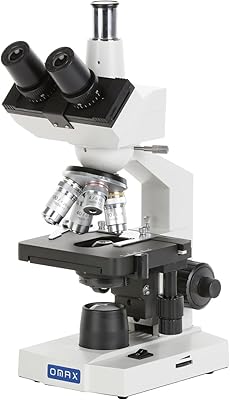
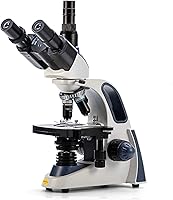
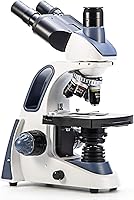
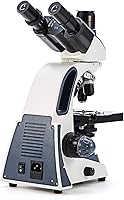
The Swift SW380T Trinocular Compound Microscope sits in an interesting middle ground — serious enough for clinical and academic work, yet priced well below the instruments you'd find in a fully equipped research lab. What immediately sets it apart from entry-level scopes is the trinocular head, which opens the door to camera attachments and livestreaming without replacing the scope entirely. The all-metal construction weighs in at around 9.5 pounds — you notice it the moment you set it on a bench. This thing does not flex or wobble. It's a real instrument at a considered price point, not a glorified toy.
Features & Benefits
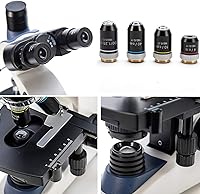
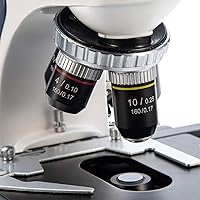
The Siedentopf head is one of the more practical design choices here — it rotates a full 360 degrees and adjusts for different interpupillary distances without losing your focus point, which genuinely matters when multiple users share the same scope. Four DIN achromatic objectives deliver six magnification steps from 40X up to 2500X, though the top end realistically requires oil immersion and a steady hand. The mechanical stage makes systematic slide scanning far easier than nudging specimens manually. Coarse and fine focus controls are notably smooth, something you appreciate immediately on delicate work. LED lighting keeps heat low and brightness consistent throughout long sessions.
Best For
This compound scope works especially well for high school and university students who need more than a basic classroom instrument but cannot justify research-grade pricing. Hobbyists serious about specimen documentation will appreciate the trinocular port — pair it with a compatible USB camera and you can capture images or record sessions without interrupting your workflow. It is also a smart pick for educators running shared lab stations, since the rotating head lets users swap positions quickly without re-focusing. Clinicians or lab techs looking for a dependable backup scope on a budget will find it holds up to regular bench use without fuss.
User Feedback
Buyers consistently rate the SW380T around 4.3 out of 5 stars, and the pattern in reviews is clear: most people are impressed by optical sharpness at lower magnifications and the solid, no-flex metal frame. Setup gets praised regularly — it is not a scope that demands an afternoon of calibration out of the box. The recurring frustrations center on two things: the trinocular port is a feature, not a bundle — no camera is included — and the 2500X setting is genuinely demanding, requiring oil immersion and patience to use well. A handful of buyers note that long-session comfort from the eyepieces is adequate but unremarkable. Most feel the value holds.
Pros
- Optical clarity at low-to-mid magnifications is noticeably sharp and well-corrected for the price tier.
- The Siedentopf head rotates 360 degrees, making it practical for shared lab or classroom use.
- All-metal construction gives this trinocular microscope a solid, wobble-free feel that cheaper plastic scopes cannot match.
- Six distinct magnification levels cover a wide range of specimen work from basic biology to detailed cell examination.
- The mechanical stage allows precise, repeatable slide positioning — a real advantage when scanning systematically.
- Fine focus control is smooth and responsive, which matters considerably when working at higher magnifications.
- LED illumination stays cool during long sessions and provides consistent brightness without the maintenance of halogen bulbs.
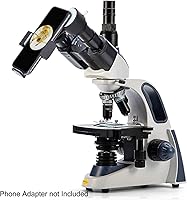
- The trinocular port is ready for a compatible camera attachment, opening up imaging and recording without buying a new scope.
- Wide-field 10X and 25X eyepieces are interchangeable and comfortable for extended viewing sessions.
- Setup out of the box is straightforward, with most buyers reporting it is ready to use with minimal calibration.
Cons
- No camera is included — buyers expecting to shoot images immediately will need to budget separately for a compatible attachment.
- At roughly 9.5 pounds, this compound scope is not easy to move around or store in a small space.
- The 2500X magnification requires oil immersion and careful technique to produce a usable image, which can frustrate less experienced users.
- Eyepiece comfort during very long sessions is functional but not outstanding compared to higher-end oculars.
- The power supply is fixed at 110V AC, limiting plug-and-play use outside North America without an adapter.
- Replacement parts and Swift-specific accessories can be harder to source quickly compared to mainstream lab brands.
- The 30-degree viewing angle, while ergonomic for most, may not suit users who prefer a steeper or flatter eyepiece tilt.
- There is no carrying case or protective cover included, which is a minor but genuine inconvenience for long-term storage.
Ratings
The scores below for the Swift SW380T Trinocular Compound Microscope were generated by our AI system after analyzing verified buyer reviews from multiple global platforms, with spam, incentivized, and bot-driven submissions actively filtered out. Both the strengths that drive repeat recommendations and the frustrations that generate one- and two-star responses are reflected honestly in each category. Where this compound scope consistently impresses and where it genuinely falls short are treated with equal weight.
Optical Clarity
Build Quality
Focusing Mechanism
Trinocular Head & Camera Compatibility
Mechanical Stage
Eyepiece Comfort
LED Illumination
Ease of Setup
Value for Money
Shared-Use Flexibility
Objective Turret
Magnification Range
Durability Over Time
Suitable for:
The Swift SW380T Trinocular Compound Microscope is a strong match for anyone who has outgrown beginner scopes but is not ready to spend several thousand dollars on full lab-grade equipment. University and advanced high school students will find it reliable enough for coursework that demands real optical performance across a range of magnifications. Hobbyists who want to document their work — whether that means photographing specimens or streaming sessions online — will appreciate the trinocular port, which makes attaching a compatible camera straightforward without needing a second instrument. The Siedentopf head and mechanical stage are genuine quality-of-life features for anyone sharing the scope with lab partners or classmates, since neither user has to fight to re-establish a comfortable viewing position or reposition slides from scratch. Clinicians or technicians who need a dependable secondary bench scope without a large capital outlay will also find this compound scope punches above its price class in day-to-day use.
Not suitable for:
The Swift SW380T Trinocular Compound Microscope is not the right tool for professionals who depend on optics for diagnostic or publication-quality imaging day in and day out — the glass and mechanics are good for the price, but they are not at the level of Zeiss, Leica, or Nikon research systems. Complete beginners who just want to look at pond water occasionally will likely find this scope more instrument than they need, and simpler, lighter options exist at a lower price. Anyone buying with the expectation of immediate camera use will be caught off guard — the trinocular port is a hardware feature, not a bundle, and a compatible microscope camera must be sourced and purchased separately. The 2500X top magnification sounds impressive on paper, but reaching usable image quality at that level requires oil immersion technique, the right slides, and some practice — casual users may find it frustrating rather than useful. If portability or storage space is a real constraint, the nearly 9.5-pound metal frame is not something you casually move around.
Specifications
- Magnification Range: Offers six magnification levels spanning 40X, 100X, 250X, 400X, 1000X, and 2500X via four DIN achromatic objectives.
- Objectives: Four DIN achromatic objectives are mounted on a revolving turret for quick, click-stop magnification changes.
- Head Type: Siedentopf trinocular head rotates a full 360 degrees and includes a third port for optional camera attachment.
- Eyepieces: Includes interchangeable wide-field 10X and 25X glass eyepieces with a fixed 30-degree ergonomic viewing angle.
- Interpupillary Adjust: The eyepiece spacing is adjustable for different interpupillary distances without disrupting the current focus point.
- Focusing System: Dual coarse and ultra-fine focus controls allow precise specimen adjustment suitable for delicate high-magnification work.
- Stage: Mechanical stage with X-Y axis control enables repeatable, systematic slide scanning with consistent positional accuracy.
- Illumination: Built-in LED illumination system provides cool, consistent lighting throughout extended sessions without the heat of halogen bulbs.
- Power Supply: Operates on 110V AC power; not designed for plug-and-play use in regions with different voltage standards without an adapter.
- Body Material: Full metal construction throughout the frame and head assembly, contributing to overall rigidity and long-term durability.
- Weight: Weighs 4.3 kg (9.48 lbs), which reflects the all-metal build and makes it best suited as a permanent bench instrument.
- Dimensions: Overall footprint measures 13.39″L x 9.45″W x 17.72″H, requiring a dedicated and stable workspace surface.
- Camera Compatibility: The trinocular port accepts compatible third-party microscope cameras for imaging, video recording, and livestreaming (camera sold separately).
- Viewing Angle: Eyepieces are fixed at a 30-degree tilt to reduce neck and shoulder strain during prolonged observation sessions.
- Manufacturer: Manufactured by NJEDU and sold under the Swift brand, with the model designated SW380T.
- Availability: Has been available since January 2019 and is confirmed as not discontinued by the manufacturer as of current listings.
Related Reviews
SWIFT SW400 Trinocular Compound Microscope
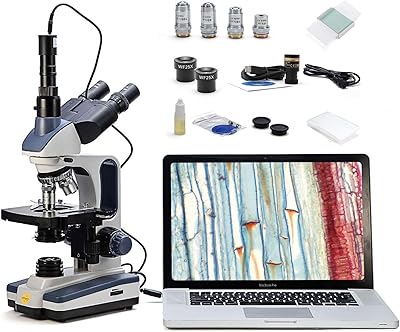
SWIFT SW350T Trinocular Compound Microscope
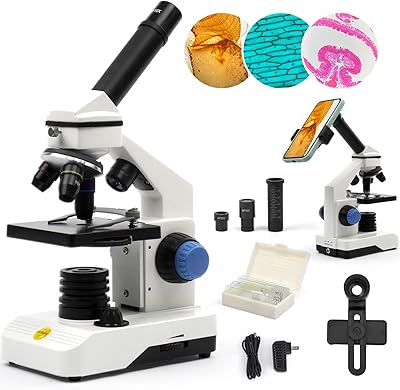
SWIFT SS121 Compound Monocular Microscope Kit
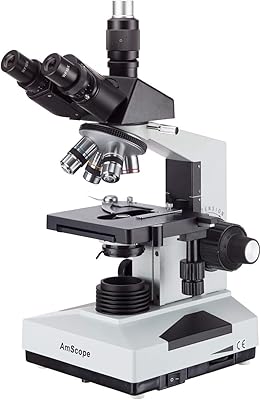
AmScope T490B Compound Trinocular Microscope
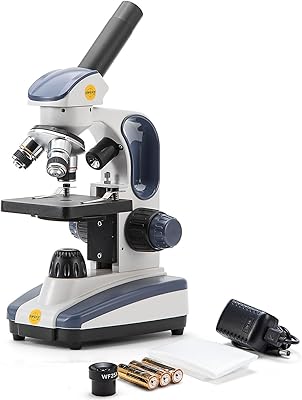
SWIFT SW200DL Compound Monocular Microscope
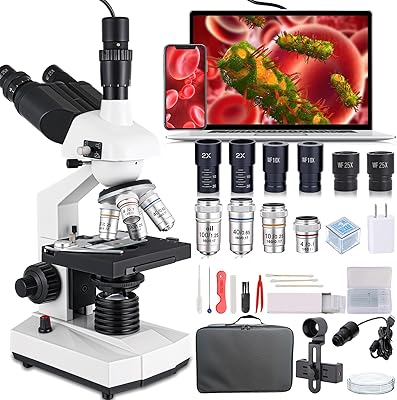
Poothoh SMXWJ-02 Trinocular Compound Microscope
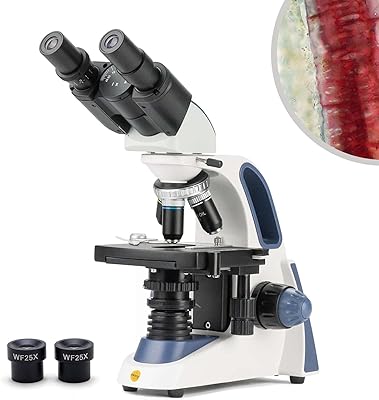
Swift SW380B Binocular Compound Microscope
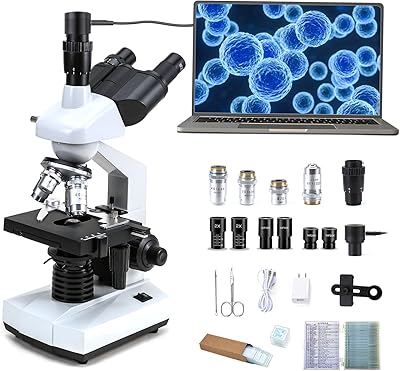
Crspexil 2024 Trinocular Compound Microscope
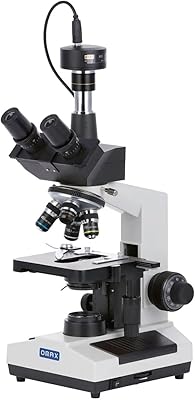
OMAX M837ZL-C100U Trinocular Compound LED Microscope