Overview

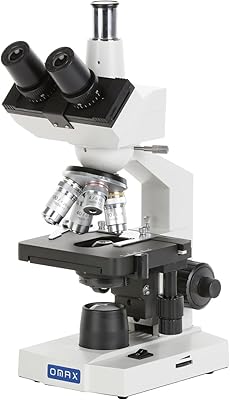
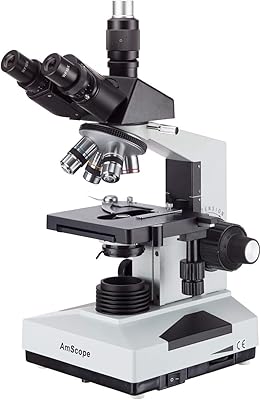
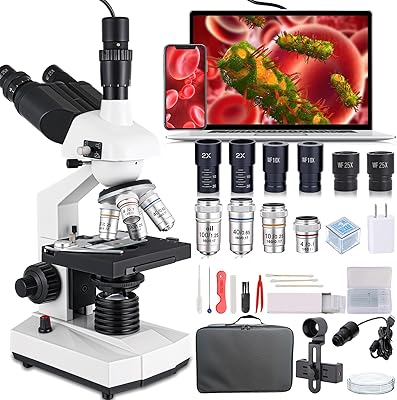
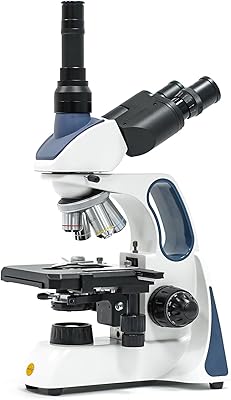
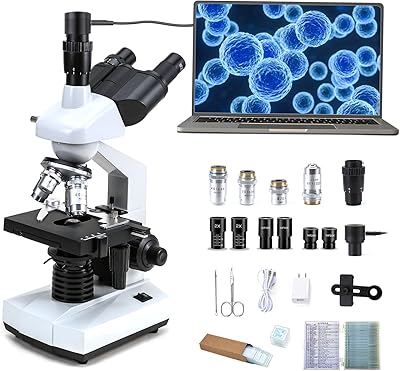
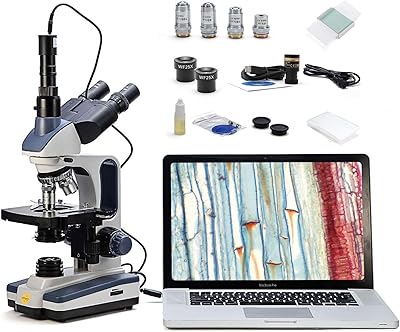
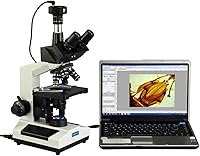
The OMAX M837ZL-C100U Trinocular Compound LED Microscope sits firmly in the mid-to-upper tier of lab-grade compound scopes — serious enough for professional use, yet accessible enough for advanced hobbyists who want real optical performance without institutional pricing. The trinocular head is the central selling point: it lets you observe through the eyepieces while the camera captures simultaneously, so you never have to choose between viewing and documenting. LED illumination runs cooler and lasts far longer than halogen, which matters during extended lab sessions. The all-metal frame and optical glass lenses signal durability, and the bundled 10MP USB camera removes a purchase most buyers would otherwise need to make separately.
Features & Benefits

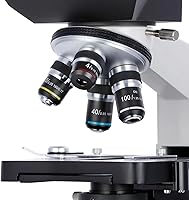
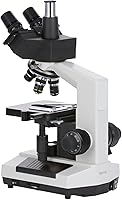
The achromatic objective lenses cover 40x up to 2500x magnification — enough range to examine prepared tissue slides at moderate power, identify bacteria at higher settings, or observe live aquatic specimens at the lower end. In practice, that top-end magnification is only as useful as your slide preparation and lighting allow, so don't treat 2500x as a guaranteed daily working range. The 3D mechanical stage with coaxial controls is a genuine workday asset: repositioning specimens is smooth and repeatable, which matters enormously during lengthy analysis sessions. The 45-degree inclined head reduces neck strain noticeably, and the all-metal construction keeps optical alignment stable even after years of regular use.

Best For

This lab trinocular microscope is well-suited to settings where imaging and documentation are part of the daily workflow. University and college labs benefit from the camera integration for capturing and projecting live images during lectures or storing records of student work. Clinicians and researchers running routine slide analysis will appreciate the precise stage control and ergonomic head angle during long sessions. Educators teaching remotely can connect the USB camera to a display or record sessions directly. Advanced hobbyists — particularly those working in entomology, pathology, or microbiology — who find consumer-grade scopes limiting will find this compound microscope a meaningful upgrade without requiring a full institutional budget.

User Feedback

With a 3.8 out of 5 rating across 89 reviewers, the OMAX trinocular scope earns genuine respect without inspiring universal enthusiasm. Buyers consistently praise optical image clarity and the build quality for the price, with many noting the bundled camera as a strong value addition. The friction shows up elsewhere: USB camera software compatibility is a recurring complaint, particularly on macOS, where drivers may require workarounds or third-party applications. Some users report inconsistencies in the focus mechanism feel between units, suggesting mild quality-control variation. Professionals generally rate it higher than casual users, who occasionally find the initial setup steeper than expected. Warranty support feedback is sparse but notably mixed.

Pros

  • Optical clarity from the achromatic lenses is consistently praised across a wide range of specimen types.
  • The bundled 10MP USB camera eliminates an expensive separate purchase most buyers would otherwise need.
  • All-metal construction keeps the frame rigid and optical alignment stable through regular, long-term use.
  • The 3D mechanical stage with coaxial controls makes precise specimen repositioning noticeably faster and less frustrating.
  • LED illumination runs cooler than halogen alternatives and lasts far longer between replacements.
  • The 45-degree inclined trinocular head reduces neck and shoulder strain during extended viewing sessions.
  • A 40x to 2500x magnification range covers a broad spectrum of practical lab and hobbyist applications.
  • Professionals working in structured lab environments rate this trinocular scope highly for its consistency and build quality.
  • The trinocular head allows simultaneous eyepiece viewing and camera capture without switching between modes.

Cons

  • USB camera software compatibility is a known problem, especially on macOS, where drivers may not work out of the box.
  • Some buyers report noticeable unit-to-unit variation in focus mechanism feel, pointing to mild quality-control inconsistency.
  • Practical resolution at the top magnification range depends heavily on slide preparation quality, which the listing does not emphasize.
  • Initial setup and calibration take more time and know-how than many buyers anticipate from unboxing.
  • Warranty and after-sale customer support experiences are mixed and inconsistently reported across user reviews.
  • At its size and weight, this lab trinocular microscope is not portable and requires a dedicated, stable workspace.
  • Casual or first-time buyers may find the overall complexity and price point excessive for occasional use.
  • The 110V voltage requirement limits international usability without a step-down converter.

Ratings

Our AI-generated scores for the OMAX M837ZL-C100U Trinocular Compound LED Microscope were produced by analyzing verified global user reviews, with spam, bot submissions, and incentivized feedback actively filtered out before scoring. The results reflect a genuinely mixed picture — real strengths in optics and build quality sit alongside documented frustrations with software and quality control consistency. Both sides of the ownership experience are represented here without softening.
Optical Clarity
83%
Across professional and hobbyist reviewers alike, the achromatic lenses draw consistent praise for producing sharp, contrast-rich images across the mid-magnification range — particularly on prepared tissue slides and stained specimens. Users working in histology and microbiology report that image quality at 100x to 400x feels genuinely lab-grade rather than consumer-grade.
At the extreme upper end of the magnification range, image sharpness becomes heavily dependent on slide preparation quality and precise illumination adjustment, which frustrates buyers expecting clean results at 2000x or above without extra effort. A handful of reviewers noted minor edge softness even at moderate magnifications, suggesting some unit-to-unit lens variation.
Build Quality
81%
19%
The all-metal frame makes an immediate impression — this compound microscope feels substantial and stable on a lab bench in a way that plastic-body alternatives simply do not. Long-term users report that optical alignment stays consistent over months of regular use, which is exactly what professionals need from a scope that sees daily handling.
Despite the solid frame, some buyers have reported inconsistencies in the machining of smaller mechanical components, particularly around the coarse focus knob, which can feel looser or stiffer than expected depending on the individual unit received. This variability is a recurring enough theme to suggest quality control is not perfectly uniform across production runs.
Camera Performance
67%
33%
The bundled 10MP USB camera captures detailed still images that work well for documentation, slide archiving, and sharing with colleagues — users teaching biology or running small research labs find it genuinely useful for projecting live images without sourcing a separate camera. Image resolution at moderate magnifications is considered good for the price tier.
Software compatibility is a significant and well-documented problem, particularly for macOS users who often find the bundled drivers fail to install correctly or produce unstable connections. Even on Windows, some reviewers describe the imaging software interface as clunky and outdated, requiring third-party applications to unlock the camera's full usability.
Stage Precision
78%
22%
The 3D mechanical stage with coaxial X-Y controls is one of the more appreciated aspects of this lab trinocular microscope among professional users — repositioning specimens during long analysis sessions is smooth and repeatable in a way that single-axis stages cannot match. Researchers doing systematic slide scanning particularly value how consistently they can return to a marked position.
A subset of buyers reports that stage tension feels slightly off out of the box, with some units exhibiting minor drift when the coaxial controls are released. While not universal, this issue appears often enough in reviews to suggest the stage mechanism could benefit from tighter manufacturing tolerances.
Ergonomics
76%
24%
The 45-degree inclined trinocular head is a practical comfort feature that pays dividends during sessions lasting more than an hour — users who have switched from straight-tube scopes consistently note reduced neck and upper back strain. This makes the OMAX trinocular scope a noticeably better choice for educators and researchers who spend extended time at the eyepiece.
The interpupillary distance adjustment on the binocular portion has a limited range that does not accommodate all users equally, and a few reviewers with wider or narrower than average eye spacing found the eyepiece positioning uncomfortable. The eyepiece diopter adjustment, while present, was described by some as imprecise to dial in.
LED Illumination
82%
18%
The LED light source delivers consistent, cool-temperature illumination that handles extended sessions without generating the heat buildup associated with older halogen systems — an important practical advantage when working with heat-sensitive live specimens. Brightness adjustment is smooth, and the light color temperature suits standard brightfield microscopy well.
A small number of users noted that the LED intensity at its lowest setting is still slightly bright for certain low-contrast specimens, and fine-tuning the diaphragm to compensate adds an extra step to the workflow. There are also isolated reports of LED units showing early dimming, though these represent a minority of feedback.
Value for Money
72%
28%
For buyers who need both a capable compound scope and an integrated camera solution, the bundled 10MP USB camera meaningfully improves the overall value calculation — purchasing a comparable camera separately would add considerable cost. Professional users who fully utilize the imaging and stage features generally feel the price reflects fair market positioning for the feature set.
Buyers who encounter software compatibility issues or focus mechanism inconsistencies quickly feel the value equation shift, since troubleshooting time and potential repair costs were not part of their expectation at this price point. Casual users who do not need camera documentation frequently question whether the premium over a solid binocular scope was justified for their actual use case.
Setup & Ease of Use
61%
39%
Users with prior compound microscope experience report that physical assembly is logical and well-documented, with the mechanical components coming pre-aligned well enough to begin viewing reasonably quickly. The coaxial focus controls are intuitive for anyone familiar with lab-grade equipment.
First-time buyers or those upgrading from basic consumer scopes consistently describe the initial setup — particularly camera driver installation and software configuration — as a frustrating experience that is poorly supported by the included documentation. macOS users face an additional layer of difficulty that the manual does not acknowledge or address.
Software & Connectivity
53%
47%
When the USB camera software functions correctly on a compatible Windows system, it covers core needs adequately — image capture, basic measurement overlays, and live preview work as intended. Some users have successfully supplemented it with third-party imaging software for a significantly better experience.
The bundled software is widely regarded as dated and limited, and macOS compatibility is effectively absent without manual workarounds. Several reviewers describe spending hours troubleshooting driver conflicts that were never fully resolved, which is a serious usability failure for a camera that is central to the product's value proposition.
Focus Mechanism
69%
31%
The dual coarse and fine focus controls offer a reasonably precise focusing experience, and on well-calibrated units the fine focus in particular allows users to step through focal planes with good control — useful when examining thicker specimens or working at higher magnifications.
Unit-to-unit consistency in focus knob tension is a recurring complaint, with some buyers receiving scopes where the coarse focus moves too freely and overshoots, while others report stiffness that makes fine adjustments harder than they should be. This variability points to inconsistency in the factory calibration process.
Durability & Longevity
77%
23%
The metal frame and optical glass components are designed for a working lifespan well beyond what consumer-grade plastic microscopes can offer, and long-term users — particularly in university settings — report the scope holding up reliably through regular use over multiple years. The LED light source further removes a historically common maintenance point.
Durability of the mechanical accessories, particularly the stage rack and focus knob internals, is less certain over the long term, with a handful of multi-year owners reporting gradual loosening or increased backlash in the stage mechanism. Replacement parts availability through OMAX has not been consistently praised.
Customer Support
49%
51%
Some buyers report satisfactory resolution of warranty claims and responsive email communication with OMAX support, particularly for clear manufacturing defects reported shortly after delivery. The brand has been in the market long enough to have an established support infrastructure.
The overall picture from reviewer feedback on after-sale support is genuinely mixed and leans negative — response times are inconsistent, and several users describe difficulty obtaining replacement parts or clear guidance for camera software issues. This is a meaningful risk factor for professional buyers who depend on uptime.
Packaging & Delivery Condition
74%
26%
The majority of buyers report the scope arriving well-packaged and intact, with protective foam inserts that handle standard shipping conditions adequately. Most units arrive with optical surfaces clean and free of dust or debris, which is a baseline expectation that this model generally meets.
A non-trivial number of reviews mention receiving units with minor cosmetic damage or components that appeared to have shifted during transit, raising questions about whether packaging is consistently sufficient for a relatively heavy and precision-sensitive instrument. A few buyers reported needing to recollimate or readjust components upon arrival.

Suitable for:

The OMAX M837ZL-C100U Trinocular Compound LED Microscope is built for people who need a capable, camera-ready compound scope and use it regularly enough to justify the investment. University and college instructors will find the USB camera integration genuinely practical — it makes projecting live specimen feeds or capturing images for course materials straightforward. Researchers and clinicians who run routine slide analysis benefit from the 3D mechanical stage, which allows precise, repeatable specimen positioning without the frustration of drifting or imprecise manual repositioning. Advanced hobbyists in fields like entomology, histology, or microbiology who have outgrown entry-level scopes will recognize immediately that the all-metal frame and optical glass lenses represent a meaningful step up in long-term reliability. Educators delivering remote or hybrid instruction can use the 10MP camera output to record sessions or stream live microscopy without sourcing separate equipment.
Not suitable for:

Buyers expecting plug-and-play camera software across all operating systems should approach this compound microscope with caution — macOS users in particular have reported driver compatibility issues that may require workarounds or third-party software to resolve. If your primary need is purely observational and camera documentation is an afterthought, the price point may be harder to justify compared to binocular alternatives at a lower cost. This scope also is not the right fit for casual or first-time microscope users who want a simple setup with minimal configuration; the learning curve is real, and initial calibration takes time and patience. Buyers who require the absolute highest resolution for demanding research-grade imaging at extreme magnifications may find the practical ceiling of this instrument falls short of dedicated research microscopes in higher price brackets. Finally, anyone anticipating strong after-sale support should research OMAX customer service carefully before committing, as warranty and support experiences in user reviews are inconsistently reported.

Specifications

  • Brand: Manufactured by OMAX, a brand focused on laboratory-grade optical instruments.
  • Model Number: The exact model designation is M837ZL-C100U, used for identification and parts sourcing.
  • Magnification Range: Supports 40x to 2500x magnification via a set of achromatic objective lenses.
  • Objective Lenses: Achromatic objectives are included, designed to reduce chromatic and spherical aberration for cleaner imaging across the magnification range.
  • Head Type: Trinocular head inclined at 45 degrees, allowing simultaneous eyepiece observation and camera capture without switching modes.
  • Camera: Includes a bundled 10MP USB digital camera for still image capture, video recording, and live display output to a connected computer.
  • Stage: Features a 3D mechanical stage with coaxial controls for smooth, repeatable X-Y specimen movement during analysis.
  • Light Source: LED illumination system provides consistent, cool-temperature lighting with a significantly longer operational lifespan than halogen alternatives.
  • Frame Material: The main body is constructed from metal, contributing to structural rigidity and long-term optical alignment stability.
  • Optical Elements: Lenses and optical components are made from optical glass, not plastic, which supports better light transmission and image fidelity.
  • Dimensions: The unit measures 7.87 x 10.24 x 16.14 inches, requiring a dedicated, stable bench or lab surface.
  • Voltage: Rated for 110V operation, making it suitable for standard North American outlets without a converter.
  • Color: Available in white with a standard professional lab aesthetic consistent with the OMAX product line.
  • Connectivity: The 10MP camera connects to a computer via USB, enabling image capture and live preview through compatible imaging software.
  • View Angle: The real angle of view is listed at 45 degrees, reflecting the inclined trinocular head design for comfortable extended use.
  • First Available: This model has been available on the market since January 2015, indicating an established product with a known user track record.
  • Category Rank: Holds a rank of #11 in Lab Compound Trinocular Microscopes on Amazon, reflecting consistent mid-tier category presence.
  • Discontinuation Status: The manufacturer has confirmed this model is not discontinued and remains in active production as of the latest available data.

Related Reviews

OMAX M83ES 40X-2000X Lab Trinocular Biological Compound LED Microscope
84%
91%
Magnification Performance
89%
LED Illumination Quality
87%
Build Quality & Durability
93%
Ease of Setup
85%
Focus Mechanism
More
OMAX MD82ES10 40X-2000X Digital Compound Microscope
78%
83%
Optical Clarity
67%
Built-in Camera
88%
Mechanical Stage
86%
Illumination Quality
79%
Build Quality
More
OMAX M82E Binocular Compound Lab Microscope
82%
88%
Optical Clarity
91%
Build Quality & Durability
86%
Ease of Setup
83%
Magnification Range & Versatility
87%
Illumination Quality
More
AmScope T490B Compound Trinocular Microscope
74%
88%
Optical Clarity
91%
Trinocular Head
78%
Camera Integration
86%
Mechanical Stage
89%
Build Quality
More
Poothoh SMXWJ-02 Trinocular Compound Microscope
73%
83%
Optical Clarity
88%
Build Quality
67%
USB Camera Performance
84%
Mechanical Stage
81%
Illumination
More
SWIFT SW400 Trinocular Compound Microscope
78%
91%
Optical Image Quality
89%
Focusing System
88%
Build Quality
86%
Objective Lenses
84%
Ergonomics & Comfort
More
SWIFT SW350T Trinocular Compound Microscope
79%
91%
Optical Clarity
88%
Build Quality
54%
Camera Quality
57%
Software Usability
86%
Ergonomics
More
Crspexil 2024 Trinocular Compound Microscope
71%
78%
Optical Clarity
74%
Camera Performance
76%
Build Quality
82%
Value for Money
71%
Ease of Setup
More
Vabiooth Darkfield Brightfield Trinocular Compound Microscope
76%
83%
Optical Clarity
74%
Darkfield Performance
71%
Digital Imaging
82%
LCD Monitor
79%
Value for Money
More
AmScope SE306R-P-LED Stereo Microscope
79%
83%
Optical Clarity
88%
Build Quality
79%
Illumination Quality
54%
Magnification Range
81%
Ergonomics & Comfort
More

FAQ

This is one of the more common frustrations buyers run into. The bundled camera software is primarily designed for Windows, and macOS users have reported driver compatibility issues that are not always easy to resolve. That said, some Mac users have had success using third-party imaging applications like AmScope or even open-source options. If you are on macOS, be prepared to do a bit of troubleshooting before the camera is fully functional.

Realistically, the practical upper limit most users work at comfortably is somewhere in the 400x to 1000x range. Getting clean, usable images at 2500x requires excellent slide preparation, proper immersion oil technique, and precise lighting — conditions that not every setup will meet consistently. Think of 2500x as the ceiling, not the everyday working range.

The magnification range makes it well-suited for prepared slides of tissue sections, blood smears, bacteria, and protozoa. At lower magnifications you can observe larger live specimens like algae or small aquatic invertebrates. It covers the core needs of biology, histology, microbiology, and basic pathology work effectively.

Yes, that is exactly what the trinocular head is designed for. The third optical port feeds the camera independently, so you can observe through the eyepieces while the camera simultaneously captures or streams the image. You do not need to switch between viewing modes.

The LED runs noticeably cooler, which matters when you are working with heat-sensitive specimens or simply working for extended periods. It also produces a more consistent color temperature and will not need bulb replacements the way halogen systems do. Most users who switch from halogen find the LED illumination adjustment takes a brief period to get used to, but the consistency is generally seen as an improvement.

The OMAX M837ZL-C100U Trinocular Compound LED Microscope works well in a dedicated home lab, provided you have a stable, vibration-free surface and enough desk space to accommodate its footprint. Advanced hobbyists in biology or entomology regularly use it outside of institutional settings. It is not a casual tabletop scope, though — it expects a proper workspace and an operator who understands basic compound microscopy.
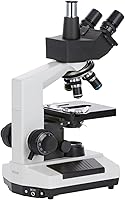
The coaxial controls on the 3D mechanical stage give you reasonably precise X-Y movement, and most users report it holds position well during active viewing. Some reviewers have noted that stage tension can feel slightly inconsistent between individual units, which is worth keeping in mind. For the majority of routine slide analysis work, the stage performs reliably.

OMAX typically bundles its own imaging software with the camera, and it covers basic functions like image capture, video recording, and measurement tools. On Windows it generally installs without issues. On macOS or Linux you will likely need to source compatible third-party software independently, as the bundled application may not support those platforms fully.

The all-metal frame adds meaningful heft, which actually works in your favor here — the scope does not shift or wobble when you adjust the coarse or fine focus knobs. Users who have switched from lighter plastic-body scopes often comment on how much more stable the focusing experience feels with this compound microscope.

OMAX offers a manufacturer warranty on their scopes, though the specific terms should be confirmed at time of purchase as they can vary. User feedback on after-sale support is genuinely mixed — some buyers report smooth resolution of issues, while others describe difficulty getting timely responses. It is worth keeping your purchase documentation organized and reaching out promptly if any defects appear early, rather than waiting.