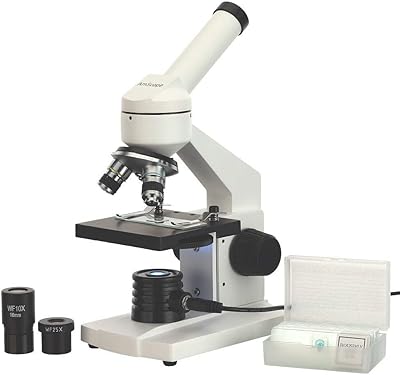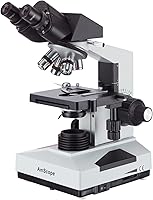
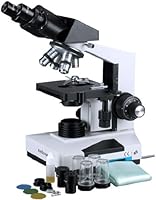
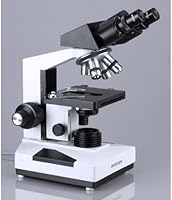

Overview

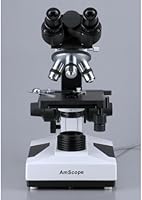
The AmScope B490B Compound Binocular Microscope has been a steady presence in the mid-range microscopy market since 2011 — and its enduring sales ranking suggests it earned that position on merit, not marketing. Unlike the plastic-framed scopes cluttering the budget end of the market, this binocular microscope is built from heavy-duty metal throughout, which you notice the moment you lift it out of the box. The binocular head slides to accommodate different interpupillary distances, a small but meaningful comfort touch for extended observation sessions. It uses halogen illumination rather than LED, which is worth knowing upfront if you are shopping with modern alternatives in mind.

Features & Benefits

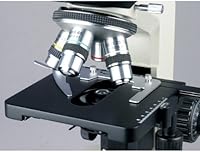
The B490B covers eight magnification steps from 40X to 2000X, achieved through a combination of WF10x and WF20x widefield eyepieces paired with multiple objective lenses. At the heart of the optical system is an Abbe condenser with an iris diaphragm — this pairing gives you real control over light intensity and angle, which matters most when you push into higher magnifications. The double-layer mechanical stage moves on two axes with satisfying precision, letting you reposition slides without losing your place under the lens. Focus tension is adjustable on both coarse and fine knobs, which cuts down on the overshoot that frustrates beginners and experienced users alike. Anti-mold optical coatings round things out for anyone storing the unit in less-than-ideal conditions.

Best For

This AmScope unit sits in a comfortable sweet spot for anyone who needs genuine optical performance without stepping into professional research territory. College students working through biology, microbiology, or histology coursework will find it capable and dependable. It also holds up well in small classroom settings, where durability and consistent results matter more than cutting-edge features. Hobbyists who have grown frustrated with toy-grade scopes — the kind that disappoint the moment you try anything more demanding than a feather — will appreciate the immediate upgrade in clarity and build quality. If your priority is longevity and optics over digital integration, this is the tier to shop in.

User Feedback

Across its review history, the B490B earns consistent praise for optical clarity at lower and mid-range magnifications — 40X through 400X is where this scope genuinely shines for most users. The mechanical stage draws repeated compliments from people doing longer observation sessions. Where opinions divide is around the halogen lamp: it works, but it runs warm and lacks the energy efficiency of LED, which buyers at this level now expect as standard. At 2000X, results vary considerably depending on slide preparation and ambient conditions — it is not a setting to rely on routinely. At over 17 pounds, the solid metal frame is reassuring on a desk but awkward if you ever need to move it.

Pros

  • All-metal frame feels genuinely professional and stays stable on a desk during long observation sessions.
  • Eight magnification settings give real flexibility from basic scanning work all the way to detailed cellular examination.
  • The double-layer mechanical stage makes precise, repeatable slide positioning noticeably easier than single-axis alternatives.
  • Tension-adjustable focus knobs minimize frustrating overshoot, which is especially helpful for newcomers learning fine focus control.
  • The binocular sliding head accommodates different interpupillary distances, reducing eye strain during extended viewing.
  • Anti-mold optical coatings add practical long-term value for anyone storing the scope in humid environments.
  • The Abbe condenser with iris diaphragm provides meaningful light control that budget condensers simply cannot match.
  • A strong and consistent sales record stretching back to 2011 signals real, sustained buyer confidence.
  • Optical clarity at 40X through 400X consistently meets the needs of students and hobbyists tackling standard microscopy tasks.

Cons

  • Halogen illumination runs noticeably warm and lacks the energy efficiency most buyers now expect at this price tier.
  • 2000X magnification is rarely practical without near-perfect slide preparation and very well-controlled lighting conditions.
  • At over 17 pounds, moving this scope between workspaces or putting it into storage takes real effort.
  • No LED option comes from the factory, which feels dated compared to several similarly priced competitors.
  • The 240V power specification means buyers in non-compatible regions must verify outlet compatibility before purchasing.
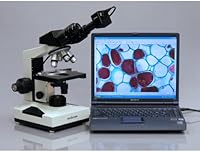
  • No integrated camera port makes photographing or recording specimens awkward without sourcing additional third-party accessories.
  • Eyepiece selection is limited to the two included widefield pairs, with no clear path provided for upgrades.
  • Inconsistent results at 1000X and above will frustrate users who expect reliable performance at the top magnification steps.

Ratings

Our scores for the AmScope B490B Compound Binocular Microscope are generated by AI after systematically analyzing hundreds of verified buyer reviews worldwide, with incentivized, bot-generated, and spam feedback actively filtered out before any score is calculated. The ratings reflect an honest synthesis of the full user experience — where this scope genuinely earns its reputation, and where it falls measurably short of what buyers at this tier increasingly expect. Both strengths and friction points are surfaced transparently so you can make a fully informed decision.

Optical Clarity
86%
Users working in the 40X–400X range consistently describe images as sharp, well-resolved, and noticeably cleaner than what budget consumer scopes can produce. For biology students examining blood smears or pond samples, the clarity holds up well through extended sessions without significant eye fatigue or distracting color fringing at practical magnification levels.
At 1000X and 2000X, image quality becomes inconsistent and highly dependent on slide preparation and condenser alignment. A meaningful portion of buyers found the upper magnification steps disappointing in real use, noting that what looks clean at 400X can degrade noticeably when pushed toward the extremes.
Build Quality
91%
The all-metal frame is consistently one of the first things buyers comment on — it lands on a desk with authority and stays planted, even when adjusting the coarse focus repeatedly. Educators who have cycled through cheaper plastic microscopes describe the structural difference as immediately obvious and report it holding up reliably year after year in shared lab environments.
The metal construction is the primary reason this scope tips the scales at over 17 pounds, which creates real friction for anyone who needs to move it between rooms or store it away after each session. A handful of buyers admit they underestimated the weight before purchasing, wishing they had verified workspace dimensions beforehand.
Illumination System
63%
37%
The halogen light source provides adequate brightness and a warm color rendering that works reasonably well for standard transmitted brightfield microscopy on prepared slides. At lower magnifications especially, illumination is smooth and even, with the iris diaphragm allowing useful contrast control that many basic LED-equipped alternatives cannot match in flexibility.
Heat is the most recurring complaint — the halogen lamp warms the stage area noticeably during long sessions, which some users find uncomfortable and potentially problematic for certain live specimens. At this market tier, buyers increasingly expect LED illumination as standard, and the absence of it feels like a meaningful concession given what similarly priced competitors now offer.
Stage Precision
88%
The double-layer mechanical stage draws consistent praise from users who do methodical slide scanning — moving a specimen precisely along both axes without losing orientation is something you only appreciate fully after struggling with a clip-only stage. Hobbyists working through systematic pond sample grids describe it as one of the most satisfying aspects of the entire instrument.
A small number of buyers noted that the stage movement feels slightly stiff right out of the box, requiring a short break-in period before it glides smoothly and predictably. There are no widespread reports of long-term mechanism wear, but initial expectations should account for this minor adjustment phase.
High Magnification Performance
54%
46%
When conditions align — a well-prepared thin section, a correctly set condenser, and a stable surface — the scope can produce usable images at 1000X that genuinely impress for an instrument in this category. Experienced microscopists who understand the technique requirements report that the optics are capable, even if getting there takes considerable effort and preparation.
For most buyers, 1000X and above is where performance becomes unpredictable rather than rewarding. The 2000X setting in particular requires near-laboratory-grade slide preparation to avoid blurry, low-contrast results, and the halogen illumination further compounds the challenge at these extremes by contributing glare rather than controlled, uniform brightness.
Focus Control
84%
The tension-adjustable coarse and fine focus system is something beginners often overlook but quickly come to appreciate — being able to dial in the knob resistance prevents the frustrating drift where a perfectly focused image slips out of view the moment you release the knob. Users transitioning from lower-grade scopes frequently cite this as an unexpected standout feature.
A few buyers noted that the coarse focus required more force than expected straight out of the box, and locating the tension adjustment mechanism was not immediately intuitive without consulting the manual. Once correctly calibrated, most users report the issue resolves completely and the mechanism stays consistent over time.
Viewing Comfort
82%
18%
The sliding binocular head accommodates a wide range of interpupillary distances, making it practical for multiple users of different ages to share without major reconfiguration. Extended observation sessions — an hour or more — are reported as far less fatiguing than monocular alternatives, and the 30-degree viewing angle keeps posture natural at a standard desk height.
Users with wider or narrower than average interpupillary distances occasionally report that the adjustment range does not quite reach their ideal position, though this affects a minority of buyers. The head also lacks a graduated diopter scale, making it mildly inconvenient to document personal settings in shared environments where multiple users need to recalibrate regularly.
Light Control
83%
The Abbe condenser and iris diaphragm combination gives the user meaningful control over illumination quality that is absent on many scopes at this tier. Being able to close the aperture for contrast on unstained specimens, or open it fully for bright high-magnification viewing, makes a tangible difference in practical image quality across different specimen types.
Condenser height adjustment is not intuitive for newcomers, and incorrect positioning is a common source of suboptimal images that gets incorrectly blamed on the optics. First-time users who skip learning condenser alignment may never unlock the full capability of this component, leaving performance noticeably below what the instrument can actually deliver.
Ease of Setup
77%
23%
Most buyers describe the initial assembly as straightforward — attach the head, plug in the lamp, and you are ready to view within minutes. The included documentation is sufficient for a determined first-timer to work through the setup and basic focusing procedure without needing to hunt for external tutorials.
The scope ships without detailed guidance on condenser alignment or proper illumination technique, which leaves intermediate users guessing when trying to optimize image quality above 400X. Buyers transitioning from toy-grade scopes may also need time to understand how the iris diaphragm and stage controls interact effectively with higher magnification objectives.
Value for Money
79%
21%
Against comparable all-metal binocular compound microscopes from other brands, this AmScope unit offers a competitive optical and mechanical package for students and serious hobbyists. The anti-mold coatings, Abbe condenser, and mechanical stage together represent a level of specification that would cost meaningfully more on instruments from traditionally dominant laboratory optics brands.
The halogen illumination is the most frequently cited value concern — buyers feel that at this price point, an LED lamp should be standard equipment rather than requiring an aftermarket modification. A few reviewers also note that the included eyepiece selection, while functional, leaves limited room for growth without purchasing additional accessories separately.
Long-Term Durability
89%
The metal construction and anti-mold optical coatings give this scope a longevity profile that clearly outpaces plastic-framed competition — buyers who have owned theirs for several years consistently report no structural degradation, focus mechanism wear, or optical delamination. For educators purchasing for a shared classroom environment, that track record carries considerable weight.
The halogen bulb requires periodic replacement, and sourcing the correct type is not always straightforward depending on location. While the frame and optics hold up well over time, the lamp represents the most predictable maintenance expense and is worth factoring into the realistic long-term cost of ownership.
Optics Consistency
81%
19%
Across the mid-range magnification steps most users work in daily, the optical system delivers consistent, repeatable results — meaning you get comparable image quality each time you return to a familiar specimen and power level. That reliability matters in educational contexts where students need to trust their instrument rather than second-guess it.
Consistency drops noticeably at the upper magnification settings, where small environmental factors — vibration, a slight draft, or an imperfect slide — can produce meaningfully different results from one session to the next. The scope performs most reliably in a stable, controlled environment, which not every home lab setup can guarantee.
Beginner Friendliness
73%
27%
The B490B hits a reasonable middle ground for motivated beginners — not so complex that it overwhelms, yet rewarding enough that learning proper technique produces noticeably better results. The adjustable focus tension and mechanical stage both provide immediate positive feedback that helps new users build good habits from their first sessions onward.
The learning curve around condenser alignment, iris diaphragm control, and slide preparation is steeper than many first-time buyers anticipate, and the included documentation does not fully bridge that gap. Users expecting plug-and-play simplicity comparable to entry-level consumer scopes may find the initial experience more demanding than they bargained for.
Portability
44%
56%
The base does not take up excessive bench space relative to the instrument's capability, and a single person can lift and reposition it across a room when needed. The all-metal arm provides a secure, comfortable grip point for those short-distance moves between workspaces.
At 17.2 pounds, this is unambiguously a stationary instrument, and buyers who planned to pack it away after each session or carry it between locations quickly discovered how impractical that becomes. Several reviewers specifically flagged that the weight caught them off guard, having not fully internalized the specification before their purchase arrived.

Suitable for:

The AmScope B490B Compound Binocular Microscope is built squarely for the serious student, dedicated hobbyist, or working educator who needs lab-grade performance without a research-institution price tag. College students taking biology, microbiology, or histology courses will find it capable across the magnification ranges that most coursework actually demands — primarily 40X through 400X. Advanced high schoolers doing independent science projects or preparing for competitive academic work will similarly benefit from having access to a real optical instrument rather than a classroom toy. Educators outfitting a small teaching lab or supplementing existing school equipment will appreciate the all-metal construction, which holds up to repeated handling in ways that plastic-framed alternatives simply do not. Home lab enthusiasts who spend time examining pond water samples, fungal specimens, or prepared slides will find the mechanical stage and focus controls rewarding to use over extended sessions.

Not suitable for:

If your primary goal is high-magnification research work — regularly relying on 1000X or 2000X to examine fine cellular structures — the AmScope B490B Compound Binocular Microscope may leave you wanting more consistency than halogen illumination and this optical tier can reliably deliver at those extremes. Buyers who expect LED lighting as standard at this price point will need to factor in the inconvenience of a potential lamp upgrade down the line. At over 17 pounds, this is not an instrument you will casually carry between locations; anyone needing a portable or travel-friendly scope should look elsewhere. Photographers and digital content creators hoping to attach a camera or smartphone adapter for capturing microscopy footage may find this unit limiting, as it lacks any dedicated digital integration. If budget is the primary concern and basic optical performance is sufficient, lighter and less expensive options exist — though they sacrifice the build quality that makes the B490B stand out.

Specifications

  • Magnification Range: The scope provides eight discrete magnification steps spanning from 40X to 2000X, achieved through a combination of two widefield eyepieces and a set of multiple objective lenses.
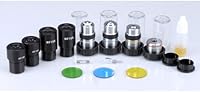
  • Eyepieces: Two widefield eyepieces are included — WF10x and WF20x — both designed to provide a broad field of view and reduce eye strain during extended observation sessions.
  • Illumination: A built-in halogen light source delivers transmitted brightfield illumination, appropriate for standard prepared slides and wet mount specimens.
  • Condenser: An Abbe-type condenser paired with an iris diaphragm allows the user to precisely control the intensity and angle of the light cone reaching the specimen.
  • Stage: The 3D double-layer mechanical stage moves independently along both X and Y axes, enabling systematic slide scanning and highly repeatable specimen positioning.
  • Head Type: The sliding binocular head adjusts interpupillary distance to fit different users and can be angled to reduce neck and shoulder strain during long viewing sessions.
  • Focus Controls: Both coarse and fine focus knobs incorporate a tension adjustment mechanism that minimizes focus drift and reduces overshoot when zeroing in on fine specimen detail.
  • Frame Material: The body, arm, and base are constructed entirely from heavy-duty metal, providing structural rigidity and long-term resistance to wear under regular use.
  • Optics Coating: All optical elements are treated with an anti-mold coating to resist fungal growth, meaningfully extending lens lifespan in humid storage or operating environments.
  • Optical Mode: This is a transmitted brightfield compound microscope, meaning it is designed for thin, translucent specimens and is not suited for examining solid or opaque objects.
  • Dimensions: The unit measures 20″ long by 17″ wide by 10.5″ tall, and requires a dedicated, cleared benchtop area of comparable size for stable operation.
  • Weight: At 17.2 pounds, this scope is best treated as a stationary benchtop instrument rather than one that moves between locations regularly.
  • Voltage: The unit is rated at 240V, so buyers in regions with different standard voltages should confirm outlet compatibility or arrange for an appropriate step-up adapter before use.
  • Color: Finished in white, the scope has a clean, professional appearance consistent with standard laboratory and educational equipment aesthetics.
  • Manufacturer: Produced by United Scope LLC under the AmScope brand, a company specializing in optical instruments for educational, hobbyist, and light laboratory applications.

Related Reviews
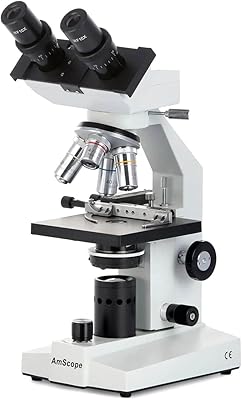
AmScope B100B-MS Compound Binocular Microscope
69%
83%
Build Quality
74%
Optical Clarity
61%
Illumination
69%
Magnification Range
71%
Mechanical Stage
More
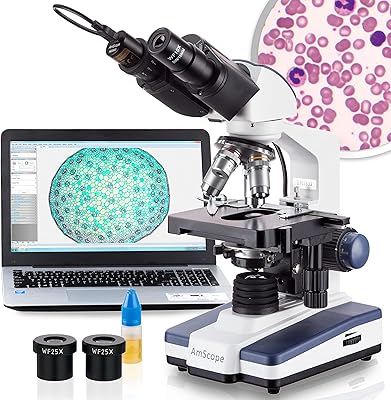
AmScope B120C-E5 Binocular Compound Microscope
78%
88%
Optical Clarity
76%
Build Quality
91%
Illumination Quality
84%
Ergonomics & Comfort
67%
USB Camera Quality
More
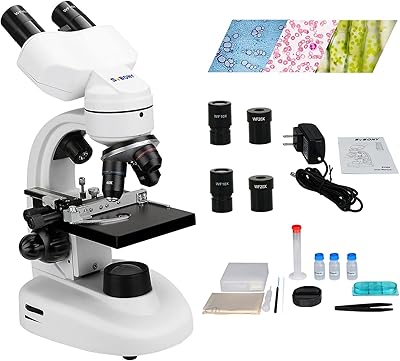
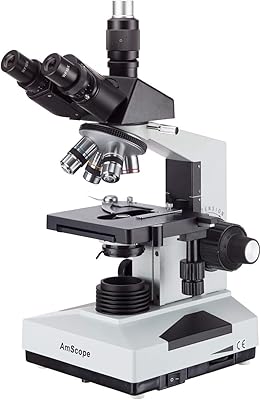
SVBONY SV605 Binocular Compound Microscope
80%
83%
Optical Clarity
81%
Build Quality
91%
Mechanical Stage
86%
Illumination System
88%
Viewing Comfort
More
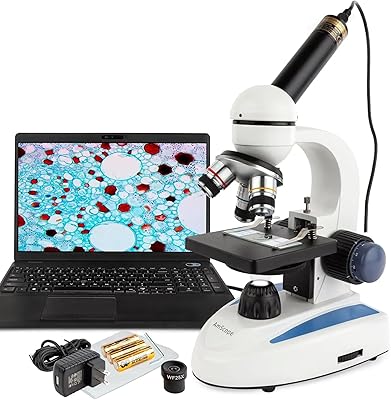
AmScope T490B Compound Trinocular Microscope
74%
88%
Optical Clarity
91%
Trinocular Head
78%
Camera Integration
86%
Mechanical Stage
89%
Build Quality
More
AmScope M150C Compound Microscope
81%
88%
Build Quality
76%
Optical Clarity
69%
Magnification Range
84%
Value for Money
91%
Kit Contents
More
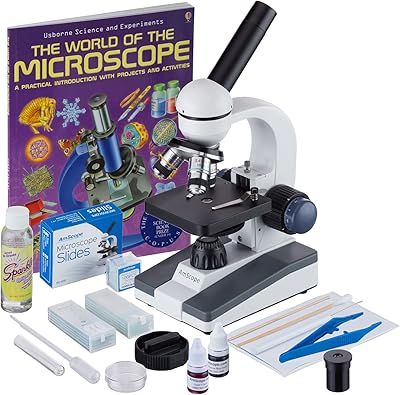
AmScope M158 USB Compound Microscope
74%
88%
Build Quality
79%
Optical Clarity
51%
Camera Quality
91%
Ease of Setup
62%
Software Experience
More
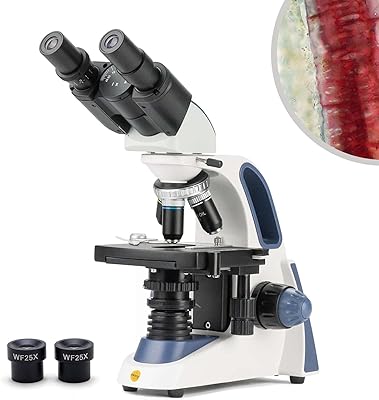
AmScope M102C Biological Compound Microscope
79%
83%
Optical Image Quality
88%
Build Quality
86%
Value for Money
81%
Ease of Setup
79%
Ease of Use
More
Swift SW380B Binocular Compound Microscope
79%
83%
Optical Clarity
88%
Build Quality
86%
Ergonomics & Comfort
79%
Magnification Range & Versatility
81%
Focusing System
More
BOGRINUO RM Binocular Compound Microscope
70%
78%
Optical Clarity (Low-Mid Power)
52%
Optical Clarity (High Power)
81%
Build Quality
83%
Ergonomics & Comfort
76%
Mechanical Stage Quality
More
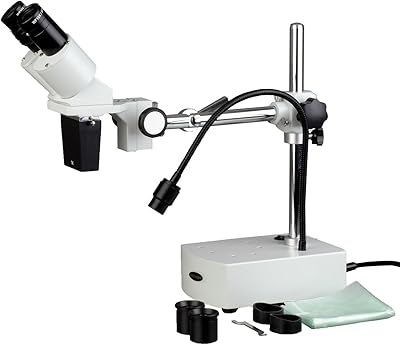
AmScope SE400-Z Binocular Stereo Microscope
77%
88%
Build Quality
79%
Optical Clarity
93%
Working Distance & Clearance
86%
Boom Arm Flexibility
81%
Eyepiece Comfort & Ergonomics
More

FAQ

It is technically achievable, but practically speaking, results at 2000X are highly dependent on slide quality and lighting. You need a very thin, well-prepared specimen and optimal condenser settings to get a usable image at that level. Most users find that 400X to 1000X is the reliable working range, and 2000X is best treated as an occasional option rather than an everyday setting.

The B490B does not ship with an LED option, but some users have successfully retrofitted compatible LED bulbs into the lamp housing. It requires sourcing the right bulb size and verifying the fit, and results vary. If LED illumination is a firm requirement rather than a nice-to-have, it may be worth considering a model that includes it from the factory to avoid the hassle.

Yes, it is well matched to that use case. The magnification range comfortably covers what most undergraduate biology, microbiology, and histology courses require, and the optical quality at 40X through 400X is reliably strong. The all-metal build also means it will hold up through years of coursework without the frame flexing or the focus mechanism wearing out prematurely.

Plan on leaving it in one dedicated spot. It is not impossible to carry, but the weight is a direct byproduct of the all-metal construction that also makes it so stable on the desk. Treating it as a fixed workstation instrument is the right mindset — find a good surface, set it up once, and work from there.

There is no dedicated camera port built into this scope, so you would need a third-party smartphone adapter that clamps over one of the eyepieces. Universal adapters are widely available and inexpensive, but image quality will vary. For serious photomicroscopy work, a scope with a built-in trinocular port and a camera-ready tube would give far more consistent results.

As a transmitted brightfield compound microscope, it works with thin, translucent specimens — prepared slides, stained tissue sections, blood smears, pond water samples, and similar material. It is not the right tool for looking at solid or opaque objects like insects, rocks, or circuit boards; those require a stereo or reflected-light microscope instead.

The head slides horizontally so you can adjust the distance between the two eyepieces — called the interpupillary distance — until the two fields of view merge into one clear circle. One eyepiece also has a diopter adjustment ring for correcting any difference in prescription between your two eyes. It takes a minute or two to dial in the first time, but once set it is very comfortable for extended sessions.

It does make a real practical difference, especially for anyone in a humid climate or storing the scope in a room that gets warm and damp. Fungal growth on optical glass is a well-documented and frustrating problem — once it develops, the glass is typically ruined and requires professional cleaning or replacement. The anti-mold treatment reduces that risk meaningfully over the long term, even if it is not a topic most buyers think about at the point of purchase.

The iris diaphragm controls how much light passes through the condenser and reaches the slide. At low magnifications you often want less light to improve contrast, while at higher magnifications you open it up for more brightness and resolution. Beginners often ignore it entirely at first, but learning to use it correctly makes a noticeable improvement in image quality — particularly when working above 400X.

The most immediate difference shows up in everyday use — plastic frames flex and wobble, which makes maintaining sharp focus frustrating and fatiguing. The all-metal construction here eliminates that problem, giving you a stable platform that stays in focus as you adjust. The optical components are also of a meaningfully higher grade, so images tend to be sharper with less chromatic fringing at comparable magnifications. The gap in usability between this tier and budget plastic scopes is larger than the price difference alone might suggest.

Where to Buy