Overview

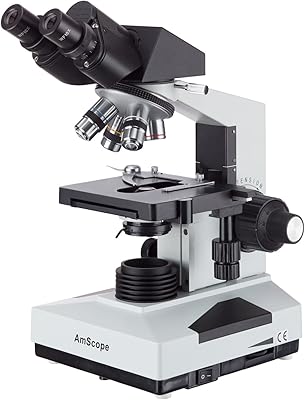
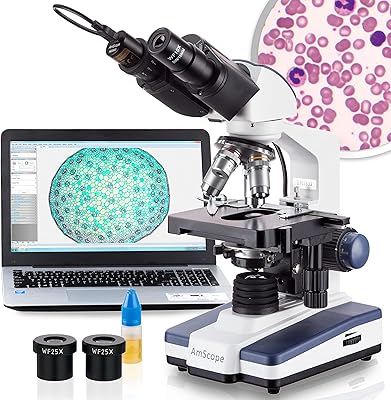
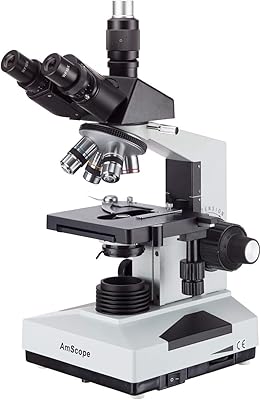
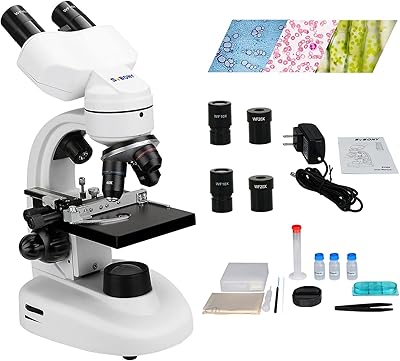
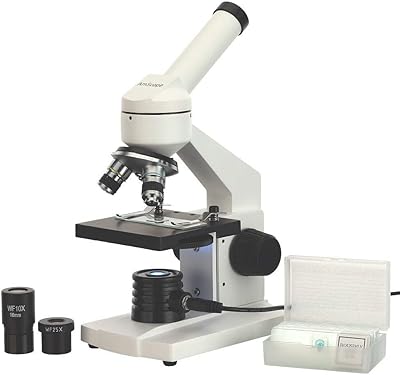
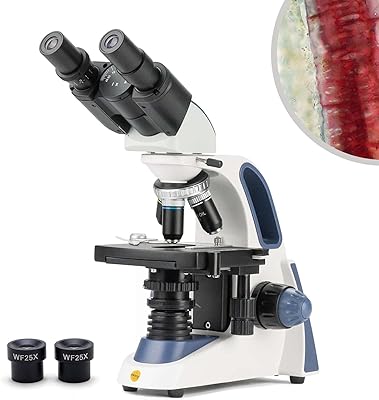
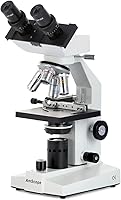
The AmScope B100B-MS Compound Binocular Microscope sits squarely in the mid-range bracket — built for students, educators, and dedicated hobbyists who need something more serious than a toy scope but aren't ready to spend research-lab money. The all-metal frame is an immediate confidence booster; it feels substantial and stable in a way that budget plastic alternatives simply don't. The binocular head tilts at 45 degrees and swivels a full 360 degrees, which matters more than it sounds — extended viewing sessions are noticeably more comfortable compared to straight monocular designs. Tungsten illumination paired with an Abbe condenser delivers solid, focused light for slide work, and with over 300 real-world ratings accumulated since 2011, there's plenty of buyer experience to draw from.
Features & Benefits

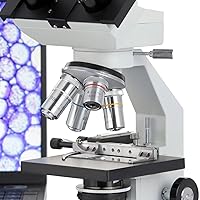
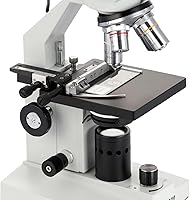
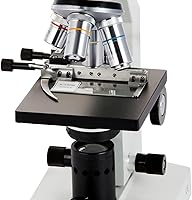
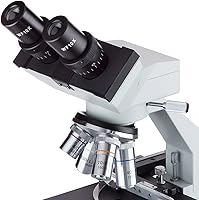
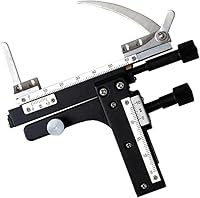
Where this binocular microscope earns its keep is in the practical details. Eight magnification steps — running from 40X up to 2000X — cover most educational and hobbyist use cases comfortably, though it's worth being upfront: that top-end figure is largely theoretical. Tungsten lighting limits usable clarity well before you hit 2000X, so treat the upper range as a ceiling rather than a working setting. The mechanical stage is a genuine highlight; spiral-control positioning lets you scan slides with precision that clip stages simply can't match. Separate coarse and fine focus knobs with tension adjustment prevent the frustrating overshoot beginners often experience. Achromatic objectives keep color fringing minimal, and the iris diaphragm on the Abbe condenser gives real control over contrast.

Best For

This compound scope is a strong fit for high school and college students working through biology or microbiology coursework — it handles prepared slides and basic specimens reliably without overwhelming a newcomer. Home lab enthusiasts who have graduated past toy microscopes will appreciate the step up in build quality and optical performance. It also works well in small classroom settings; the swiveling binocular head makes passing the scope between students far less awkward than fixed designs. Hobbyists who regularly examine pond water, plant cells, or blood smear slides will find the magnification range covers everyday curiosity thoroughly. If you want binocular ergonomics for long sessions without climbing into professional-grade pricing territory, this sits in a genuinely practical sweet spot.

User Feedback

Across its 321 ratings, the AmScope B100B-MS lands at 3.9 out of 5 — respectable, but the spread tells a more nuanced story. Buyers upgrading from cheap beginner scopes tend to be genuinely impressed by build and optics at lower magnifications, and setup is consistently praised as straightforward. The recurring complaints are worth knowing: the 2000X upper limit is essentially unusable in practice, and some users note the tungsten bulb runs noticeably warm during long sessions — replacement bulbs are available, but it is an ongoing consideration. Mechanical stage smoothness draws mixed opinions; some find it fluid out of the box, others report stiffness that improves with use. Buyers comparing it to newer LED-lit scopes occasionally flag the warmer, slightly yellow tungsten light as a drawback.

Pros

  • Solid all-metal construction feels durable and stable — a clear step above plastic entry-level scopes.
  • The mechanical stage allows precise, repeatable slide positioning that clip-style stages simply cannot match.
  • Eight magnification steps from 40X to 2000X cover a genuinely wide range of everyday specimen work.
  • Separate coarse and fine focus knobs with tension control make zeroing in on specimens far less frustrating.
  • The 45-degree inclined binocular head reduces eye and neck strain noticeably during longer sessions.
  • Achromatic objective lenses keep color fringing minimal, producing cleaner images at working magnifications.
  • The iris diaphragm on the Abbe condenser gives real hands-on control over contrast and depth of field.
  • Setup is consistently described as straightforward — most buyers are up and viewing within minutes of unboxing.
  • The 360-degree swiveling head makes sharing this compound scope in a classroom or shared lab setting easy.
  • Over a decade on the market with hundreds of real reviews means buyers can make an informed, low-risk decision.

Cons

  • Tungsten illumination runs noticeably warm during long sessions and will eventually need bulb replacement.
  • Usable image clarity degrades well before the advertised 2000X upper limit — that figure is largely theoretical.
  • Tungsten light casts a warmer, slightly yellow tone compared to the cleaner output of modern LED alternatives.
  • Some buyers report the mechanical stage feels stiff or rough out of the box and requires break-in time.
  • The 240V voltage rating may require a converter for buyers in regions running on standard 120V supply.
  • At 18 inches long and over 3 pounds, this binocular microscope is a fixed desk instrument — not portable.
  • Advanced users familiar with LED-lit or plan-achromatic scopes will likely find the optics underwhelming at high magnification.
  • No digital imaging output or camera adapter support is included, limiting compatibility with modern documentation workflows.

Ratings

Our AI scoring model analyzed verified global reviews for the AmScope B100B-MS Compound Binocular Microscope, actively filtering out incentivized, duplicate, and bot-generated feedback to surface what real buyers actually experienced. The scores below reflect a balanced picture — genuine strengths are recognized, but recurring pain points are weighted just as honestly. Whether this scope earns a place on your desk depends heavily on who you are and what you expect from it.

Build Quality
83%
The all-metal frame is a consistent highlight across buyer feedback — it feels noticeably more solid than the plastic-bodied scopes many users upgraded from. Students and hobbyists who handle the instrument regularly report that it holds up well over time without developing the wobble or looseness common to budget alternatives.
A portion of buyers note that while the body itself is sturdy, some smaller components — particularly the stage control knobs — feel slightly less refined than the main frame suggests. A few long-term owners also report minor cosmetic wear around the focus mechanism after extended daily use.
Optical Clarity
74%
26%
At working magnifications between 40X and 400X, the achromatic lenses produce clean, well-defined images with minimal color fringing — a real step up from the basic optics found on toy or introductory-level scopes. Biology students examining prepared slides or hobbyists looking at pond water samples consistently find the image quality satisfying for their needs.
Image quality degrades visibly as you push past 400X to 1000X and beyond, with clarity and contrast both suffering under tungsten illumination. Users expecting crisp, detailed imaging at the advertised 2000X ceiling will be disappointed — that figure reflects optical capability on paper, not practical usability with this light source.
Illumination
61%
39%
The built-in tungsten bulb paired with the Abbe condenser does a reasonable job illuminating standard prepared slides and wet mounts at low to mid magnifications. For the core tasks this scope is marketed toward — basic biology, educational slide sets, pond water samples — the brightness level is generally sufficient.
Tungsten illumination is an older technology, and its limitations show in everyday use. The bulb runs noticeably warm during extended sessions, the light has a yellowish tone compared to modern LED alternatives, and it simply cannot deliver the brightness or evenness needed to support clean viewing at high magnifications.
Magnification Range
69%
31%
Eight discrete magnification settings give users genuine flexibility — you can start broad at 40X to locate a specimen, then step up methodically through the range to examine finer detail. For students working through a structured lab curriculum, this range covers virtually every assignment they are likely to encounter.
The upper magnification range is misleading in practice. Buyers who purchase this scope specifically for high-magnification work — expecting usable views at 1000X or 2000X — frequently report frustration when they discover how quickly image quality falls apart at those settings under tungsten lighting.
Mechanical Stage
71%
29%
The spiral-control mechanical stage is one of the most practically useful features on this scope, and buyers who have used clip-style stages before consistently notice the difference. Being able to scan across a slide in a controlled, repeatable way — rather than nudging it by hand — makes working through a set of specimens significantly less tedious.
Out-of-box smoothness is inconsistent, with a meaningful portion of buyers reporting that the stage controls feel stiff or slightly gritty when first used. Most find it loosens up with regular use, but it is a frustrating first impression for a scope at this price point and can feel like a quality control issue.
Ergonomics & Comfort
78%
22%
The 45-degree inclined binocular head is a genuine comfort advantage for anyone spending more than 20 or 30 minutes at the eyepieces. Teachers, students running long lab sessions, and hobbyists who lose track of time examining specimens all note that eye and neck fatigue is markedly lower compared to straight monocular designs.
The 360-degree swivel head, while useful for sharing the scope, occasionally loosens slightly with heavy use — a couple of users noted they needed to re-tighten the head after it drifted during a session. The fixed 45-degree angle also will not suit every user's preferred seating height or posture.
Ease of Setup
87%
First-time microscope buyers consistently praise how straightforward it is to get this scope up and running. Most report being ready to view within minutes of unboxing — head attachment is simple, controls are logically labeled, and the learning curve for basic operation is genuinely low even without prior experience.
The documentation included in the box is functional but thin — users who want to understand more advanced techniques like condenser alignment or optimal iris diaphragm settings for specific specimens will need to look elsewhere. The voltage compatibility issue (240V rating) also catches some North American buyers off guard if they have not read the specifications carefully.
Focus Mechanism
79%
21%
Having both coarse and fine focus controls with adjustable tension is a meaningful practical advantage, particularly for newer users who tend to overshoot when trying to lock in on a specimen. Once tension is set to the user's preference, the focus system responds predictably and reduces the frustration of losing a view mid-adjustment.
Some buyers find the tension adjustment range a little narrow — the sweet spot between too loose and too stiff is achievable but narrower than experienced microscopists might prefer. A small number of users also report the fine focus knob feels slightly loose from the factory and benefits from a minor mechanical tightening.
Value for Money
66%
34%
For buyers stepping up from toy-grade or sub-100-dollar scopes, this binocular microscope represents a substantial jump in capability and build quality, and most in that situation feel the investment is justified. The mechanical stage, metal construction, and binocular head together deliver features that would cost considerably more on branded educational instruments from laboratory suppliers.
At its price point, the tungsten illumination stands out as a notable compromise — several competing scopes in the same bracket now ship with LED lighting, which is cooler, brighter, and longer-lasting. Buyers doing side-by-side comparisons with LED alternatives often feel this scope trails on illumination quality relative to what the price suggests they should be getting.
Durability Over Time
72%
28%
The core metal frame holds up solidly with regular use — buyers who have owned this compound scope for two or more years generally report it remains mechanically sound, with no significant degradation in the frame, optics, or main focus mechanism. It is built to last longer than a typical school or hobbyist scope lifecycle.
Consumable components — primarily the tungsten bulb — are the main durability concern over time. Bulb replacement is necessary eventually, and while spares are available, it is an ongoing maintenance consideration. A handful of long-term users also note that the mechanical stage control cables can develop minor slop after years of heavy use.
Condenser & Contrast Control
76%
24%
The Abbe condenser with iris diaphragm gives users real hands-on control over how light hits the specimen — a feature absent on most entry-level scopes. Hobbyists and students who take time to learn condenser adjustment find it meaningfully improves contrast and depth of field, particularly when examining unstained wet mounts.
For buyers who are new to compound microscopy, the condenser controls add a layer of complexity that is not always intuitive without guidance. The included documentation does not go deep enough on condenser technique, and users who skip this step tend to get suboptimal results and occasionally blame the optics rather than the light path setup.
Portability
44%
56%
The 3.25-pound weight is manageable enough that most users can carry the scope between rooms or pack it for a short trip if needed. The all-metal build does at least mean the instrument survives occasional relocation without the fragility concerns that plague lighter plastic-framed alternatives.
At 18 x 12 x 8 inches, this is fundamentally a desk-bound instrument — it was not designed to travel. There is no carrying case included, no compact form factor consideration, and the mains power requirement means it needs an outlet nearby at all times. Anyone expecting field use or easy transport between locations will find this scope impractical.
Compatibility & Expandability
53%
47%
Standard eyepiece dimensions mean third-party accessories — including aftermarket eyepiece camera adapters — can technically be fitted to this binocular microscope with some research and effort. Users interested in basic photomicrography have found workable solutions using compatible adapters available separately.
There is no native camera port or digital output, no built-in USB connectivity, and no manufacturer-supported imaging pathway. This limits the scope considerably for anyone interested in documenting specimens or sharing images digitally — a growing expectation at this price level — and the workarounds require additional spending and trial and error.
Voltage & Power Setup
48%
52%
Once the voltage compatibility issue is resolved — either through a converter or by sourcing the scope in a 240V market — the power setup is uncomplicated and the tungsten illumination turns on without any delay or warm-up issues. The power connection itself is stable and has not been flagged as a reliability concern.
The 240V rating is a genuine friction point for North American buyers, who need a step-up converter that adds cost and setup complexity. This is not clearly communicated in marketing materials, and several buyers only discovered the incompatibility after unboxing — a frustrating experience that has contributed to negative reviews that may not fairly reflect the scope's optical performance.

Suitable for:

The AmScope B100B-MS Compound Binocular Microscope is a natural fit for high school and college students who need a dependable, well-built instrument for biology or microbiology coursework without the fragility of budget alternatives. Home lab enthusiasts who have hit the ceiling of toy-grade scopes will find the mechanical stage and achromatic optics represent a meaningful and satisfying step up. Teachers running small classroom sessions benefit from the 360-degree swiveling binocular head, which makes passing the scope between students practical rather than awkward. Hobbyists who regularly examine pond water, plant tissue, or prepared slides will get solid, reliable performance across the everyday magnification range. Anyone prioritizing comfortable extended viewing sessions — thanks to the 45-degree inclined binocular head — over the single-eye fatigue of a monocular design will notice the difference quickly.
Not suitable for:

The AmScope B100B-MS Compound Binocular Microscope is not the right call for anyone expecting true, research-grade optical performance — the tungsten illumination, while functional, is older technology that runs warm and cannot match the cool, consistent brightness of modern LED-lit scopes. Buyers specifically chasing usable 2000X magnification will be disappointed; image quality degrades well before that upper limit under tungsten light, making the top-end figure more of a marketing ceiling than a practical setting. Advanced microscopists or semi-professional users accustomed to LED illumination, plan-achromatic objectives, or digital imaging integration will quickly feel constrained by this scope's feature set. If you need a portable or lightweight instrument, the all-metal build and 18-inch footprint make this a decidedly stationary, desk-bound piece of equipment. And for buyers in regions where 240V power supply compatibility is a concern, the voltage specification warrants a close look before purchasing.
Specifications

  • Magnification Range: Offers eight widefield magnification settings spanning from 40X at the low end up to 2000X at the maximum.
  • Optical Type: Uses achromatic objective lenses, which correct for color fringing and produce cleaner, sharper images across the working magnification range.
  • Head Type: Features a binocular head inclined at 45 degrees with full 360-degree swivel capability for ergonomic, flexible positioning.
  • Illumination: Tungsten bulb illumination is built into the base, providing warm, bright transmitted light suited to standard prepared and wet slides.
  • Condenser: Equipped with a spiral-control Abbe condenser paired with an iris diaphragm for adjustable contrast and depth-of-field control.
  • Stage: Includes a mechanical stage with spiral control, enabling precise and repeatable slide movement across both X and Y axes.
  • Focus System: Separate coarse and fine focusing knobs are both fitted with tension control to minimize overshoot and protect delicate specimens.
  • Frame Material: The body and arm are constructed from metal, providing a stable, durable build that resists flex during focusing and stage adjustment.
  • Dimensions: The unit measures 18 x 12 x 8 inches, making it a fixed desk instrument rather than a portable field scope.
  • Weight: Weighs approximately 3.25 pounds, which is sturdy enough to stay stable on a desk without being difficult to reposition.
  • Voltage: Rated at 240V, which may require a step-up voltage converter for buyers using standard 120V outlets in North America.
  • Color Finish: Ships in a black, silver, and white finish that is consistent with a professional laboratory aesthetic.
  • Objective Lenses: Achromatic objectives are included across the magnification range, a meaningful quality step above the simple lenses found on entry-level scopes.
  • Condenser Control: The iris diaphragm on the Abbe condenser allows the user to fine-tune light intensity and aperture without changing the bulb or adding filters.
  • Manufacturer: Produced by United Scope LLC, the company behind the AmScope brand, which has focused on microscopy equipment for the educational and hobbyist market.
  • Market Availability: Has been commercially available since March 2011, giving it a long track record with hundreds of verified purchaser reviews.

Related Reviews

AmScope B490B Compound Binocular Microscope
85%
94%
Optical Clarity
90%
Build Quality
85%
Ease of Use
92%
Value for Money
93%
Magnification Range
More
AmScope B120C-E5 Binocular Compound Microscope
78%
88%
Optical Clarity
76%
Build Quality
91%
Illumination Quality
84%
Ergonomics & Comfort
67%
USB Camera Quality
More
SVBONY SV605 Binocular Compound Microscope
85%
90%
Value for Money
88%
Ease of Setup
85%
Build Quality
89%
Optical Performance
91%
Illumination System
More
AmScope M150C Student Compound Microscope
82%
89%
Value for Money
85%
Build Quality
88%
Ease of Use
82%
Performance at High Magnification
86%
Image Clarity
More
AmScope M158 USB Compound Microscope
74%
88%
Build Quality
79%
Optical Clarity
51%
Camera Quality
91%
Ease of Setup
62%
Software Experience
More
AmScope T490B Compound Trinocular Microscope
74%
88%
Optical Clarity
91%
Trinocular Head
78%
Camera Integration
86%
Mechanical Stage
89%
Build Quality
More
AmScope M102C Biological Compound Microscope
79%
83%
Optical Image Quality
88%
Build Quality
86%
Value for Money
81%
Ease of Setup
79%
Ease of Use
More
Swift SW380B Binocular Compound Microscope
79%
83%
Optical Clarity
88%
Build Quality
86%
Ergonomics & Comfort
79%
Magnification Range & Versatility
81%
Focusing System
More
BOGRINUO RM Binocular Compound Microscope
70%
78%
Optical Clarity (Low-Mid Power)
52%
Optical Clarity (High Power)
81%
Build Quality
83%
Ergonomics & Comfort
76%
Mechanical Stage Quality
More
AmScope SE400-Z Binocular Stereo Microscope
77%
88%
Build Quality
79%
Optical Clarity
93%
Working Distance & Clearance
86%
Boom Arm Flexibility
81%
Eyepiece Comfort & Ergonomics
More

FAQ

Yes, it is a solid fit for that use case. The magnification range covers everything typically needed for high school biology — cell structure, plant tissue, basic microorganisms — and the mechanical stage makes working through a set of prepared slides much easier than cheaper clip-style alternatives. The binocular head also reduces eye fatigue during longer study sessions, which students genuinely appreciate.

Technically the scope can reach 2000X, but practically speaking, the tungsten illumination limits how useful that top end really is. Image quality degrades noticeably at the highest settings — you will see something, but clarity and contrast drop off considerably. Most users find the sweet spot for clean, detailed viewing sits somewhere between 40X and 400X with this type of lighting.

It uses a standard tungsten bulb, which is widely available and not expensive to replace. The bulb does run warm during extended use, so it is worth giving the scope a few minutes to cool down before handling the lamp area for a swap. Replacement bulbs compatible with AmScope tungsten models are easy to find online.

The AmScope B100B-MS Compound Binocular Microscope does not come with a built-in camera port or digital output, so there is no direct native integration. However, third-party eyepiece camera adapters designed for standard eyepiece diameters can work with this scope. Results vary depending on the adapter quality, and it is more of a workaround than a seamless solution.
This is worth paying attention to. The scope is rated at 240V, while standard US household outlets run at 120V. You would need a step-up voltage converter to use it safely on a US outlet. It is not a dealbreaker, but it is an added cost and setup step that buyers should factor in before purchasing.

User feedback on this is mixed. Some buyers find the stage moves smoothly right away, while others report it feels a bit stiff initially and needs some break-in time with regular use. It generally loosens up over time, but if you receive a unit that feels notably rough, reaching out to AmScope's customer support is a reasonable first step.

LED scopes at a similar price point have a couple of practical advantages — cooler operation, lower long-term running costs, and a whiter, more neutral light that some users find easier to work with for extended sessions. The tungsten light on this compound scope produces a slightly warmer tone, which is not a problem for most educational or hobbyist work but is a real consideration for anyone doing color-sensitive specimen analysis.

Not simultaneously — it is a binocular scope, not a dual-head teaching microscope. That said, the 360-degree swiveling head and 45-degree incline make it much easier to pass between users in a classroom or shared lab setting compared to fixed-head designs. One person views, then the next person rotates the head to a comfortable angle without repositioning the whole instrument.

This binocular microscope handles standard compound microscopy specimens well — prepared glass slides, wet mounts of pond water or cheek cells, plant cross-sections, blood smears, bacteria at lower to mid magnifications, and similar samples. It is not designed for dissection or surface viewing of solid objects, which would require a stereo microscope instead.

Setup is consistently praised as one of the more straightforward aspects of this scope. Most buyers report being ready to view within a few minutes of unboxing — attaching the head, plugging in, and getting a slide under the stage does not require any specialized knowledge. The included documentation covers the basics, and the controls are logically laid out for first-time users.