
Overview

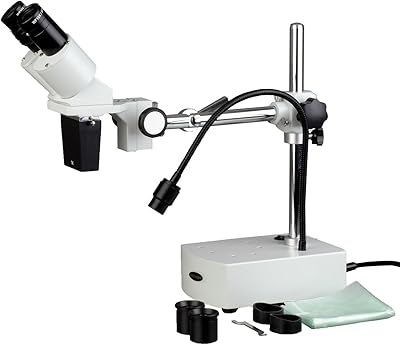
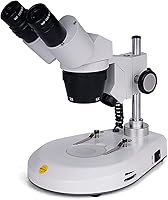
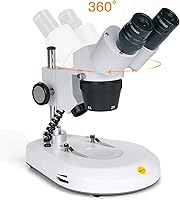
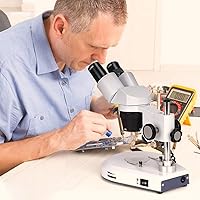
The Swift S306S Binocular Stereo Microscope is a capable mid-range scope built for hobbyists, repair technicians, and educators who need reliable surface-level magnification without the complexity of a compound system. It covers a practical 20x to 80x range — enough to inspect solder joints, examine a coin's fine relief, or study a small insect in satisfying detail. The 360° rotatable head is a genuinely useful design touch, letting multiple users take turns at the eyepieces without disturbing the specimen. Dual LED lighting and a reversible stage plate round things out. Just be clear on what this is: a stereo scope for solid objects and surfaces, not a tool for viewing cells on a slide.

Features & Benefits

What makes this stereo microscope genuinely practical comes down to a few thoughtful design decisions. The head swings a full 360°, which sounds minor until you're sharing the scope with a student or colleague — no awkward repositioning required. Swapping between the 10x and 20x eyepieces takes seconds and gives you three magnification steps: 20x, 40x, and 80x. The 45-degree binocular angle keeps your posture comfortable during longer sessions. Both upper and lower LEDs are independently dimmable, letting you dial in the right light for opaque or semi-transparent specimens. The achromatic objective lenses keep images clean with minimal color fringing across the full magnification range.

Best For

This binocular scope earns its place on the workbench of anyone doing close-up surface inspection work. Electronics repair technicians will likely get the most out of it — identifying cold solder joints or checking component placement at 40x or 80x is exactly what it is built for. Gemologists, jewelers, and collectors examining coins or stamps will find the magnification range comfortable and the image quality more than adequate. It also works well in educational settings where the rotatable head allows group observation without disruption. What it is not suited for is deep biological work; if you need to examine prepared slides or live cells, a compound microscope is the right call.

User Feedback

Buyer sentiment around this stereo microscope sits at a solid 4.1 stars, and reading through the reviews, the picture is fairly consistent. Image clarity at 20x and 40x gets frequent praise, as does the build quality relative to the price tier. The rotatable head draws particular appreciation from teachers and instructors. On the other side, a handful of buyers note that 80x is where optical limitations begin to show, and some mention the focus knob feeling stiff straight out of the box. A few reviewers flagged minor packaging or accessory concerns. Overall, most buyers report a straightforward setup and come away satisfied with what the scope delivers for its intended uses.

Pros

  • The 360° rotatable head is a genuinely practical feature for shared use and group demonstrations.
  • Dual dimmable LED lights handle both opaque and semi-transparent specimens without swapping accessories.
  • Interchangeable eyepieces give three distinct magnification levels, adding real flexibility to a single scope.
  • Image clarity at 20x and 40x is consistently praised by buyers across a wide range of use cases.
  • Achromatic objective lenses keep color fringing minimal, producing cleaner images than budget alternatives.
  • The 45-degree binocular head angle makes extended viewing sessions noticeably more comfortable.
  • Setup is straightforward with minimal assembly, making it accessible to first-time stereo microscope users.
  • The reversible black/white stage plate meaningfully improves contrast depending on the specimen type.
  • Build quality feels solid relative to the mid-range price point, with few reports of early mechanical failure.
  • Ranks among the top stereo microscopes in its category on Amazon, reflecting consistent buyer satisfaction.

Cons

  • Image quality softens noticeably at 80x, which is the hard upper limit with no upgrade path for higher magnification.
  • Some buyers report the focus knob feels stiff straight out of the box and requires a break-in period.
  • No trinocular port means you cannot attach a camera for documentation or digital display without modification.
  • The frosted glass stage plate can show smudges and scratches that affect transmitted light viewing over time.
  • At roughly 6.7 pounds, the scope is not particularly portable for users who need to move it frequently.
  • Accessory and packaging quality has drawn occasional criticism, with some buyers noting missing or poorly fitted parts.
  • The 80x ceiling may feel limiting sooner than expected for users whose inspection needs grow over time.
  • No zoom objective is included, so moving between magnification levels requires a full eyepiece swap rather than a smooth continuous adjustment.

Ratings

Our AI rating system analyzed verified buyer reviews for the Swift S306S Binocular Stereo Microscope from multiple global sources, actively filtering out incentivized, spam, and bot-generated feedback to surface what real users genuinely experience. The scores below reflect both the strengths that keep buyers satisfied and the friction points that show up repeatedly across independent reviews. Nothing has been smoothed over — the ratings are calibrated to help you make an informed decision, not to sell you on the product.

Optical Clarity
83%
At 20x and 40x, most users report impressively sharp, well-resolved images — sharp enough to read date marks on coins or identify cold solder joints on a circuit board without eye strain. The achromatic objectives do a solid job of controlling color fringing across the mid-magnification range.
Push to 80x and the image noticeably softens, which frustrates users who assumed the top magnification would deliver the same crispness as the lower settings. For casual inspection this rarely matters, but detail-critical tasks at maximum power expose the optical ceiling fairly quickly.
Build Quality
79%
21%
The overall frame and arm feel solid and well-weighted for a scope in this price tier — it does not wobble or shift during use, which matters a lot when you are trying to hold a steady view at higher magnification. Buyers regularly mention that it feels more substantial than expected.
Some mechanical components, particularly the focus adjustment knob, have drawn criticism for feeling stiff or inconsistent out of the box. A handful of users also noted that plastic elements near the eyepiece housing feel slightly less premium than the metal base and arm.
Illumination System
88%
The independently dimmable upper and lower LEDs are one of the most consistently praised aspects across all buyer feedback. Being able to switch between incident light for opaque objects and transmitted light for the frosted plate — without swapping accessories — is genuinely useful during real workbench sessions.
A small number of users noted uneven LED brightness or slight color temperature differences between the upper and lower lights, which can affect how specimens appear under combined illumination. Neither issue is a dealbreaker, but perfectionists doing color-sensitive gemology work may notice it.
Magnification Range
71%
29%
Three usable magnification steps — 20x, 40x, and 80x — cover the practical needs of most hobbyist and light-professional users. Swapping eyepieces is quick, and the range handles everything from broad specimen orientation at 20x to fine detail inspection at 40x very comfortably.
The 80x ceiling is a genuine limitation for users whose needs grow over time, and there is no zoom objective to transition smoothly between levels. Advanced users who routinely need more than 80x will find this scope limiting sooner rather than later.
Head Design & Ergonomics
91%
The 360° rotatable head is a standout practical feature — teachers, workshop instructors, and anyone sharing the scope with a colleague can swing the eyepieces to a new user in seconds without touching the specimen. The fixed 45-degree binocular angle genuinely reduces neck fatigue during hour-long sessions.
The binocular head angle is fixed at 45 degrees and cannot be adjusted, which may not suit every user's workstation height or seating position. Taller users working at low benches occasionally note they have to hunch slightly to achieve a comfortable viewing posture.
Ease of Setup
86%
The vast majority of buyers describe unboxing and assembly as straightforward — attach the head, insert the eyepieces, plug in the power, and you are essentially ready to go. No calibration rituals or confusing multi-step procedures are required to get a usable image on your first session.
The included instructions are functional but sparse, and a small number of buyers without prior microscope experience found the interpupillary adjustment and diopter fine-tuning confusing without supplementary guidance. A more thorough quick-start guide would reduce early frustration for complete beginners.
Stage & Specimen Plates
77%
23%
Having both a reversible black/white plate and a frosted glass transmitted-light plate included at this price point is a practical bonus. The contrast difference between the black and white plate surfaces is immediately useful when switching between light and dark specimens.
The frosted glass plate scratches more easily than users expect and can develop haze over time with regular use, subtly degrading transmitted light quality. Some buyers also noted that the stage platform is not as large as they anticipated for working with bigger specimens.
Value for Money
82%
18%
Relative to comparable stereo binocular scopes at similar price points, the Swift S306S delivers a feature set — dual dimmable LEDs, interchangeable eyepieces, rotating head, two stage plates — that buyers consistently describe as strong value for hobbyist and light educational use.
Users comparing it to entry-level professional stereo scopes note that the optical and mechanical quality gap widens as the budget increases, and a modest additional investment opens up significantly better optics. For strictly hobbyist use it is well-priced, but professionals may find the value calculation less convincing.
Focus Mechanism
67%
33%
The coarse focus knob provides enough travel and control to navigate across the working distance comfortably, and most users find it adequate for locking in a sharp image at lower magnifications once they have worked it in through regular use.
Stiffness in the focus knob is among the most frequently reported mechanical complaints, particularly when the scope is brand new. Some buyers reported the resistance never fully resolved, making fine focus adjustments at higher magnification genuinely fiddly rather than smooth.
Eyepiece Quality
78%
22%
The wide-field eyepieces provide a noticeably broad field of view compared to standard eyepieces, which makes scanning across a specimen — whether a stamp or a PCB — faster and less tiring. Buyers with glasses appreciate the eye relief, which is reasonable for a scope in this class.
The eyepiece rubber cups can feel a bit flimsy and do not always seat as securely as users expect, occasionally shifting during use. A minority of buyers also noted slight image distortion toward the outer edges of the field of view, particularly with the 20x eyepieces at maximum objective magnification.
Stability & Vibration
84%
The weighted base keeps the scope planted firmly on a workbench even when adjusting the head or swapping eyepieces mid-session. Users doing electronics work specifically note that the stability prevents the kind of micro-vibrations that can blur a view at higher magnification.
On surfaces that are not perfectly level or on lighter portable workstations, some minor wobble has been reported when applying pressure to the focus knob. This is rare under normal desktop conditions but worth noting for users working in field or mobile setups.
Packaging & Accessories
62%
38%
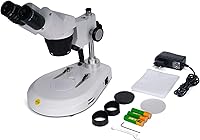
Most buyers report receiving the scope in adequate condition, and the included accessory set — two eyepiece pairs, two stage plates, and the power adapter — covers the basics for immediate use without requiring additional purchases out of the gate.
Packaging quality has been flagged in a meaningful number of reviews, with some buyers receiving units with minor cosmetic damage or loosely fitted accessories due to insufficient internal padding. A few buyers also noted missing components, requiring follow-up with customer support to resolve.
Lighting Longevity
81%
19%
LED-based illumination means the lights are unlikely to need replacing under normal hobbyist or classroom use cycles — a practical advantage over older halogen systems that required bulb swaps and generated significantly more heat near the specimen.
There are limited long-term reports given the scope's 2020 launch date, so LED lifespan under heavy daily professional use remains somewhat unverified. A small number of users reported one LED channel dimming earlier than expected, though this appears to be isolated rather than a widespread pattern.

Suitable for:

The Swift S306S Binocular Stereo Microscope is a strong fit for anyone who regularly works with small, solid objects and needs magnified surface detail without a steep learning curve. Electronics hobbyists and repair technicians will find it particularly useful — inspecting solder joints, tracing circuit board traces, or checking component placement at 40x or 80x is exactly the kind of work this scope handles well. Coin and stamp collectors, gemologists, and jewelry makers who want sharp, well-lit close-up views without investing in professional-grade lab equipment will also get solid value here. The 360° rotatable head makes it a smart choice for teachers or workshop instructors who need to share the view with multiple students without disturbing the specimen. It also suits entry-level to mid-level users who want a genuinely capable stereo microscope that is straightforward to set up and use from day one.

Not suitable for:

The Swift S306S Binocular Stereo Microscope is not the right tool if your primary interest is biological research or viewing prepared slides and microorganisms — that requires a compound microscope with significantly higher magnification and a fundamentally different optical design. Users who anticipate needing magnification beyond 80x will hit the ceiling of what this scope can deliver, and pushing to that upper limit is where some optical softness begins to appear. Professional researchers, advanced microscopists, or anyone working in a scientific lab context will likely find the feature set underwhelming relative to their needs. If you are after a trinocular setup for attaching a camera or documentation system, this binocular-only model does not accommodate that directly. Finally, buyers who expect crisp, publication-quality imaging at maximum magnification may be disappointed — this is a capable hobbyist and light-professional tool, not a precision research instrument.

Specifications

  • Brand: Manufactured by Swift, a brand focused on optical instruments for educational and hobbyist use.
  • Model Number: The exact model designation is S306S-20-2L, identifying the binocular stereo configuration with dual eyepiece set.
  • Magnification: Offers three magnification levels — 20x, 40x, and 80x — achieved by combining 2x and 4x objectives with the included 10x and 20x eyepieces.
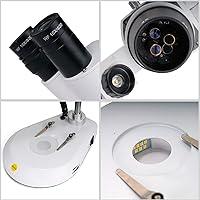
  • Eyepieces: Includes two pairs of wide-field eyepieces: 10x and 20x, both interchangeable and mounted on a binocular head with interpupillary adjustment.
  • Objective Lenses: Fitted with two achromatic objective lenses at 2x and 4x magnification, designed to minimize color fringing and optical distortion.
  • Head Rotation: The forward-mounted binocular head rotates a full 360°, allowing repositioning for different users or viewing angles without moving the specimen.
  • Viewing Angle: The binocular head is fixed at a 45-degree angle to promote an ergonomic, upright posture during extended observation sessions.
  • Illumination: Features independently dimmable upper (incident) and lower (transmitted) LED lights to suit both opaque and semi-transparent specimens.
  • Stage Plates: Comes with two stage plates: a reversible black/white plate for contrast viewing and a frosted glass plate for transmitted light use.
  • Interpupillary Adj.: The binocular head supports interpupillary distance adjustment to accommodate different users comfortably.
  • Item Weight: The assembled unit weighs approximately 6.69 pounds (3.04 kg), making it stable on a workbench but not particularly portable.
  • Dimensions: Packaged dimensions measure 14.3 x 12.8 x 9.2 inches, reflecting the compact but solid footprint of the assembled scope.
  • Power Input: Operates on 240V AC power via the included adapter, suitable for standard mains electrical supply.
  • Light Source: Both upper and lower illumination systems use LED bulbs, offering energy efficiency and a long operational lifespan compared to halogen alternatives.
  • Optical Material: Primary optical components, including the eyepiece lenses and stage plate, are constructed from glass for clarity and scratch resistance.
  • Head Type: Binocular (two-eyepiece) stereo configuration; no trinocular port is included for camera attachment.
  • Category Rank: Ranked #54 in Lab Stereo Microscopes on Amazon as of its listing data, reflecting strong market presence in its segment.
  • Availability: First made available for purchase in October 2020, with consistent availability maintained since launch.

Related Reviews
Swift SW380B Binocular Compound Microscope
79%
83%
Optical Clarity
88%
Build Quality
86%
Ergonomics & Comfort
79%
Magnification Range & Versatility
81%
Focusing System
More
AmScope SE508 8X Magnification Binocular Stereo Microscope
85%
91%
Build Quality
88%
Usability & Ergonomics
80%
Magnification Performance
85%
LED Illumination Effectiveness
93%
Stability
More
AmScope SE400-Z Binocular Stereo Microscope
77%
88%
Build Quality
79%
Optical Clarity
93%
Working Distance & Clearance
86%
Boom Arm Flexibility
81%
Eyepiece Comfort & Ergonomics
More
AmScope SM-4B Stereo Zoom Microscope Boom Stand
76%
93%
Build Quality
88%
Optical Clarity
91%
Boom Stand Versatility
41%
Illumination
82%
Ergonomics
More
Swift SW350B Binocular Compound Microscope
75%
83%
Optical Clarity
88%
Build Quality
86%
Ergonomics & Comfort
61%
Camera Performance
47%
Software Usability
More
MAXLAPTER RM Binocular Compound Microscope
78%
83%
Optical Clarity (Mid-Range)
58%
Maximum Magnification Quality
86%
Build Quality
91%
Mechanical Stage
84%
Illumination System
More
Swift SW380T Trinocular Compound Microscope
81%
83%
Optical Clarity
89%
Build Quality
81%
Focusing Mechanism
77%
Trinocular Head & Camera Compatibility
86%
Mechanical Stage
More
LAKWAR 40X-1000X Binocular Compound Microscope
75%
83%
Optical Clarity (Low Magnification)
54%
Optical Clarity (High Magnification)
88%
Binocular Viewing Comfort
81%
Dual LED Illumination
61%
Build Quality & Durability
More
Celestron Labs S20 Stereo Microscope
76%
93%
Ease of Setup
76%
Optical Clarity
41%
Magnification Versatility
72%
Lighting System
89%
Portability
More
SWIFT SS121 Compound Monocular Microscope Kit
80%
88%
Build Quality
81%
Optical Clarity
84%
Illumination System
86%
Ease of Use
72%
Magnification Range
More

FAQ

Not effectively. This is a stereo microscope designed for surface inspection of solid, three-dimensional objects — think circuit boards, coins, or insects. For viewing cells, bacteria, or prepared biological slides, you need a compound microscope with much higher magnification. These are two fundamentally different tools.

Most buyers find it quite manageable. The main steps involve attaching the head to the stand, inserting the eyepieces, and plugging in the light source. There is no complicated calibration required to get started, and the included instructions cover the basics adequately.

Not directly. This is a binocular-only model without a trinocular port, so there is no dedicated camera mount built in. Some users have experimented with eyepiece-mounted phone adapters for casual photo capture, but if documentation or live display is a core need, you should look at a trinocular stereo microscope instead.

For the vast majority of hobbyist and light-professional electronics tasks — soldering, component identification, trace inspection — 20x to 40x is actually the most useful range, and 80x covers more demanding detail work. If you are doing highly specialized microelectronics work that routinely demands beyond 80x, you may eventually outgrow it, but most repair technicians find the range fully adequate.

They are independently controlled and each is dimmable, which is one of the more practical features on this scope. You can run just the upper light for opaque objects, just the lower light for translucent specimens on the frosted glass plate, or combine both for even illumination.

A stiff focus knob is a common early complaint and does not necessarily mean the unit is defective. Some users report it loosens up with regular use after a short break-in period. If it remains unusably tight, it is worth contacting Swift's support team, as the brand has a reasonable reputation for addressing mechanical issues.

The binocular head allows you to adjust the spacing between the two eyepieces to match your own eye spacing, which is standard on stereo binocular scopes. The adjustment is straightforward — you simply pull or push the eyepiece tubes apart or together until you see a single merged image rather than two separate circles.

Yes, with appropriate supervision. The rotatable head is particularly useful in classroom settings where multiple students need to observe the same specimen in turn. The controls are not overly complex, and the 45-degree viewing angle is comfortable for younger users. For younger children, adult guidance is still recommended for setup and handling.

The eyepiece tube accepts standard 30mm diameter eyepieces, so compatible third-party options can technically be used. That said, swapping in non-matched optics can affect image quality, and the scope is optimized around the included eyepiece and objective combinations. If you experiment with aftermarket eyepieces, results may vary.

Stereo microscopes generally offer a generous working distance compared to compound scopes, and this binocular scope is no exception. There is enough clearance beneath the objective lenses to manipulate specimens with tweezers or small tools while viewing, which is particularly useful for electronics work or dissection tasks.