Overview

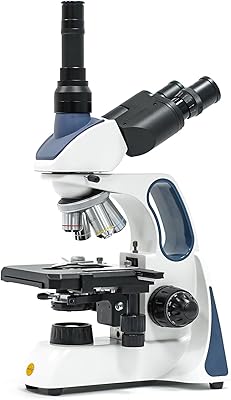
The Swift SW350B Binocular Compound Microscope sits in an interesting middle ground — substantial enough for serious slide work, yet accessible enough for students and dedicated hobbyists who want more than a toy. Swift has built a quiet but steady reputation among science educators, and this instrument reflects that: it feels thoughtfully put together rather than spec-padded. The binocular Siedentopf head alone sets it apart from budget monoculars; adjusting interpupillary distance mid-session without losing focus is a genuine practical convenience. The bundled 1.3MP camera adds real documentation value. Just know this is a transmitted-light scope — designed for specimens on slides, not rocks or insects on a table.

Features & Benefits

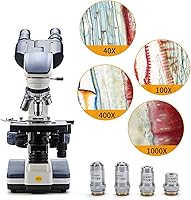
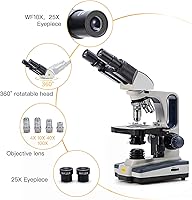
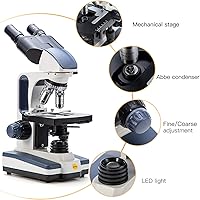
Four DIN achromatic objectives on a revolving turret deliver six magnification steps from 40X up to 2500X. In practice, the sweet spot for most users falls between 40X and 400X, where image clarity is genuinely impressive. The 100X oil immersion objective pushes into higher territory, but those upper levels demand careful technique — not ideal for beginners. The mechanical stage is one of the SW350B's standout practical touches: it holds slides firmly and lets you scan across a specimen with controlled, repeatable movements. LED illumination through an Abbe condenser keeps things bright and even, while the all-metal body adds real rigidity when dialing in fine focus.

Best For

This Swift binocular microscope is a natural fit for students and hobbyists who need reliable optics for coursework or independent study without the complexity of a full research-grade instrument. Amateur mycologists examining fungal spores, or home lab enthusiasts preparing their own slides, will appreciate the camera integration for capturing and sharing what they observe. The ergonomic binocular head also makes it practical for clinical settings where multiple people share the scope throughout a day. If you're currently using an entry-level monocular and finding it fatiguing or limiting, this compound microscope is a meaningful step up — better optics, a sturdier stage, and photographic documentation built right in.

User Feedback

With a 4.0-star average across dozens of reviews, the SW350B earns its rating honestly — most buyers are satisfied, but it is not without complaints. Mid-range optical clarity and the solid all-metal build draw consistent praise, and setup is reported to be straightforward even for first-time microscope owners. The friction comes mainly from two areas: the bundled camera software can be clunky, with some users struggling to get it running reliably on newer operating systems, and the 2500X magnification claim draws real skepticism — achieving a usable image at that power requires oil immersion technique that many buyers simply are not prepared for. Packaging and customer support receive mixed marks, so inspect carefully on arrival.

Pros

  • Binocular viewing is noticeably more comfortable than monocular scopes during extended sessions.
  • Optical clarity from 40X to 400X is strong for the price tier — images are sharp and well-defined.
  • The mechanical stage allows precise, controlled specimen scanning rather than awkward hand-nudging.
  • All-metal construction makes the SW350B feel sturdy and stable, with no flex during fine-focus adjustments.
  • The Siedentopf head adjusts interpupillary distance without losing focus — a practical convenience most budget scopes skip.
  • Bundled 1.3MP camera is functional for capturing and sharing images without buying additional accessories.
  • Six magnification steps give real flexibility for moving between low-power surveys and higher-detail inspection.
  • LED illumination is bright, even, and adjustable — no bulb replacements or warm-up time needed.
  • Setup is straightforward enough for first-time users to get viewing quickly.
  • Ranks among the top-selling compound binocular microscopes, reflecting broad buyer confidence.

Cons

  • The bundled camera software feels dated and can be finicky on current operating systems.
  • 2500X magnification is technically possible but rarely delivers a clean, usable image without expert technique.
  • At nearly 10 pounds, the SW350B is heavy and not practical to move or transport frequently.
  • The 1.3MP camera resolution is adequate for documentation but noticeably limited for detailed imaging work.
  • Some buyers report inconsistent packaging quality, with minor cosmetic damage arriving on occasion.
  • Oil immersion at 100X requires specific supplies and technique that beginners may not anticipate needing.
  • Customer support response times have drawn mixed feedback from buyers needing post-purchase assistance.
  • No carrying case is included, which is a gap given the weight and investment involved.
  • The 240V voltage spec may require a converter for users in regions with different electrical standards.

Ratings

The scores below reflect an AI-driven analysis of verified global buyer reviews for the Swift SW350B Binocular Compound Microscope, with spam, incentivized, and bot-generated feedback actively filtered out to protect integrity. Covering everything from optical performance to software usability, each category is scored to honestly reflect where this compound microscope earns real praise — and where it leaves buyers frustrated. Both the strengths and the friction points are represented without bias.

Optical Clarity
83%
At working magnifications between 40X and 400X, users consistently report sharp, well-resolved images with good contrast — well above what most expect at this price tier. Students examining cell structures and hobbyists exploring pond samples praise the achromatic objectives for producing clean, color-accurate views without significant fringing.
At higher magnifications, particularly approaching 1000X and 2500X, image quality drops noticeably unless the user has solid oil-immersion technique. Several buyers reported frustrating softness and chromatic distortion at the upper end, which feels misleading given the advertised magnification range.
Build Quality
88%
The all-metal chassis is one of the most consistently praised aspects across reviews — users note it feels substantial and professional, not hollow or plasticky like cheaper competitors. The focus knobs operate smoothly without backlash, and the revolving objective turret clicks firmly into each position without wobble.
A subset of buyers reported minor cosmetic imperfections arriving out of the box — small marks on the body or slight finish inconsistencies — suggesting quality control is solid but not perfectly uniform across every unit shipped.
Ergonomics & Comfort
86%
The 30-degree binocular viewing angle makes a meaningful difference during longer sessions compared to flat-tube monocular scopes — users report far less neck and shoulder strain during extended study or research work. The Siedentopf interpupillary adjustment is also praised for accommodating different users quickly without disturbing the focused image.
A few users with smaller or larger than average interpupillary distances found the adjustment range slightly limiting. The eyecups, while functional, are not the most luxurious for eyeglass wearers who need precise eye relief management.
Camera Performance
61%
39%
For its intended purpose — basic documentation, sharing images with students, or keeping a visual log of specimens — the 1.3MP camera gets the job done. Users who simply want to save images of slides for study notes or blog posts find it a convenient, hassle-free addition that avoids the cost of a separate purchase.
Anyone expecting genuinely detailed photomicrographs will be let down — the resolution is clearly entry-level, and color accuracy under higher magnification is inconsistent. More critically, several users report the camera software is difficult to install on modern operating systems, which undercuts what should otherwise be a handy included feature.
Software Usability
47%
53%
The bundled software does offer a reasonable feature set on paper — stitching, extended depth of field, and measurement tools are genuinely useful capabilities for students and researchers who manage to get it working correctly. Mac users with older OS versions and Windows users on legacy systems tend to have the smoothest experience.
This is the most common pain point in user reviews. The software feels outdated, lacks intuitive design, and routinely causes compatibility issues on current Windows and Mac versions. Multiple buyers described spending more time troubleshooting the software than using the microscope itself, which is a significant frustration for the price paid.
Stage & Specimen Control
84%
The double-layered mechanical stage is well-regarded for making systematic specimen scanning actually practical — users describe the ability to move a slide incrementally across a grid pattern as a substantial upgrade from fixed-stage entry-level scopes. The slide holder grips firmly without cracking standard glass slides.
The stage movement controls, while functional, can feel slightly stiff when brand new and require a short break-in period before they move with real smoothness. A small number of users reported slight backlash in one axis of movement, though this appears to vary by unit.
Illumination Quality
81%
19%
The LED light source paired with the Abbe condenser delivers bright, consistent illumination across the field of view, and the adjustable brightness dial is simple and effective. Users appreciate never having to deal with bulb replacements, heat buildup, or warm-up time that older halogen-equipped scopes required.
At maximum brightness, a handful of users noted the illumination can feel slightly uneven toward the edges of the field when using lower-power objectives, which is more a characteristic of the Abbe condenser design than a defect, but worth knowing for users who prioritize flat-field illumination.
Ease of Setup
87%
The SW350B arrives largely pre-assembled, and most buyers report being up and viewing slides within 15 to 20 minutes of opening the box. The process of attaching objectives and seating eyepieces is intuitive even for first-time users, and the included instructions cover the basics adequately.
Getting the camera and software configured adds meaningful complexity that is not well-reflected in the setup guide. Users who are not particularly tech-savvy describe the camera installation as a genuinely frustrating experience that required outside research to resolve.
Value for Money
76%
24%
For buyers who use the optics regularly — students, hobbyists, small labs — the SW350B delivers real value through its binocular head, mechanical stage, and solid build quality, features that are meaningful upgrades over similarly priced monocular alternatives. The included camera removes a separate purchase that would otherwise cost extra.
If the camera software is barely usable on your system, a key part of the value proposition evaporates. Buyers who purchase expecting a smooth all-in-one digital microscope experience may feel the price is harder to justify when the camera component consistently underdelivers.
Magnification Range
69%
31%
Having six usable magnification levels gives this scope genuine versatility for the typical slide-based workflow — from broad survey views at 40X to meaningful detail work at 400X. The range covers the vast majority of what students, hobbyists, and clinicians actually need in day-to-day use.
The advertised 2500X figure consistently overpromises. Reaching that level requires oil immersion technique, precise slide preparation, and considerable experience — conditions most buyers do not have. Framing this as a headline specification sets unrealistic expectations and has generated notable buyer disappointment.
Durability & Longevity
82%
18%
The metal construction that defines this scope's feel also contributes to its longevity — users who have owned the SW350B for a year or more report that optical and mechanical performance holds up well under regular academic or hobbyist use without meaningful degradation.
There is limited long-term data on the LED module lifespan, and some users have expressed uncertainty about the availability of replacement parts if components eventually fail. The all-metal body is durable but adds weight that makes the unit less portable over time.
Packaging & Unboxing
67%
33%
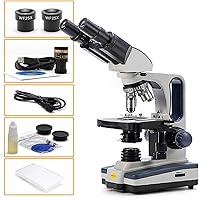
The majority of buyers receive their unit in acceptable condition, with foam inserts protecting the optics and body reasonably well during transit. The package includes the key accessories — objectives, eyepieces, camera, and power cable — without requiring immediate additional purchases for basic use.
A visible minority of reviews mention arriving units with cosmetic blemishes, loose objective turrets, or accessories that appear to have shifted during shipping. While not a structural failure in most cases, it creates an underwhelming first impression for a mid-range purchase and has contributed to some negative early ratings.
Customer Support
59%
41%
Some users who have reached out to Swift directly report receiving helpful responses, particularly regarding software troubleshooting guidance. The brand has a recognized presence among the science education community, which gives some buyers confidence that support exists beyond a generic retail channel.
Response times and support quality appear inconsistent based on reviews. A notable share of buyers who experienced software or camera issues describe slow replies or generic troubleshooting steps that did not resolve their specific problem, leaving them to self-solve through user forums.
Compatibility & Expandability
78%
22%
The binocular head accepts standard eyepiece camera attachments, meaning buyers can upgrade to a higher-resolution camera in the future without replacing the whole scope. The interchangeable eyepiece system also allows compatible third-party accessories to be used with the existing body.
The voltage specification at 240V requires buyers in North America and other 110-120V regions to verify their setup carefully — though a converter is typically straightforward to source, it is an extra consideration that the product listing does not make prominently clear.

Suitable for:

The Swift SW350B Binocular Compound Microscope is an excellent match for high school and university students who need a dependable, capable instrument for biology coursework without the steep cost of professional lab equipment. Hobbyists with a serious interest in microscopy — whether they are examining fungi, preparing their own blood smears, or exploring pond water samples — will find the optical quality and built-in camera genuinely useful for documenting and sharing findings. Educators running small-group science sessions benefit from the fully rotatable Siedentopf head, which makes sharing the scope between students fast and comfortable. Small clinical settings or independent practitioners who need a reliable shared-use instrument will also appreciate the ergonomic binocular design during long sessions. If you are upgrading from a basic single-eyepiece scope and want a meaningful jump in comfort, image quality, and functionality, the SW350B hits that mark well.
Not suitable for:

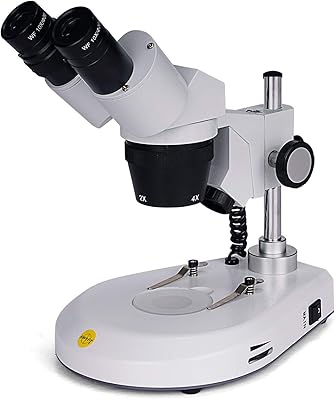
The Swift SW350B Binocular Compound Microscope is not the right tool for anyone expecting to work primarily with three-dimensional objects like insects, coins, circuit boards, or mineral samples — that requires a stereo microscope, which this is not. Buyers attracted by the advertised 2500X magnification should temper expectations: reaching that level cleanly requires oil immersion technique, precise slide preparation, and considerable practice, making it largely inaccessible for casual or beginning users. Professional researchers or imaging specialists who need publication-quality photomicrography will find the 1.3MP camera insufficient and the software dated compared to dedicated imaging systems. Those who need full portability or battery-powered field use will be disappointed by the corded LED system and the near 10-pound metal body. Finally, buyers on a very tight budget looking for the absolute lowest entry point may find better value in a simpler monocular scope, since the SW350B's strengths are best realized by users who will actually use the binocular head and camera features.
Specifications

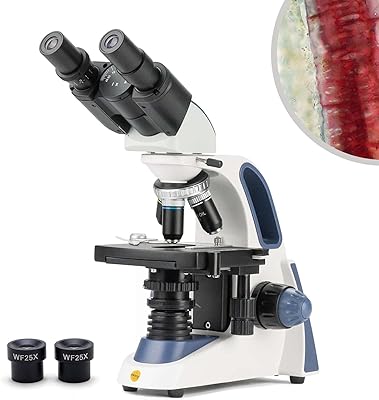
  • Head Type: Binocular Siedentopf head, fully rotatable, with a fixed 30-degree ergonomic viewing tilt to reduce neck and shoulder strain during extended use.
  • Eyepieces: Two pairs of interchangeable wide-field glass eyepieces are included: 10X and 25X, both compatible with standard camera and eyepiece attachments.
  • Objectives: Four DIN achromatic objectives — 4X, 10X, 40X (spring-loaded), and 100X (spring-loaded, oil immersion) — mounted on a revolving turret.
  • Magnification: Six magnification levels are achievable: 40X, 100X, 250X, 400X, 1000X, and 2500X, depending on the eyepiece and objective combination used.
  • Stage: Double-layered mechanical stage with a secure slide holder allows precise X-Y specimen positioning for repeatable, controlled scanning.
  • Illumination: LED light source with adjustable brightness transmits through an Abbe condenser beneath the stage for consistent, even transillumination of slide specimens.
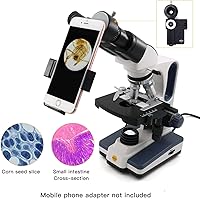
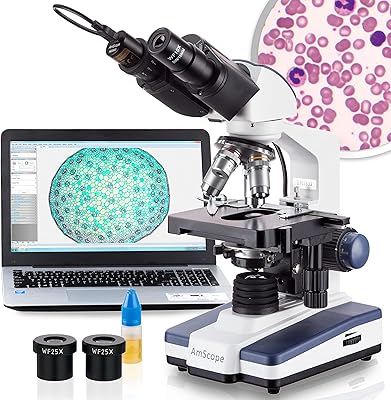
  • Camera: A 1.3MP digital eyepiece camera is included, connecting via USB for live viewing, image capture, and video recording on a connected computer.
  • Software: Bundled imaging software is compatible with Mac OS X and Windows Vista, 7, 8, and 10 (both 32-bit and 64-bit), and supports stitching, extended depth of field (EDF), and on-screen measurement tools.
  • Body Material: The chassis and arm are constructed from metal, providing structural rigidity and minimizing vibration during fine-focus adjustments.
  • Item Weight: The unit weighs approximately 10.12 pounds (4.6 kg), reflecting the all-metal build intended for stable bench-top use.
  • Dimensions: Packaged dimensions are 18.1 x 12.9 x 9.1 inches, suitable for standard lab benches or dedicated desk setups.
  • Voltage: The LED illumination system operates at 240V, and users in regions with different electrical standards should verify compatibility before use.
  • Interpupillary Adj.: The Siedentopf binocular head allows interpupillary distance adjustment so different users can adapt the eyepiece spacing without losing the current focus.
  • Condenser: An Abbe condenser is positioned beneath the mechanical stage and works in conjunction with the LED source to optimize light concentration on specimens.
  • Market Rank: The SW350B holds a position of approximately #12 in Lab Compound Binocular Microscopes on Amazon, based on sales performance data.

Related Reviews

Swift SW380B Binocular Compound Microscope
79%
83%
Optical Clarity
88%
Build Quality
86%
Ergonomics & Comfort
79%
Magnification Range & Versatility
81%
Focusing System
More
SWIFT SW200DL Compound Monocular Microscope
81%
83%
Optical Clarity
78%
Magnification Range
91%
Dual Illumination System
88%
Build Quality & Durability
86%
Fine Focus Mechanism
More
AmScope B490B Compound Binocular Microscope
85%
94%
Optical Clarity
90%
Build Quality
85%
Ease of Use
92%
Value for Money
93%
Magnification Range
More
SWIFT SS121 Compound Monocular Microscope Kit
80%
88%
Build Quality
81%
Optical Clarity
84%
Illumination System
86%
Ease of Use
72%
Magnification Range
More
SVBONY SV605 Binocular Compound Microscope
85%
90%
Value for Money
88%
Ease of Setup
85%
Build Quality
89%
Optical Performance
91%
Illumination System
More
AmScope B100B-MS Compound Binocular Microscope
69%
83%
Build Quality
74%
Optical Clarity
61%
Illumination
69%
Magnification Range
71%
Mechanical Stage
More
BOGRINUO RM Binocular Compound Microscope
70%
78%
Optical Clarity (Low-Mid Power)
52%
Optical Clarity (High Power)
81%
Build Quality
83%
Ergonomics & Comfort
76%
Mechanical Stage Quality
More
Swift S306S Binocular Stereo Microscope
79%
83%
Optical Clarity
79%
Build Quality
88%
Illumination System
71%
Magnification Range
91%
Head Design & Ergonomics
More
SWIFT SW400 Infinity-Corrected Trinocular Compound Microscope
85%
94%
Optical Performance
91%
Build Quality
88%
Ease of Use
89%
Magnification Range
86%
Illumination Quality
More
AmScope B120C-E5 Binocular Compound Microscope
78%
88%
Optical Clarity
76%
Build Quality
91%
Illumination Quality
84%
Ergonomics & Comfort
67%
USB Camera Quality
More

FAQ

It is actually a great fit for serious high school students and anyone at the university level. The optics are strong enough for real coursework — cell structures, prepared slides, basic microbiology — without being so complicated that a student cannot figure it out. If anything, it will last well beyond high school and into college-level use.

Technically yes, but practically it is very difficult unless you know what you are doing. Reaching 2500X requires the 100X oil immersion objective combined with the 25X eyepiece, and that means applying immersion oil to your slide, precise focus control, and well-prepared specimens. Beginners will likely find the image blurry or washed out at that power. Most useful work happens between 40X and 400X.

Most buyers report a straightforward setup experience — unbox, attach the objectives and eyepieces, plug in the LED, and you are viewing within minutes. The Swift SW350B Binocular Compound Microscope ships mostly assembled, so there is very little mechanical work involved. Getting the camera software running on your computer takes a bit more patience, particularly on newer operating systems.
Yes, the bundled software officially supports Mac OS X, but some users have reported compatibility hiccups depending on their specific OS version and security settings. If you run into issues, it is worth checking Swift's website for updated drivers or software before concluding the camera does not work.

Yes, and that is one of the practical strengths of this scope. The Siedentopf head rotates fully, so a second person can swing it to their side without moving the whole unit. Adjusting the interpupillary distance for a different user also does not knock the focus off, which makes sharing in a classroom or clinic setting genuinely convenient.

This is a compound transmitted-light microscope, so it is designed for thin, flat specimens on prepared slides — think cells, bacteria, fungi, blood smears, and tissue sections. It is not meant for three-dimensional objects like insects, coins, or circuit boards. For those, you would need a stereo microscope instead.

For casual documentation, sharing on social media, or including in student reports, the 1.3MP camera is perfectly usable. It is not a high-resolution imaging solution, so if you need sharp, publication-quality photomicrographs, you would want to invest in a better camera separately. For most everyday documentation needs, though, it does the job.

At just over 10 pounds, the SW350B is solidly built but not particularly portable. It is designed to live on a bench or desk and stay there. Moving it between rooms occasionally is fine, but it is not something you would want to carry to and from school regularly without a proper bag or case — neither of which are included.

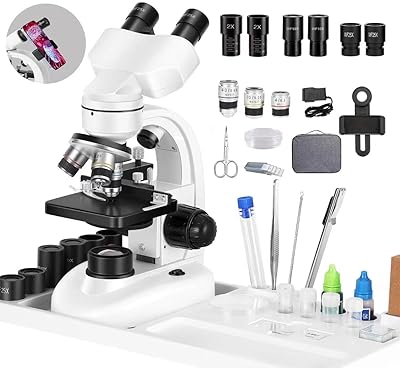
For basic viewing, you just need prepared slides, which are widely available and inexpensive. If you plan to use the 100X oil immersion objective, you will need to purchase immersion oil separately — it does not come included. A USB cable for the camera should be in the box, but double-check against the listed contents when yours arrives.

A handful of buyers have mentioned receiving units with minor cosmetic marks or packaging that showed some wear in transit. When yours arrives, check all four objectives for any scratches or debris on the glass, verify that both eyepieces seat properly, and test the LED illumination before anything else. If something seems off, contact the seller promptly rather than waiting.

Where to Buy