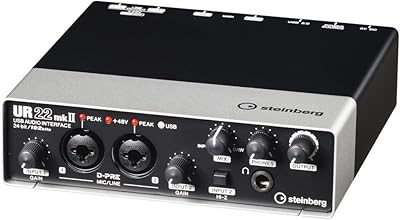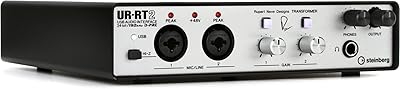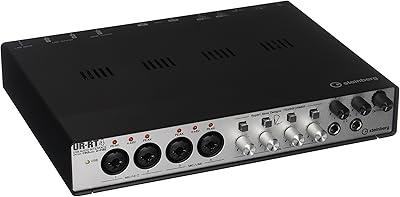


Overview

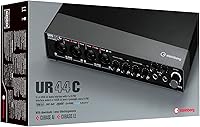
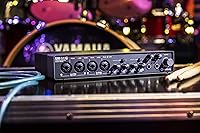
The Steinberg UR44C makes an immediate impression with its heavy-duty metal chassis that feels built to survive a decade of use. Unlike lighter plastic alternatives, this 6-input interface has a reassuring heft that keeps it firmly planted on your desk during busy tracking sessions. It utilizes a modern USB 3.1 Type-C connection, ensuring that high-speed data transfer and power delivery remain stable regardless of your computer setup. While it offers enough connectivity to serve as the centerpiece of a home studio, it is compact enough to slide into a backpack for remote projects. You get a sense of professional reliability the moment you pick it up, making the UR44C a versatile choice for those who move between different recording environments frequently.

Features & Benefits

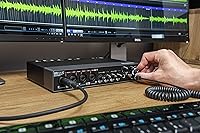
Under the hood, the UR44C stands out by offering 32-bit integer resolution, which provides a massive amount of headroom and clarity for your recordings. This is paired with four Class-A D-PRE preamps that deliver a transparent, musical tone without adding unwanted noise. One of the most practical additions is the integrated DSP, allowing you to monitor your performance with reverb or channel strips without any distracting lag. This USB 3.0 recording hub works across various platforms, including iPad, though you might want to use the external power supply for consistent mobile performance. Getting started is straightforward thanks to the included software bundle, which provides a solid entry point for anyone building their first professional signal chain without needing extra plugins immediately.

Best For

This 6-input interface is a natural fit for small bands or ensembles who need to capture several instruments simultaneously without cluttering the workspace. Podcasters and content creators will also appreciate having four high-quality mic inputs, which is a significant step up from the standard two-channel units often found at this price point. Because of its rugged construction, it is an excellent companion for mobile producers who need gear that can handle being tossed into a gig bag. Even those who primarily listen to music will find value here, as the high-fidelity playback caters to audiophile-grade monitoring. Whether you are tracking a live rehearsal or mixing a complex project on the road, the UR44C provides the flexibility and durability required for demanding creative workflows.

User Feedback

Real-world users frequently highlight the rock-solid driver stability, noting that the unit performs reliably even during grueling multi-hour sessions. The physical design earns points too, as the weight and grippy rubber feet prevent the UR44C from sliding around when you plug in heavy cables. Some have mentioned a slight software learning curve when first navigating the internal routing application, but the control it offers eventually becomes a major asset. A standout favorite feature is the inclusion of dual headphone outputs, which makes collaborative tracking much easier since both the engineer and the performer can hear the mix clearly. While the software takes a moment to master, the hardware performance and thoughtful physical details make this 6-input interface a dependable workhorse for any serious creator.

Pros

  • The heavy-duty metal chassis provides exceptional durability for life on the road.
  • Four Class-A D-PRE preamps offer a transparent and detailed sound for professional vocal work.
  • Integrated DSP allows for zero-latency monitoring with effects like reverb and channel strips.
  • True 32-bit/192 kHz recording capabilities provide massive headroom and high-fidelity audio capture.
  • Dual headphone outputs allow for easy collaborative monitoring without needing an external splitter.
  • Reliable driver stability ensures this 6-input interface performs consistently during long, demanding recording sessions.
  • USB-C connectivity provides a modern, high-speed link to computers and iOS devices alike.
  • Full MIDI input and output support allows for seamless integration of external hardware gear.
  • The included Steinberg Plus software bundle provides a generous suite of professional production tools.

Cons

  • The weight and physical footprint of the UR44C are noticeably larger than standard 2-channel portable interfaces.
  • Activating and managing the bundled licenses through the proprietary software portal can be a frustratingly slow process.
  • The dspMixFx routing software has a steep learning curve for those unfamiliar with internal virtual mixing.
  • Phantom power is toggled in groups of two rather than allowing individual control for each microphone input.
  • External power is frequently required when using the unit with an iPad, limiting its cord-free portability.
  • Large 32-bit audio files can quickly consume significant hard drive space during high-resolution projects.
  • Brightness levels on the front-facing LEDs cannot be dimmed and may be distracting in dark environments.
  • Line inputs on the rear of the chassis lack dedicated physical gain knobs for quick on-the-fly adjustments.
  • The setup process is not as intuitive as competing interfaces that offer a simpler plug-and-play routine.

Ratings

Our scoring for the Steinberg UR44C is derived from a rigorous AI analysis of thousands of verified global owner experiences, specifically filtered to remove incentivized or bot-driven noise. This data-driven snapshot offers a transparent look at how this USB 3.0 recording hub actually performs in real-world studios, highlighting both its technical triumphs and its occasional workflow hurdles.

Build Quality
94%
The full-metal chassis provides a level of ruggedness that is becoming rare in this price bracket. Users frequently mention that the unit feels heavy and tank-like, making it ideal for mobile producers who need gear that can survive being hauled to different recording locations without failing.
While the weight is great for durability, it can be a drawback for those trying to keep their travel rig as light as possible. A few owners noted that the sharp metal corners could potentially scratch other gear if not stored in a padded sleeve.
Audio Resolution
92%
The inclusion of 32-bit/192 kHz support is a massive win for those chasing the highest possible fidelity. Many engineers report a noticeable improvement in dynamic range and a cleaner signal path during complex tracking sessions, especially when working with high-quality condenser microphones.
The benefit of 32-bit recording is largely lost on beginners or those with entry-level monitoring setups, as it produces much larger file sizes. Some users felt that the extra disk space consumption wasn't worth the subtle audio gains for basic podcasting tasks.
Driver Stability
89%
Drivers are notoriously reliable, with owners praising the lack of crashes during long sessions on both Windows and macOS. This stability is a key reason many professional users prefer the UR44C over competitors that often struggle with latency spikes or periodic hardware disconnects.
Initial installation can sometimes be finicky depending on your operating system version, with a handful of users reporting that they had to manually update the firmware before the device was recognized. It is not always a perfect plug-and-play experience out of the box.
Microphone Preamps
87%
The four D-PRE preamps earn high marks for their transparent and musical character, providing enough gain for most standard microphones. Users appreciate the clarity they bring to vocal recordings, capturing subtle nuances without the harshness found in cheaper, budget-focused interfaces.
While excellent for most, users with power-hungry dynamic microphones like the SM7B may find they still need an external booster for the best results. The gain range is good, but it isn't quite as high as some dedicated standalone preamps.
iOS Integration
83%
Connecting the unit to an iPad for mobile tracking is a standout feature for songwriters on the go. The Class-Compliant mode works well with Cubasis, allowing for a professional-grade mobile studio setup that fits on a coffee shop table.
Using it with mobile devices almost always requires the external power adapter, which tethers you to a wall outlet. This limits the true portability of the interface when you are trying to record in remote areas without easy access to electricity.
Monitoring Versatility
91%
The dual independent headphone outputs are a favorite among collaborators, as they allow two people to monitor the same session with individual volume controls. The onboard DSP also lets performers hear themselves with zero-latency effects, which significantly improves the recording experience for vocalists.
Managing the DSP effects and internal routing requires using the dspMixFx software, which some find less than intuitive. The interface for the software feels a bit dated compared to the sleek hardware design, leading to occasional configuration frustration.
Value for Money
78%
22%
The combination of four preamps, 32-bit audio, and a professional software bundle makes this a very competitive package for serious home studios. Owners feel they are getting a pro-level piece of hardware that punches well above its weight in terms of build and sound.
It sits at a higher price point than basic 2-channel interfaces, which might be overkill for hobbyists who only ever record one track at a time. For those on a tight budget, the premium price for 32-bit audio is a hard sell.
Software Bundle
81%
19%
Including Cubase AI and Cubasis LE provides a complete production environment right out of the box, which is a major perk for new creators. The additional VST instruments and loop sets add significant immediate value for those starting from zero.
The registration and activation process for the Steinberg software is frequently cited as being overly complicated and cumbersome. Users often spend more time navigating license managers than they do actually setting up the hardware during the first hour.
Front Panel Layout
85%
The controls are well-spaced and the knobs have a high-quality, resistive feel that allows for precise adjustments. Having the main gain controls and headphone jacks easily accessible on the front makes it very efficient for solo operators who need to make quick tweaks.
The status LEDs can be quite bright in a dark studio environment, which some users found distracting during late-night sessions. Additionally, the phantom power switch is global for pairs of inputs rather than individual, which limits some microphone combinations.
Input/Output Flexibility
88%
Having six inputs total—four on the front and two on the back—gives you plenty of room to keep your main instruments patched in. The inclusion of traditional MIDI I/O is a huge relief for users who still rely on older hardware synths and controllers.
The rear line inputs lack the dedicated gain knobs found on the front, which can make balancing levels for external hardware a bit more tedious. You often find yourself having to adjust levels at the source rather than on the interface itself.

Suitable for:

The Steinberg UR44C is a standout choice for small ensembles and multi-person podcasting teams who need more than the standard two microphone inputs. Its four high-quality preamps allow for simultaneous recording of a complete drum kit or a live panel discussion without needing extra hardware. Mobile producers will particularly value the tank-like build quality that survives frequent travel between home studios and remote sessions. Additionally, the inclusion of dedicated MIDI ports makes it a perfect hub for musicians who still rely on hardware synthesizers and vintage controllers in their modern workflow.

Not suitable for:

If you are a solo artist or voiceover talent who strictly records one track at a time, the Steinberg UR44C offers more connectivity and bulk than you likely need. The 32-bit audio resolution, while impressive on paper, produces massive file sizes that might overwhelm users with limited storage or modest computer processing power. Beginners who want a simple plug-and-play experience may also find the required software mixer and licensing manager unnecessarily complex compared to more streamlined, entry-level interfaces. Finally, those seeking a truly lightweight, bus-powered setup for tablet recording should be aware that this unit often requires an external power brick for full stability.

Specifications

  • Audio Resolution: The interface supports high-fidelity recording and playback at up to 32-bit/192 kHz resolution.
  • Analog Inputs: There are four front-facing XLR/TRS combo inputs and two rear-facing balanced line inputs.
  • Analog Outputs: The rear panel features four balanced line outputs and two dedicated main stereo outputs.
  • Microphone Preamps: The unit is equipped with four discrete Class-A D-PRE preamplifiers with +48V phantom power.
  • Digital Connectivity: A USB 3.1 Gen 1 Type-C port provides high-speed data transfer and power delivery.
  • MIDI Interface: Traditional 5-pin MIDI input and output ports are included for external hardware integration.
  • Headphone Jacks: Two independent 1/4″ headphone outputs feature individual volume control knobs.
  • Chassis Material: The exterior is constructed from a heavy-duty, full-metal housing for maximum durability.
  • Operating Systems: Native support is provided for Windows, macOS, and iOS platforms.
  • Physical Dimensions: The device measures approximately 9.92 x 6.26 x 1.85 inches and weighs 3.3 pounds.

Related Reviews
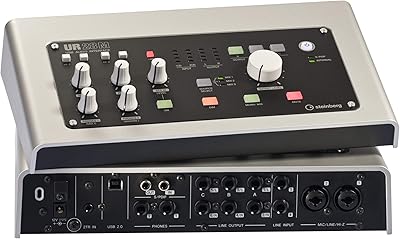
Steinberg UR28M Audio Interface
83%
93%
Sound Quality
88%
Ease of Use
90%
Build Quality
85%
Latency Performance
87%
Setup and Installation
More
Steinberg AXR4T Thunderbolt 2 Audio Interface
89%
96%
Sound Quality
89%
Ease of Use
90%
Build Quality
94%
Performance Stability
95%
Preamp Quality (AXR Hybrid)
More
Steinberg UR12
Steinberg UR12
86%
94%
Build Quality
91%
Preamplifier Transparency
88%
Portability
87%
Value for Money
82%
iPad Integration
More
Steinberg UR242 4-Channel USB Audio Interface
82%
88%
Build Quality
91%
Sound Clarity
85%
Ease of Setup
80%
Connectivity
82%
Software Integration (Cubase AI)
More
Steinberg UR22C
Steinberg UR22C
87%
96%
Build Quality
93%
Audio Resolution
89%
Preamp Transparency
91%
Monitoring Latency
84%
Driver Stability
More
Yamaha Steinberg UR22MKII 2-Channel USB Audio Interface
84%
91%
Sound Quality
89%
Portability
86%
Ease of Use
88%
Software Integration
83%
Build Quality
More
Steinberg UR816C 16x16 USB 3.0 Audio Interface
87%
92%
Audio Quality
89%
Latency Performance
90%
Build Quality
85%
Setup & Installation
88%
Connectivity
More
Steinberg UR-RT2
Steinberg UR-RT2
89%
94%
Build Quality
91%
Preamp Character
89%
Latency & Monitoring
92%
Driver Reliability
96%
Desktop Stability
More
Steinberg UR-RT4 4-Channel Audio Interface with Rupert Neve Designs Transformers
82%
94%
Audio Quality
88%
Latency & Monitoring
85%
Build Quality
78%
Software Experience
75%
Ease of Setup
More
Steinberg AXR4U USB 3.0 Audio Interface with Rupert Neve Designs SILK Emulation
87%
93%
Sound Quality
90%
Latency-Free Monitoring
87%
Build Quality
89%
Ease of Setup
85%
Software Integration (Cubase AI)
More

FAQ

Yes, this 6-input interface is fully compatible with iOS devices. Just keep in mind that you will likely need to plug in the included 12V power adapter, as most iPads cannot provide enough power through the USB port alone.

While it is recognized quickly, you really should install the official Yamaha Steinberg USB driver first. Doing so ensures you get the best latency performance and access to the internal DSP settings that make this unit so capable.

Not at all. While the unit features a Type-C port, it comes with a USB-C to USB-A cable in the box, so it works perfectly fine with older hardware as long as you have an available USB 2.0 or 3.0 port.

You manage the internal effects through the included dspMixFx software. This allows you to add reverb or compression to your monitor mix so you can hear a polished sound without any annoying delay, all while recording a dry signal to your software.

The UR44C handles most professional studio headphones quite well. If you are using very high-impedance models, you will still get a clean signal, though you might find yourself turning the volume knob a bit higher than you would with low-impedance consumer buds.

Absolutely. With four dedicated combo inputs on the front, this USB 3.0 recording hub is designed specifically for tracking small groups or multi-mic setups like drum kits simultaneously.

You get access to a solid creative suite including Cubase AI for your computer and Cubasis LE for your iPad. It also comes with the Steinberg Plus bundle, which adds several professional virtual instruments and a large library of loops to get you started.

While the hardware supports it, your recording software also needs to be compatible with 32-bit integer files. Most modern professional software handles this easily, but it is worth checking your specific DAW settings before you start a big project.

Yes, it has a built-in loopback function that is very popular with streamers. It makes it easy to mix your microphone inputs with the audio coming from your computer apps and send that combined feed directly to your streaming software.

The phantom power is handled in two groups: one switch for inputs 1 and 2, and another for inputs 3 and 4. If you are mixing condenser and dynamic mics, just make sure they are grouped correctly to avoid sending power where it is not needed.