QNAP TS-h973AX 32G 9-Bay NAS
Overview
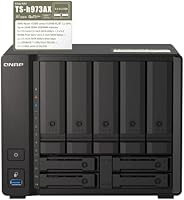
The QNAP TS-h973AX 32G 9-Bay NAS arrived in late 2020 as a serious contender for small businesses and power users who refuse to compromise on storage reliability. At its core is the AMD Ryzen Embedded V1500B, a quad-core processor that handles concurrent workloads without breaking a sweat. The hybrid bay design — five 3.5-inch and four 2.5-inch slots — lets you mix spinning drives with SSDs in ways that purely HDD-focused units simply cannot match. What really separates this QNAP unit from the crowd, though, is QuTS hero OS, a ZFS-native platform that brings enterprise-grade snapshot management and data integrity to a desktop-sized enclosure.
Features & Benefits
The networking stack on the TS-h973AX is where things get interesting. You get dual 2.5GbE ports for link aggregation or multi-subnet flexibility, plus a single 10GBASE-T port for connecting to compatible switches — handy if your infrastructure supports it, though most small office setups will not fully saturate that pipe right away. Standard 32GB of DDR4 RAM with optional ECC support is a thoughtful inclusion: under ZFS, ECC memory actively guards against silent data corruption in ways standard RAM simply cannot. Inline deduplication and compression can meaningfully shrink storage consumption for repetitive datasets, and the two SO-DIMM slots mean you can scale to 64GB when virtualization demands eventually grow.
Best For
This 9-bay NAS is a natural fit for small business IT teams who need flexible, high-capacity shared storage without committing to a full rack-mount setup. Video editors and photographers moving large RAW or 4K files across multiple workstations will appreciate the multi-gigabit throughput options. It also performs well for anyone running mixed workloads simultaneously — think surveillance feeds, virtual machines, and file sharing all at once — where a lesser NAS would buckle. Buyers stepping up from a consumer-grade unit who want real data protection will find the ZFS foundation genuinely reassuring. This is not a budget buy; it rewards users whose workloads justify the investment.
User Feedback
With a 4.0-star average across 91 ratings, the TS-h973AX earns its score honestly — not through universal love, but through strong performance where it counts and real shortcomings buyers should weigh. Recurring praise centers on QuTS hero OS stability, the headroom the platform provides for growing workloads, and how reliably the unit handles multi-user throughput day to day. The friction points are equally consistent: users coming from Synology DSM describe the QuTS hero interface as a steep adjustment, and fan noise under load is a notable complaint for anyone placing this unit in a quiet workspace. A handful of reviewers flagged setup complexity for first-timers, though most agreed the payoff justified the patience.
Pros
- Nine hybrid bays let you mix high-capacity HDDs with fast SSDs in a single, compact enclosure.
- ZFS-native QuTS hero OS delivers enterprise-grade snapshots and data self-healing that consumer NAS platforms lack.
- 32GB of DDR4 RAM standard gives generous headroom for virtualization and multi-user workloads from day one.
- Optional ECC RAM support actively prevents silent data corruption — critical for always-on business storage.
- Dual 2.5GbE plus one 10GbE port covers both multi-user file sharing and high-throughput workstation connections.
- Inline deduplication and compression under ZFS can meaningfully reduce actual storage consumption for repetitive datasets.
- The all-metal chassis feels built for long-term, continuous operation rather than occasional home use.
- RAM is expandable to 64GB via two SO-DIMM slots, keeping the unit viable as workloads grow over time.
- The Ryzen Embedded processor handles concurrent tasks — transcoding, backups, VMs — without becoming an obvious bottleneck.
- USB 3.2 Gen2 ports on both Type-C and Type-A support fast direct-attach backup rotations without adapters.
Cons
- QuTS hero OS has a steep learning curve that catches first-time QNAP users off guard during initial setup.
- Fan noise under sustained load is loud enough to make placing this unit in a quiet workspace genuinely impractical.
- Buyers coming from Synology DSM will find the interface logic and app ecosystem noticeably less intuitive.
- The 10GbE port adds no real-world value unless your switch infrastructure already supports 10GbE — most small offices do not.
- Fully populating all nine bays with quality drives adds substantial cost on top of an already premium unit price.
- ECC RAM requires separate purchase of compatible SO-DIMMs, adding both cost and research time post-purchase.
- Past QNAP firmware security vulnerabilities across their product line mean careful network isolation is essentially mandatory.
- The app ecosystem lags behind competitors in third-party integration quality and update frequency.
- Heavy multi-VM deployments will eventually hit the quad-core processor ceiling sooner than a dedicated server would.
- Initial ZFS pool configuration mistakes can be difficult to correct without starting over, punishing under-prepared buyers.
Ratings
The QNAP TS-h973AX 32G 9-Bay NAS scores below are generated by our AI review engine after analyzing verified global buyer feedback, with spam, incentivized submissions, and bot activity actively filtered out. This unit draws a genuinely mixed but mostly positive response — strong where it counts for serious workloads, but with friction points that matter depending on your technical background. Both the standout strengths and the recurring frustrations are reflected transparently in every score.
Storage Flexibility
Network Performance
Operating System & Software
Processor & Compute Headroom
RAM & Memory Configuration
Build Quality & Chassis
Fan Noise & Acoustics
Setup & Initial Configuration
Data Protection & Reliability
USB Connectivity
Value for Money
Virtualization Support
App Ecosystem & Expandability
Long-Term Firmware & Support
Suitable for:
The QNAP TS-h973AX 32G 9-Bay NAS is built for buyers who have outgrown consumer storage solutions and need something that can genuinely carry serious workloads without flinching. Small business IT teams will find it particularly well-suited for running shared file storage, lightweight virtualization, and surveillance recording simultaneously — all on the same box — without needing a dedicated rack server. Content creators, particularly video editors or photographers working across multiple workstations, will appreciate the multi-gigabit networking options and the hybrid bay design that lets fast SSDs and high-capacity HDDs coexist in one enclosure. For organizations where data integrity is non-negotiable — think legal, financial, or healthcare adjacent environments — the ZFS-based QuTS hero OS with optional ECC RAM support provides a meaningful layer of protection that consumer NAS platforms simply do not offer. IT administrators who want tiered storage flexibility and enterprise-grade snapshot capabilities without an enterprise-grade procurement process will feel right at home here.
Not suitable for:
The QNAP TS-h973AX 32G 9-Bay NAS is not the right choice for anyone expecting a plug-and-play experience out of the box. If your idea of NAS setup is installing a couple of drives and having everything work intuitively within an hour, this unit will likely frustrate you — QuTS hero OS has a real learning curve, and configuring ZFS storage pools, network shares, and user permissions correctly requires genuine preparation. Buyers coming from Synology DSM should go in with eyes open: the interface logic is meaningfully different, and the third-party app ecosystem is less polished. This QNAP unit is also a poor fit for noise-sensitive environments like home studios or open-plan offices, since the fans become clearly audible under sustained load. And if your existing network infrastructure tops out at standard gigabit, you will be paying for networking headroom — particularly the 10GbE port — that you cannot actually use without additional hardware investment.
Specifications
- Processor: AMD Ryzen Embedded V1500B quad-core processor running at 2.2 GHz with 8 threads, providing solid multi-threaded headroom for concurrent NAS workloads.
- RAM: 32GB DDR4 installed across two SO-DIMM slots, expandable to a maximum of 64GB, with support for optional ECC memory modules.
- Drive Bays: 9 total bays in a hybrid configuration: 5 x 3.5-inch bays for traditional HDDs and 4 x 2.5-inch bays suited for SSDs or smaller spinning drives.
- Network Ports: Two 2.5GbE RJ45 LAN ports and one 10GBASE-T port provide flexible multi-gigabit connectivity for high-throughput and multi-user network environments.
- USB Ports: One USB 3.2 Gen2 Type-C port and one USB 3.2 Gen2 Type-A port support fast direct-attach storage and peripheral connections.
- Operating System: Runs QNAP QuTS hero, a ZFS-native operating system with built-in support for inline deduplication, compression, snapshots, and advanced data integrity checking.
- Chassis Material: All-metal construction designed for continuous 24/7 operation, providing structural rigidity and better thermal durability than plastic-bodied consumer alternatives.
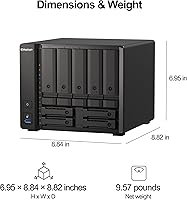
- Dimensions: The unit measures 15.9 x 14 x 10.7 inches (L x W x H), making it a desktop tower form factor suitable for shelf or desk placement.
- Weight: The unit weighs 7.74 pounds without drives installed, which is typical for an all-metal 9-bay NAS chassis of this class.
- Storage Compatibility: Compatible with standard 3.5-inch SATA HDDs, 2.5-inch SATA SSDs, and 2.5-inch SATA HDDs depending on bay type and drive specification.
- Max Raw Capacity: Raw capacity potential depends on installed drives; with nine high-capacity HDDs, total raw storage can reach well into the hundreds of terabytes.
- ZFS Features: QuTS hero supports ZFS-based features including copy-on-write integrity, automatic bit-rot detection, near-instant snapshots, and storage pool-level compression.
- Virtualization: Virtualization Station support allows users to run virtual machines directly on the NAS, taking advantage of the Ryzen processor and generous base RAM.
- ECC Support: The system supports optional ECC (Error-Correcting Code) SO-DIMM modules, which actively detect and correct single-bit memory errors to protect ZFS data integrity.
- Model Number: The official model designation is TS-H973AX-32G, where the 32G suffix indicates the 32GB DDR4 RAM configuration included in this variant.
- Availability Date: This unit first became available in December 2020 and has received ongoing firmware and software support from QNAP since its launch.
- Amazon Ranking: Ranked #68 in the Network Attached Storage Devices category on Amazon, reflecting sustained buyer interest in the prosumer and small business segment.
- Average Rating: Holds a 4.0 out of 5 stars average based on 91 verified ratings, indicating broadly positive reception with acknowledged limitations.
- Manufacturer: Designed and manufactured by QNAP Systems, Inc., a Taiwan-based company specializing in NAS hardware and storage software platforms.
- Cooling System: Active cooling via internal fans manages thermal output; fan speed is adjustable through QuTS hero, though noise increases noticeably under sustained processor and drive load.
Related Reviews
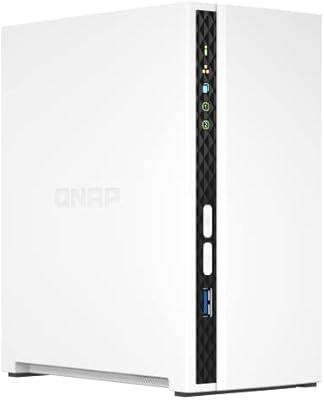
QNAP TS-233 2-Bay NAS Drive
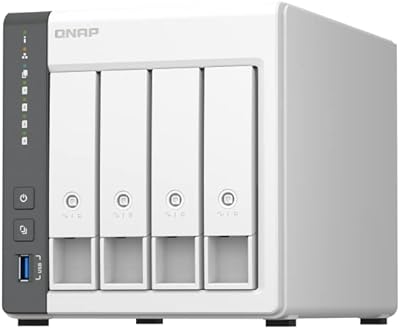
QNAP TS-433-4G 4-Bay NAS
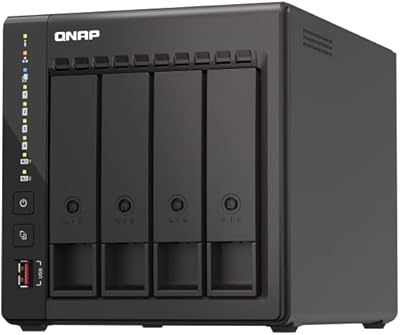
QNAP TS-453E 4-Bay NAS

QNAP TS-435XeU-4G 4-Bay Rackmount NAS
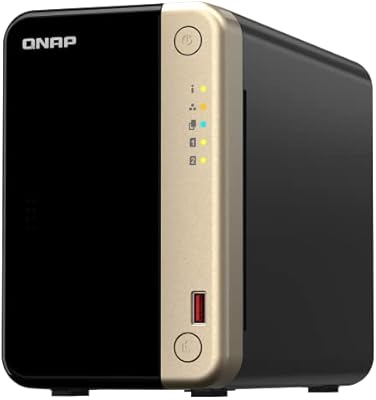
QNAP TS-264 8G 2-Bay Desktop NAS
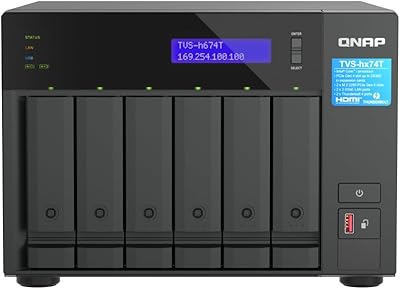
QNAP TVS-h674T i5 6-Bay Desktop NAS
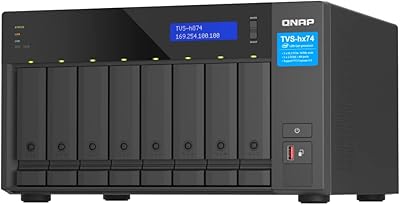
QNAP TVS-h874 i7-32G 8-Bay NAS
QNAP TS-832PX-4G 8-Bay NAS
QNAP TS-632X 6-Bay Desktop NAS