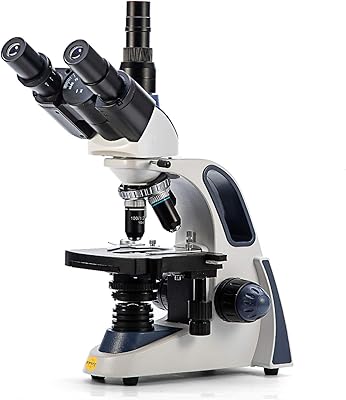
OMAX M83ES Trinocular Compound Microscope
Overview
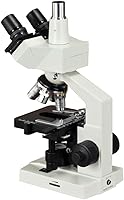
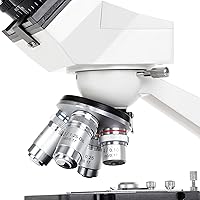
The OMAX M83ES Trinocular Compound Microscope is built with classrooms, small labs, and dedicated hobbyists in mind, and it shows in how the unit is put together. You get eight fixed magnification steps running from 40X up to 2000X, which covers everything from a quick scan of a slide to a close look at fine cellular detail. The body is metal rather than plastic, so it has some real heft on a desk and does not feel flimsy when you adjust it. A double-layer mechanical stage lets you move specimens with small, controlled movements instead of nudging them by hand. For the price range it sits in, it lands as a solid mid-tier choice rather than a toy or a research-grade instrument.
Features & Benefits
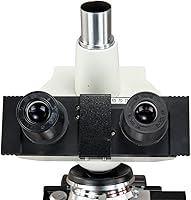
Lighting comes from a variable-intensity LED source, so you can dial brightness up or down depending on how dense or transparent your sample is, rather than fighting a single fixed setting. Paired with the NA1.25 Abbe condenser and its iris diaphragm, this lab scope gives you a decent amount of control over contrast once you get used to adjusting both together. The trinocular head is one of the more useful design choices here, since it lets you keep observing through the eyepieces while a camera stays mounted on the third port. Interpupillary distance slides to fit different users, which matters in a shared classroom. Coaxial focus knobs on both sides also mean left- and right-handed users adjust just as easily.
Best For
This compound microscope makes the most sense for biology students who need a single instrument that can handle a wide range of magnification levels across a semester of coursework, from basic tissue samples to smaller cellular structures. Home hobbyists looking at pond water, hair, fabric fibers, or backyard specimens will also get plenty of use out of it without feeling underpowered. Small labs or homeschool setups that want something sturdier than an entry-level plastic scope but do not need professional-grade optics fit well here too. The trinocular port is a nice bonus for anyone who plans to add a camera down the road for documentation or sharing images, rather than buying a separate scope later just for that purpose.
User Feedback
Feedback on this trinocular microscope tends to be fairly consistent on a few points. Several owners describe the build as sturdier than expected for the price, with the metal housing holding up well under regular use in classrooms or at home. That said, a number of buyers mention a real learning curve when first setting up the lighting and condenser together, since getting clean contrast takes a bit of trial and error early on. Opinions are split on the included accessories, with some users wishing for more slides or tools in the box and others finding the basics sufficient. Overall, repeat use over months or years seems to hold up reasonably well for most owners.
Pros
- Wide 40X-2000X magnification range covers most student and hobbyist needs
- Metal housing feels sturdier than typical entry-level microscopes at this price
- Trinocular head lets you mount a camera without losing eyepiece viewing
- Variable LED brightness adjusts easily for thicker or thinner samples
- Double-layer mechanical stage gives smoother, more controlled specimen movement
- Coaxial focus knobs work comfortably for both left- and right-handed users
- Sliding interpupillary adjustment makes it easy for multiple users to share one unit
- Many owners report it holds up well over months of repeated classroom or home use
Cons
- Calibrating the condenser and lighting together takes some trial and error at first
- Included accessories feel basic compared to what some buyers expected
- Not suitable for professional or clinical-grade lab work requiring certified precision
- Young children may need adult help getting comfortable with manual focusing
- No mention of digital camera or eyepiece included, so documentation requires separate gear
- Setup process may feel slower than simpler toy-grade microscopes for total beginners
Ratings
These scores for the OMAX M83ES Trinocular Compound Microscope come from an AI analysis of verified buyer reviews collected globally, with spam, bot activity, and incentivized feedback actively filtered out before scoring. The goal is to give you an honest, balanced read on where this lab scope genuinely excels and where it falls short for real-world classroom and home use.
Build Quality
Optical Clarity & Magnification
Ease of Setup
Lighting Performance
Stage Precision & Control
Ergonomics
Value for Money
Camera & Trinocular Compatibility
Included Accessories
Beginner Friendliness
Durability Over Time
Versatility for Specimens
Suitable for:
The OMAX M83ES Trinocular Compound Microscope is a strong fit for biology students who need one instrument to handle everything from a basic textbook lab to a closer look at slide samples across a semester. Homeschool families and small teaching labs will appreciate the metal build, since it can survive being handled by multiple students without feeling fragile. Hobbyists who like examining pond water, hair, fabrics, or other household specimens will find the magnification range wide enough to stay interesting well past the first few weeks. Anyone who eventually wants to document what they see through a camera will benefit from the trinocular port, which avoids having to swap in a separate scope later. It also suits buyers who want adjustable lighting and stage control rather than a fixed, entry-level toy microscope.
Not suitable for:
The OMAX M83ES Trinocular Compound Microscope is not the right pick for anyone expecting plug-and-play simplicity straight out of the box. Buyers who get easily frustrated by manual calibration should know there is a real adjustment period with the lighting and condenser before images look sharp and well-contrasted. It is also not built for professional or clinical lab work that demands research-grade optics or certified precision. Those hoping for a generous accessory bundle may come away disappointed, since feedback suggests the included extras are fairly basic. Finally, very young children without supervision may struggle with the more involved focusing process compared to a simplified toy-grade microscope.
Specifications
- Magnification Range: The microscope offers eight fixed magnification levels spanning 40X, 80X, 100X, 200X, 400X, 800X, 1000X, and 2000X.
- Head Type: It uses a trinocular head with a sliding adjustable interpupillary distance for shared viewing between eyepieces.
- Illumination: Lighting comes from a variable-intensity LED source built into the base for adjustable brightness.
- Condenser: An NA1.25 Abbe condenser with an iris diaphragm and filters helps control contrast and light intensity.
- Focus System: Coaxial coarse and fine focus knobs are positioned on both sides of the body for comfortable two-handed adjustment.
- Stage Type: A double-layer mechanical stage allows controlled, incremental movement of slides during observation.
- Body Material: The main housing and frame are constructed from metal rather than plastic.
- Dimensions: The unit measures 7.87″ in length, 7.28″ in width, and 14.17″ in height.
- Weight: The microscope weighs approximately 8 pounds.
- Voltage: It operates on 7.5 volts for the built-in LED illumination system.
- Angle of View: The real angle of view is rated at 45 degrees.
- Model Number: The product is identified by the model number M83ES.
- Camera Compatibility: The trinocular port allows a compatible camera to be attached while still using both eyepieces.
- Color: The unit is listed with a multicolor finish combining metal tones.
Related Reviews
OMAX M837ZL-C100U Trinocular Compound LED Microscope
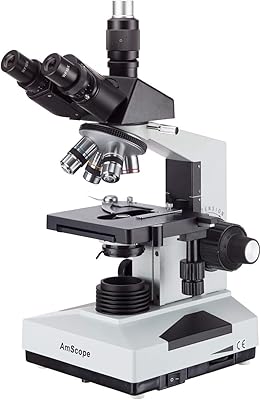
AmScope T490B Compound Trinocular Microscope
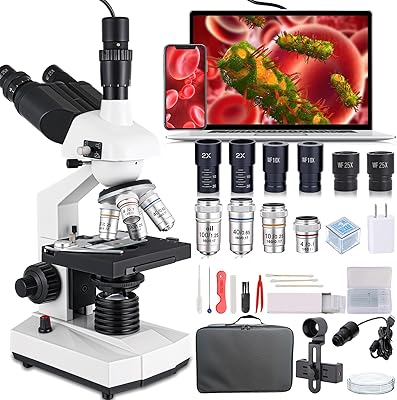
Poothoh SMXWJ-02 Trinocular Compound Microscope
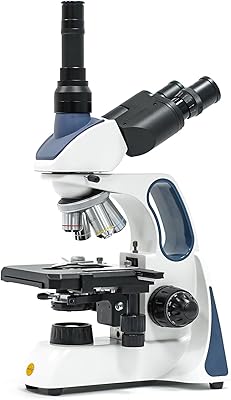
SWIFT SW400 Trinocular Compound Microscope
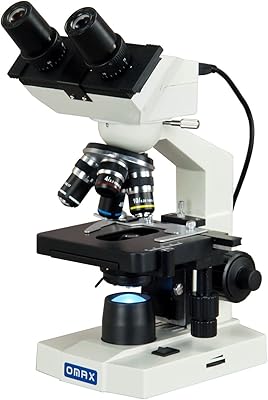
OMAX MD82ES10 40X-2000X Digital Compound Microscope
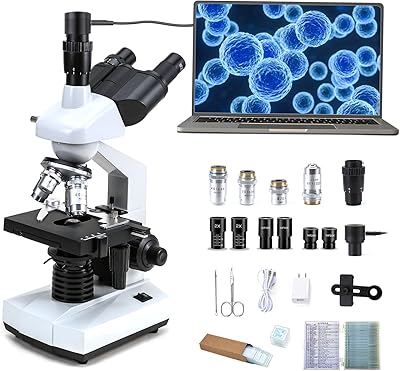
Crspexil 2024 Trinocular Compound Microscope
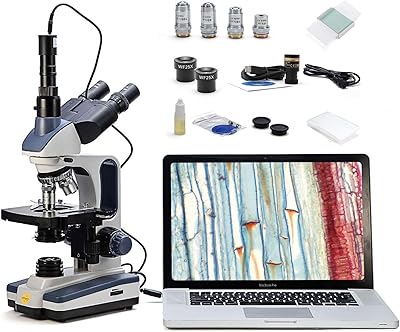
SWIFT SW350T Trinocular Compound Microscope
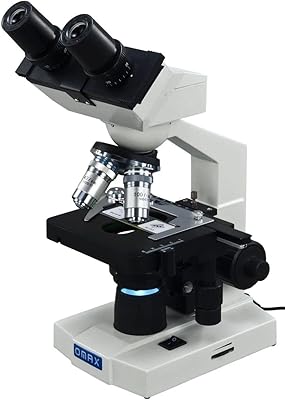
OMAX M82E Binocular Compound Lab Microscope
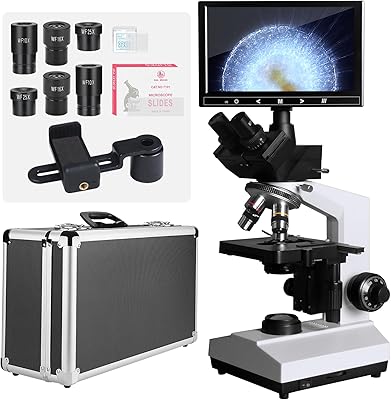
Vabiooth Darkfield Brightfield Trinocular Compound Microscope