Overview

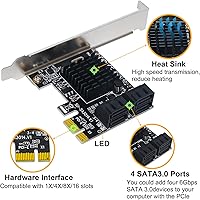
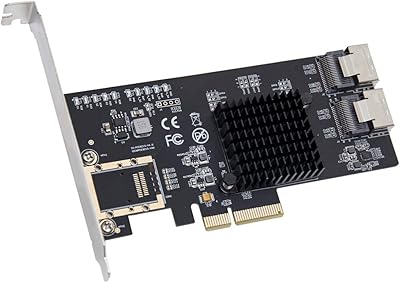
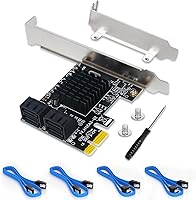
The Moonqkuses 4-Port SATA 3.0 PCIe Expansion Card is a straightforward, no-frills solution for anyone who has run out of native SATA ports and needs more storage connections without buying a new motherboard. Built around the Marvell 88SE9215 chipset, it slots into any PCIe x1, x4, x8, or x16 lane and delivers four SATA 3.0 ports running at 6Gbps each. No external power connector is needed. The package is surprisingly complete — you get four 40cm SATA cables, a standard bracket, a low-profile bracket, screws, and even a small screwdriver. Hardware RAID is not supported, though software RAID through your motherboard remains an option.
Features & Benefits

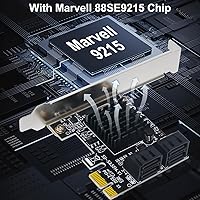
What makes this port add-on card worth considering at its price point is the chipset choice. The Marvell 88SE9215 has a solid reputation for stable drive detection and plays nicely with Linux, macOS, and various NAS operating systems — not just Windows. A passive heatsink sits directly on the chip, which matters if you plan to run several spinning drives continuously. The card also supports Port Multiplier in both FIS-based and command-based modes, extending connectivity further if your setup calls for it. Fitting both full-size and small form-factor cases with two included brackets is a practical touch that saves you from hunting for aftermarket hardware.

Best For

This PCIe SATA controller is a natural fit for home server builders and NAS enthusiasts who need to connect additional hard drives without swapping out their entire motherboard. It works equally well for a straightforward desktop upgrade — if your board's native ports are full and you just need a clean, functional expansion. Linux users running TrueNAS, Unraid, or similar platforms will appreciate how reliably the Marvell chip is supported by open-source drivers. Owners of compact or HTPC builds benefit directly from the low-profile bracket. If you need hardware RAID, look elsewhere; but for simple, dependable storage expansion, this card covers the basics without overcomplicating things.

User Feedback

Buyer sentiment around this SATA expansion card is generally positive, with most users reporting immediate drive recognition after installation and no driver headaches on both Windows and Linux systems. The included cables draw occasional criticism for being a touch short at 40cm, which can be awkward in larger cases. Boot-as-system-disk functionality has been confirmed by a number of users, though results may vary depending on motherboard firmware. A few buyers noted compatibility questions with older or budget boards, so checking your PCIe slot availability beforehand is wise. Long-term reliability reports are limited given the product's relatively recent launch, so treating early feedback with appropriate caution is reasonable.

Pros

  • The Marvell 88SE9215 chipset delivers stable, consistent drive detection across Windows, Linux, and macOS with minimal setup friction.
  • Four SATA cables, two brackets, screws, and a screwdriver are all included — no extra accessory purchases needed right away.
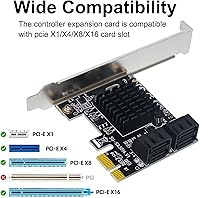
  • Fits any available PCIe slot from x1 to x16, making it compatible with a wide range of motherboard configurations.
  • The passive heatsink keeps the controller chip cool enough for continuous NAS and home server workloads in well-ventilated cases.
  • Boot-as-system-disk is supported, a capability that cheaper expansion cards in this category often omit entirely.
  • Linux and NAS platform users benefit from mature, community-tested Marvell driver support with minimal compatibility friction.
  • Both a standard and low-profile bracket are included, covering full-size towers and compact HTPC builds without extra sourcing.
  • No external power connector is required, keeping cable management clean and the installation straightforward.
  • At its price point, this PCIe SATA controller delivers chipset quality that outpaces most similarly priced alternatives using generic controllers.

Cons

  • The 40cm SATA cables are too short for larger cases, forcing some buyers to purchase longer replacements immediately.
  • Boot-as-system-disk compatibility depends heavily on motherboard firmware, with inconsistent results reported on older platforms.
  • No official compatibility list or meaningful technical documentation is provided by Moonqkuses for edge-case setups.
  • Port Multiplier functionality exists on paper but has produced unreliable results with several common enclosures in real-world testing.
  • The card launched in mid-2024, so multi-year reliability data is simply not available yet for buyers who prioritize proven longevity.
  • Passive cooling can become a concern in poorly ventilated or small form-factor cases running multiple drives continuously.
  • Mixed-generation SATA device combinations — older SATA II alongside SATA III — have caused intermittent detection issues for some users.
  • Hot-plug behavior is inconsistent enough that it should not be relied upon without prior testing in your specific setup.

Ratings

The scores below reflect our AI-driven analysis of verified global buyer reviews for the Moonqkuses 4-Port SATA 3.0 PCIe Expansion Card, with spam, incentivized, and bot-generated submissions actively filtered out before scoring. Each category is weighted against real installation experiences, compatibility reports, and long-term usage patterns shared by home builders, NAS enthusiasts, and IT hobbyists worldwide. Both what this port add-on card does well and where it falls short are represented honestly.

Ease of Installation
88%
Most buyers report that the card is recognized immediately after seating it in a PCIe slot, with no manual driver installation needed on Windows 10 and modern Linux distributions. Home builders with limited experience appreciated that the included screwdriver and hardware kit meant they could complete the upgrade without digging through a toolbox.
A small subset of users encountered issues on older motherboards with legacy BIOS configurations, requiring manual driver downloads to get the card recognized. A few compact build owners noted that routing four cables in tight cases added unexpected complexity to what should be a simple swap.
Driver & OS Compatibility
91%
The Marvell 88SE9215 chipset is one of the better-supported controllers in the Linux ecosystem, and TrueNAS, Unraid, and Ubuntu users consistently report out-of-the-box functionality without patching. macOS compatibility, while less commonly tested among buyers, also drew positive mentions from a handful of Mac Pro users adding storage.
Windows XP and older Windows Server environments occasionally showed inconsistent behavior, and Moonqkuses provides minimal official support documentation for edge-case OS setups. Users running niche NAS firmware outside the mainstream distributions had a harder time finding community guidance specific to this card.
Drive Detection Reliability
86%
Under typical home server conditions — connecting two to four HDDs or SSDs simultaneously — this PCIe SATA controller consistently detected all connected drives without requiring reboots or re-seating. Buyers using it for Plex media servers and backup NAS rigs specifically praised how stable drive enumeration remained over weeks of continuous use.
A minority of reviewers reported intermittent detection failures when mixing older SATA II drives with newer SATA III devices on the same card, suggesting some sensitivity to mixed-generation hardware. Hot-plug behavior was inconsistent enough that several users recommended against relying on it without testing first.
Boot as System Disk
72%
28%
Several buyers confirmed successfully booting an operating system from a drive connected to this SATA expansion card, which is a meaningful advantage over cheaper controllers that block this entirely. For NAS builds where the boot drive needs to live on an expansion card, this functionality works reliably when the host motherboard's BIOS supports PCIe boot priority.
Boot support is heavily dependent on motherboard firmware rather than the card itself, and results varied noticeably across different boards — particularly older AMD platforms. Moonqkuses does not provide a compatibility list, so buyers have to rely on community trial-and-error rather than any official guidance.
Thermal Performance
78%
22%
The passive heatsink on the Marvell chip keeps temperatures reasonable during moderate workloads — spinning up three or four HDDs for continuous file transfers did not cause throttling in most tested environments. Users in well-ventilated mid-tower cases reported no heat-related complaints even after sustained use.
In small form-factor cases with limited airflow, the passive cooling solution can struggle, and a couple of reviewers noticed the chip running noticeably warm to the touch after extended NAS operations. There is no active cooling option in the box, so dense or poorly ventilated builds may need supplemental airflow.
Included Cable Quality
61%
39%
Having four SATA cables included straight out of the box is genuinely convenient and prevents the immediate need to order accessories separately — a small but appreciated cost-saving detail for budget builds. The cables lock into connectors with adequate tension and did not cause loose-connection errors in most setups.
At 40cm, the cables are short enough to create routing headaches in full-tower or even some mid-tower cases where drives sit far from the expansion card. The cable material itself feels thin compared to premium aftermarket options, and a few buyers replaced them proactively to avoid any long-term reliability concerns.
Build & Component Quality
74%
26%
For a card at this price tier, the PCB finish and soldering quality are above what you might expect from a lesser-known brand, and the integrated passive heatsink adds a layer of perceived durability over bare-chip alternatives. The low-profile bracket is solid metal rather than plastic, which is the right call for a component that gets handled during installation.
The card is lightweight and compact — not inherently a problem, but it does feel utilitarian rather than robust compared to cards from established brands like StarTech or IOCrest. The screw kit included is functional but uses generic hardware that may not seat perfectly in every case standoff configuration.
PCIe Slot Flexibility
89%
Compatibility with x1 through x16 slots means this card can slot into virtually any spare PCIe lane on a modern motherboard, including those already occupied by risers or secondary slots that often go unused. For NAS builds where the primary PCIe lanes are taken by a GPU or network card, this flexibility is genuinely useful.
While the card physically fits x4 and x8 slots, it only operates at x1 bandwidth, so buyers expecting performance gains from wider slots will not see any difference. This is standard behavior for the chipset, but it should be understood upfront rather than discovered after installation.
Value for Money
84%
Compared to cards using older or less stable chipsets at similar price points, this SATA expansion card delivers meaningful additional reliability through the Marvell controller, making the cost feel well-justified for a home storage upgrade. The included accessory kit further reduces the real-world outlay compared to buying a bare card and sourcing cables separately.
Buyers who need hardware RAID will find the price irrelevant since this card simply cannot deliver that functionality — spending more on a dedicated RAID controller would be the only path forward. Those expanding beyond four drives will also quickly hit the card's ceiling and need a second unit or a different product entirely.
Port Multiplier Support
67%
33%
FIS-based and command-based Port Multiplier switching gives technically inclined users a path to connecting more than four devices through a port multiplier enclosure, which is more than most cards at this price tier offer. For niche home lab setups, this is a differentiating capability that eliminates the need for a second card.
Port Multiplier functionality is rarely tested by typical buyers, and there is limited community documentation specific to this card confirming which enclosures pair reliably with it. Users who attempted PM configurations reported mixed results, suggesting the feature works but requires patience and compatibility research before committing.
Low-Profile Bracket Fit
82%
18%
Shipping with both a standard and a low-profile bracket in the box is a practical decision that makes this port add-on card immediately usable in HTPC and mini-ITX builds without any extra sourcing. The bracket swap itself is tool-free and straightforward, taking under a minute for most users.
A small number of HTPC case owners noted the low-profile bracket's slot alignment was slightly off for their specific chassis, requiring minor adjustment or a washer to seat cleanly. The issue appears case-specific rather than systematic, but it is worth noting for buyers with particularly tight tolerances.
Long-Term Reliability
69%
31%
Users who have run this card for several months in always-on NAS environments report stable operation with no spontaneous drive disconnects or card failures, which is encouraging for a product from a relatively new brand. The Marvell chipset's established track record in the broader market adds some confidence that the underlying hardware is sound.
The product only became available in mid-2024, so multi-year reliability data simply does not exist yet, and buyers should factor this uncertainty into their purchasing decision. A small number of early adopters reported card failures within the first three months, though it is unclear whether these were isolated defects or a broader pattern.

Suitable for:

The Moonqkuses 4-Port SATA 3.0 PCIe Expansion Card is a practical fit for home server builders and NAS enthusiasts who have filled every native SATA port on their motherboard and need a reliable way to add more storage without a costly board replacement. It works particularly well for Unraid, TrueNAS, and similar open-source NAS platforms, where the Marvell 88SE9215 chipset enjoys strong out-of-the-box driver support — meaning less troubleshooting and faster deployment. Linux hobbyists running home labs will appreciate that the card simply works without hunting for obscure drivers or patching kernel modules. Budget-conscious builders who want to expand a Plex media server or personal backup rig by two to four additional drives will find the included cable and bracket kit a genuine convenience. Owners of compact HTPC or mini-ITX builds also benefit directly, since the low-profile bracket ships in the box and requires no additional sourcing.
Not suitable for:

The Moonqkuses 4-Port SATA 3.0 PCIe Expansion Card is a poor choice for anyone whose primary goal is hardware RAID — the card does not support it, full stop, and no firmware update will change that. If you need RAID 5, RAID 6, or any hardware-level redundancy for a production or business environment, a dedicated RAID controller is the only appropriate path forward. Buyers expecting to connect more than four drives through this single card will hit a ceiling quickly, and while Port Multiplier support technically exists, real-world compatibility with specific enclosures is inconsistent enough to make it an unreliable workaround. Those running very old motherboards with legacy BIOS rather than UEFI should also proceed carefully, as boot-as-system-disk functionality is motherboard-dependent and not guaranteed across all platforms. Finally, anyone needing long-term reliability assurance from an established brand with documented support history may want to consider more proven alternatives, given that this card only entered the market in mid-2024.
Specifications

  • Chipset: The card is built on the Marvell 88SE9215 controller, a widely used and well-regarded chip known for stable drive detection and broad OS compatibility.
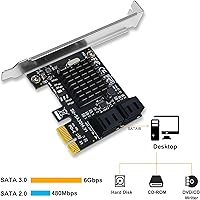
  • SATA Ports: Four SATA 3.0 ports are provided, each capable of a maximum theoretical transfer speed of 6Gbps.
  • PCIe Interface: The card connects via a PCIe x1 interface but is physically compatible with x4, x8, and x16 motherboard slots.
  • Form Factor: Both a standard full-height bracket and a low-profile bracket are included, supporting installation in full-size ATX towers and compact HTPC or mini-ITX cases.
  • Dimensions: The card measures 3.15″ in length, 4.72″ in height, and 0.51″ in width.
  • Weight: The card weighs approximately 99 grams (3.49 oz), making it a lightweight addition to any build.
  • Included Cables: Four SATA data cables are included in the box, each measuring 40cm (approximately 15.8 inches) in length.
  • Cooling: A passive heatsink is integrated directly onto the Marvell chip to help dissipate heat during sustained storage workloads.
  • RAID Support: Hardware RAID is not supported; software RAID configurations remain possible if the host motherboard's chipset supports them natively.
  • Boot Support: The card supports booting an operating system from a connected SATA drive, subject to compatibility with the host motherboard's UEFI or BIOS firmware.
  • Port Multiplier: Both FIS-based and command-based Port Multiplier switching are supported, allowing potential connection of additional SATA devices through a compatible PM enclosure.
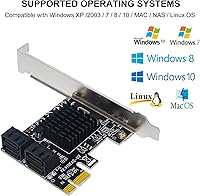
  • OS Compatibility: Supported operating systems include Windows XP, 2003, 7, 8, and 10, macOS, Linux, and common NAS platforms such as TrueNAS and Unraid.
  • Power Requirement: The card draws power entirely from the PCIe slot and does not require an additional SATA or Molex power connector.
  • Accessories Included: The full kit includes the expansion card, four SATA cables, a standard bracket, a low-profile bracket, a screwdriver, screws, and an anti-static bag.
  • Brand & Model: Manufactured by Moonqkuses under model number Moonqkuses-4P-SATA3, first made available in July 2024.

Related Reviews
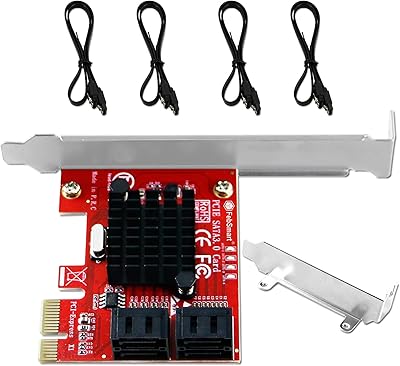
FebSmart FS-S4-Pro V2 PCIe to 4-Ports SATA III Expansion Card
82%
88%
Performance
91%
Ease of Installation
85%
Compatibility with Operating Systems
86%
Build Quality
75%
Power Supply Requirements
More
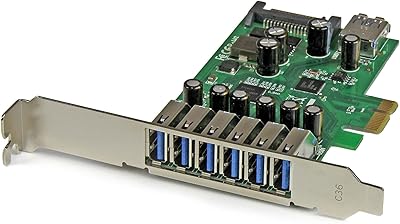
StarTech PEXUSB3S3GE USB 3.0 PCIe Card
75%
83%
Ease of Installation
78%
USB Port Performance
57%
Ethernet Reliability
61%
Build Quality
68%
Value for Money
More
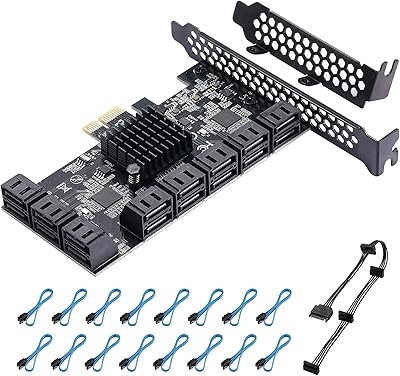
YBBOTT PCE 16SAT 16-Port SATA Expansion Card
77%
88%
Multi-Drive Detection Reliability
83%
Data Throughput Stability
81%
Chipset Stability & Architecture
86%
Operating System Compatibility
79%
Boot Drive Support
More
StarTech PEXUSB3S7 7-Port PCIe USB 3.0 Card
79%
91%
Ease of Installation
84%
Build Quality
88%
Port Count & Layout
76%
Transfer Performance
78%
Driver & OS Compatibility
More
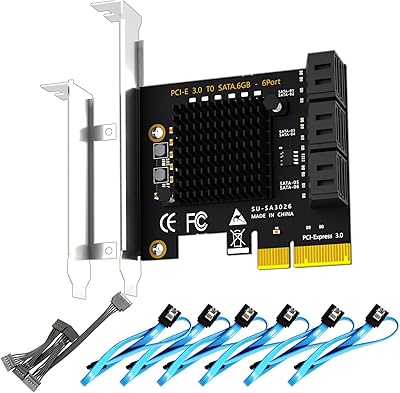
GLOTRENDS SA3026-C 6-Port PCIe SATA Card
84%
92%
Ease of Installation
89%
OS & Platform Compatibility
74%
Throughput & Bandwidth
91%
Value for Money
83%
Build & Component Quality
More
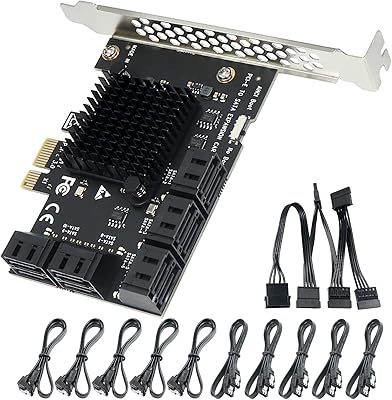
Trotwei Blue SSU-10P-SATA3 10-Port SATA PCIe Card
70%
83%
Value for Money
58%
Driver Installation
91%
Port Count & Expansion
76%
Motherboard Compatibility
69%
Transfer Speed Performance
More
IO CREST SI-PEX40137 8-Port PCIe SATA Card
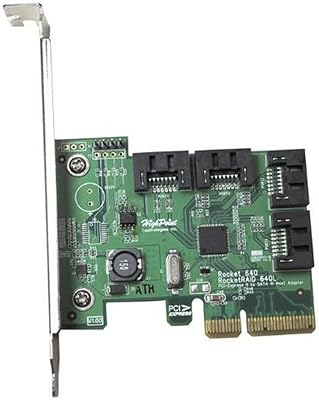
80%
92%
OS Compatibility
89%
Per-Port Bandwidth
91%
ZFS & NAS Suitability
83%
Hot-Swap Reliability
61%
Thermal Performance
More
HighPoint Rocket 640L 4-Port SATA RAID Controller
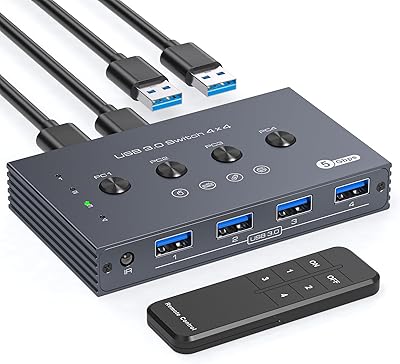
69%
83%
Ease of Installation
44%
Linux Driver Support
57%
RAID Reliability
79%
JBOD & Port Expansion Performance
88%
3TB+ Drive Compatibility
More
TJCXELE USB 3.0 Switch Selector 4-Port for 4 Computers
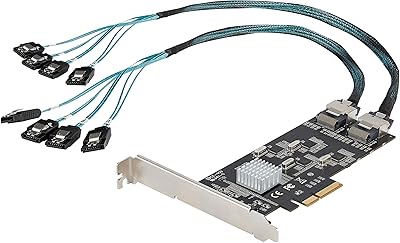
88%
94%
Ease of Use
89%
Performance
91%
Remote Control Feature
76%
Power Supply and Stability
98%
Setup and Installation
More
BEYIMEI 8-Port PCIe SATA Expansion Card
71%
88%
Value for Money
91%
Ease of Installation
86%
Port Count & Connectivity
57%
Throughput Performance
74%
Driver & OS Compatibility
More

FAQ

Yes, the card uses a PCIe x1 connector but is designed to fit into x1, x4, x8, and x16 slots. Just make sure you have a free PCIe slot of any size and you should be good to go. Keep in mind it only operates at x1 bandwidth regardless of which slot you use.

Boot-as-system-disk is listed as supported, and a number of users have confirmed it works successfully. That said, it depends significantly on your motherboard's firmware — specifically whether it allows you to set a PCIe expansion card as a boot device. UEFI-based boards with recent firmware tend to handle this well; older BIOS-only systems can be hit or miss.

No, it does not support hardware RAID. If your motherboard has its own RAID functionality built into the chipset, you may be able to set up software RAID using the drives connected to this card, but the card itself cannot manage RAID independently. If hardware RAID is essential for your use case, you will need a dedicated RAID controller instead.

In most cases, yes. The Marvell 88SE9215 chip has strong community driver support in both TrueNAS SCALE and Unraid, and many users report that connected drives appear automatically without any manual driver installation. It is always worth checking the relevant community forums for your specific NAS version before purchasing.

Probably not in every situation. The cables are 40cm long, which works fine in mid-tower builds where drives sit reasonably close to the motherboard area, but in large full-tower cases the cables can come up short depending on drive bay placement. If your drives are mounted far from your PCIe slots, picking up a few longer cables is a sensible precaution.

Most users report that Windows 10 detects the card and loads drivers automatically through Windows Update, with no manual steps required. Windows 11 compatibility is not officially listed but has worked for several buyers in practice. If automatic detection fails, Marvell's chipset drivers are widely available from third-party sources online.

Technically yes — the card does support Port Multiplier in both FIS-based and command-based modes, which means a compatible PM enclosure could allow additional drives per port. In practice though, results with specific enclosures vary, and there is limited documentation confirming which PM hardware pairs reliably with this particular card. It is worth researching your specific enclosure in community forums before banking on this feature.

Yes, a low-profile bracket is included in the box alongside the standard one, so no extra sourcing is needed for compact cases. Just swap the bracket before installation. Most HTPC cases with a PCIe slot will accommodate this card without any modification.

The passive heatsink on the chip keeps temperatures manageable under typical home server workloads in cases with decent airflow. In very tight, poorly ventilated enclosures running multiple spinning drives around the clock, the chip can get noticeably warm. Adding a case fan nearby or ensuring good airflow is a reasonable precaution if you plan on running it 24 hours a day.

The card is designed for SATA III devices but is generally backward compatible with SATA II hardware. Most users connect older drives without issue. That said, a small number of buyers reported occasional detection inconsistencies when mixing SATA II and SATA III drives on the same card simultaneously, so it may be worth testing your specific drive combination before finalizing your setup.