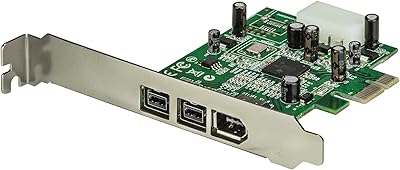
Trotwei Blue SSU-10P-SATA3 10-Port SATA PCIe Card
Overview
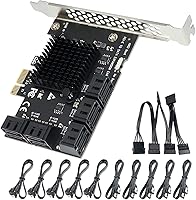
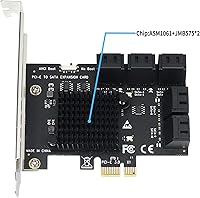
The Trotwei Blue SSU-10P-SATA3 10-Port SATA PCIe Card is a straightforward, budget-conscious solution for desktop users who've simply run out of SATA ports on their motherboard. Built around an ASMedia controller chip, it slots into any PCIe x1, x4, x8, or x16 slot, so compatibility with most boards isn't a concern. One thing to know upfront: only two drives are recognized without installing the driver first. That's not a dealbreaker, but it catches people off guard. Install the driver, and all ten ports come alive. SSU released this under the Trotwei Blue brand in mid-2022, positioning it squarely at the value end of the market.
Features & Benefits
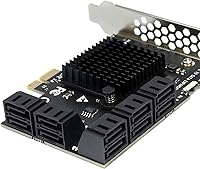
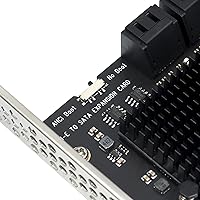
Each of the ten ports runs on SATA 3.0, rated up to 6 Gbps, which is plenty for both spinning hard drives and budget SSDs. The PCIe edge connector uses an immersion gold process — a small but meaningful detail that helps maintain a clean electrical connection over time. SSU also enlarged the heatsink on the ASMedia chip, which matters when you're pushing data across multiple drives simultaneously. This PCIe SATA controller carries no RAID support whatsoever; it presents each drive independently to the OS, keeping things simple. OS support stretches back to Windows XP and covers Windows 10 in both 32 and 64-bit, so older machines aren't left out.
Best For
This 10-port SATA expansion card hits its stride in home NAS builds where you need to pack many drives into one machine without spending heavily. It's also a natural fit for anyone converting an old workstation into a bulk storage box, or adding drives for surveillance footage and large video projects. That said, if you're planning any kind of RAID array — whether for speed or redundancy — this card simply won't do it. It has no hardware RAID capability and isn't intended for enterprise or mission-critical environments. For straightforward JBOD storage expansion on a tight budget, though, it covers the bases well.
User Feedback
Buyers generally appreciate how well this port-multiplier card performs once the driver is in place, with several reporting stable operation across all ten ports at once. Driver installation gets mixed reviews — some found the process easy enough, while others struggled to locate the correct driver file. Real-world speeds land below the theoretical 6 Gbps ceiling, which is normal for any multi-port controller sharing bandwidth. A handful of users noted the card runs warm during heavy transfers but reported no issues over months of use. Linux compatibility is largely untested in buyer reports, so this is firmly a Windows-first solution. Long-term reliability seems reasonable for the price, though it's not a card for production servers.
Pros
- Ten SATA 3.0 ports from a single PCIe x1 slot is exceptional port density at this price point.
- Works in PCIe x1, x4, x8, or x16 slots, so finding a free slot on most motherboards is rarely an issue.
- The ASMedia controller chip delivers solid compatibility across a wide range of older and modern Windows-based systems.
- Gold-plated PCIe edge connector reduces contact resistance and holds up better than bare-copper alternatives over time.
- The enlarged heatsink keeps the controller chip stable during extended multi-drive transfer sessions.
- Compact card size fits comfortably in mid-tower and full-tower cases without crowding adjacent slots.
- Once the driver is installed, all ten ports operate reliably for standard JBOD storage workloads.
- A genuinely cost-effective way to breathe new life into an older desktop by turning it into a multi-drive storage server.
Cons
- Only two drives are detected on first boot — the driver install requirement is not clearly communicated in the box.
- Shared PCIe x1 bandwidth limits real-world throughput noticeably when multiple drives are active at the same time.
- No Linux driver support makes this port-multiplier card effectively useless outside of a Windows environment.
- Some users on certain AMD motherboards reported intermittent drive detection issues that were never fully resolved.
- No SATA cables are included, which is a minor but avoidable inconvenience for new builders.
- Long-term reliability data is thin, and a subset of buyers reported individual ports failing after several months of use.
- The passive heatsink struggles in poorly ventilated cases running all ten ports under sustained heavy load.
- Documentation is vague on driver sourcing, leaving less experienced users searching online for the correct installation files.
Ratings
The scores below reflect AI-assisted analysis of verified global buyer reviews for the Trotwei Blue SSU-10P-SATA3 10-Port SATA PCIe Card, with spam, incentivized, and bot-generated feedback actively filtered out before scoring. Ratings capture the full picture — where this port-multiplier card genuinely delivers for home storage builders, and where it falls short for more demanding use cases. Both the strengths and the friction points are weighted transparently across each category.
Value for Money
Driver Installation
Port Count & Expansion
Motherboard Compatibility
Transfer Speed Performance
Build Quality
Thermal Management
OS Compatibility
Ease of Physical Installation
RAID & Advanced Features
Long-Term Reliability
Packaging & Documentation
Slot Flexibility
Suitable for:
The Trotwei Blue SSU-10P-SATA3 10-Port SATA PCIe Card is a practical pick for anyone building a home NAS, media server, or bulk storage machine on a tight budget. If your motherboard has exhausted its native SATA ports and you need to connect a stack of HDDs for video archives, surveillance footage, or large file backups, this card fills that gap without requiring a full system upgrade. It works especially well for users repurposing an older desktop workstation into a dedicated storage box, since the ASMedia controller supports Windows versions going back to XP. PC enthusiasts who run multiple large-capacity drives simultaneously — whether for a Plex server, a home security setup, or a sprawling video editing library — will find the ten-port density genuinely useful. As long as you are comfortable installing a driver before the full functionality unlocks, the setup process is manageable for intermediate builders.
Not suitable for:
This PCIe SATA controller is a hard pass for anyone who needs hardware RAID support — RAID 0, 1, 5, or any other configuration simply is not possible with this card, full stop. Users running Linux should look elsewhere too; driver support outside of Windows is effectively non-existent, and community-tested solutions are sparse at best. Anyone building a production server, a small business NAS, or any setup where data redundancy and uptime are non-negotiable should invest in a purpose-built RAID controller instead. Performance-focused builders planning to run multiple SSDs at full speed will also be disappointed, since shared PCIe x1 bandwidth creates a real throughput ceiling that limits each port when drives are active simultaneously. And if your case is a slim HTPC or a low-profile build, the card's standard bracket and physical size rule it out entirely.
Specifications
- Model Number: The card's official model identifier is SSU-10P-SATA3, manufactured by SSU under the Trotwei Blue brand.
- PCIe Interface: Uses a PCIe x1 interface and is physically compatible with x1, x4, x8, and x16 motherboard slots.
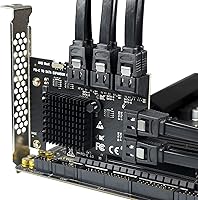
- SATA Ports: Provides 10 independent SATA 3.0 ports, each capable of connecting a standard 2.5″ or 3.5″ HDD or SSD.
- Max Transfer Rate: Each SATA port is rated for a maximum transfer speed of 6 Gbps under the SATA 3.0 specification.
- Controller Chip: Powered by an ASMedia controller chip, chosen for its broad compatibility and stable multi-drive operation.
- PCIe Connector: The PCIe edge connector uses an immersion gold (ENIG) plating process for reliable electrical contact and reduced signal degradation.
- Heatsink: An enlarged passive heatsink is mounted directly on the ASMedia controller chip to manage heat during sustained data transfers.
- RAID Support: This card does not support any form of hardware RAID; all connected drives operate as independent JBOD volumes only.
- Driver Requirement: Without a driver installed, only 2 drives are recognized; installing the provided driver unlocks all 10 ports.
- OS Support: Compatible with Windows XP, Windows Vista, Windows 7, Windows 8, and Windows 10 in both 32-bit and 64-bit editions.
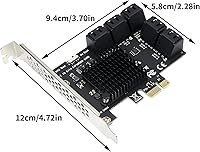
- Card Dimensions: The card measures 4.72″ in length, 3.7″ in width, and 2.28″ in height, fitting standard full-size and mid-tower cases.
- Weight: The card weighs approximately 9.9 oz (around 280 g) including the metal bracket.
- Bracket Type: Includes a standard full-height PCIe bracket only; no low-profile bracket is provided or available separately.
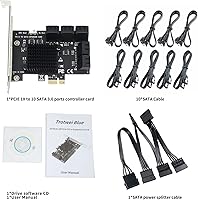
- Cables Included: No SATA data cables are included in the package; buyers need to supply their own cables for each connected drive.
- Release Date: The SSU-10P-SATA3 was first made available for purchase in June 2022.
Related Reviews
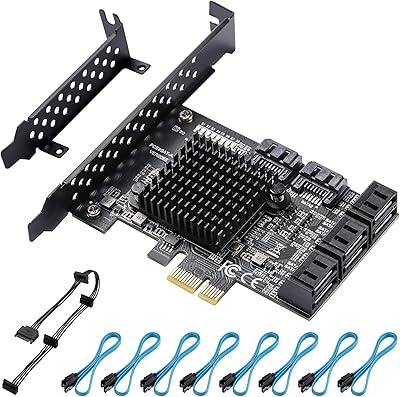
BEYIMEI 8-Port PCIe SATA Expansion Card
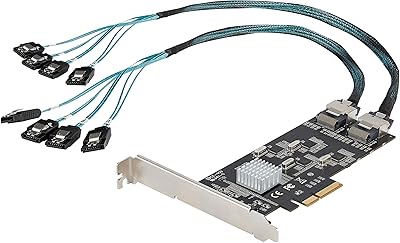
StarTech 8-Port SATA III PCIe Expansion Card
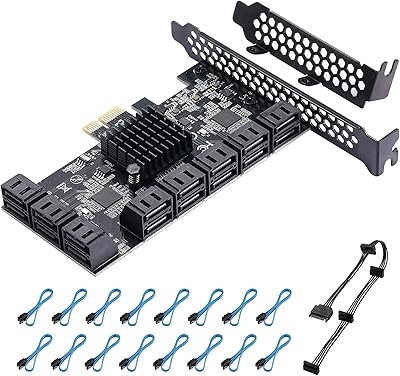
YBBOTT PCE 16SAT 16-Port SATA Expansion Card
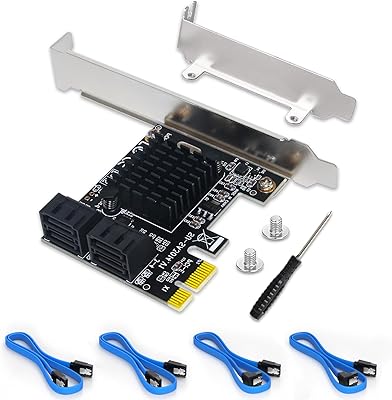
Moonqkuses 4-Port SATA 3.0 PCIe Expansion Card
GLOTRENDS SA3026-C 6-Port PCIe SATA Card
IO CREST SI-PEX40137 8-Port PCIe SATA Card
FebSmart FS-S4-Pro V2 PCIe SATA Expansion Card
FOSA M5015 SAS SATA RAID Controller Card
StarTech ST1000SPEX2L 1-Port PCIe Network Card