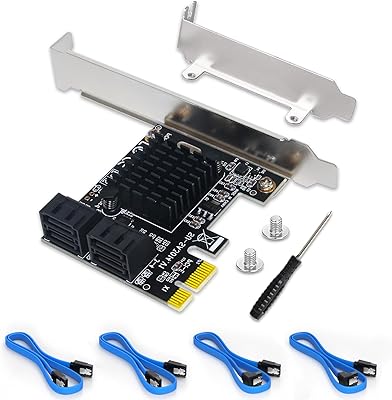
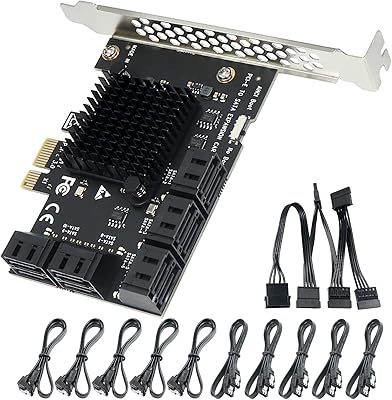
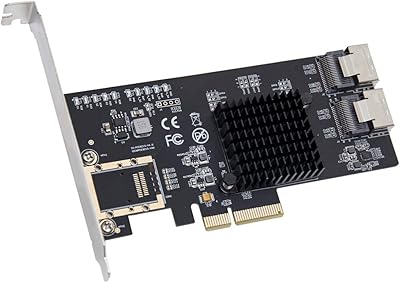
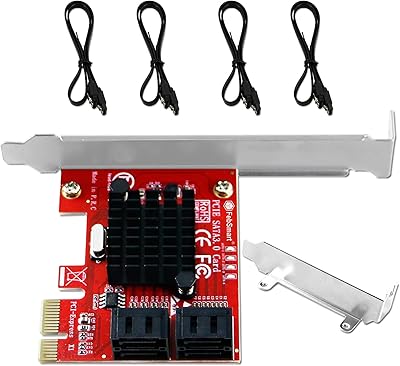
Overview

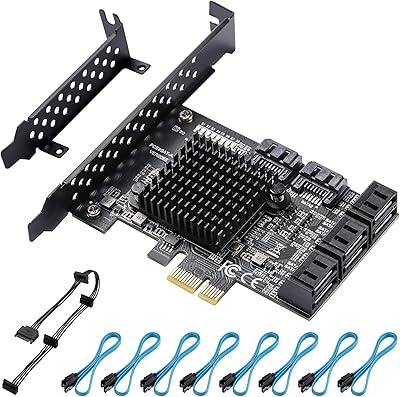
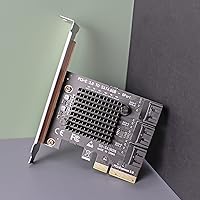
The GLOTRENDS SA3026-C 6-Port PCIe SATA Card is a no-nonsense storage expansion option built for desktop users and home lab builders who have simply run out of SATA ports. At its core, it runs on the ASM1166 controller chip over a PCIe 3.0 x2 interface, giving it a solid, well-tested foundation. Setup is refreshingly simple — plug it in, and Windows, Mac OS, Linux, and most NAS operating systems recognize it instantly, with no driver hunting required. Two things worth knowing upfront: this SATA expansion card offers no hardware RAID support, and it cannot be used as a boot drive. Keep those limitations in mind before buying.
Features & Benefits

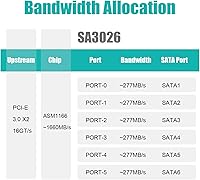
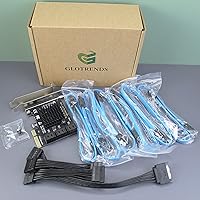
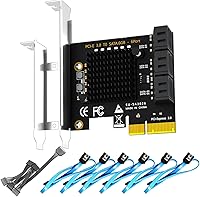
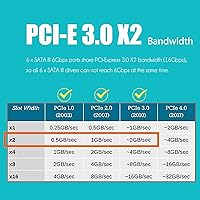
Each of the six SATA III ports can handle up to 277 MB/s — plenty of headroom for spinning HDDs and SATA SSDs alike. That said, it is worth understanding the bandwidth reality: all six ports share a single PCIe 3.0 x2 upstream connection, which means pushing all drives simultaneously will compress shared upstream bandwidth. For typical NAS or backup workloads that is rarely a problem, but heavy concurrent transfers will feel the squeeze. The card fits any PCIe x4, x8, or x16 slot, runs in AHCI mode for broad OS compatibility without proprietary drivers, and ships with a complete kit including six SATA cables, a power splitter, and both standard and low-profile brackets.

Best For

The SA3026-C is a strong fit for home NAS builders who need to connect multiple drives without swapping out their motherboard. It works equally well for PC enthusiasts building large local media libraries or backup servers using software RAID tools like Windows Storage Spaces or Linux's mdadm. Small offices needing affordable multi-drive expansion will find it capable enough for the job. ITX and mATX users with only one or two onboard SATA ports will especially appreciate the bump in capacity. Where it falls short: anyone needing to boot an OS from this card or configure a hardware RAID array should look elsewhere — those features are simply not available here.

User Feedback

Across a wide pool of verified buyers, this six-port PCIe card earns consistent praise for its hassle-free installation and immediate recognition by TrueNAS, Unraid, and mainstream Linux distros — that plug-and-play reliability clearly matters to the NAS community. The built-in LED indicators come up repeatedly as a genuinely useful touch for spotting drive issues without diving into software. On the downside, a handful of users report compatibility hiccups with older or non-standard motherboards, so checking your board's PCIe lane allocation beforehand is sensible. A smaller group notes that pushing all six drives hard simultaneously does expose the shared bandwidth ceiling. Still, a 4.6-star average across hundreds of real-world buyers reflects a card that delivers on its core promise.

Pros

  • Adds six SATA III ports to virtually any modern desktop without touching your existing storage setup.
  • Plug-and-play across Windows, Mac OS, Linux, NAS, Ubuntu, and ESXi — no driver installation needed.
  • The ASM1166 controller is a proven, widely supported chip with a strong community track record.
  • Each port handles up to 277 MB/s, which comfortably covers the real-world speeds of most HDDs and SATA SSDs.
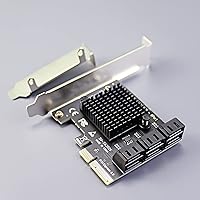
  • Built-in LED indicators make it easy to spot drive activity or diagnose issues at a glance.
  • Fits PCIe x4, x8, and x16 slots, so motherboard compatibility is rarely a concern.
  • Ships with everything you need: six SATA cables, a power splitter, and standard plus low-profile brackets.
  • Particularly well-suited for TrueNAS and Unraid builds where stable Linux support matters most.
  • Solid value for the price in a product category where many alternatives cost significantly more.
  • A 4.6-star average across hundreds of real buyers reflects consistent, reliable real-world performance.

Cons

  • Cannot be used as a boot drive, which is a hard stop for certain build configurations.
  • No hardware RAID support — all RAID is handled by the OS, adding software overhead.
  • All six ports share one PCIe 3.0 x2 upstream pipe, so heavy simultaneous transfers can saturate the connection.
  • A handful of users have reported compatibility issues with older or non-standard motherboards.
  • The 1-to-5 power splitter may strain weaker PSUs when all six drive bays are fully populated.
  • No Windows XP support, which matters for legacy system maintainers.
  • AHCI-only mode limits advanced configuration options for users who need more controller flexibility.

Ratings

The scores below for the GLOTRENDS SA3026-C 6-Port PCIe SATA Card were generated by our AI engine after analyzing verified global buyer reviews, actively filtering out incentivized, bot-generated, and low-signal feedback to surface what real users consistently experienced. Both the strengths and the friction points are reflected transparently — nothing has been smoothed over to make the card look better than it is.
Ease of Installation
92%
The overwhelming majority of buyers report sliding this card into a PCIe slot and having all six drives recognized immediately on first boot, with no driver downloads or BIOS tweaks needed. Home lab users running TrueNAS or Unraid particularly appreciate that the card just works, even on fresh OS installs.
A small but consistent group of users with older or non-standard motherboards ran into recognition issues that required BIOS updates or slot swapping to resolve. These cases are edge situations, but they are real enough to warrant checking your board's PCIe compatibility before purchasing.
OS & Platform Compatibility
89%
Verified buyers across Windows 10, Windows 11, various Linux distros, Ubuntu, ESXi, TrueNAS, and Unraid confirm reliable detection without any manual driver installation. This breadth of support makes the SA3026-C a low-friction choice for mixed-OS home lab environments.
Windows XP is completely unsupported, and a handful of users running niche or legacy NAS firmware versions reported inconsistent port detection. These are narrow use cases, but buyers on non-mainstream platforms should verify compatibility before committing.
Throughput & Bandwidth
74%
26%
For typical home NAS workloads — serving media files, running incremental backups, or filling drives sequentially — the per-port throughput is more than adequate, and most HDDs will never saturate even a fraction of the available bandwidth per port.
All six ports share a single PCIe 3.0 x2 upstream pipe, which becomes a real bottleneck when multiple drives are accessed simultaneously under heavy load. Users who stress-tested the card with parallel large-file transfers to all six drives noticed measurable throughput compression that matters in performance-sensitive scenarios.
Value for Money
91%
Buyers consistently describe this six-port PCIe card as one of the most cost-effective ways to expand SATA capacity on a budget, especially given that the package includes cables, a power splitter, and both bracket sizes. For NAS builders and media hoarders, the price-to-port ratio is hard to beat.
The value proposition weakens if your use case requires hardware RAID or OS boot support, since you would need a more capable — and significantly more expensive — HBA card. Buying this card for the wrong workload makes it poor value, not good value.
Build & Component Quality
83%
The card feels solid in hand, and the ASM1166 controller chip has an established reputation for reliability in the enthusiast community. Several long-term users report running the card continuously for over a year without failures or drive drop-offs.
The physical build is functional rather than premium — PCB quality is adequate but unremarkable compared to higher-end HBA cards. A few users noted the SATA port connectors feel slightly less robust than those on name-brand server cards, though no widespread connector failure reports exist.
LED Activity Indicators
88%
The six built-in LEDs received genuine praise from buyers who use the card in multi-drive NAS enclosures, where spotting a dead or misbehaving drive without launching diagnostic software saves real time. The solid versus flashing distinction is intuitive and immediately useful.
The LEDs are red only, with no color differentiation between drive states beyond active and idle, which limits diagnostic granularity compared to cards with multi-color indicators. In brightly lit environments, the indicators can also be hard to spot without looking directly at the card.
Included Accessories
86%
Shipping with six SATA data cables, a 1-to-5 power splitter, and both full-height and low-profile brackets is genuinely thoughtful packaging — most competing cards ship with fewer or no cables. Buyers in small form factor cases particularly appreciated not having to source a low-profile bracket separately.
The 1-to-5 power splitter is convenient but can put stress on a single PSU power rail when all five branches are loaded with active drives. Users with older or lower-wattage power supplies should be cautious about daisy-chaining too many drives from one connector.
NAS & Unraid Performance
91%
This is arguably the card's strongest real-world use case, and the buyer feedback from Unraid and TrueNAS users is notably positive. Drive detection is consistent across reboots, and the AHCI mode plays well with ZFS and other file systems commonly used in home server builds.
Users running all-flash NAS setups with high-speed SATA SSDs are more likely to feel the shared bandwidth ceiling than those using spinning drives. The card is optimized by design for HDD-centric builds, and SSD-heavy configurations will expose its upstream throughput limits faster.
Software RAID Reliability
79%
21%
Buyers using Windows Storage Spaces and Linux mdadm report stable long-term operation with no unexpected drive drops or array corruption issues attributable to the card itself. The AHCI mode is broadly compatible with most software RAID implementations without workarounds.
Because hardware RAID is entirely absent, the CPU and OS bear all RAID processing overhead, which can be a meaningful consideration on lower-powered NAS systems. Users expecting a hardware RAID controller will need to recalibrate expectations or choose a different card entirely.
Slot Compatibility
87%
Fitting into PCIe x4, x8, and x16 slots means the card works in practically any modern desktop motherboard that has a free full-length slot, including boards where the only available slots are larger x16 graphics slots.
The card requires a physically open x4 or larger slot, which can be a real constraint on compact ITX boards that may have only one PCIe slot already occupied by a GPU. Users with tightly configured builds should audit slot availability carefully before ordering.
Long-Term Stability
82%
18%
A notable number of buyers specifically mention running the card around the clock in always-on NAS and media server builds for extended periods without drive disconnections or system instability. Thermal behavior under sustained load appears well-managed for a passively cooled card.
There are occasional reports — not widespread, but present — of drive drop events after extended uptime, particularly in builds with marginal airflow around the PCIe slot area. Whether these are card-specific or environmental is unclear, but they are worth monitoring in sealed or low-airflow enclosures.
Documentation & Support
63%
37%
For users on mainstream operating systems, the plug-and-play nature of the card means the included documentation rarely needs to be consulted, and the community around TrueNAS and Unraid provides a robust secondary support layer through forums and wikis.
The printed documentation is minimal, and GLOTRENDS does not have a well-known direct support channel that buyers can lean on for edge-case troubleshooting. Users hitting compatibility issues with non-standard setups are largely on their own beyond community forums.

Suitable for:

The GLOTRENDS SA3026-C 6-Port PCIe SATA Card is a practical, well-priced pick for anyone who has hit the SATA port ceiling on their existing motherboard and needs a straightforward way to add more drives. Home NAS enthusiasts running TrueNAS, Unraid, or similar platforms will find the plug-and-play compatibility with Linux and NAS operating systems especially appealing, since there is no driver setup involved. PC builders assembling large local media servers or multi-drive backup rigs using software RAID tools like Windows Storage Spaces or mdadm will get real value here without overspending. Small form factor users on ITX or mATX boards are a particularly good fit, since those platforms routinely ship with only two or three onboard SATA ports. The included accessory bundle — cables, power splitter, and both bracket sizes — means you can go from box to installed without a separate shopping trip.
Not suitable for:

Buyers who need to boot their operating system from an expansion card should stop here — the SA3026-C does not support OS booting, and that limitation is not a workaround situation. Anyone looking for hardware RAID functionality will also be disappointed, since this card operates exclusively in AHCI mode and leaves all RAID configuration to the operating system. Users planning to push all six drives simultaneously with sustained heavy workloads should understand that all ports share a single PCIe 3.0 x2 upstream connection, which can become a bottleneck in bandwidth-intensive scenarios like simultaneous large-file transfers across every drive. People running older or highly non-standard motherboards have reported occasional compatibility issues, so it is worth verifying PCIe slot availability and lane support before buying. If your workload demands dedicated per-port bandwidth or enterprise-grade RAID management, a more specialized HBA card is the smarter path.

Specifications

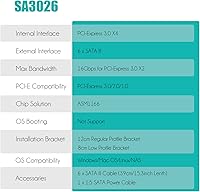
  • Host Interface: The card connects via PCI-Express 3.0 x2 and physically fits into any PCIe x4, x8, or x16 slot on a standard desktop motherboard.
  • SATA Ports: Six external SATA III ports are provided, each supporting data transfer rates up to 6 Gb/s per the SATA III specification.
  • Controller Chip: The ASM1166 is the onboard controller, a widely supported and proven chip commonly used in multi-port SATA expansion cards.
  • Per-Port Bandwidth: Each individual port can sustain up to 277 MB/s of throughput under optimal conditions, sufficient for most HDDs and SATA SSDs.
  • Upstream Bandwidth: All six ports share a combined upstream connection of 16 GT/s over the PCIe 3.0 x2 interface, which is the total available pipeline to the host system.
  • Controller Mode: The card operates exclusively in AHCI mode, enabling broad OS-level compatibility without requiring proprietary or third-party drivers.
  • OS Compatibility: Supported operating systems include Windows (Vista and later), Mac OS, Linux, Ubuntu, ESXi, and most NAS platforms; Windows XP is not supported.
  • OS Boot Support: This card does not support booting an operating system from any drive connected to it.
  • RAID Support: Hardware RAID is not supported; software RAID configurations such as Windows Storage Spaces or Linux mdadm can be set up at the OS level.
  • LED Indicators: Six red LED indicators are built in, with a steady light indicating normal drive activity and a flashing light signaling active data read or write operations.
  • Included Cables: Six SATA III data cables (each 350 mm / approximately 13.5 inches long) are included in the box.
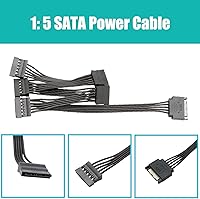
  • Power Cable: A single 1-to-5 SATA power splitter cable is included to help distribute power across multiple connected drives.
  • Bracket Options: Both a 12 cm full-height bracket and an 8 cm low-profile bracket are included, covering standard ATX and small form factor cases.
  • Card Weight: The card weighs 10.9 ounces, which is typical for a PCIe expansion card of this port density.
  • Package Dimensions: The retail package measures 10.51 x 6.5 x 1.46 inches, sized to accommodate the card and all bundled accessories.
  • Drive Compatibility: The card supports up to six SATA-based storage devices including 2.5-inch SSDs, 3.5-inch HDDs, and optical drives with a SATA interface.
  • Form Factor Fit: The card's PCIe x4 electrical interface makes it compatible with virtually all modern desktop form factors including ATX, mATX, and ITX boards that have a free x4 or wider slot.
  • Date Available: This product was first made available in November 2022 and has since accumulated substantial real-world buyer feedback.

Related Reviews

StarTech 8-Port SATA III PCIe Expansion Card
80%
88%
Drive Detection Reliability
84%
Multi-Controller Architecture
79%
OS Compatibility
86%
Motherboard Compatibility
81%
Included Cables
More
BEYIMEI 8-Port PCIe SATA Expansion Card
71%
88%
Value for Money
91%
Ease of Installation
86%
Port Count & Connectivity
57%
Throughput Performance
74%
Driver & OS Compatibility
More
GLOTRENDS LE8202 2-Port Gigabit PCIe Network Card
82%
88%
Driver Compatibility
91%
Ease of Installation
94%
Value for Money
86%
OS & Platform Coverage
79%
Build Quality
More
YBBOTT PCE 16SAT 16-Port SATA Expansion Card
77%
88%
Multi-Drive Detection Reliability
83%
Data Throughput Stability
81%
Chipset Stability & Architecture
86%
Operating System Compatibility
79%
Boot Drive Support
More
Moonqkuses 4-Port SATA 3.0 PCIe Expansion Card
78%
88%
Ease of Installation
91%
Driver & OS Compatibility
86%
Drive Detection Reliability
72%
Boot as System Disk
78%
Thermal Performance
More
Trotwei Blue SSU-10P-SATA3 10-Port SATA PCIe Card
70%
83%
Value for Money
58%
Driver Installation
91%
Port Count & Expansion
76%
Motherboard Compatibility
69%
Transfer Speed Performance
More
IO CREST SI-PEX40137 8-Port PCIe SATA Card
80%
92%
OS Compatibility
89%
Per-Port Bandwidth
91%
ZFS & NAS Suitability
83%
Hot-Swap Reliability
61%
Thermal Performance
More
FebSmart FS-S4-Pro V2 PCIe to 4-Ports SATA III Expansion Card
82%
88%
Performance
91%
Ease of Installation
85%
Compatibility with Operating Systems
86%
Build Quality
75%
Power Supply Requirements
More
FOSA M5015 SAS SATA RAID Controller Card
68%
83%
Value for Money
78%
Compatibility
66%
Firmware Flashing Experience
61%
Build Quality
69%
Drive Detection Reliability
More
StarTech ST1000SPEX2L 1-Port PCIe Network Card
82%
91%
Ease of Installation
88%
Connection Stability
93%
Low-Profile Compatibility
82%
OS & Driver Compatibility
94%
Value for Money
More

FAQ

Yes, and this is actually one of its stronger use cases. The ASM1166 controller is well-recognized by both TrueNAS and Unraid without any manual driver installation. Multiple users running these platforms have confirmed stable, immediate recognition of all six ports after a cold boot.

No, that is not possible with this card. It does not support OS booting from any connected drive. If you need a bootable expansion solution, you will need a different card that explicitly lists boot support in its specifications.

Not quite, and this is worth understanding before buying. All six SATA ports share a single PCIe 3.0 x2 upstream connection, which provides a combined bandwidth ceiling across all ports. For typical workloads like a home NAS serving files or a backup job, this is rarely a problem. If you plan to hammer all six drives with large simultaneous transfers, you may notice the shared pipe become a limiting factor.

No, it does not. The card runs in AHCI mode only and has no onboard RAID controller. You can absolutely set up software RAID using tools like Windows Storage Spaces, mdadm on Linux, or ZFS on NAS platforms, but all the RAID management happens at the OS level, not on the card itself.

The GLOTRENDS SA3026-C 6-Port PCIe SATA Card uses a PCIe x4 electrical interface but is physically compatible with x4, x8, and x16 slots. As long as you have one of those slots free on your board, it should fit and function correctly.
For the vast majority of users on modern operating systems, it is genuinely plug-and-play. Windows (Vista onward), Mac OS, Linux, Ubuntu, ESXi, and most NAS operating systems recognize the ASM1166 controller natively. Windows XP is the one exception where no driver support exists.

It should. The package includes both a full-height 12 cm bracket and a low-profile 8 cm bracket, so it covers both standard ATX cases and smaller slim or mATX enclosures. Just confirm your case has a usable low-profile PCIe slot opening before ordering.

The included 1-to-5 SATA power splitter cable helps address this by letting one PSU connector power multiple drives. That said, if your PSU is already heavily loaded, daisy-chaining five drives from a single connector can push the limits of that cable and your power rail. For builds with six populated bays, using two separate PSU connectors split between the drives is the safer approach.

Most modern boards work without any issues, but a small number of users with older or non-standard motherboards have reported problems. The most common culprit is a motherboard BIOS that does not properly handle PCIe lane negotiation for expansion cards. Checking that your board supports PCIe x4 expansion cards and updating the BIOS to the latest version before installing can help avoid most of these edge cases.

You get the expansion card itself, six SATA III data cables (each about 13.5 inches long), one 1-to-5 SATA power splitter cable, a full-height bracket already attached, and a low-profile bracket for smaller cases. It is a reasonably complete kit that covers most installation scenarios without requiring extra purchases.