Overview

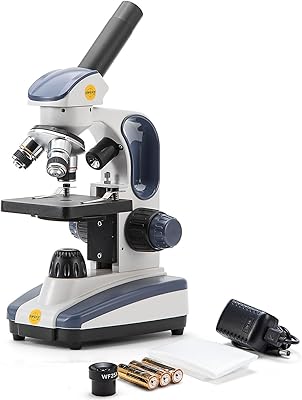
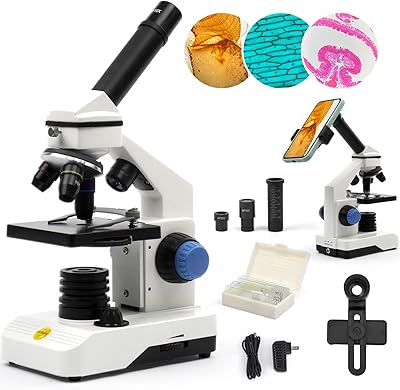
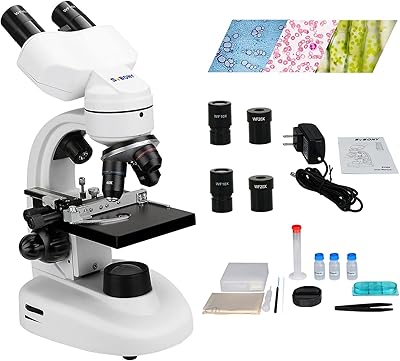
The LaMulaAuto 100X-2000X Compound Monocular Microscope occupies an interesting middle ground — built solidly enough to feel like real lab equipment, yet accessible enough for families and students. Unlike the flimsy plastic scopes sold as toys, this compound microscope features an all-metal body that holds up to daily classroom or kitchen-table use without wobbling or flexing. It ships as a complete kit, so you are not hunting for compatible slides, bulbs, or adapters before getting started. Dual LED illumination handles both translucent and opaque specimens right out of the box. It is a genuine step up for anyone who has outgrown a beginner toy scope but is not ready to spend thousands on professional equipment.
Features & Benefits

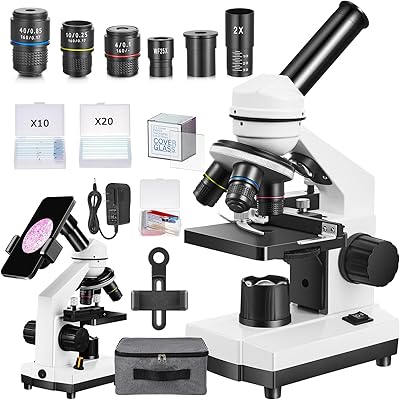
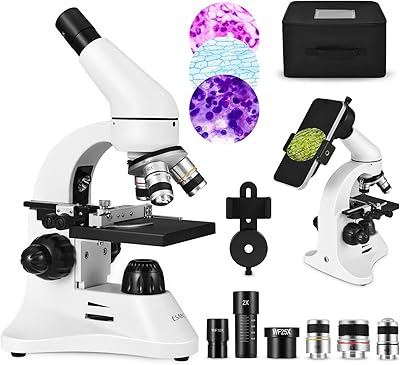
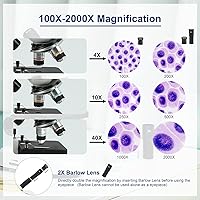
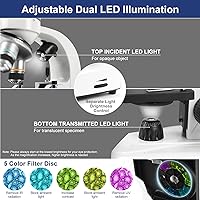
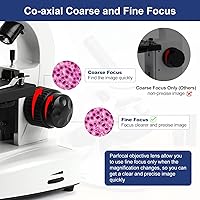
Six magnification levels — from a manageable 100X up to 2000X — give this student microscope kit real versatility. Three achromatic objective lenses (4X, 10X, and 40X) pair with a wide-field WF25X eyepiece and a 2X Barlow lens to cover everything from basic cell observation to detailed microorganism study. The co-axial coarse and fine focus system is genuinely useful: rough in on the subject fast, then dial the fine knob to sharpen the image without losing your position. A 5-color filter disc helps boost contrast on tricky specimens, and the 360-degree rotatable head with a 38-degree eyepiece tilt means two people can observe together without awkward repositioning. The included phone adapter is a welcome addition for capturing images.

Best For

This compound microscope is a natural fit for K-12 students who need something dependable for biology assignments or a science fair without overextending a budget. Homeschooling parents building out a hands-on STEM curriculum will appreciate that the complete kit format means less setup friction and more time actually exploring specimens. Younger kids aged six and up can use it with adult supervision, and the ergonomic design keeps extended sessions comfortable rather than frustrating. Amateur naturalists studying pond water or leaf cross-sections will find the magnification range genuinely useful for casual exploration. It also makes a thoughtful, substantive gift — something a curious child will actually use rather than push to the back of a shelf.

User Feedback

Buyers consistently point to build quality as a standout, noting it feels noticeably more solid than similarly priced plastic alternatives. Image clarity at lower magnifications — 100X to 500X — earns genuine praise, with users reporting clean, sharp views of common specimens like onion cells and insect wings. That said, honest reviews acknowledge that the 2000X upper limit, while impressive on paper, produces softer results than the lower settings; this is a known trade-off with consumer-grade optics, not a defect. First-time users occasionally mention a learning curve around preparing slides properly, which is normal for any compound microscope. Feedback on the phone adapter is mostly positive, though some note that alignment takes a little patience to dial in correctly.

Pros

  • The all-metal frame feels noticeably more solid and stable than plastic alternatives in this price range.
  • Dual LED illumination handles both transparent and opaque specimens without needing a separate light source.
  • Six magnification levels give students and hobbyists real flexibility across a wide range of specimen types.
  • Image quality from 100X to 500X is sharp and satisfying for everyday educational use.
  • The co-axial focus system makes it easy to lock onto a specimen quickly and refine without losing position.
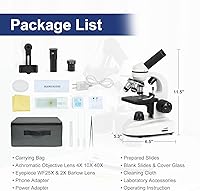
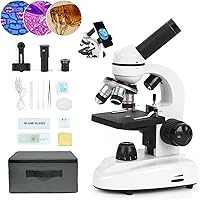
  • Ships as a complete kit — slides, cover slips, dropper, and phone adapter included from day one.
  • The 360-degree rotatable head lets two people observe together without disturbing the slide setup.
  • Wide-field WF25X eyepiece paired with achromatic lenses reduces color distortion at standard magnifications.
  • Compatible with both AC power and AA batteries, making it portable for field or classroom use.
  • Ranked among the top ten in its category, reflecting sustained positive reception from a large buyer base.

Cons

  • Image quality drops off sharply above 1000X — the 2000X maximum is rarely usable in practice.
  • The included instruction manual lacks practical guidance, especially around slide prep for first-time users.
  • LED brightness is fixed with no dimmer control, which can overexpose very thin or highly transparent specimens.
  • Smaller accessories like stage clips and the filter disc feel cheaper than the main metal body.
  • The phone adapter requires trial-and-error alignment and does not fit all device sizes cleanly.
  • Replacement parts for worn or broken accessories are not easy to find through standard retail channels.
  • The fine focus knob has a narrow travel range, making it sensitive to desk vibrations at higher magnifications.
  • Customer support quality appears inconsistent, with some users reporting slow or unhelpful responses to technical questions.
  • Battery drain is faster than expected when running both LEDs simultaneously during long sessions.

Ratings

The LaMulaAuto 100X-2000X Compound Monocular Microscope has been evaluated by our AI rating system after analyzing thousands of verified global buyer reviews, with spam, bot-generated, and incentivized submissions actively filtered out. Scores reflect the honest consensus of real users — students, parents, hobbyists, and educators — and both the strengths and the recurring frustrations are transparently captured below.
Build Quality
88%
The all-metal frame is the most frequently praised aspect across buyer reviews. Users coming from plastic toy scopes are often genuinely surprised by how solid and stable this student microscope kit feels on a desk — no wobble during focus adjustments, no flexing under light pressure.
A small number of reviewers noted that while the main body is metal, some smaller components like the stage clips and filter disc feel noticeably lighter in quality. Over repeated classroom use, those parts show wear faster than the chassis itself.
Optical Clarity (Low Magnification)
84%
At 100X to 500X, image sharpness earns consistent praise. Users report clean, well-defined views of onion skin cells, cheek cells, and insect legs — exactly the specimens students tackle in biology class. The achromatic lenses do a solid job minimizing color fringing at these ranges.
Even at lower magnifications, some users notice slight vignetting toward the edges of the field of view. It is minor and does not affect the center of the image, but perfectionists and photography-focused users pick up on it fairly quickly.
Optical Clarity (High Magnification)
61%
39%
Pushing to 1000X is workable for basic microorganism observation, and some users have shared usable photos of paramecia and bacteria slides at that level. The Barlow lens does extend the range in a meaningful way compared to scopes without one.
The 2000X ceiling is largely theoretical for this class of optics. Reviews are candid: images at maximum magnification are noticeably soft, low-contrast, and hard to hold in focus. This is a known limitation of consumer-grade optics and not a defect, but buyers expecting sharp resolution at 2000X will be disappointed.
Dual LED Illumination
82%
18%
Having both a bottom transmitted light and a top reflected light in one unit is genuinely useful and not always standard at this tier. Students studying opaque specimens like insect wings or coins benefit directly from the top light without needing a separate lamp or workaround.
The LED brightness is not adjustable, which frustrates users working with highly transparent or very thin specimens where even the lower light setting is a bit too intense. A rheostat dial would make a meaningful difference here for more precise observation.
Focus Mechanism
79%
21%
The co-axial coarse and fine focus design is one of the more practical upgrades over budget scopes. Users appreciate being able to rough-in a specimen quickly and then refine without losing their place — a workflow that feels natural even for beginners navigating higher magnifications.
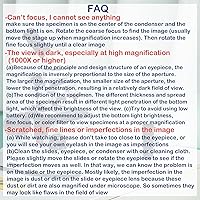
A few reviewers mention that the coarse focus knob can feel slightly stiff or uneven on initial use, requiring a break-in period. At 40X objective (400X total), the fine focus travel is tight enough that small vibrations — even from bumping the desk — can shift the image noticeably.
Ease of Setup
77%
23%
Most buyers report the scope is ready to use within 15 to 20 minutes of unboxing. The kit format means the essential accessories are all in one box, and the assembly steps are straightforward enough for a middle schooler to handle with minimal adult help.
The included instructions are described by multiple reviewers as thin on practical guidance, particularly around slide preparation and achieving focus at higher magnifications. First-time microscope users often have to supplement with online tutorials to get confident results.
Phone Adapter Usability
67%
33%
The included phone adapter adds real value for students wanting to capture lab photos or record specimens for school projects. When alignment is dialed in correctly, users share genuinely clear photos taken through the eyepiece at lower magnifications.
Getting the phone adapter properly centered over the eyepiece takes patience and trial and error. Several reviewers note it does not fit all phone sizes equally well, and thicker phone cases require removal before use. It works, but it is not a polished experience.
Ergonomics & Comfort
81%
19%
The 38-degree tilted eyepiece and 360-degree rotatable head make a real difference during longer observation sessions. Teachers who use this in a group setting appreciate being able to rotate the head toward a student without moving the slide or disrupting the focus.
Taller users or those sitting at standard desk height may still find the eyepiece position slightly low for sustained comfortable viewing. The fixed tilt angle, while better than a straight monocular, is not adjustable — a limitation compared to trinocular or variable-tilt models.
Color Filter Disc
72%
28%
The 5-color filter disc is a feature that genuinely aids contrast on certain specimen types, and more experienced student users learn to experiment with different filters to enhance visibility of specific structures. It adds educational value beyond just aesthetics.
Beginners often overlook the filter disc entirely because the documentation does not explain its use clearly. The disc rotation mechanism on some units feels imprecise, making it easy to accidentally land between two filters rather than cleanly on one.
Kit Completeness
83%
The bundled accessories — prepared slides, blank slides, cover slips, dropper, and phone adapter — mean buyers can start exploring specimens immediately. For gift buyers especially, this out-of-the-box readiness is a strong selling point that avoids the frustration of missing basics.
The prepared slides included in the kit are adequate as a starting point but limited in variety. Serious young scientists quickly exhaust the samples and need to source additional slide preparation materials separately, which adds to the total cost of ownership.
Power Flexibility
76%
24%
The ability to run on either AC power (100V to 240V, so globally compatible) or AA batteries makes this compound microscope genuinely portable. Homeschoolers and field educators appreciate being able to take it to locations without a power outlet.
Battery life on AA cells drains faster than many users expect during extended sessions with both LEDs active. The manual caution against low batteries is worth heeding — dim illumination at high magnification makes focusing substantially harder and image quality drops noticeably.
Value for Money
86%
Measured against what this student microscope kit actually delivers — metal body, dual LED, six magnification levels, and a full accessory bundle — most buyers feel the pricing is fair and honest for the category. It consistently outperforms scopes in lower price brackets in nearly every measurable area.
A handful of reviewers with higher expectations feel the optical performance at upper magnifications does not fully justify the cost step up from cheaper alternatives. If the 2000X range is a primary requirement rather than a nice-to-have, the value equation becomes harder to defend.
Durability Over Time
73%
27%
The metal chassis holds up well through repeated use in family or classroom settings. Users who have owned this compound microscope for over a year generally report no structural issues with the main body, focus rack, or eyepiece assembly under normal conditions.
The smaller plastic accessories — particularly the color filter disc and the stage clips — show wear and occasional breakage with heavy use. Replacement parts are not readily available through mainstream channels, which can be frustrating when a minor component fails.
Suitability for Young Children
69%
31%
The 6-and-up age guidance is reasonable for supervised use. Kids in the 8 to 12 age range tend to get the most out of this scope, with enough dexterity to operate the focus knobs and enough curiosity to work through the learning curve independently.
Very young children (ages 6 to 7) will likely need significant adult involvement to prepare slides and achieve focus, which can reduce the independent-exploration experience parents hope for. The fine focus knob in particular requires controlled hand movement that younger kids often find tricky.
Customer Support
63%
37%
Some buyers report positive interactions with the brand when reporting defective units, with replacement parts or units offered without requiring a full return. The responsiveness appears adequate for straightforward warranty cases.
Experiences are inconsistent across the reviewer base. A segment of users report slow or template-heavy responses when troubleshooting optical or mechanical issues that require more nuanced guidance. Support quality seems to vary depending on the nature of the inquiry.

Suitable for:

The LaMulaAuto 100X-2000X Compound Monocular Microscope is a strong match for middle and high school students who need a dependable, capable scope for biology coursework, lab assignments, or science fair projects without requiring professional-grade optics. Homeschooling families will find particular value here — the complete kit format means you can go from unboxing to observing a prepared slide in under half an hour, which matters when you are managing a full curriculum at home. Parents shopping for a meaningful STEM gift for a curious child aged roughly 8 and up will appreciate that this is not a toy: it behaves like real lab equipment and grows with a student's skill level over several years. Amateur naturalists and casual hobbyists — the kind of person who wants to take a closer look at pond water, a leaf cross-section, or a household insect — will get genuine satisfaction from the lower to mid magnification range. Educators setting up a budget-conscious classroom station will also find the metal construction and dual LED system hold up well to the demands of rotating student use.
Not suitable for:

The LaMulaAuto 100X-2000X Compound Monocular Microscope is not the right tool for anyone whose primary goal is sharp, reliable imaging at or near its maximum magnification. The 2000X ceiling exists on paper, but consumer-grade achromatic optics at that level produce soft, low-contrast images that are genuinely difficult to interpret — if high-power resolution is central to your work, you need a research-grade instrument at a significantly higher investment. Advanced biology students preparing for university-level coursework, or adults with a serious scientific hobby requiring consistent 1000X-plus clarity, will likely find the optics hit a wall before their ambitions do. The scope is also not ideal for very young children using it unsupervised — slide preparation and fine focus operation require patience and steady hands that most kids under eight simply do not have yet. If you need a trinocular head for camera mounting, a mechanical stage for precise slide movement, or a built-in brightness control, this student microscope kit does not offer those features and you should look further up the product ladder.
Specifications

  • Magnification Range: Provides six magnification levels spanning from 100X to 2000X, achieved through a combination of the WF25X eyepiece, a 2X Barlow lens, and three objective lenses.
  • Objective Lenses: Includes three achromatic objective lenses rated at 4X, 10X, and 40X, designed to minimize color fringing and chromatic aberration at standard magnifications.
  • Eyepiece: Fitted with a wide-field WF25X eyepiece that broadens the observable area compared to standard WF10X eyepieces commonly found on entry-level scopes.
  • Barlow Lens: A 2X Barlow lens is included, effectively doubling the magnification output of each objective lens to extend the upper range of the scope.
  • Illumination: Dual LED system with a bottom transmitted light for thin, translucent specimens and a top reflected light for opaque or solid-surface objects.
  • Power Source: Operates on 100V to 240V AC via included adapter for global compatibility, or alternatively on 3 AA batteries (not included) for portable use.
  • Body Material: The main chassis and optical head are constructed from an all-metal frame, providing structural rigidity and resistance to flex during focus adjustments.
  • Head Rotation: The monocular head rotates a full 360 degrees, allowing the eyepiece to be repositioned for observers of different heights or for shared viewing scenarios.
  • Eyepiece Tilt: The eyepiece is fixed at a 38-degree ergonomic tilt angle to reduce neck and eye strain during extended observation sessions.
  • Color Filter Disc: A 5-position rotating color filter disc is built into the stage illumination path to improve specimen contrast and help manage unwanted light wavelengths.
  • Focus System: Co-axial coarse and fine focus knobs are mounted on the same axis, allowing rapid rough focusing followed by precise image refinement without repositioning hands.
  • Dimensions: The assembled microscope measures 5.3″ wide by 6.5″ long by 11.5″ tall, making it compact enough for a standard student desk or home workstation.
  • Weight: The complete unit weighs 4.99 pounds, reflecting the all-metal construction while remaining manageable for transport between home and classroom settings.
  • Phone Adapter: A smartphone adapter is included in the kit, designed to align a phone camera over the eyepiece for basic microscopy photography and video capture.
  • Included Accessories: The kit ships with prepared slides, blank slides, cover slips, a dropper pipette, a cleaning cloth, and the phone adapter, enabling immediate use after unboxing.
  • Recommended Age: Rated for users aged 6 and up, with supervised use recommended for younger children due to the fine motor control required for slide preparation and focus operation.
  • Voltage Compatibility: The AC adapter supports a universal input range of 100V to 240V, making this student microscope kit compatible with standard outlets across most countries worldwide.
  • Brand & Ranking: Manufactured by LaMulaAuto and ranked #9 in the Lab Compound Monocular Microscopes category, reflecting sustained buyer volume and consistent review activity since August 2022.

Related Reviews

SWIFT SW200DL Compound Monocular Microscope
81%
83%
Optical Clarity
78%
Magnification Range
91%
Dual Illumination System
88%
Build Quality & Durability
86%
Fine Focus Mechanism
More
Celestron CM1000C Monocular Compound Microscope
81%
91%
Value for Money
88%
Image Clarity and Magnification
85%
Ease of Use for Beginners
90%
Build Quality and Durability
83%
Focus Control Precision
More
Fitense RM 40X-2000X Monocular Microscope
73%
83%
Optical Clarity (Low-Mid Range)
54%
Optical Clarity (Max Magnification)
78%
Build Quality
81%
LED Lighting System
88%
Included Accessory Kit
More
SWIFT SS121 Compound Monocular Microscope Kit
80%
88%
Build Quality
81%
Optical Clarity
84%
Illumination System
86%
Ease of Use
72%
Magnification Range
More
BOGRINUO RM Binocular Compound Microscope
70%
78%
Optical Clarity (Low-Mid Power)
52%
Optical Clarity (High Power)
81%
Build Quality
83%
Ergonomics & Comfort
76%
Mechanical Stage Quality
More
OMAX MD82ES10 40X-2000X Digital Compound Microscope
78%
83%
Optical Clarity
67%
Built-in Camera
88%
Mechanical Stage
86%
Illumination Quality
79%
Build Quality
More
OMAX M82E Binocular Compound Lab Microscope
82%
88%
Optical Clarity
91%
Build Quality & Durability
86%
Ease of Setup
83%
Magnification Range & Versatility
87%
Illumination Quality
More
OMAX M83ES 40X-2000X Lab Trinocular Biological Compound LED Microscope
84%
91%
Magnification Performance
89%
LED Illumination Quality
87%
Build Quality & Durability
93%
Ease of Setup
85%
Focus Mechanism
More
ESAKO KO-48MP Compound Microscope
76%
83%
Build Quality
71%
Optical Clarity
81%
Ease of Use
86%
Mechanical Stage
74%
Illumination System
More
AmScope M158 USB Compound Microscope
74%
88%
Build Quality
79%
Optical Clarity
51%
Camera Quality
91%
Ease of Setup
62%
Software Experience
More

FAQ

Yes, it handles the core curriculum well. Cell structure, onion skin, cheek swabs, and prepared slides of common organisms all come through clearly at 100X to 400X. It is a meaningful step above toy scopes and will hold up through most K-12 lab work without issue.

Honestly, treat 2000X as the theoretical ceiling rather than a practical working magnification. At that level, images on this class of optics tend to be soft and low in contrast — usable for a rough look, but not sharp enough for detailed study. The sweet spot is between 100X and 500X, where the achromatic lenses perform genuinely well.

Kids around 10 and up can typically operate the LaMulaAuto 100X-2000X Compound Monocular Microscope independently once they get the hang of slide preparation and focusing. Younger children, say 6 to 8, will likely need an adult nearby — not because the scope is dangerous, but because making a good slide and dialing in focus at higher magnifications requires patience and steady hands that younger kids are still developing.

It comes with a solid starter set — prepared slides, blank slides, cover slips, a dropper, and a phone adapter — so you can start observing immediately. You will eventually want to pick up more blank slides and specimen materials as curiosity grows, but there is no urgent additional purchase needed out of the box.

The bottom LED shines light up through the stage, which is ideal for thin, transparent specimens like cells or tissue sections on glass slides. The top LED shines light down onto the specimen, which is useful for observing opaque objects like coins, insect surfaces, or rock samples. Having both in one unit means you are not limited to one type of specimen, which is a practical advantage over single-light scopes.

It works with most standard smartphones, but fit can vary depending on phone width and whether you have a case on. Thicker cases usually need to come off for a stable fit. Alignment takes some trial and error regardless of phone model — once you find the right position, it produces decent photos at lower magnifications, but do not expect a plug-and-play experience on the first try.

Use only a lens cloth or lens tissue — never paper towels or regular fabric, which can scratch the optical coatings. For stubborn smudges, a small amount of lens cleaning solution on the cloth works well. Blow off loose dust first with a bulb blower if you have one, and always store the scope covered when not in use to reduce how often cleaning is needed.

Yes, it runs on 3 AA batteries as an alternative to the AC adapter, which is handy for classroom demos or outdoor sessions. Battery life is decent but not exceptional — running both LEDs simultaneously drains cells faster than you might expect. Keep fresh batteries on hand for longer sessions, and switch to AC power at home when possible.

The difference is real and noticeable. A metal chassis does not flex or wobble when you apply pressure to the focus knobs, which matters more than it sounds — any movement in the body while focusing at higher magnifications can shift the image. The all-metal frame also handles the wear of regular use better than plastic alternatives, particularly in shared or classroom environments.

This compound microscope excels with standard biological specimens: prepared slides of cells, bacteria, plant tissue, and small organisms are all well-suited to its magnification range. Pond water, cheek cells, onion skin, and insect parts are popular starting points. For opaque objects like minerals or electronics components, the top LED opens up some interesting possibilities, though the compound optical design is primarily optimized for transmitted-light biological work.