Overview
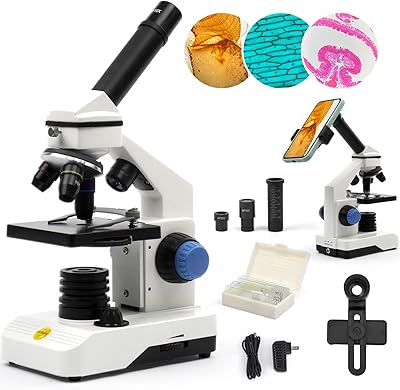
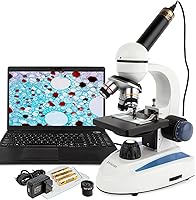
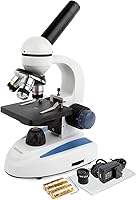
The AmScope M158 USB Compound Microscope has been around since 2011, and the fact that it's still selling says something real about its staying power in the student and home-lab market. What keeps it relevant is the all-metal frame — at this price point, most competitors ship you something that feels like a toy. This one doesn't. It sits solidly on a desk and handles regular use without wobbling apart. The built-in USB camera is the feature that pushes it past basic entry-level options, letting you actually capture what you're seeing rather than just squinting through the eyepiece. Just be clear going in: this is an educational tool, not a research-grade instrument.
Features & Benefits
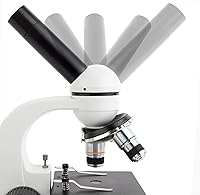
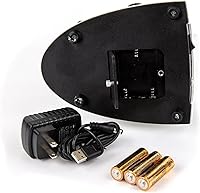
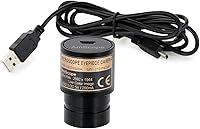
The rotating monocular head swings a full 360 degrees, which sounds like a small thing until you're sharing the scope with a left-handed kid or trying to orient it in a cramped workspace — it genuinely matters. Five magnification steps take you from 40X for getting oriented all the way up to 1000X for cellular detail. The LED light runs off either the wall outlet or AA batteries, so you can take it to a classroom or kitchen table without hunting for a power strip. The USB camera feeds 640x480 footage to your computer for photos and video, and the bundled Windows software adds measurement tools, extended depth of focus, and image stitching for more advanced work.
Best For
This compound microscope is a natural fit for middle and high school students tackling biology assignments or science fair projects — it's approachable enough for a beginner but sturdy enough to survive years of regular use. Homeschool families tend to get a lot of mileage out of it, since the camera makes it easy to display images during group lessons. Hobbyists examining insects, plant cells, or pond water will find the magnification range covers most casual specimen work. It also holds up well as a classroom demo scope for teachers. If you want camera functionality without spending professional-grade money, this one makes a reasonable case for itself.
User Feedback
Most owners praise the solid construction right out of the box — people are visibly relieved that the frame doesn't flex or creak like cheaper plastic alternatives. Setup is straightforward, and image clarity at lower magnifications draws consistent compliments. That said, the 640x480 camera resolution is a recurring sticking point; anyone used to modern webcam quality will find it noticeably soft. Mac users also report a rougher software experience than Windows owners. A handful of buyers mention shipping damage or missing accessories on arrival, so inspecting the package carefully is worth the extra minute. At 1000X, results depend heavily on slide preparation skills — several reviewers discovered that limitation only after buying.
Pros
- All-metal frame feels noticeably more solid and durable than plastic competitors at a similar price.
- Five magnification steps from 40X to 1000X handle a wide variety of everyday specimen types.
- The 360-degree rotating head is a practical convenience when sharing the scope or working in tight spaces.
- LED lighting runs on both AC power and AA batteries, so portability is a real option.
- USB camera lets students capture images and video without buying any extra accessories.
- Windows software includes useful tools like measurement functions, EDF, and image stitching.
- Setup is straightforward enough for a middle schooler to manage independently.
- The scope has been on the market since 2011, indicating a product with tested, stable design.
- LED brightness is consistently rated as adequate for typical specimens and slide work.
- Bundled student-focused software interface lowers the learning curve for younger users.
Cons
- The 640x480 camera resolution looks soft and dated compared to any modern webcam or phone camera.
- Mac users get significantly less software functionality than Windows users out of the box.
- Achieving usable images at 1000X magnification requires proper slide preparation skills most beginners lack.
- Some buyers report receiving units with missing accessories or packaging damage on arrival.
- The monocular head limits this compound microscope to single-eye viewing, which can cause fatigue over long sessions.
- No binocular or trinocular upgrade path exists within this model line.
- Camera image quality at higher magnifications degrades noticeably and is not suitable for detailed documentation.
- Third-party software is required for a fully functional Mac experience, adding setup friction.
- At nearly three pounds, the unit is reasonably portable but not lightweight enough for casual field use.
- Long-term customer support and replacement parts availability can be inconsistent for older units.
Ratings
The scores below for the AmScope M158 USB Compound Microscope were generated by our AI system after analyzing thousands of verified global buyer reviews, with spam, incentivized, and bot-flagged submissions actively filtered out before scoring. Each category reflects the honest distribution of real user sentiment — strengths are credited where earned, and recurring frustrations are weighted just as seriously. The result is a balanced scorecard that gives you a clear picture of where this compound microscope genuinely delivers and where it falls short.
Build Quality
Optical Clarity
Camera Quality
Ease of Setup
Software Experience
Magnification Range
Lighting Performance
Value for Money
Portability
Durability Over Time
Ergonomics
Compatibility
Accessories Included
Instructions & Documentation
Suitable for:
The AmScope M158 USB Compound Microscope is a strong match for middle and high school students who need a capable, durable scope for biology coursework, science fair projects, or general specimen exploration. Homeschool families in particular tend to get outsized value here — the USB camera makes it easy to project live images during group lessons, turning a solo activity into a shared learning experience. Hobbyists with a casual interest in entomology, botany, or pond-water biology will find the five magnification levels cover the vast majority of everyday specimen work without requiring any specialized lab skills. Teachers looking for a reliable classroom demonstration tool will appreciate the all-metal construction, which holds up to repeated handling far better than comparably priced plastic alternatives. If you are a first-time microscope buyer who wants the ability to photograph and record specimens without spending significantly more, this compound microscope makes a genuinely practical case for itself.
Not suitable for:
The AmScope M158 USB Compound Microscope is not the right tool for anyone who needs publication-quality imaging or high-resolution digital capture — the 640x480 USB camera was modest even when this product launched, and it will feel noticeably limited to anyone accustomed to modern smartphone or webcam quality. Serious hobbyists or amateur researchers who routinely work at very high magnifications should also think twice; getting usable results at 1000X requires well-prepared slides and a fair amount of technique, and buyers expecting sharp, effortless views at maximum power are frequently disappointed. Mac users should be aware that the bundled software is Windows-only in its full-featured form, and the Mac experience has been a consistent source of frustration in user feedback. Anyone sourcing this for a professional lab environment, clinical setting, or advanced scientific work will quickly outgrow its capabilities. If image capture quality is a primary requirement rather than a nice-to-have, it is worth budgeting for a model with a higher-resolution camera.
Specifications
- Brand: Manufactured by United Scope LLC under the AmScope brand, a company focused on optical instruments for educational and hobbyist use.
- Model Number: The official model identifier is M158C-E, sometimes listed as M158 in shorthand references.
- Dimensions: The unit measures 10.24 x 6.69 x 14.96 inches, giving it a compact but stable footprint on a desk or lab table.
- Weight: At 2.98 pounds, the all-metal frame is heavier than plastic alternatives but still manageable for repositioning or transport.
- Frame Material: The body is constructed from all-metal components, which contributes to long-term durability and reduces wobble during use.
- Magnification: Five discrete magnification levels are available: 40X, 100X, 250X, 400X, and 1000X, covering a broad range of specimen types.
- Head Type: The monocular head rotates a full 360 degrees, allowing the eyepiece to be repositioned for different users or workspace configurations.
- Optics: Optical glass lenses are used throughout, providing clearer and more accurate image rendering than acrylic or plastic lens alternatives.
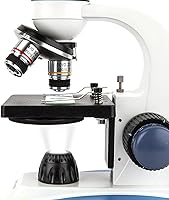
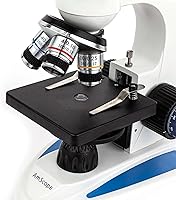
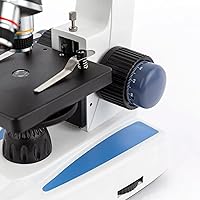
- Condenser: A single glass lens condenser paired with a 6-hole disc diaphragm allows users to control the amount and shape of light reaching the specimen.
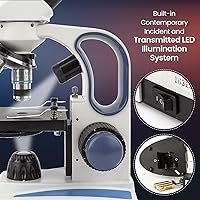
- Light Source: LED illumination is built in and can be powered via a 110V AC outlet or two AA batteries, making battery-powered field use possible.
- Camera: A 640x480 resolution USB 2.0 digital camera is integrated, enabling still photo and video capture directly to a connected computer.
- OS Compatibility: The camera and included software are compatible with both Windows and Mac, though full-featured software tools are available on Windows only.
- Software: Bundled Windows software supports image stitching, extended depth of focus (EDF), video recording, and on-screen measurement functions.
- Power Supply: Primary power runs on 110V AC via outlet; battery backup uses 2 AA batteries (not included) for portable operation.
- Color: The unit ships in white with standard black optical and mechanical components.
- Availability: This product has been available since March 2011 and has not been discontinued by the manufacturer as of current listings.
- Connectivity: USB 2.0 port connects the integrated camera to a Windows or Mac computer for live viewing, image capture, and video recording.
- View Angle: The eyepiece is set at a 45-degree angle, which is a common and ergonomically comfortable orientation for extended viewing sessions.
Related Reviews
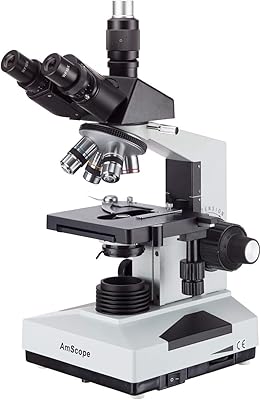
AmScope T490B Compound Trinocular Microscope
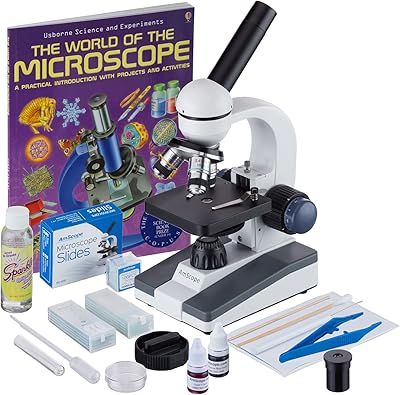
AmScope M150C Compound Microscope
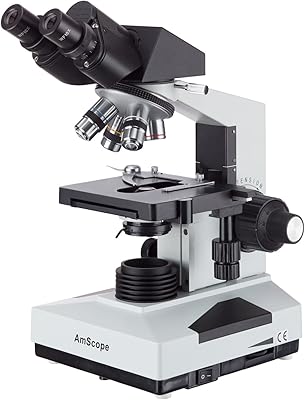
AmScope B490B Compound Binocular Microscope
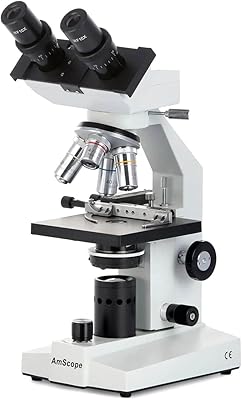
AmScope B100B-MS Compound Binocular Microscope
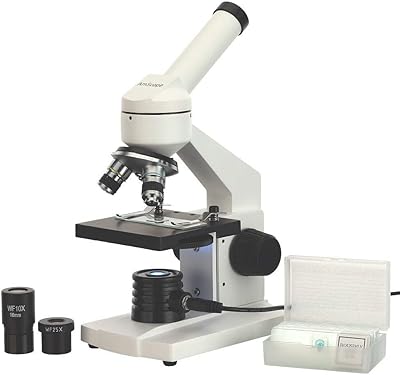
AmScope M102C Biological Compound Microscope
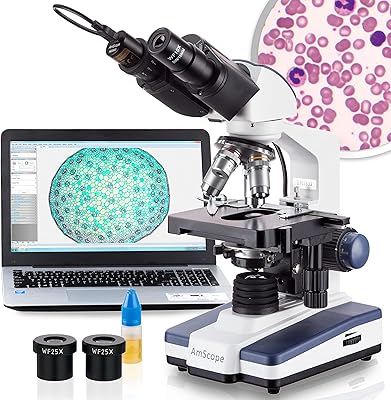
AmScope B120C-E5 Binocular Compound Microscope
PalliPartners SWXWJ-1 Compound Microscope
Celestron CM1000C Monocular Compound Microscope
SWIFT SW200DL Compound Monocular Microscope