Overview

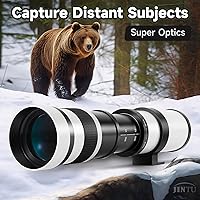
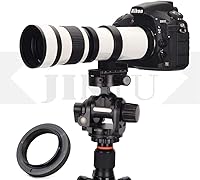
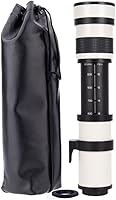
The JINTU 420-1600mm Telephoto Zoom Lens is a budget-conscious super-telephoto option built for Canon EF and EF-S mount shooters who want serious reach without spending serious money. Right away, one thing needs to be clear: this is a fully manual lens — no autofocus, no electronic contacts, no image stabilization. That limitation will frustrate some buyers, but for hobbyists chasing moon shots or distant birds on a tight budget, it is a workable trade-off. The barrel is full metal construction, which feels reassuringly solid in hand, and the glass elements carry multi-coated treatment to reduce flare and chromatic issues at long distances.

Features & Benefits

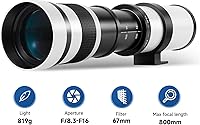
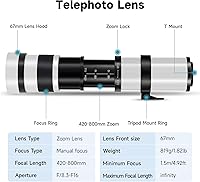
At its core, this manual zoom lens covers a 420–800mm focal range, and with the included 2x teleconverter attached, that reach extends to 1600mm — genuinely impressive territory for the price. The aperture runs from f/8.3 to f/16 and adjusts automatically as you zoom, so there is no separate aperture ring to manage. A 67mm filter thread opens the door for neutral density or polarizing filters. At 2.2 lbs and just over 11 inches long, it is manageable but benefits from support. Because there are no electronic contacts, your camera will display F00 and you must shoot entirely in Manual mode — no exceptions.

Best For

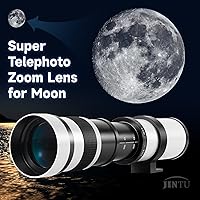
This telephoto lens finds its strongest audience among hobbyist moon photographers and backyard wildlife watchers shooting Canon DSLRs — particularly Rebel-series bodies like the T7, T7i, or T6. If you are comfortable dialing in focus manually and working with a tripod, the value proposition becomes quite compelling. It is also a solid pick for beginners wanting to experiment with extreme focal lengths before committing to expensive glass. Travelers who prioritize reach over convenience will appreciate it too. Keep in mind it does not work with Canon EOS R or M mirrorless systems, so confirm your body has a standard EF or EF-S mount before buying.

User Feedback

With a 3.8-star average across nearly 280 ratings, reception is mixed but leans positive for what it costs. Buyers who set realistic expectations tend to come away satisfied — many highlight surprisingly strong moon photography results when the lens is locked down on a sturdy tripod. The recurring criticism is consistent: the focus ring can feel stiff, handheld sharpness is difficult to nail at these focal lengths, and image quality drops noticeably at the 1600mm teleconverter end. Photographers accustomed to autofocus are frequently caught off guard by how demanding manual focus becomes at 800mm and beyond — knowing that upfront makes a real difference.

Pros

  • Extreme 1600mm reach is available at a price point almost nothing else can match.
  • The all-metal barrel feels far more solid than typical budget lenses in this range.
  • Multi-coated glass elements do a reasonable job controlling flare and color fringing.
  • Moon photography results are genuinely impressive when the lens is properly supported on a tripod.
  • Compatible with a vast range of Canon EF and EF-S DSLRs, including most Rebel models.
  • The included 2x teleconverter and lens pouch add real value without extra cost.
  • At 2.2 lbs, the weight is manageable enough for travel with a lightweight tripod.
  • A 67mm filter thread allows use of standard ND and polarizing filters.
  • Ranked in the top 100 in its Amazon category, suggesting consistent buyer interest over time.
  • An affordable way for beginners to learn manual focus technique on a real telephoto.

Cons

  • No autofocus whatsoever — tracking moving subjects at long focal lengths is extremely difficult.
  • Camera displays F00 due to absent electronic contacts, requiring full Manual mode operation.
  • Image sharpness drops noticeably when the 2x teleconverter is attached.
  • Focus ring stiffness is a recurring complaint and can make precise adjustments frustrating.
  • Handheld shots at 800mm and beyond are rarely sharp without a sturdy tripod.
  • Incompatible with Canon EOS R and EOS M mirrorless systems entirely.
  • Aperture maxes at f/8.3, making low-light and action shooting unrealistic.
  • No image stabilization of any kind, compounding the challenge of handheld use.
  • Optical quality does not match native Canon telephoto glass at comparable focal lengths.

Ratings

The scores below reflect AI-powered analysis of verified global buyer reviews for the JINTU 420-1600mm Telephoto Zoom Lens, with spam, bot-generated, and incentivized feedback actively filtered out to ensure the results represent genuine user experiences. This manual super-telephoto attracts a wide range of hobbyist Canon shooters, and the ratings honestly capture both the areas where it genuinely over-delivers and the friction points that frustrate buyers expecting more from a budget lens.

Value for Money
83%
For the asking price, the sheer focal reach — especially with the 2x teleconverter included — is difficult to find anywhere else. Hobbyists who want to experiment with extreme telephoto without a significant financial commitment consistently report feeling the purchase was worth it once they adjusted their expectations.
Buyers who compare it against more expensive telephoto glass quickly feel the optical trade-offs. Some report that the cost of a quality tripod and head, which is practically required for usable shots, pushes the real total investment higher than the lens price alone suggests.
Focal Reach
88%
The native 420–800mm range is genuinely impressive for the category, and attaching the included teleconverter to hit 1600mm gives users a taste of astrophotography and wildlife reach that would otherwise require spending many times more. Moon photographers in particular praise the reach as a standout strength.
At the 1600mm teleconverter end, image quality degrades noticeably — softness and reduced contrast are common observations. The reach is there on paper, but extracting clean, sharp images at maximum extension requires ideal conditions, a rock-solid tripod, and some post-processing work.
Image Sharpness
61%
39%
At the 420–600mm range, with a well-locked tripod and proper manual focus technique, users capture genuinely crisp lunar surface detail and acceptable wildlife shots. Multi-coated glass elements help keep chromatic aberration manageable in good light.
Sharpness is inconsistent and highly dependent on technique — handheld shots at 800mm are almost always soft, and the teleconverter compounds this significantly. Users with higher expectations, particularly those coming from name-brand telephoto lenses, tend to be disappointed by the center-to-edge sharpness at longer focal lengths.
Build Quality
79%
21%
The full metal barrel is a genuine surprise at this price point — it feels solid and substantial in hand, and several users note it holds up well through regular outdoor use including dusty safari and birdwatching trips. The construction inspires more confidence than typical plastic-bodied budget lenses.
While the barrel is metal, there is no weather sealing of any kind, which limits its use in rain or high-humidity conditions without extra precaution. A few users also report that the zoom mechanism feels looser over time with repeated extension and retraction.
Manual Focus Experience
54%
46%
For photographers who enjoy the deliberate, hands-on nature of manual focusing, this lens rewards patience. Shooting stationary subjects like the moon, perched birds, or static landscapes gives enough time to dial in focus carefully and achieve satisfying results.
The focus ring draws consistent complaints for stiffness — particularly when new — making fine adjustments frustrating, especially in cold weather. At 800mm, even minor inaccuracies in focus placement produce noticeably soft images, which creates a steep learning curve for anyone new to long manual telephoto work.
Compatibility
86%
The lens covers an exceptionally broad range of Canon EF and EF-S DSLR bodies, from entry-level Rebel models all the way to professional 1D and 5D series cameras. Canon Rebel owners with crop sensors actually benefit the most, gaining additional effective reach compared to full-frame shooters.
Compatibility stops completely at Canon mirrorless systems — EOS R and EOS M series bodies are fully excluded, with no adapter workaround supported. Buyers who have transitioned or plan to transition to mirrorless will find this lens a dead end.
Ease of Use
58%
42%
Once set up on a tripod in Manual mode, the shooting workflow becomes straightforward and even meditative for patient hobbyists. The zoom range covers a variety of distant subjects without needing to swap lenses.
The absence of any electronic communication with the camera — resulting in the F00 display — catches many buyers off guard and requires a mode switch that first-time users often find confusing. The mandatory Manual mode requirement is a real barrier for beginners who are not yet comfortable with full exposure control.
Tripod Performance
77%
23%
When properly mounted on a sturdy tripod with a fluid or ball head, this manual zoom lens performs well above what its price suggests. Moon photographers report sharp, detailed lunar surface shots that genuinely impress when the setup is stable.
The lens lacks a tripod collar, which can cause balance issues on lighter tripod heads at longer focal lengths. Users report that a cheap or flimsy tripod negates most of the optical potential, requiring an additional investment in stable support equipment.
Included Accessories
72%
28%
Bundling a 2x teleconverter, a protective lens pouch, and front and rear caps into the box adds tangible value — particularly the teleconverter, which would cost extra with most competing products in this category.
The soft pouch offers minimal protection for transport in a camera bag, and there is no lens hood included despite the long barrel being susceptible to flare in bright shooting conditions. Buyers who shoot outdoors frequently will likely need to source a 67mm hood separately.
Aperture Performance
53%
47%
The f/8.3 maximum aperture is adequate for bright daylight shooting of the moon or outdoor wildlife in good conditions, and the auto-adjustment mechanism works reliably without requiring manual intervention as you zoom.
f/8.3 is a narrow maximum aperture that makes low-light and indoor shooting impractical, and the lens cannot be used for any subject requiring a shallow depth of field or fast shutter speeds in dim conditions. Golden hour and dusk wildlife shots are generally outside the realistic capability of this lens.
Portability
69%
31%
At 2.2 lbs and just over 11 inches, the lens is lighter than many telephoto options in this focal class, making it feasible to pack for travel or carry on nature walks when paired with a compact travel tripod.
The 11-inch length makes it awkward to store in standard camera bags, and the absence of a padded case means users need to plan storage carefully. Extending it to 1600mm with the teleconverter increases the overall length considerably, further complicating transport.
Moon Photography
81%
19%
This is arguably the strongest real-world use case for the lens — buyers who set it up on a tripod on a clear night consistently report lunar shots with impressive crater and surface detail that far exceed what a kit lens or smartphone can produce.
Getting consistently sharp moon shots still demands precise manual focus technique and a remote shutter release or self-timer to avoid camera shake at the moment of exposure. Atmospheric conditions on humid or hazy nights can reduce sharpness regardless of technique.
Wildlife & Bird Use
59%
41%
For stationary or slow-moving subjects — a bird perched on a branch, deer grazing at a distance — the reach is genuinely useful and the image quality is acceptable for social media sharing or personal enjoyment at this hobbyist level.
Tracking moving birds or wildlife in flight is a serious challenge with no autofocus and a stiff manual focus ring. The narrow maximum aperture also limits shooting in shaded woodland environments where most wildlife photography actually takes place.

Suitable for:

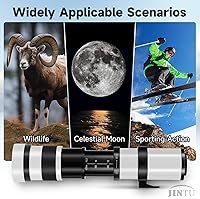
The JINTU 420-1600mm Telephoto Zoom Lens is genuinely well-matched to hobbyist photographers who shoot with Canon EF or EF-S mount DSLRs and want extreme reach without a large financial commitment. If your idea of a great evening is setting up a tripod in the backyard to capture lunar surface detail, this lens delivers a surprisingly compelling result for what it costs. Bird watchers and casual wildlife observers who are patient enough to work with manual focus will find the 420–800mm native range more than adequate for stationary or slow-moving subjects. Canon Rebel owners — the T6, T7, T7i, and similar bodies — are a natural fit, since this lens pairs well with the crop sensor advantage those cameras provide, effectively pushing reach even further. It also suits beginners who want to develop manual focus discipline and understand how telephoto shooting actually works before spending on autofocus glass.

Not suitable for:

The JINTU 420-1600mm Telephoto Zoom Lens is a poor choice for anyone who relies on autofocus, and that covers a wider audience than you might expect — sports shooters, action photographers, and anyone tracking fast-moving subjects will find manual focusing at 800mm a genuinely frustrating experience. Photographers shooting on Canon EOS R or EOS M mirrorless systems should stop here entirely, as this lens is incompatible with those mounts. If you expect consistently sharp, publication-quality images straight out of the camera, the optical trade-offs at this price point will disappoint — sharpness is usable but not exceptional, and attaching the 2x teleconverter introduces a noticeable drop in image quality. Handheld shooting is impractical at these focal lengths, so if you travel light without a tripod, this lens will rarely deliver keepers. Anyone upgrading from a decent mid-range telephoto should also temper their expectations significantly.

Specifications

  • Focal Length: Covers 420–800mm natively, extending to 1600mm when the included 2x teleconverter is attached.
  • Focus Type: Fully manual focus only — there is no autofocus motor or electronic communication with the camera body.
  • Aperture Range: Maximum aperture is f/8.3, narrowing automatically to f/16 as focal length increases toward 800mm.
  • Lens Mount: Designed exclusively for Canon EF and EF-S mount DSLRs; incompatible with EOS R and EOS M mirrorless systems.
  • Filter Thread: The front element accepts standard 67mm screw-in filters such as polarizers or neutral density filters.
  • Weight: The lens body weighs 2.2 lbs (approximately 1 kg), not including the 2x teleconverter attachment.
  • Dimensions: Measures 11.4 × 2.63 × 2.63 inches when at minimum focal length without the teleconverter attached.
  • Body Material: The outer barrel is constructed from full metal, providing durability above what is typical at this price tier.
  • Glass Elements: Optical elements use multi-coated low-dispersion glass designed to reduce flare, ghosting, and chromatic aberration.
  • Electronic Contacts: There are no electronic contacts on the mount; the camera will display F00 and requires shooting in full Manual mode.
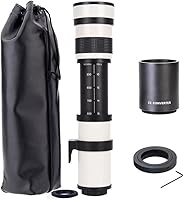
  • In The Box: Package includes the lens body, a 2x teleconverter, a soft lens pouch, and front and rear protective caps.
  • Teleconverter: The bundled 2x teleconverter doubles the focal range to 1600mm but results in a corresponding reduction in image sharpness.
  • Compatibility: Works with Canon EOS Rebel series (T2i through T8i), EOS 5D, 6D, 7D, 80D, 90D, and many other EF-mount bodies.
  • Incompatible Models: Does not fit Canon EOS R, Ra, RP, R3, R5, R6, R7, R8, R10, R50, R100, or any EOS M mirrorless camera.
  • Aperture Control: The lens has no manual aperture ring; aperture adjusts automatically in response to zoom position changes.
  • Category Rank: Holds a Best Sellers Rank of #88 in the SLR Camera Lenses category on Amazon at time of review.
  • User Rating: Carries a 3.8 out of 5 star average rating based on 278 customer reviews on Amazon.
  • Availability: First listed in June 2019 and confirmed as not discontinued by the manufacturer as of the review date.

Related Reviews
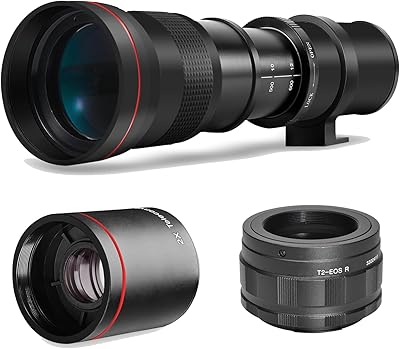
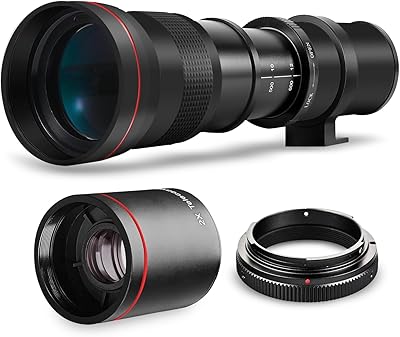
BM Premium 420-1600mm f/8.3 Telephoto Zoom Lens
69%
83%
Value for Money
88%
Focal Reach
57%
Image Sharpness
61%
Manual Focus Usability
59%
Build Quality
More
Big Mike's 420-1600mm Manual Telephoto Lens
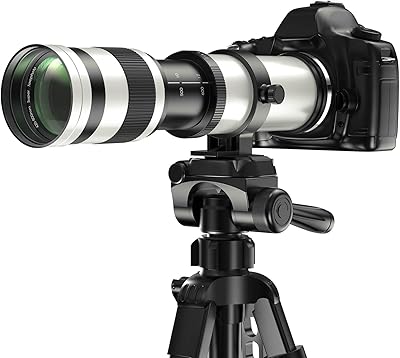
60%
78%
Value for Money
47%
Optical Sharpness
88%
Focal Reach
54%
Manual Focus Usability
31%
Low-Light Performance
More
Lightdow 420-800mm F8.3 Telephoto Zoom Lens
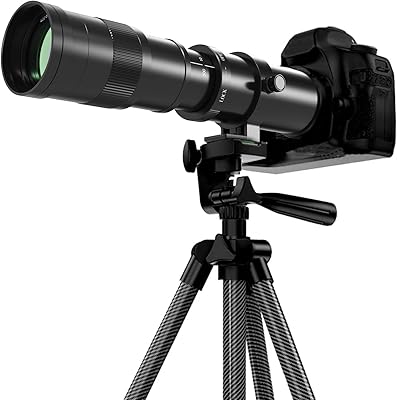
68%
83%
Value for Money
61%
Image Sharpness
69%
Manual Focus Usability
58%
Build Quality
72%
Setup & Compatibility
More
BENOISON 420-800mm RF Telephoto Lens
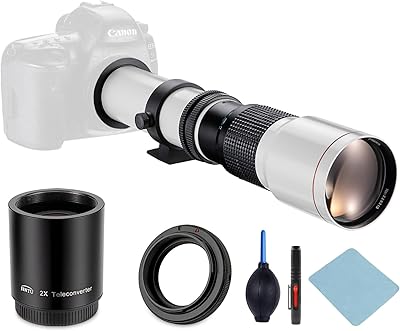
69%
83%
Value for Money
78%
Focal Range Versatility
71%
Build Quality
62%
Image Sharpness
54%
Ease of Setup
More
JINTU 500-1000mm f/8 Manual Telephoto Lens
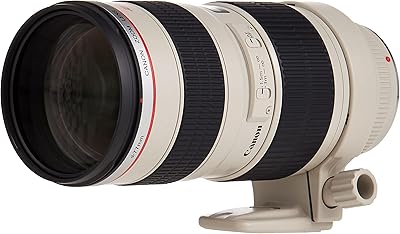
66%
74%
Image Quality at 500mm
46%
Image Quality at 1000mm
78%
Value for Money
58%
Manual Focus Usability
63%
Build Quality
More
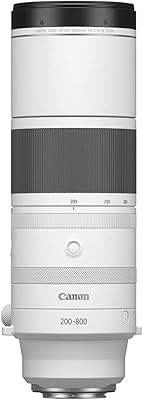
Canon RF200-800mm F6.3-9 IS USM Zoom Lens
82%
96%
Zoom Range Versatility
91%
Image Stabilization
83%
Autofocus Performance
89%
Portability & Weight
58%
Aperture Range
More
Canon EF 70-200mm f/2.8L USM Telephoto Zoom Lens
82%
91%
Autofocus Speed
93%
Image Sharpness
94%
Build Quality
92%
Aperture Consistency
89%
Bokeh & Subject Separation
More
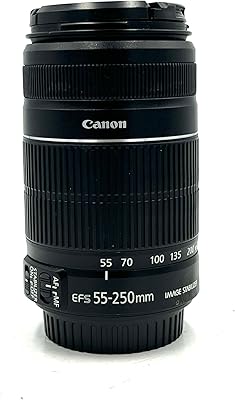
Canon EF-S 55-250mm f/4-5.6 IS II Telephoto Zoom Lens
82%
91%
Value for Money
88%
Image Stabilization Performance
65%
Autofocus Speed in Low Light
93%
Portability & Size
85%
Image Quality & Sharpness
More
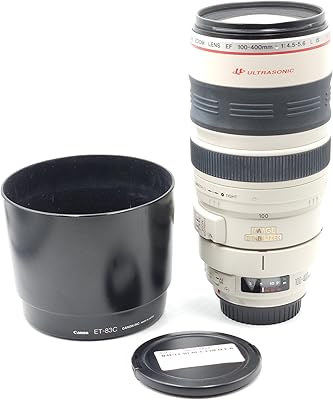
Canon EF 100-400mm f/4.5-5.6L Telephoto Zoom Lens
81%
91%
Autofocus Speed & Accuracy
88%
Image Stabilization
86%
Optical Sharpness
93%
Build Quality & Weather Sealing
67%
Push-Pull Zoom Mechanism
More
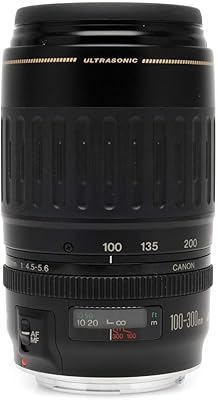
Canon EF 100-300mm f/4.5-5.6 Telephoto Zoom Lens
75%
88%
Autofocus Speed
91%
Autofocus Noise
67%
Image Sharpness
43%
Image Stabilization
78%
Build Quality
More

FAQ

No, it does not. This manual zoom lens is built for Canon EF and EF-S mount DSLRs only. The EOS R, EOS M, and all their variants use different mount systems and are not compatible, even with an adapter in most cases. Check that your camera body has a standard EF or EF-S bayonet mount before purchasing.

Nothing is wrong. Because this lens has no electronic contacts on the mount, your camera cannot read the aperture value and defaults to displaying F00. This is completely normal behavior. Simply switch your camera to Manual mode (M on the dial) and you will be able to shoot without any issues.

Handheld shooting is technically possible but rarely produces sharp results at these focal lengths. At 420mm and beyond, even minor hand movement gets magnified significantly, so a stable tripod or monopod makes a real practical difference. For moon photography especially, a tripod is essentially non-negotiable if you want detail in your shots.

It takes patience and practice. Slow-moving or stationary subjects like perched birds, distant buildings, or the moon are very manageable once you get used to the focus ring. Fast-moving animals or birds in flight are a different story — tracking them manually at this focal length is genuinely difficult, and you should expect a lower keeper rate than with an autofocus lens.

Yes, there is a visible drop in sharpness and contrast when using the teleconverter to reach 1600mm. That trade-off is expected given the price and optics involved. The 420–800mm native range produces better results overall, and most users will find the teleconverter useful mainly for casual experimentation rather than critical shooting.

Yes, both the 90D and 80D use the Canon EF-S mount, so this lens is fully compatible with those bodies. The crop sensor on these cameras actually works in your favor here, giving the equivalent of even greater reach compared to a full-frame body.

Yes. The front element has a 67mm filter thread, so standard screw-in filters work fine. A circular polarizer can help reduce atmospheric haze for landscape and wildlife shots, while an ND filter is useful for controlling exposure in bright outdoor conditions.

The zoom ring is generally smooth, though some users note the focus ring can feel stiff — particularly when new. It tends to loosen slightly with use. The all-metal construction means the lens feels solid and well-built, but it also means there is no soft-touch coating on the barrel, which can feel cold in outdoor winter conditions.

You get the lens body itself, a 2x teleconverter that threads onto the front, a soft lens pouch for storage and transport, and front and rear protective caps. There is no lens hood included, so if you shoot in bright conditions, you may want to source a compatible 67mm hood separately.

It can be, with the right expectations. If you are curious about manual focus technique and want to explore extreme focal lengths without a large investment, this telephoto lens offers a hands-on learning experience that is hard to match at the price. Just go in knowing that the learning curve is real — expect some trial and error before you start getting consistently sharp results.