Overview

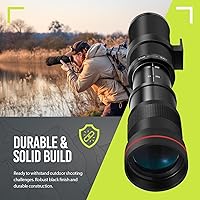
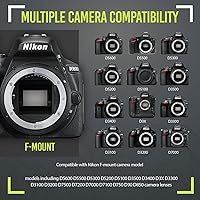
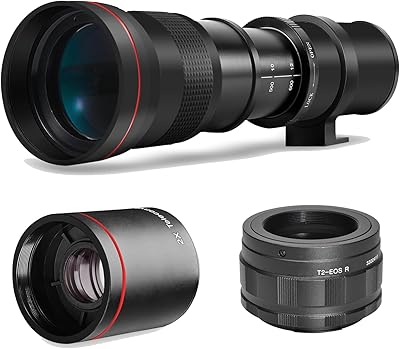
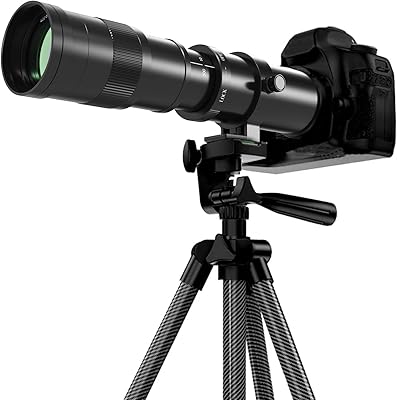
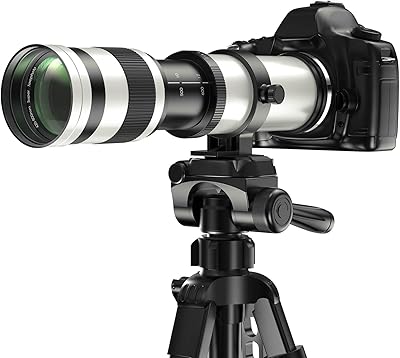
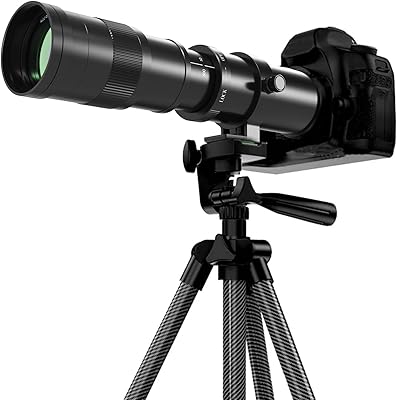
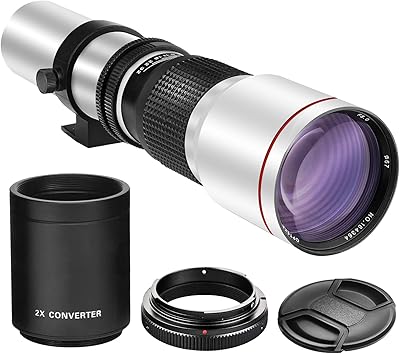
Big Mike's 420-1600mm Manual Telephoto Lens is one of the few genuinely budget-accessible ways for Nikon DSLR shooters to explore super-telephoto territory without spending a small fortune. The most critical thing to understand upfront: this is a manual focus only lens, with no autofocus, no electronic coupling, and no EXIF data recorded to your camera. With the included 2x teleconverter, the focal range stretches from 420mm to a striking 1600mm — enough reach to fill the frame with subjects that are very far away. It fits Nikon F-mount bodies from the D90 and D3000 series right up through the D850, covering a broad range of Nikon DSLRs.
Features & Benefits

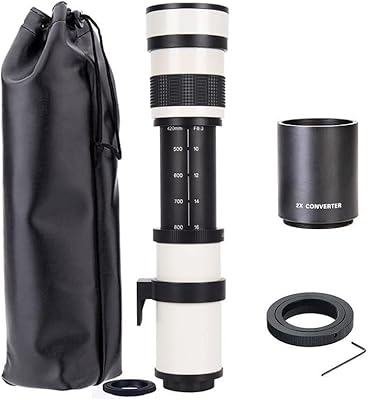
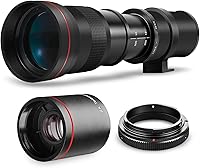
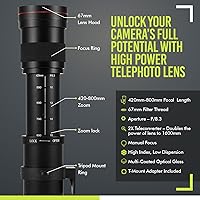
The core focal range runs from 420mm to 800mm, with the bundled doubler pushing that ceiling to 1600mm for subjects at serious distance. Both the aperture and focus are controlled by manual rings on the barrel — the focus ring has decent rotational travel, which helps when fine-tuning, though nailing sharp focus on a moving subject takes real practice and patience. The f/8.3 maximum aperture is a genuine constraint: in bright midday sun it performs acceptably, but in overcast or shaded conditions you will wrestle with exposure and shutter speed. No electronic contacts means your camera receives zero lens data — no stabilization coupling, no metadata. The kit does include a carrying case, lens caps, and a cleaning cloth.

Best For

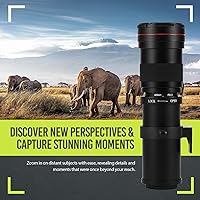
This super-telephoto zoom is best understood as an entry-level experimentation tool, not a professional workhorse. Backyard birders wanting close-up shots of a hawk on a distant fence, or sports spectators shooting from the stands on a bright afternoon, will find it surprisingly capable when the light cooperates. Astrophotography hobbyists particularly enjoy it for lunar imaging — the moon fills the frame dramatically at 800mm, and results can genuinely impress. Travelers who want serious reach without the weight or cost of a native telephoto prime also find it a reasonable carry. Just commit to bringing a sturdy tripod; handheld shooting at these focal lengths produces nothing but motion blur regardless of technique.

User Feedback

With a 3.4-star average across 191 ratings, the response to this manual telephoto lens is genuinely mixed — though it tells you more about buyer expectations than about the optic itself. Satisfied owners are typically hobbyists who understood upfront they were buying a budget manual lens, and they report enjoying moon shots, backyard bird photography, and outdoor daytime events. Critics point to soft images at full zoom, visible chromatic aberration toward 1600mm, and occasional inconsistency in build quality between units. The recurring theme among unhappy buyers is expecting autofocus-like sharpness at this price tier, which is simply not realistic. Go in with calibrated expectations and there is plenty to appreciate here.

Pros

  • Extraordinary focal reach at an entry-level price makes super-telephoto accessible to casual shooters.
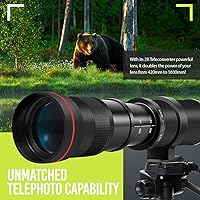
  • The included 2x teleconverter extends range to 1600mm with no extra purchase required.
  • Works well for static or slow-moving subjects in bright daylight conditions.
  • Lunar photography results can be genuinely impressive given the price point.
  • Broad Nikon F-mount compatibility covers a wide range of DSLR bodies.
  • Manual aperture and focus rings give tactile control that some shooters actively prefer.
  • Kit accessories — case, caps, and cleaning cloth — add practical day-one value.
  • Lightweight enough at 2.18 pounds to carry without fatigue on longer outings.
  • A low-risk way to decide whether super-telephoto shooting is worth a future investment.

Cons

  • No autofocus means tracking moving subjects is frustrating and inconsistent for most users.
  • f/8.3 aperture severely limits usefulness in overcast, shaded, or indoor shooting conditions.
  • Chromatic aberration becomes visibly problematic toward the upper end of the zoom range.
  • Image sharpness drops noticeably at full zoom, particularly in the corners of the frame.
  • No electronic contacts means zero EXIF data, no stabilization coupling, and no focus confirmation.
  • Build quality is inconsistent — some units feel solid while others show loose tolerances out of the box.
  • A tripod or monopod is non-negotiable at these focal lengths, adding bulk and setup time.
  • The 2x teleconverter compounds optical weaknesses, making 1600mm results soft in most conditions.
  • Manual focus at extreme telephoto distances has a steep learning curve that will frustrate beginners.

Ratings

Our AI-powered scoring for Big Mike's 420-1600mm Manual Telephoto Lens was built by analyzing verified global buyer reviews, actively filtering out incentivized, bot-generated, and outlier feedback to surface what real photographers actually experienced. The result is a transparent, category-by-category breakdown that reflects both the genuine strengths and the honest frustrations that surface repeatedly across hundreds of real-world shooting situations. Buyers who went in with calibrated expectations and those who felt misled both shaped these scores equally.
Value for Money
78%
22%
For hobbyists who simply want to find out what shooting at 800mm feels like, the price-to-reach ratio is hard to argue with. Users regularly mention being surprised by how much usable reach they got for the cost, particularly for casual moon photography and backyard wildlife sessions.
Buyers who compared sharpness and color rendering against even modestly priced native Nikon telephoto lenses felt the value proposition weakened quickly. If you need reliable results rather than occasional wins, the savings start to feel less significant.
Optical Sharpness
47%
53%
In the 420mm to 600mm range on a bright day with a locked-down tripod, users report acceptably sharp center-frame detail for casual subjects like perched birds or a distant building facade. The sweet spot is narrow, but it does exist.
Edge sharpness is consistently soft, and image quality degrades noticeably as you push toward 800mm and beyond. With the teleconverter attached at 1600mm, chromatic aberration and overall softness become significant problems that no amount of post-processing fully corrects.
Focal Reach
88%
420mm to 1600mm is an extraordinary range to access at this price tier, and users frequently describe moments of genuine delight — filling the frame with a full moon, isolating a hawk on a distant telephone pole, or picking out individual players on a far sideline. The reach itself is not in dispute.
The practical usable ceiling is closer to 800mm for most shooting scenarios; beyond that the teleconverter introduces enough optical degradation that the extra reach becomes more of a gimmick than a genuine tool for most users.
Manual Focus Usability
54%
46%
Photographers who approach this lens with patience and a willingness to shoot stationary subjects — the moon, a parked aircraft, architecture — find the focus ring has reasonable travel and allows for deliberate, considered focusing. Some users genuinely enjoy the tactile, deliberate process.
On anything that moves, manual focus at these focal lengths is genuinely punishing. The shallow depth of field means the margin for error is tiny, and without any focus confirmation from the camera body, achieving consistent sharpness on even slow-moving wildlife is a real challenge.
Low-Light Performance
31%
69%
Lunar photography at night is the one genuine exception — the moon is bright enough that the f/8.3 aperture is workable, and this is consistently cited as one of the most enjoyable use cases for the lens regardless of shooting conditions.
In any other low-light or overcast scenario, f/8.3 is a severe restriction. Users shooting at dusk, in shade, or on cloudy days report needing ISO levels that introduce significant noise, or shutter speeds too slow to freeze even minor subject movement. This is not a lens for dim conditions.
Build Quality
53%
47%
The majority of buyers describe the barrel as feeling reasonably solid for the price, with a weight distribution that feels intentional rather than cheap. Most units arrive in good working order and hold up adequately under careful outdoor use.
A notable minority of reviewers report loose or inconsistent zoom and focus rings out of the box, pointing to quality control variability between units. There is no weather sealing of any kind, which limits confidence when shooting in dusty or lightly damp field conditions.
Chromatic Aberration
38%
62%
At the shorter end of the focal range and in high-contrast bright-light scenes, color fringing is manageable and can be reduced with lens correction tools in Lightroom or Capture One without destroying fine detail.
Chromatic aberration is one of the most consistently flagged issues in user reviews, especially at 800mm and with the teleconverter attached. Purple and green fringing along high-contrast edges is visible even at web-display sizes, and it is one of the clearest signs of the optical limitations at this price point.
Tripod Compatibility
69%
31%
The lens pairs straightforwardly with standard tripod heads and ball heads, and users who committed to a solid tripod setup reported a meaningful improvement in their keeper rate compared to attempts at handheld shooting.
There is no built-in tripod collar on the lens, which shifts the mounting stress to the camera body rather than the lens barrel — a concern noted by users with heavier DSLR bodies who felt the arrangement was not ideal for extended shooting sessions.
Ease of Setup
72%
28%
Mounting onto a Nikon F-mount body is straightforward and takes seconds. The teleconverter also attaches without difficulty, and the included case makes transport and storage simple enough for day trips or travel.
First-time manual lens users consistently note that setting aperture and exposure manually — with no in-camera guidance — creates a steeper initial learning curve than they anticipated, and the first few outings often yield disappointing results until the workflow clicks.
Astrophotography Suitability
67%
33%
Lunar imaging is the standout use case that earns repeated genuine enthusiasm in user reviews. Filling the frame with a sharp, detailed moon is achievable and satisfying, and many users cite it as the moment the lens justified its purchase entirely.
Beyond the moon, deep-sky or planetary astrophotography at f/8.3 is extremely limited without long-exposure stacking, and the lack of electronic coupling prevents proper astro-tracking integration with most motorized mounts. It is a one-subject astrophotography lens in practical terms.
Wildlife Photography
49%
51%
Stationary or slow-moving subjects — a heron standing in a marsh, a deer grazing at the edge of a field — are legitimate targets for this super-telephoto zoom when light is strong and a tripod is deployed, and users do bring home usable frames in these conditions.
Birds in flight, running animals, or any fast-moving wildlife subject quickly exposes the limits of manual focus and a narrow maximum aperture. The combination of slow focusing, f/8.3 exposure constraints, and optical softness makes dynamic wildlife shooting genuinely difficult with this lens.
Sports Photography
43%
57%
From a fixed position at an outdoor stadium on a sunny afternoon, users have captured readable action frames during pauses in play — a quarterback at the line, a pitcher mid-windup — where the subject held relatively still.
Fast-moving sports action is largely incompatible with manual focus at 400mm-plus focal lengths. The reaction time required to track, focus, and shoot a moving athlete simply cannot be achieved without autofocus, and most users who tried report a high miss rate.
Accessories & Packaging
71%
29%
Including a 2x teleconverter, a hard carrying case, lens caps for both ends, and a cleaning cloth in the box is a genuinely thoughtful kit for the price. New buyers appreciate having everything needed to start shooting without extra purchases.
The quality of the included accessories is modest — the carrying case is functional but not padded enough for rough handling, and the cleaning cloth is basic. The teleconverter, while a welcome addition, does not significantly outperform what users might buy separately at this tier.
Camera Compatibility
83%
The Nikon F-mount coverage is broad and includes a decade-plus range of crop-sensor and full-frame DSLRs. Buyers across a wide range of Nikon body generations confirm clean physical mounting with no fitting issues reported.
The complete absence of electronic contacts means compatibility is physical only — metering, EXIF, stabilization coupling, and exposure modes that rely on lens communication are all unavailable regardless of how capable the camera body is.

Suitable for:

Big Mike's 420-1600mm Manual Telephoto Lens is a strong fit for hobbyist photographers who want to explore super-telephoto shooting without a large financial commitment. If you enjoy photographing the moon from your backyard, watching birds at a feeder fifty yards away, or shooting your kid's Saturday soccer game from the sidelines on a sunny afternoon, this super-telephoto zoom can genuinely deliver satisfying results. Astrophotography beginners will find lunar imaging particularly rewarding — the reach at 800mm fills the frame with crater detail in a way that feels remarkable for the price. It also suits Nikon DSLR owners who are curious about manual focus as a discipline and want an affordable way to build that skill. Travelers who want dramatic compression and long-range reach in their kit, without spending on a heavy native telephoto prime, will appreciate what this lens offers when the light is on their side.
Not suitable for:

Big Mike's 420-1600mm Manual Telephoto Lens is not the right choice for photographers who need speed, reliability, or professional image quality. If you shoot fast-moving subjects — wildlife darting through brush, athletes sprinting across a field, birds in flight — the manual-only focus system will leave you with far more misses than keepers. The f/8.3 maximum aperture is a hard wall: in anything less than bright outdoor light, you will find yourself fighting slow shutter speeds or pushing ISO to uncomfortable levels. Shooters who rely on in-camera EXIF data, stabilization coupling, or autofocus confirmation should look elsewhere entirely. Anyone expecting the optical sharpness and color accuracy of a dedicated telephoto prime at this focal range will almost certainly be disappointed — this is an exploratory tool, not a production lens.
Specifications

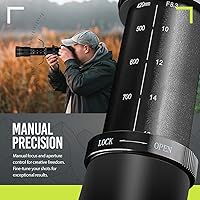
  • Focal Length: Covers 420mm to 800mm natively, extending to 1600mm when the included 2x teleconverter is attached.
  • Max Aperture: Fixed maximum aperture of f/8.3 across the entire focal range.
  • Aperture Control: Aperture is set manually via a dedicated ring on the lens barrel; no electronic aperture control is supported.
  • Focus Type: Fully manual focus only — no autofocus motor, electronic coupling, or focus confirmation signal is present.
  • Lens Mount: Nikon F-mount, compatible with a broad range of Nikon DSLR bodies from the D90 through the D850 generation.
  • Electronic Contacts: No electronic contacts are present, meaning no EXIF metadata, no stabilization coupling, and no autofocus assist is transmitted to the camera.
  • Teleconverter: A 2x teleconverter doubler is included in the kit, effectively doubling the focal length to a maximum of 1600mm.
  • Weight: The lens body weighs approximately 2.18 pounds (about 990g) without accessories attached.
  • Dimensions: Physical dimensions measure approximately 2.9 × 8 × 11.1 inches when stored in a compact position.
  • Compatible Bodies: Designed for Nikon F-mount DSLRs including the D90, D300 series, D600, D610, D700, D750, D800, D800e, D810, D810a, D850, and D3000 through D7500 series bodies.
  • Brand & Model: Manufactured by Big Mike's under model number BM-SLY420NK-K2.
  • Lens Type: Super-telephoto zoom lens designed for long-distance static or slow-moving subject photography.
  • In-Box Accessories: Kit includes the lens body, 2x teleconverter, front and rear lens caps, a carrying case, and a lens cleaning cloth.
  • Tripod Use: Due to the extreme focal length and substantial barrel length, use of a tripod or monopod is strongly recommended for all shooting situations.
  • Image Stabilization: No optical image stabilization is built into this lens; any in-body stabilization on compatible Nikon bodies will not receive coupling data from this lens.
  • Market Rating: Holds a 3.4 out of 5 star average based on 191 customer ratings on Amazon, ranking #582 in the SLR Camera Lenses category.

Related Reviews

BM Premium 420-1600mm f/8.3 Telephoto Zoom Lens
69%
83%
Value for Money
88%
Focal Reach
57%
Image Sharpness
61%
Manual Focus Usability
59%
Build Quality
More
BENOISON 420-800mm RF Telephoto Lens
69%
83%
Value for Money
78%
Focal Range Versatility
71%
Build Quality
62%
Image Sharpness
54%
Ease of Setup
More
JINTU 420-1600mm Telephoto Zoom Lens
71%
83%
Value for Money
88%
Focal Reach
61%
Image Sharpness
79%
Build Quality
54%
Manual Focus Experience
More
Lightdow 420-800mm F8.3 Telephoto Zoom Lens
68%
83%
Value for Money
61%
Image Sharpness
69%
Manual Focus Usability
58%
Build Quality
72%
Setup & Compatibility
More
BENOISON 420-800mm Manual Focus Telephoto Lens
69%
88%
Value for Money
91%
Focal Reach
58%
Manual Focus Usability
67%
Image Sharpness
74%
Build Quality
More
BM Premium 500mm f/8 Manual Telephoto Lens
51%
71%
Value for Money
38%
Image Sharpness
41%
Chromatic Aberration
49%
Manual Focus Usability
36%
Teleconverter Performance
More
TTArtisan 50mm f2 X-Mount Manual Focus Lens
85%
88%
Image Quality
90%
Build Quality
93%
Portability/Size
70%
Manual Focus Performance
75%
Ease of Use for Vlogging
More
TTArtisan 50mm f2 Manual Focus Lens for L Mount Cameras
84%
87%
Image Quality
91%
Manual Focus Precision
90%
Bokeh Quality
85%
Build Quality
82%
Low Light Performance
More
TTArtisan 50mm F1.2 APS-C Manual Focus Lens
84%
88%
Image Quality
75%
Manual Focus Experience
90%
Low Light Performance
85%
Build Quality
91%
Portability
More
Nikon NIKKOR Z 100-400mm VR S Telephoto Lens
84%
93%
Autofocus Performance
91%
Image Sharpness
89%
Vibration Reduction Effectiveness
88%
Build Quality & Weather Sealing
74%
Value for Money
More

FAQ

No — Big Mike's 420-1600mm Manual Telephoto Lens has no autofocus capability whatsoever. You will need to turn the focus ring by hand for every shot. There is also no focus confirmation signal sent to the camera body, so you are relying entirely on your eye and the viewfinder to judge sharpness.
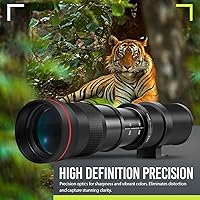
Because there are no electronic contacts on this lens, most Nikon DSLRs will not be able to perform through-the-lens metering automatically. You will typically need to shoot in Manual mode and dial in exposure settings yourself, or use a handheld light meter as a reference.

A tripod or monopod is essentially non-negotiable at these focal lengths. Even small hand tremors are massively amplified at 420mm and beyond, and the result is almost always a blurry image. A sturdy ball-head tripod will make a dramatic difference in the sharpness of your shots.

The teleconverter threads or mounts between the lens and your camera body, optically doubling the focal length from 800mm to 1600mm. It does come at a cost — image sharpness and contrast take a noticeable hit at 1600mm, and chromatic aberration becomes more visible. Most users find 1600mm useful for casual moon shots but would not rely on it for detail-critical work.

Yes, it mounts on any Nikon F-mount body including APS-C crop-sensor DSLRs. Keep in mind that on a crop-sensor body the effective focal length is multiplied by approximately 1.5x, so at 800mm you are looking at an equivalent of around 1200mm — an enormous amount of reach for everyday shooting.

It performs best in bright daylight on static or slow-moving subjects. Backyard bird photography, lunar imaging, distant landscape compression, and outdoor sports from a fixed spectator position are all scenarios where users report satisfying results. It struggles with fast action, low light, and situations where precise focus timing is critical.

There is a genuine learning curve, especially for photographers who have only used autofocus lenses. At 400mm and beyond, depth of field is very shallow, so small adjustments to the focus ring make a big difference. Most users find that with practice — particularly on stationary subjects like the moon or a perched bird — they can dial in acceptable focus fairly reliably.

The barrel is reasonably solid for the price, and most users report it holds up fine under normal outdoor conditions. However, user reviews do flag some inconsistency between units — a small number of buyers have received examples with loose focus or zoom rings. It is not weather-sealed, so shooting in rain or dusty conditions is not recommended.

No. Because the lens has no electronic contacts, your camera cannot communicate with it at all. Your EXIF data will either be blank for lens-related fields or show default placeholder values depending on your camera model. If tracking metadata is important to your workflow, be aware that you would need to add lens information manually in post-processing software.

That is probably its strongest use case. If you have never shot at 400mm or longer and want to find out whether wildlife, sports, or astrophotography is worth a larger investment, this manual telephoto lens lets you explore the discipline at a fraction of the cost of a native telephoto prime. Just go in knowing it is a starting point, not a destination.

Where to Buy