Overview

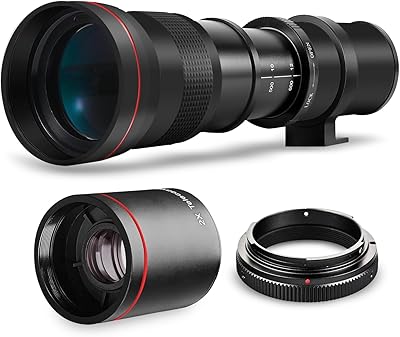
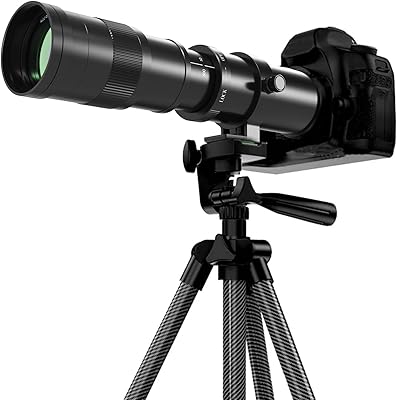
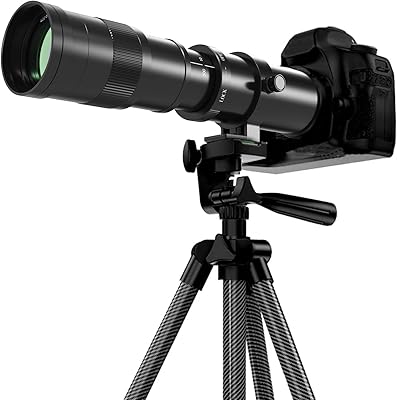
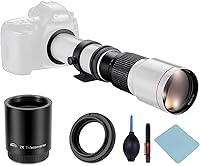
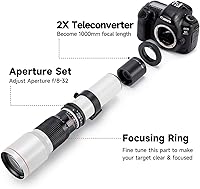
The JINTU 500-1000mm f/8 Manual Telephoto Lens is one of the few ways to get genuine super-telephoto reach on a Canon DSLR without spending a small fortune. That accessibility comes with a clear trade-off you should understand before buying: this is a fully manual lens with no autofocus, no image stabilization, and no electronic contacts whatsoever. It ships as a 500mm prime, and a bundled 2x teleconverter doubles that reach to 1000mm. It mounts on Canon EF and EF-S bodies, covering the vast majority of Canon DSLRs, but it will not work on any Canon mirrorless camera — EOS R and EOS M users should look elsewhere. This super-telephoto prime rewards patience and a steady tripod, not speed.
Features & Benefits

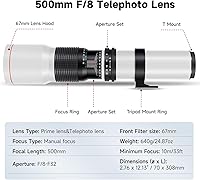
At its core, this manual telephoto lens is a 500mm f/8 prime — fixed focal length, fixed maximum aperture, fully mechanical. The included 2x teleconverter extends that to 1000mm, though that is where optical performance takes a noticeable step down compared to the native focal length. The glass uses high-index, low-dispersion elements intended to control chromatic aberration and keep edges reasonably clean at 500mm. Practical details worth noting: a 67mm filter thread lets you stack polarizers or ND filters, and the minimum focus distance of 4.92 feet is genuinely close for a lens of this size. Weighing under two pounds, it is also lighter than you might expect.

Best For

This super-telephoto prime is genuinely well-suited to a specific type of shooter. Wildlife and bird photographers who work from a hide or a fixed position with a tripod will get the most out of it, as will anyone interested in moon and planetary photography — lunar shots at 500mm are where this lens consistently earns its keep. Canon DSLR owners curious about extreme focal lengths but not ready to spend on professional glass will also find it a reasonable entry point. Beginners wanting to build manual focus discipline in a forgiving, low-cost setting should consider it too. Sports photographers or anyone chasing fast-moving subjects should not.

User Feedback

The 3.6-star average across nearly 200 reviews tells a nuanced story. Buyers who approach the JINTU 500mm lens with realistic expectations — tripod mounted, patient, shooting stationary subjects — tend to come away satisfied. Sharpness at the native 500mm focal length draws consistent praise, particularly for moon shots and distant landscapes. The friction starts at 1000mm: images through the 2x teleconverter are noticeably softer, and several reviewers flag how much of a difference a remote shutter release makes when trying to eliminate camera shake. The manual-only workflow also surprises some newcomers; the learning curve is real. That said, a handful of buyers point out that for occasional use, owning this lens outright beats renting telephoto glass every time.

Pros

  • Delivers surprisingly sharp images at 500mm when mounted on a tripod in good light.
  • Bundled 2x teleconverter extends reach to 1000mm without any additional purchase.
  • Weighs under two pounds — unusually light and portable for a super-telephoto prime.
  • Compatible with a wide range of Canon DSLR bodies using EF and EF-S mounts.
  • The 67mm filter thread lets you add polarizers or ND filters for creative control.
  • Minimum focus distance of 4.92 feet is impressively short for a lens of this focal length.
  • Manual aperture ring from f/8 to f/32 gives full exposure control in any situation.
  • A practical and affordable alternative to renting telephoto glass for occasional shoots.
  • Well-suited to moon photography, where its limitations matter least and reach matters most.

Cons

  • Image quality drops noticeably at 1000mm — the 2x teleconverter introduces visible softness.
  • No autofocus makes tracking any moving subject slow, difficult, and often unsuccessful.
  • Completely unusable on Canon mirrorless bodies, including all EOS R and EOS M cameras.
  • No image stabilization means a remote shutter release and solid tripod are essentially required gear.
  • No electronic contacts — the camera cannot read aperture data, which affects EXIF records and metering.
  • The manual focus learning curve catches many newcomers off guard, especially at extreme focal lengths.
  • Handheld shooting produces blurry results at virtually any shutter speed without additional support.
  • Build quality is functional but feels plasticky compared to mid-range branded telephoto lenses.
  • Achieving consistent, repeatable focus at 1000mm is genuinely difficult even for experienced shooters.

Ratings

Our score for the JINTU 500-1000mm f/8 Manual Telephoto Lens was generated by AI after analyzing verified buyer reviews from multiple global markets, with spam, bot submissions, and incentivized feedback actively filtered out. The scores reflect the full picture — not just the highlights — so both where this lens earns its keep and where it genuinely struggles are represented with equal weight.
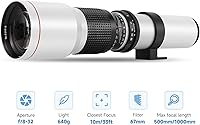
Image Quality at 500mm
74%
26%
Buyers consistently report sharper-than-expected results when shooting at the native 500mm focal length on a tripod in good daylight. Moon shots and static wildlife subjects — herons, perched raptors, distant deer — regularly draw genuine surprise from users who expected far worse at this price point.
Center sharpness holds reasonably well, but edge performance falls off noticeably, and contrast is softer than any branded telephoto at a similar focal length. In lower light or with fast-moving subjects, the image quality gaps become harder to overlook.
Image Quality at 1000mm
46%
54%
The 2x teleconverter does deliver a genuine 1000mm effective reach, and for large, bright subjects like the full moon, a surprising number of users have captured usable, detail-rich shots that justify the extra attachment.
Softness through the teleconverter is the single most consistent complaint in the review pool — the optical degradation is significant, and many buyers feel the 1000mm setting is only reliable under near-ideal conditions. Chromatic fringing also increases noticeably at this extended focal length.
Value for Money
78%
22%
For photographers who shoot super-telephoto subjects occasionally and cannot justify the cost of branded glass, this manual telephoto lens represents a genuinely practical ownership proposition. Several reviewers explicitly note that buying it outright is cheaper than renting comparable reach for two or three trips.
The value calculation shifts unfavorably for anyone who buys expecting professional-grade output — the price is low, but so are the ceiling results, and some buyers felt misled by listing images that did not reflect real-world performance from this lens.
Manual Focus Usability
58%
42%
The focus ring itself is smooth and well-damped for a budget lens, with enough resistance to make fine adjustments without overshooting. Photographers who already have experience with manual glass tend to adapt quickly and appreciate the tactile control it offers.
At 500mm and beyond, depth of field is razor thin, and without focus confirmation aids or a built-in focus limiter, nailing critical sharpness is genuinely difficult — especially for newcomers. Multiple reviewers mention spending significant time on a single shot only to find it slightly soft on review.
Build Quality
63%
37%
The barrel feels more solid than typical at this price tier, and the aperture ring clicks with reasonable precision. Most users report no issues with the physical construction after months of casual outdoor use, which is a reasonable expectation at this market level.
The lens is predominantly plastic, and the fit between lens and T-mount adapter can feel slightly loose on some bodies, which adds to focusing imprecision. It does not feel weather-resistant in any meaningful sense, and users report being cautious about humidity and dust.
Tripod Compatibility
81%
19%
The lens barrel includes a tripod collar mount point, which is exactly what a lens of this size and focal length needs. Users who paired it with a fluid head or a quality ball head reported a much more stable and enjoyable shooting experience than those using lightweight travel tripods.
The collar quality is functional but not confidence-inspiring for heavier setups, and the lens balance point can shift when the teleconverter is attached, requiring minor repositioning on the tripod mount. A stiffer, more precise collar would meaningfully improve the shooting experience.
Stabilization Performance
22%
78%
There is no image stabilization in this super-telephoto prime, which is an intentional design reality of the product category at this price. Buyers who knew this upfront and compensated with a solid tripod and remote shutter release were generally satisfied with their keeper rate.
For anyone who discovered the lack of stabilization after purchase, this was a significant source of frustration. Handheld shots are essentially unusable — even at fast shutter speeds, the focal length amplifies micro-tremors to a degree that produces visibly blurry results in nearly every frame.
Ease of Setup
67%
33%
Attaching the T-mount adapter and mounting the lens is a simple, tool-free process that most buyers complete correctly on the first attempt. The included teleconverter also threads on cleanly with no reported issues around fit or attachment.
Getting the camera into the correct manual mode to use the lens properly requires reading the instructions, and a meaningful portion of reviewers initially struggled because their cameras defaulted to settings that conflicted with the absence of electronic contacts — resulting in error messages or black frames.
Portability
82%
18%
At under two pounds, this is notably lighter than most super-telephoto options, and its narrow barrel makes it easier to pack into a camera bag alongside other gear than bulkier alternatives in this focal range. Wildlife photographers who hike to their shooting locations appreciate this more than most.
At 15 inches long, the barrel is still substantial and makes the kit awkward to transport without a dedicated lens case or bag compartment. The length-to-weight ratio is good, but it remains an inherently large piece of gear that requires deliberate packing.
Canon DSLR Compatibility
86%
The lens covers an impressively wide range of Canon DSLR bodies via the EF and EF-S mount system, making it accessible to a large installed base of Canon shooters from entry-level Rebels through to mid-range and enthusiast bodies. Most buyers found the mount adapter reliable and consistent.
The hard exclusion of all Canon mirrorless bodies — including the entire EOS R and EOS M lineups — is a dealbreaker for a growing segment of Canon users who have already transitioned away from DSLRs. There is no workaround that restores full functionality on mirrorless bodies.
Suitability for Astronomy
77%
23%
Moon photography is arguably the strongest use case for the JINTU 500mm lens, and reviewers who tested it specifically for lunar shots were among the most satisfied in the entire review pool. The fixed focal length and manual aperture control suit the slow, deliberate pace of celestial imaging well.
Deep-sky or planetary work beyond the moon is limited by the f/8 maximum aperture, which simply does not gather enough light for faint objects without extremely long exposures. The lack of electronic communication also complicates integration with astro-tracking software and intervalometers.
Learning Curve
53%
47%
For photographers actively trying to improve their manual shooting discipline, this super-telephoto prime is a legitimate teaching tool — it forces users to think about every exposure variable deliberately, and those who persist through the initial difficulty often report real improvements in their overall technique.
Buyers who are new to manual focus and expected this lens to behave like a modern autofocus lens were frequently disappointed and left negative reviews as a result. The gap between expectation and reality is the primary driver of the 3.6-star aggregate rating, not the lens itself failing at what it is designed to do.
Filter System
72%
28%
The 67mm filter thread is a widely supported standard, meaning polarizers, ND filters, and UV protectors are readily available at modest prices. Landscape and wildlife shooters who use polarizers to cut haze found this a welcome and practical addition at this price tier.
The 67mm size, while common, is not universal across a photographer's existing filter collection, so some buyers faced an additional cost to acquire compatible filters. There is also no mention of a filter holder system or drop-in filter compatibility for stacking multiple filters.

Suitable for:

The JINTU 500-1000mm f/8 Manual Telephoto Lens is genuinely well-matched to hobbyist photographers who shoot at their own pace and already own a Canon DSLR with an EF or EF-S mount. Wildlife and bird photographers who work from a fixed position — a hide, a car window, or a sturdy tripod setup — will find the 500mm focal length capable of pulling in distant subjects with solid clarity. Moon and celestial photographers are arguably the sweet spot: stationary subjects, controlled environments, and no need for autofocus make this a surprisingly capable tool for lunar detail at a fraction of what premium telephoto glass costs. It also works well as a learning tool for photographers who want to build real manual focus and exposure skills without risking a serious financial commitment. If you shoot occasionally and have been renting telephoto glass for one-off projects, owning this super-telephoto prime outright may simply make more financial sense.
Not suitable for:

Anyone shooting Canon mirrorless should stop here — the JINTU 500-1000mm f/8 Manual Telephoto Lens has no compatibility with the EOS R or EOS M series, full stop. Sports photographers and anyone trying to track fast-moving subjects will find this lens practically unusable: without autofocus, locking onto a moving bird in flight or a sprinting athlete is an exercise in frustration rather than photography. Handheld shooting at these focal lengths is also a non-starter; without image stabilization, even minor camera movement at 500mm produces blur, and the problem compounds sharply at 1000mm through the teleconverter. Photographers expecting the sharpness and contrast of a name-brand telephoto will likely be disappointed — this is a budget-tier optic, and the image quality reflects that, especially when the 2x converter is attached. If your primary need is consistent, sharp results in unpredictable lighting or fast situations, this manual telephoto lens is not the right tool.
Specifications

  • Focal Length: The lens has a native focal length of 500mm, which extends to 1000mm when the included 2x teleconverter is attached.
  • Maximum Aperture: The maximum aperture is f/8, which is fixed at the widest setting and cannot be opened further.
  • Aperture Range: The manual aperture ring adjusts from f/8 through to f/32, covering a broad range of exposure control.
  • Focus System: This is a fully manual focus lens with no autofocus motor or electronic communication with the camera body.
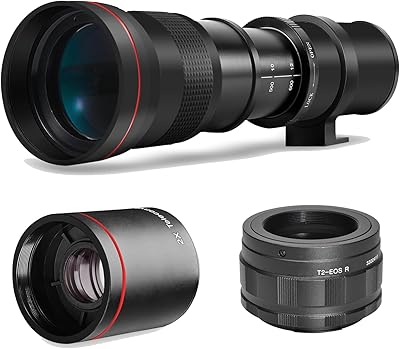
  • Lens Mount: Mounts on Canon EF and EF-S cameras via an included T-mount adapter; it is not compatible with Canon mirrorless systems.
  • Filter Thread: The front element accepts 67mm screw-in filters, including polarizers and neutral density filters.
  • Min. Focus Distance: The minimum focus distance is 4.92 ft (approximately 1.5m), which is notably short for a lens of this focal length.
  • Stabilization: There is no optical or electronic image stabilization of any kind built into this lens.
  • Electronic Contacts: The lens has no electronic contacts, meaning aperture data, autofocus signals, and EXIF lens information are not transmitted to the camera.
  • Weight: The lens weighs 1.87 pounds (approximately 848g), making it relatively light for a super-telephoto prime.
  • Dimensions: The lens measures 15 x 4 x 4 inches, with a long, narrow barrel suited to tripod-mounted use.
  • Lens Type: This is a prime telephoto lens with a fixed focal length, not a zoom — the focal length only changes when the 2x teleconverter is physically attached.
  • Glass Construction: The optical formula uses high-index, low-dispersion glass elements intended to reduce chromatic aberration at extreme focal lengths.
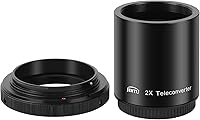
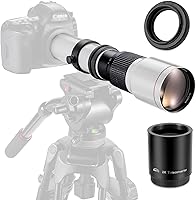
  • Includes: The package includes the 500mm lens body and a 2x teleconverter extender that doubles the effective focal length to 1000mm.
  • Compatible Bodies: Works with Canon DSLR bodies using the EF or EF-S mount, covering most Canon Rebel, EOS xxD, and EOS xD series cameras.
  • Incompatible Bodies: Not compatible with any Canon EOS R series mirrorless body or any Canon EOS M series camera.
  • Lens Category: Classified as a super-telephoto prime, this lens is designed primarily for distant subjects such as wildlife, birds, and celestial objects.
  • Manufacturer: Made by JINTU, a third-party lens brand specializing in manual, budget-accessible optics for major camera mount systems.

Related Reviews

Big Mike's 420-1600mm Manual Telephoto Lens
60%
78%
Value for Money
47%
Optical Sharpness
88%
Focal Reach
54%
Manual Focus Usability
31%
Low-Light Performance
More
BM Premium 420-1600mm f/8.3 Telephoto Zoom Lens
69%
83%
Value for Money
88%
Focal Reach
57%
Image Sharpness
61%
Manual Focus Usability
59%
Build Quality
More
BENOISON 420-800mm Manual Focus Telephoto Lens
69%
88%
Value for Money
91%
Focal Reach
58%
Manual Focus Usability
67%
Image Sharpness
74%
Build Quality
More
JINTU 85mm f1.8 Portrait Prime Lens
75%
84%
Build Quality
73%
Optical Sharpness
82%
Bokeh Quality
88%
Value for Money
71%
Manual Focus Experience
More
Sony SEL85F18 85mm F/1.8 Prime Lens
81%
91%
Autofocus Speed & Accuracy
93%
Bokeh Quality
88%
Image Sharpness
82%
Chromatic Aberration Control
89%
Autofocus Noise
More
Canon EF 85mm f/1.8 USM Lens
86%
91%
Image Sharpness
93%
Bokeh Quality
88%
Autofocus Speed
94%
Autofocus Noise
86%
Low-Light Performance
More
BM Premium 500mm f/8 Manual Telephoto Lens
51%
71%
Value for Money
38%
Image Sharpness
41%
Chromatic Aberration
49%
Manual Focus Usability
36%
Teleconverter Performance
More
BENOISON 420-800mm RF Telephoto Lens
69%
83%
Value for Money
78%
Focal Range Versatility
71%
Build Quality
62%
Image Sharpness
54%
Ease of Setup
More
Sony SEL35F18 35mm f/1.8 Prime Lens
82%
91%
Optical Sharpness
88%
Low-Light Performance
79%
Autofocus Speed
83%
Video Autofocus
84%
Image Stabilization
More
BENOISON 85mm F1.8 Nikon F Portrait Lens
67%
83%
Bokeh Quality
76%
Center Sharpness
47%
Corner Sharpness
53%
Vignetting
68%
Manual Focus Usability
More

FAQ

No, it will not. The JINTU 500-1000mm f/8 Manual Telephoto Lens is built for Canon EF and EF-S mounts, which are found on Canon DSLRs. It has no compatibility with any camera in the EOS R or EOS M mirrorless lineup, and there is no reliable adapter that will make it function correctly on those bodies.
A tripod is essentially mandatory for usable results. At 500mm, even minor hand tremor is magnified enormously, and without any image stabilization, handheld shots will almost always come out blurry regardless of shutter speed. A remote shutter release or the camera's self-timer adds another layer of stability that makes a real difference.

It depends on what you are shooting. The 2x teleconverter does genuinely double your reach, and for large, bright subjects like the moon, results can be quite usable. That said, image sharpness drops noticeably compared to the native 500mm focal length, and you will need excellent light and a perfectly still setup to get clean results. Treat 1000mm as a bonus rather than the primary reason to buy.

You will need to switch your camera body to manual mode (M on the mode dial) to take full control of shutter speed and ISO, since the lens cannot communicate aperture data to the camera. Set the aperture directly on the lens ring. For focusing, use your camera's live view and zoom in digitally to check critical focus before shooting — it makes a significant difference at these focal lengths.

It covers a wide range of Canon DSLRs, including the Rebel series (T2i through T8i, SL1 through SL3), the mid-range xxD bodies (60D, 70D, 80D, 90D), and the higher-end xD bodies (5D, 6D, 7D series and their marked variants). If your camera uses a standard Canon EF or EF-S bayonet mount, it should be compatible.

Yes, the front element has a standard 67mm filter thread, so any 67mm screw-in filter will fit. A circular polarizer is useful for reducing atmospheric haze in outdoor shots, and an ND filter can help manage exposure when shooting in bright daylight conditions.

It takes practice. At 500mm, the depth of field is extremely shallow, and small focus adjustments make a big difference. Most experienced users recommend using live view with the camera's built-in zoom function to confirm focus precisely before taking a shot. If you are new to manual focus, expect a learning period of several sessions before you get consistently sharp results.

It can work well for birds, but only in specific situations. If you are shooting stationary or slow-moving birds from a hide or a fixed position on a tripod — herons, owls at rest, nesting birds — the reach and image quality at 500mm are genuinely respectable for the price. If you want to track birds in flight or capture fast-moving action, the lack of autofocus makes this super-telephoto prime the wrong tool for the job.

Canon APS-C bodies have a 1.6x crop factor, so the 500mm native focal length becomes an effective 800mm, and the 1000mm teleconverter setting becomes an effective 1600mm. That is an enormous amount of reach, which makes precise focus and a rock-solid tripod even more critical than on a full-frame body.

The general consensus from buyers is that it feels solid enough for casual use but is clearly a budget-tier product. The barrel is mostly plastic with some metal components, and it does not feel as robust as even entry-level branded telephoto lenses. That said, most users report it survives normal outdoor use without issues as long as it is handled with reasonable care and kept away from rain and dust.

Where to Buy