Overview

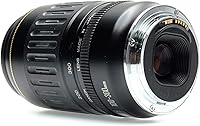
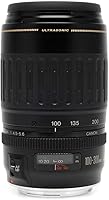
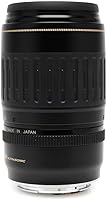
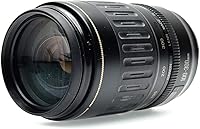
The Canon EF 100-300mm f/4.5-5.6 Telephoto Zoom Lens has been in production since 2000, and the fact that Canon has kept it in the lineup for over two decades says something real about its staying power. It occupies a practical middle ground — not a budget plastic barrel, not a heavy professional prime — but a compact, capable zoom for Canon EF-mount shooters who want genuine reach without hauling serious glass. At just under 1.2 pounds, it travels well and handles comfortably over long shoots. The ring-type USM autofocus is the kind of feature you normally pay considerably more to get, and it makes a meaningful difference in everyday use.
Features & Benefits

The 100-300mm range is genuinely versatile — wide enough at 100mm to frame a group of athletes, long enough at 300mm to isolate a bird on a distant branch. The inner focusing design keeps the barrel length fixed as you zoom, which means no awkward front-element rotation when you have a polarizer attached. Full-time manual focus override lets you nudge focus without flipping any switches, a small but welcome touch for precise work. The real trade-off is aperture: at 300mm you are shooting at f/5.6, which demands decent light. Low-light telephoto work will push this EF telephoto to its limits, so bright outdoor conditions are where it performs with the most confidence.

Best For

This telephoto zoom makes the most sense for enthusiast photographers who want real reach without committing to a bulky, expensive setup. Wildlife and bird photography in good outdoor light is a natural fit — the near-silent USM motor keeps noise to a minimum around skittish subjects, and 300mm gets you close enough for meaningful frames. Sideline sports shooters will appreciate the quick AF response. For travel, the lightweight compact build is a genuine advantage over heavier telephoto options. Canon APS-C users get an effective focal reach of around 480mm at the long end, which means this EF telephoto delivers noticeably more reach than its specs suggest on crop-sensor bodies.

User Feedback

Sitting at a 4.4-star average across nearly 100 ratings, the 100-300mm Canon lens earns its score honestly rather than on hype. Buyers consistently highlight autofocus speed and quietness, and a notable number mention using the same copy for many years without incident — that kind of longevity comment carries weight. The most common criticism is optical: sharpness at 300mm wide open can go soft, especially toward frame edges. The sharpest debate in reviews, though, centers on image stabilization — this lens has none. Many buyers directly compare it to the Canon 70-300mm IS USM, and for handheld shooting at longer focal lengths, that trade-off is worth thinking through carefully before purchasing.

Pros

  • Ring-type USM autofocus is fast and nearly silent — a genuine advantage over cheaper motorized alternatives.
  • At just over a pound, this telephoto zoom is easy to carry all day without arm fatigue.
  • The 100-300mm focal range covers a wide variety of outdoor shooting scenarios in a single lens.
  • Full-time manual focus override gives you fine control without disrupting your shooting flow.
  • Inner focusing keeps the barrel length fixed, making polarizer use straightforward and handling more predictable.
  • On APS-C bodies, effective reach stretches to around 480mm — impressive for the size and weight.
  • A long production run since 2000 suggests solid build consistency, and many owners report years of trouble-free use.
  • Holds a 4.4-star average from real buyers, with reliability and AF performance cited most frequently.

Cons

  • No image stabilization makes sharp handheld shots at 300mm genuinely difficult without a fast shutter speed.
  • Optical sharpness at 300mm wide open can be noticeably soft, especially toward the frame edges.
  • The f/5.6 maximum aperture at the long end limits usable shooting to well-lit outdoor environments.
  • Buyers comparing this lens to IS-equipped alternatives often feel the stabilization gap is hard to ignore.
  • Sharpness is inconsistent across the zoom range — results at 100mm and 300mm are not equally strong.
  • No weather sealing means shooting in rain or dusty conditions carries real risk.
  • Background separation at f/5.6 is modest, limiting creative bokeh options compared to faster telephoto glass.
  • The Canon 70-300mm IS USM, which includes stabilization and slightly better optics, is a direct competitor worth seriously considering.

Ratings

The scores below reflect our AI-driven analysis of verified global user reviews for the Canon EF 100-300mm f/4.5-5.6 Telephoto Zoom Lens, with spam, bot-generated, and incentivized feedback actively filtered out before scoring. We evaluated this telephoto zoom across categories that real buyers consistently care about, from autofocus responsiveness in the field to how it holds up after years of regular use. Both the genuine strengths and the honest shortcomings are reflected in every score — nothing is inflated.

Autofocus Speed
88%
The ring-type USM motor stands out sharply at this price tier, delivering quick lock-on that photographers notice immediately when tracking birds in flight or athletes moving across a field. Reviewers switching from slower micro-motor lenses consistently describe the AF response as a meaningful upgrade in real shooting conditions.
In lower-contrast situations — overcast skies, subjects against busy backgrounds — some users report occasional hunting before the lens settles on focus. It is not a frequent complaint, but it surfaces often enough to be worth noting for anyone shooting fast-moving subjects in mixed lighting.
Autofocus Noise
91%
Near-silent operation is one of the most praised aspects of this EF telephoto across the entire review base. Wildlife photographers specifically call it out as a practical advantage — being able to shoot without alerting nearby animals or drawing attention at quiet events makes a genuine difference on location.
A small number of users report a faint mechanical hum becoming noticeable on older copies after extended use, suggesting some wear-related degradation over time. This appears to be the exception rather than the rule, but it is a consideration for buyers purchasing used copies.
Image Sharpness
67%
33%
At 100mm and through the mid-range of the zoom, center sharpness is genuinely good for an enthusiast-tier lens, producing clean, detailed images of stationary subjects in good light. Many users report satisfying results for outdoor portraiture and landscape shots at shorter focal lengths where the optics perform at their best.
At 300mm wide open, softness becomes a recurring theme in user feedback — particularly at the frame edges, where detail loss is noticeable in direct comparisons. Stopping down to f/8 or beyond helps significantly, but that is not always an option in fast-moving shooting situations where a wider aperture is needed.
Image Stabilization
43%
57%
There is no optical stabilization to evaluate here, which is a straightforward limitation. In bright daylight with fast shutter speeds, the absence of IS is manageable, and many users report sharp results when shooting at 1/500s or faster in sunny outdoor conditions.
The lack of stabilization is the single most discussed limitation across all user feedback, with many buyers directly comparing this telephoto zoom to IS-equipped alternatives like the Canon 70-300mm IS USM. Handholding at 300mm in anything less than ideal light produces a high rate of blurred frames for most photographers.
Build Quality
78%
22%
For a lens at this price point, the physical construction earns consistent praise — users describe it as feeling solid without being plasticky, and many report no structural issues after years of regular outdoor use. The inner focusing mechanism in particular holds up well with no wobble developing over time in most reported cases.
There is no weather sealing of any kind, which limits confidence in damp or dusty environments. A few long-term users mention that the zoom ring can develop minor looseness after heavy use, and the overall material quality does not match what you get from Canon L-series glass.
Portability
93%
At just over a pound and compact enough to fit comfortably in a mid-sized camera bag, this EF telephoto earns high marks from travel photographers and day-trip shooters who want serious reach without dedicating their entire bag to one lens. Users frequently contrast it favorably against heavier 300mm alternatives that cause genuine fatigue during long shoots.
The compact size does mean the zoom ring travel is shorter than on larger lenses, which some users find makes precise zooming feel slightly rushed compared to bigger telephoto barrels. This is a minor ergonomic trade-off rather than a structural flaw, but photographers with larger hands occasionally mention it.
Value for Money
82%
18%
USM autofocus and inner focusing at this price tier represent genuine value, and users who have owned the lens for many years consistently describe it as one of the smarter purchases in their kit. For photographers entering telephoto shooting, the cost-to-capability ratio is difficult to match with comparable new alternatives.
When buyers stack it against the Canon 70-300mm IS USM — which adds image stabilization and improved optics for a moderate price increase — the value calculation becomes less clear-cut. For users who shoot handheld frequently, paying more for stabilization often proves to be the better long-term decision.
Low-Light Performance
48%
52%
At 100mm with the f/4.5 maximum aperture, performance in moderately dim conditions is acceptable, and some users report usable results at dusk with higher ISO settings on modern camera bodies that handle noise well.
At 300mm, the f/5.6 ceiling is a hard practical limit that becomes very apparent once the sun drops. The combination of narrow maximum aperture and no stabilization forces uncomfortably high ISO values in anything below bright overcast light, and user feedback is consistently critical of this combination for evening or indoor telephoto shooting.
Zoom Range Versatility
84%
The 100-300mm span covers a genuinely wide range of real-world shooting scenarios in a single lens — users appreciate being able to frame a distant landscape at 300mm and then quickly pull back to 100mm for a wider environmental shot without swapping glass. On APS-C bodies the effective range stretches further, adding even more practical flexibility.
The lens does not extend below 100mm, which means it cannot double as a general-purpose zoom — you will need a separate lens to cover shorter focal lengths. Photographers who want a single all-day lens covering wide to telephoto will find the 100mm minimum start point a noticeable constraint.
Manual Focus Usability
76%
24%
Full-time manual focus override is a feature users genuinely appreciate in real shooting — being able to nudge focus after the AF locks, without flipping any switches, speeds up workflows for macro-adjacent work and careful portrait focusing. The smooth focus ring action draws positive comments from users who rely on it regularly.
The focus ring throw is relatively short, which makes ultra-precise fine-tuning at long distances harder than on lenses with longer manual focus travel. Users accustomed to dedicated manual focus lenses note that very small adjustments can be difficult to dial in with consistent accuracy.
Chromatic Aberration
63%
37%
At moderate focal lengths and stopped down, chromatic aberration is well controlled and not a significant complaint among general users. Most everyday shooting scenarios — outdoor sports, wildlife on bright backgrounds — do not trigger obvious fringing in the final images.
At 300mm on high-contrast edges, particularly branches against bright sky or players against stadium lighting, some lateral chromatic aberration becomes visible. It is correctable in post-processing, but users shooting JPEG straight from camera or without editing workflows will notice it more readily.
Longevity & Reliability
87%
One of the more quietly impressive aspects of user feedback is how many buyers report owning the same copy for five to ten or more years with no mechanical failures. For a telephoto lens at this price tier, that level of reported reliability is genuinely above average and reflects consistent manufacturing standards.
Without weather sealing, longevity is partly dependent on how carefully the lens is handled in the field. Users who have shot in rain or heavy dust report faster degradation, and the absence of environmental protection is a real long-term risk factor for photographers who regularly shoot outdoors in unpredictable conditions.
Filter Compatibility
89%
The 58mm filter thread is a widely used standard, making it easy and inexpensive to source polarizers, ND filters, and UV protectors. The non-rotating front element during autofocus means polarizer orientation stays exactly where you set it — a practical convenience that users consistently call out as a welcome feature.
58mm is slightly smaller than the filter sizes on many competing telephoto lenses, which means photographers with existing filter collections built around larger sizes will need step-down rings or duplicate filters. It is a minor inconvenience but one that comes up in reviews from photographers managing multiple lenses.
Bokeh Quality
57%
43%
At 300mm, background separation is achievable enough for isolating subjects like birds or athletes from distant backgrounds, and users shooting outdoor portraits at the longer end report pleasing enough out-of-focus rendering for casual and enthusiast work.
The f/5.6 maximum aperture at 300mm limits how much subject separation is realistically achievable, and the bokeh rendering itself is described by more critical users as slightly busy or nervous rather than smooth. Photographers prioritizing creamy background blur will find faster telephoto glass delivers noticeably better results.

Suitable for:

The Canon EF 100-300mm f/4.5-5.6 Telephoto Zoom Lens is a strong match for enthusiast photographers who are stepping into telephoto shooting and want a capable, low-hassle option that covers a wide range of subjects without a significant financial or physical commitment. Wildlife and bird photographers who shoot primarily in daylight will find the reach genuinely useful, and the near-silent USM autofocus makes it far less likely to spook skittish animals than noisier alternatives. Sideline sports shooters covering outdoor daytime events — school athletics, local races, park games — get fast, responsive AF in a package light enough to handhold comfortably for an entire afternoon. Travel photographers who want real telephoto reach in a bag that does not weigh them down will also appreciate how little space this EF telephoto occupies. Canon APS-C body users get an especially good deal here, since the crop factor pushes effective reach to around 480mm at the long end, which is substantial for the package size.
Not suitable for:

Photographers who regularly shoot in low light or at dusk should think carefully before committing to the Canon EF 100-300mm f/4.5-5.6 Telephoto Zoom Lens, because the f/5.6 maximum aperture at 300mm leaves little room for error when ambient light drops. The complete absence of image stabilization is a real constraint — handholding at 300mm demands a fast shutter speed to avoid motion blur, which in turn demands bright conditions or higher ISO settings. Anyone who shoots handheld telephoto regularly and has used an IS-equipped lens will likely notice the difference. Photographers prioritizing edge-to-edge sharpness wide open at the long end will also run into limitations, since optical performance at 300mm f/5.6 is softer than what more expensive telephoto options deliver. If your shooting is primarily indoors, at concerts, in dim arenas, or in heavily shaded environments, this EF telephoto is simply not built for those conditions.

Specifications

  • Focal Length: Covers a 100-300mm telephoto zoom range, suitable for wildlife, sports, and distant subject photography.
  • Max Aperture: Variable maximum aperture of f/4.5 at 100mm, narrowing to f/5.6 at the 300mm end of the zoom range.
  • Lens Mount: Canon EF mount, compatible with all Canon EF-mount SLR and DSLR camera bodies.
  • Autofocus System: Ring-type UltraSonic Motor (USM) delivers fast, near-silent autofocus performance during shooting.
  • Manual Focus: Full-time manual focus override is available, allowing focus adjustment at any time without switching AF off.
  • Focus Design: Inner focusing system keeps the physical barrel length constant throughout the entire zoom and focus range.
  • Stabilization: No optical image stabilization is included; a sufficiently fast shutter speed is required to avoid motion blur when handholding.
  • Dimensions: The lens measures 7 x 4.4 x 4.2 inches, making it compact relative to its telephoto reach.
  • Weight: Weighs 1.19 pounds, which is notably light for a telephoto zoom covering up to 300mm.
  • Filter Thread: Accepts 58mm screw-in filters on the front element, a common and widely available filter size.
  • Model Number: Canon model number 2565A003, manufactured by Canon Cameras US.
  • Availability: The lens has not been discontinued by the manufacturer and remains available as a current product.
  • First Available: Originally made available in August 2000, reflecting over two decades of continuous production.
  • APS-C Reach: On Canon APS-C sensor bodies, the crop factor yields an effective focal range of approximately 160-480mm equivalent.
  • Compatibility: Works with all Canon EF-mount film SLR and digital DSLR bodies, but is not natively compatible with EF-M or RF-mount mirrorless cameras without an adapter.

Related Reviews

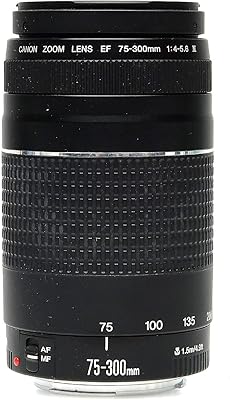
Canon EF 75-300mm III Telephoto Zoom Lens
70%
74%
Image Sharpness
58%
Autofocus Speed
69%
Build Quality
83%
Zoom Smoothness
88%
Value for Money
More
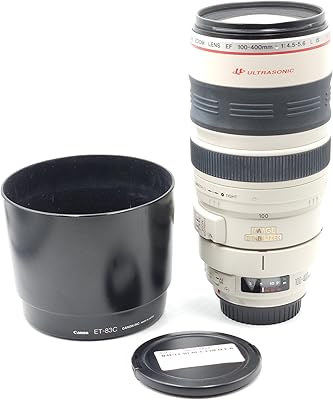
Canon EF 100-400mm f/4.5-5.6L Telephoto Zoom Lens
81%
91%
Autofocus Speed & Accuracy
88%
Image Stabilization
86%
Optical Sharpness
93%
Build Quality & Weather Sealing
67%
Push-Pull Zoom Mechanism
More
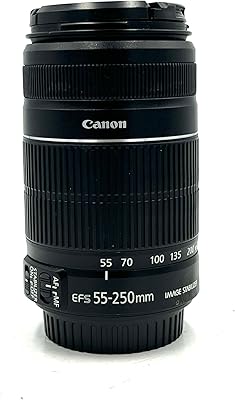
Canon EF-S 55-250mm f/4-5.6 IS II Telephoto Zoom Lens
82%
91%
Value for Money
88%
Image Stabilization Performance
65%
Autofocus Speed in Low Light
93%
Portability & Size
85%
Image Quality & Sharpness
More
Canon EF 70-300mm IS USM Telephoto Lens
77%
91%
Image Stabilization
87%
Autofocus Performance
72%
Optical Sharpness
61%
Build Quality
78%
Value for Money
More
Canon EF-S 10-18mm STM Wide-Angle Lens
75%
83%
Image Sharpness
86%
Autofocus Performance
81%
Image Stabilization
58%
Distortion & Vignetting
54%
Low-Light Capability
More
Canon EF-S 18-135mm f/3.5-5.6 IS Zoom Lens
77%
91%
Zoom Versatility
88%
Image Stabilization
76%
Sharpness & Clarity
58%
Low-Light Performance
79%
Autofocus Speed
More
Canon EF-S 10-22mm f/3.5-4.5 USM Wide-Angle Lens
80%
88%
Image Sharpness
91%
Autofocus Performance
84%
Build Quality
63%
Distortion Control
67%
Chromatic Aberration
More
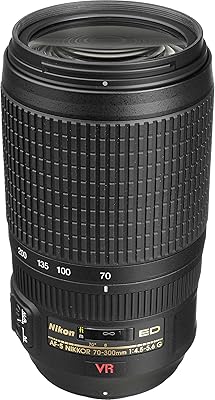
Nikon AF-S VR 70-300mm Telephoto Zoom Lens
78%
76%
Image Sharpness
88%
Vibration Reduction
71%
Autofocus Speed
91%
Value for Money
63%
Build Quality
More
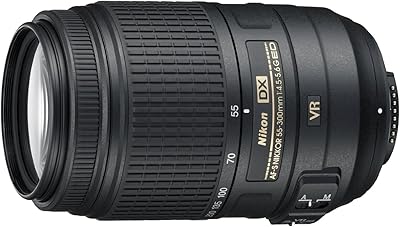
Nikon AF-S DX NIKKOR 55-300mm Zoom Lens
71%
78%
Image Sharpness
67%
Autofocus Performance
84%
Vibration Reduction
54%
Aperture Range
61%
Build Quality
More
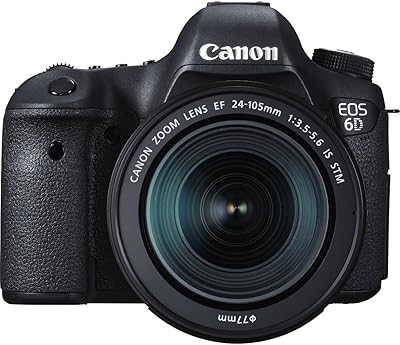
Canon EOS 6D DSLR Camera with EF 24-105mm f/3.5-5.6 IS STM Lens Kit
84%
94%
Image Quality
82%
Autofocus Performance
88%
Ease of Use
90%
Low-Light Performance
85%
Build Quality
More

FAQ

This telephoto zoom uses the Canon EF mount, so it will not attach directly to Canon RF-mount or EF-M-mount mirrorless bodies. However, Canon makes official mount adapters — the Mount Adapter EF-EOS R for RF bodies and the EF-EOS M adapter for EF-M bodies — that allow it to work with autofocus fully intact.

It depends on how you shoot. At 300mm without stabilization, you generally need a shutter speed of at least 1/500s to get consistently sharp handheld shots. In bright daylight that is usually achievable, but in overcast conditions or at dusk it becomes a real challenge. If a lot of your shooting happens in lower light or you have unsteady hands, the Canon 70-300mm IS USM is worth comparing directly.

At 100mm it performs quite well, with solid center sharpness that most photographers will be happy with. At 300mm wide open, sharpness drops noticeably, particularly toward the edges of the frame. Stopping down to f/8 or f/11 improves things, but if critical sharpness at the long end is your main priority, more expensive telephoto options will serve you better.

Yes. Because this EF telephoto uses an inner focusing design, the front element does not rotate during autofocus. That makes it straightforward to use a circular polarizer without having to readjust it every time the lens focuses.

It can handle birds in flight reasonably well in good daylight conditions — the USM autofocus is quick enough to track moving subjects in most situations. The limitation is the f/5.6 maximum aperture at 300mm, which forces higher ISO settings as light fades. For casual bird photography on sunny days it works well, but dedicated bird photographers who shoot at dawn or dusk will find it limiting.

Yes, the Canon EF 100-300mm f/4.5-5.6 Telephoto Zoom Lens is fully compatible with Canon EF-mount film SLR cameras. The EF mount standard has remained consistent since 1987, so autofocus and aperture control will function normally on compatible film bodies.
The ring-type USM motor is genuinely quiet — most people nearby will not notice it at all during a shoot. It is one of the real practical advantages of this lens at its price point, and it makes a noticeable difference compared to micro-motor AF lenses in the same range.

The minimum focusing distance is approximately 1.5 meters (about 4.9 feet) at all focal lengths. This is typical for a telephoto zoom in this range, though it means the 100-300mm Canon lens is not designed for close-up or macro work.

Many owners report using the same copy for five, ten, or more years without mechanical issues, which is encouraging for a lens at this price tier. That said, it has no weather sealing, so regular exposure to dust, moisture, or harsh environments will increase wear over time. Treat it reasonably and it tends to last.

It really comes down to whether you need that extra reach beyond 200mm. The 70-200mm f/4 will outperform this EF telephoto optically at overlapping focal lengths, so if 200mm is usually enough for you, adding this lens mainly gives you the 200-300mm extension. For wildlife or sports where closing that gap matters, the added reach is worthwhile. If you rarely find yourself wishing for more than 200mm, it is a harder case to make.

Where to Buy