Overview

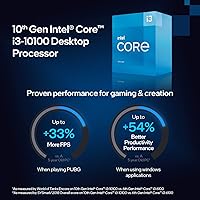
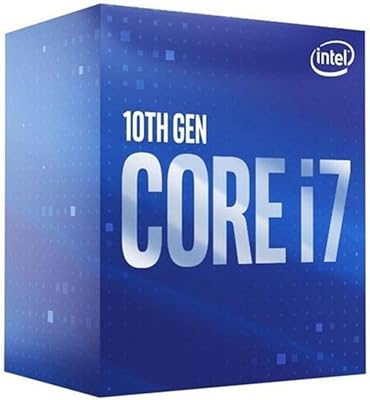
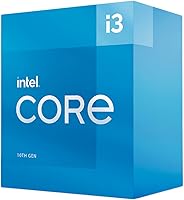
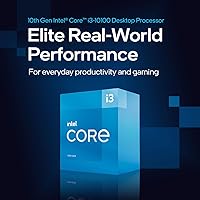
The Intel Core i3-10100 Desktop Processor is Intel's 10th-generation Comet Lake chip that quietly redefined what an entry-level processor could do. It sits a clear step below the i5 family in Intel's lineup, yet this 10th-gen i3 consistently surprises buyers who expect typical i3 limitations. Built for the LGA1200 socket and compatible exclusively with Intel 400-series chipsets, it slots into a wide range of affordable motherboards without fuss. A bundled cooler comes in the box — a small but genuinely useful inclusion for anyone keeping build costs tight. At its mid-range price point, expectations center on reliable daily performance, and this desktop chip largely delivers on that.
Features & Benefits

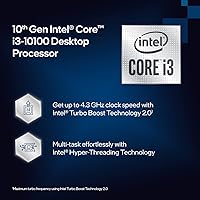
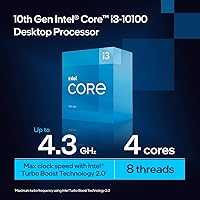
What makes the i3-10100 worth a close look is how much Intel packed into a 65W power envelope. You get 4 cores and 8 threads courtesy of Hyper-Threading — a genuine improvement over the dual-core i3s of previous generations. The base clock runs at 3.6 GHz, boosting to 4.3 GHz under load, which feels snappy for video calls, spreadsheet work, and browser-heavy multitasking. Integrated Intel UHD Graphics 630 means you can run a display without a dedicated GPU, handy for HTPC builds or temporary setups. Dual-channel DDR4-2666 memory support rounds things out, keeping bandwidth from becoming a bottleneck in typical workloads.

Best For

This 10th-gen i3 is a natural fit for anyone building a home office or student PC where the daily workload involves emails, video conferencing, and document editing rather than heavy rendering or data crunching. Pair it with a mid-range GPU and it handles most 1080p gaming titles without becoming the obvious weak link. First-time builders will appreciate the broad 400-series motherboard ecosystem and the volume of community guides available for this platform. One thing worth knowing upfront: the LGA1200 socket has a limited upgrade path, so this chip makes the most sense if you are not planning a CPU swap down the road.

User Feedback

Across well over two thousand ratings, the i3-10100 holds a 4.7-star average — unusually strong for a processor in this tier. Buyers frequently call out the smooth installation experience and the chip's dependable day-to-day stability. Gamers note that when the GPU has room to breathe, this desktop chip keeps pace without obvious frame-rate drag. That said, the feedback is not entirely glowing. The included cooler draws consistent criticism — it handles stock speeds fine, but sustained workloads push it to its limits. Enthusiasts also point out the locked multiplier, meaning there is no overclocking headroom to chase. For most buyers, though, neither issue is a dealbreaker.

Pros

  • Hyper-Threading delivers 8 threads from 4 cores, giving it real multitasking headroom for an entry-level chip.
  • Boost clocks up to 4.3 GHz feel genuinely responsive during everyday tasks like browsing and video calls.
  • A 65W TDP keeps temperatures and power consumption low, ideal for compact or budget builds.
  • Integrated UHD Graphics 630 means you can run a display and test your build before a GPU even arrives.
  • Compatible with a wide range of affordable Intel 400-series motherboards, giving builders plenty of options.
  • The included stock cooler saves money and is adequate for anyone running the i3-10100 at default settings.
  • Dual-channel DDR4-2666 support prevents memory bandwidth from dragging down day-to-day performance.
  • Holds a 4.7-star average across thousands of verified purchases, signaling strong real-world reliability.
  • Works well as a budget gaming processor when paired with a capable dedicated GPU at 1080p.
  • Intel Optane Memory support offers an optional storage boost on compatible motherboards.

Cons

  • The LGA1200 platform has no meaningful CPU upgrade path, making this a long-term commitment to the current chip.
  • The locked multiplier rules out any overclocking, leaving performance capped strictly at Intel's defaults.
  • The bundled stock cooler struggles under sustained heavy workloads and will need replacing for demanding use.
  • Four cores start to show their limits in CPU-intensive tasks like video encoding or large batch processing.
  • Faces stiff competition from AMD Ryzen alternatives that may offer better multi-core throughput at similar prices.
  • Intel Optane Memory support is rarely useful in practice, as fast NVMe SSDs have largely made it redundant.
  • Not well-suited for high-refresh-rate gaming setups where the CPU becomes the bottleneck alongside a powerful GPU.
  • Users running virtualization or multiple concurrent workloads will likely outgrow this desktop chip faster than expected.

Ratings

Our AI rating system analyzed thousands of verified global purchases of the Intel Core i3-10100 Desktop Processor, actively filtering out incentivized, duplicate, and bot-generated reviews to surface what real buyers genuinely experienced. The scores below reflect both the consistent strengths that earned this chip its loyal following and the honest limitations that matter depending on your use case. Every category is scored transparently — no category has been softened to protect the product's image.

Everyday Performance
88%
Users repeatedly describe this desktop chip as snappy and responsive during typical daily workloads — browser-heavy sessions with 20-plus tabs open, back-to-back video calls, and simultaneous document editing all run without perceptible lag. The 4.3 GHz boost clock makes a real difference in how quickly apps open and respond.
When workloads stack up beyond typical office use — think running a virtual machine alongside active video conferencing — users begin to notice the processor working harder than it should. It is not a dealbreaker for most, but the ceiling becomes visible in those moments.
Multi-Core Throughput
74%
26%
Hyper-Threading gives the i3-10100 eight logical threads, which translates to noticeably smoother multitasking compared to older dual-core i3 chips. Users building home office rigs for spreadsheet-heavy workflows or light media consumption consistently report satisfaction with how the chip juggles concurrent processes.
Against AMD Ryzen 5 chips or Intel's own i5 lineup, the 4-core configuration starts to look limited when workloads scale up. Content creators doing even light video editing report render times that feel longer than expected, and the gap to 6-core alternatives is hard to ignore in those scenarios.
Gaming Capability
77%
23%
Paired with a mid-range dedicated GPU, this 10th-gen i3 handles the majority of popular 1080p titles without the processor becoming the obvious weak link. Gamers running titles in competitive shooters or open-world games at moderate settings report smooth frame pacing and no glaring CPU-side stutters.
At higher frame rate targets — 144fps and above — or in CPU-bound game engines, the 4-core limit starts to show. Users pairing this chip with higher-end GPUs frequently mention that the processor constrains what their graphics card can actually deliver, particularly in newer, thread-hungry titles.
Thermal Management
71%
29%
The 65W TDP keeps this desktop chip genuinely cool during everyday productivity tasks and casual gaming. Users building in small form factor cases appreciate that the chip does not demand exotic cooling solutions, and temperatures under typical loads remain well within comfortable operating ranges.
Under sustained heavy loads — long encoding jobs, extended gaming marathons, or stress tests — temperatures climb more aggressively than some users expect, particularly with the stock cooler. Several builders noted they had to throttle workloads or switch to an aftermarket cooler sooner than anticipated to maintain stable temperatures.
Stock Cooler Quality
61%
39%
The fact that a cooler is included at all is genuinely appreciated by first-time builders on tight budgets — it means one fewer component to source and pays for itself immediately. For light daily use at stock speeds, it keeps the chip within acceptable temperature ranges without any fuss.
Under sustained load the stock cooler's limitations become apparent, with fan speeds ramping loudly to compensate for its modest heatsink mass. Users running any kind of extended demanding workload — even prolonged gaming — frequently end up replacing it with a budget aftermarket option within the first few weeks.
Power Efficiency
83%
At 65W TDP, this chip draws far less power than higher-core-count competitors, which translates to lower electricity costs over time and less heat to manage in compact builds. Users running always-on home servers or small business workstations specifically call out the low idle draw as a meaningful practical benefit.
While efficient for its tier, the per-core performance delivered per watt does not keep pace with newer-generation chips from AMD or Intel's own 12th-gen lineup. Buyers who factor total cost of ownership over several years will find the efficiency argument weakens compared to more modern alternatives.
Integrated Graphics
66%
34%
The UHD Graphics 630 is a genuine convenience feature — it lets builders test a new system immediately, run a display output without sourcing a GPU first, and serves HTPC builds adequately for 4K video streaming and light media playback. Users setting up quiet living room PCs frequently mention it as exactly sufficient for their needs.
For anything beyond basic display output and video playback, the integrated GPU runs out of capability quickly. Users who tried to game on integrated graphics — even at low settings — describe frame rates that make even older titles feel uncomfortable, making a discrete GPU effectively mandatory for any gaming intent.
Motherboard Compatibility
86%
The Intel 400-series ecosystem is broad, well-documented, and spans a wide price range from budget H410 boards to feature-rich Z490 options. First-time builders consistently praise how easy it was to find a compatible board, and the sheer volume of community guides and YouTube tutorials for this platform reduces the intimidation factor considerably.
The compatibility story has a hard edge: the LGA1200 socket is exclusive to 10th and 11th gen chips, and Intel's subsequent generations moved to LGA1700. Buyers who later regret the platform choice and want to upgrade to a significantly faster modern chip will need a new motherboard — a cost many did not anticipate upfront.
Upgrade Path
42%
58%
Within the LGA1200 ecosystem, there is at least some flexibility — buyers can swap in an 11th-gen chip on compatible 400-series boards with a BIOS update, offering a modest step up without full platform replacement. For users who plan to keep the same chip for several years without upgrading, this limitation is entirely irrelevant.
As a long-term platform investment, the LGA1200 socket is a genuine liability. Intel moved to LGA1700 with the 12th generation, meaning any meaningful future CPU upgrade requires a full motherboard replacement. Advanced users and buyers who like to upgrade incrementally are right to flag this as the most significant strategic weakness of choosing this platform.
Overclocking Headroom
31%
69%
For users who have no interest in overclocking, the locked multiplier is completely irrelevant and removes any risk of instability from manual tuning. The chip runs at Intel's well-validated stock frequencies, which contributes to its strong reliability track record across a broad range of builds.
For enthusiast builders who want to extract maximum performance from their hardware, the locked multiplier is a hard wall. No amount of motherboard selection or BIOS tweaking allows clock speed increases, and users who purchased this chip expecting any tuning flexibility quickly discovered there was none to find.
Installation Experience
91%
Reviewers — including many first-time builders — consistently describe the physical installation as straightforward and confidence-inspiring. The LGA1200 socket mechanism is well-designed, the included cooler mounts without issue on standard cases, and the chip was recognized immediately by compatible motherboards without BIOS complications in the vast majority of reported experiences.
A small but notable subset of users encountered boards requiring a BIOS update before the processor was recognized, which can be a frustrating obstacle when the CPU is needed to perform the update. This is a platform-level issue rather than a chip defect, but it catches unprepared first-time builders off guard.
Reliability & Defect Rate
93%
With over two thousand reviews and a 4.7-star average, the real-world reliability data for this desktop chip is among the strongest in its category. Reports of DOA units or early failures are exceptionally rare in verified purchase feedback, and the chip appears to perform consistently across a wide range of build configurations and use environments.
The small number of negative reliability reports that do exist tend to cluster around edge cases — extreme ambient temperatures, incompatible board pairings, or shipping damage rather than manufacturing defects. Intel's warranty process receives a mixed reception from users who needed to use it, with some reporting slow resolution timelines.
Value for Money
82%
18%
At its price point, the i3-10100 delivers a well-rounded package — capable daily performance, integrated graphics, an included cooler, and a stable mature platform — that justifies the cost for users whose needs align with what it actually does well. Budget-focused home office and student builds in particular get strong return on investment.
The value calculation shifts when you factor in the dead-end platform. Buyers who later need to upgrade face effectively paying for a new motherboard on top of a new CPU, which retroactively inflates the total platform cost. Competing Ryzen 5 options on more upgrade-friendly AM4 boards can represent better long-term value at similar initial outlay.
Noise Levels
69%
31%
During light workloads — document editing, streaming, casual browsing — the stock cooler runs at low fan speeds that most users describe as inaudible in a typical home office environment. The chip's 65W TDP contributes to this, since less heat generated means the cooler does not need to work aggressively under normal conditions.
Under sustained load the stock cooler fan spins up to audible levels that several users describe as distracting in quiet environments. Buyers who prioritize a silent or near-silent build are likely to need a quieter aftermarket cooler to achieve that goal, adding cost and complexity that the included cooler cannot address.

Suitable for:

The Intel Core i3-10100 Desktop Processor is a strong match for anyone building a practical, no-nonsense PC without overspending on processing power they will rarely use. Students who spend their days juggling browser tabs, video calls, and cloud-based office tools will find this 10th-gen i3 more than capable of keeping up. Home office workers and small business users who need a reliable workstation for email, spreadsheets, and light data tasks can build confidently around this chip without worrying about thermal issues or power bill surprises, thanks to its modest 65W draw. First-time builders in particular benefit from the broad Intel 400-series motherboard ecosystem, the wealth of community guides, and the fact that a usable cooler is already in the box. Those putting together a quiet media center or HTPC will also find the integrated UHD Graphics 630 sufficient for streaming and playback without needing a discrete card. Budget gamers who already own or plan to buy a mid-range GPU can pair it with the i3-10100 and play most 1080p titles without the processor becoming the obvious limiting factor.
Not suitable for:

The Intel Core i3-10100 Desktop Processor is not the right call for buyers who want room to grow within the same platform. The LGA1200 socket is a dead end — there is no meaningful upgrade path beyond what 10th and 11th gen chips offer, so if you plan to swap in a faster processor in a year or two, you will likely need a new motherboard as well. Content creators working with video editing, 3D rendering, or large audio projects will quickly feel the ceiling here; the 4-core configuration simply lacks the throughput that those workloads demand, and stepping up to an i5 or Ryzen 5 makes far more sense. Overclockers should also look elsewhere entirely, since the multiplier is locked and there is no headroom to push clocks beyond Intel's defaults. Serious competitive gamers chasing high frame rates at 1440p or beyond will find the chip starts to become a constraint when paired with a high-end GPU. And anyone doing sustained CPU-heavy tasks — long compile jobs, batch processing, heavy virtualization — will find the stock cooler inadequate and performance underwhelming compared to chips with more cores.
Specifications

  • Generation: This is a 10th-generation Intel Core processor, based on the Comet Lake architecture and manufactured on a 14nm process node.
  • Core Count: The processor features 4 physical cores with Intel Hyper-Threading Technology enabled, delivering 8 logical threads for concurrent workload handling.
  • Base Clock: The base operating frequency is 3.6 GHz, providing consistent performance across standard productivity and everyday computing tasks.
  • Boost Clock: Under single or multi-core load, the chip boosts up to 4.3 GHz automatically via Intel Turbo Boost Technology 2.0.
  • TDP: The rated Thermal Design Power is 65W, reflecting moderate heat output that is manageable for compact cases and budget cooling solutions.
  • CPU Socket: This processor requires an LGA1200 socket motherboard and is exclusively compatible with Intel 400-series chipsets such as B460, H470, and Z490.
  • Cache: The chip includes 6MB of Intel Smart Cache (L3), which helps reduce latency during repeated data access in multitasking scenarios.
  • Memory Support: It supports dual-channel DDR4 memory at speeds up to DDR4-2666, with a maximum supported capacity of 128GB across two memory channels.
  • Integrated Graphics: The processor includes Intel UHD Graphics 630 with a base frequency of 350 MHz and a burst frequency of 1.1 GHz, supporting display output without a discrete GPU.
  • Optane Support: Intel Optane Memory is supported on compatible 400-series motherboards, enabling optional storage acceleration for traditional hard drives.
  • Cooler Included: A stock Intel cooler is included in the retail box, adequate for running the processor at default clock speeds under typical workloads.
  • PCIe Version: The processor supports PCIe 3.0 lanes, providing connectivity for discrete graphics cards, NVMe storage devices, and other expansion hardware.
  • Overclocking: The multiplier is locked on this SKU, meaning clock speed overclocking is not supported regardless of the motherboard used.
  • Item Weight: The retail package weighs approximately 3.5 ounces, inclusive of the processor, stock cooler, and packaging materials.
  • Product Dimensions: The packaged unit measures approximately 2.8 x 4.21 x 4.41 inches, standard for a boxed Intel desktop processor with an included cooler.
  • Lithography: Built on Intel's 14nm++ process node, a mature and well-optimized fabrication technology that contributes to stable yields and consistent performance.
  • Max Temperature: Intel specifies a maximum junction temperature (Tjmax) of 100°C for this processor, beyond which thermal throttling will automatically engage to protect the chip.
  • BSR Ranking: This processor holds a Best Sellers Rank of #192 in the Computer CPU Processors category on Amazon, reflecting sustained consumer demand.
  • User Rating: The chip maintains an average rating of 4.7 out of 5 stars based on over 2,097 verified customer ratings at time of publication.
  • Availability: The manufacturer has confirmed this product has not been discontinued and remains available through authorized retail and online channels.

Related Reviews
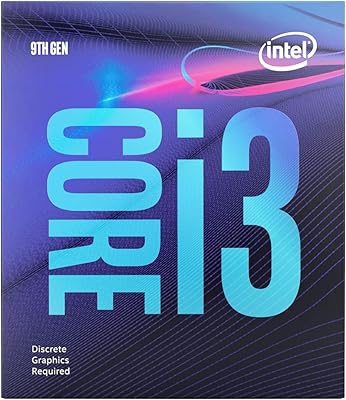
Intel Core i3-9100F Desktop Processor
71%
88%
Value for Money
83%
Gaming Performance
84%
Thermal Performance
51%
Multi-Threaded Workloads
74%
Platform Compatibility
More
Intel Core i5-13400F 2.5GHz 10-Core Desktop Processor
87%
88%
Performance
92%
Value for Money
84%
Gaming Performance
89%
Multi-core Efficiency
91%
Ease of Installation
More
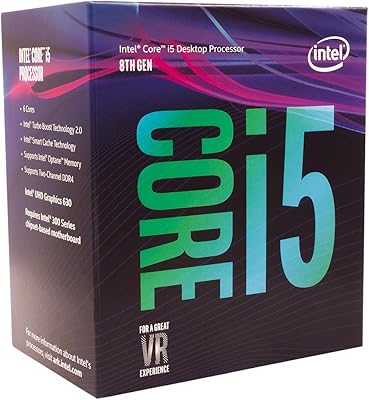
Intel Core i5-9500 Desktop Processor
72%
88%
Everyday Performance
81%
Gaming Capability
91%
Thermal Management
58%
Multi-threaded Workloads
83%
Platform Compatibility
More
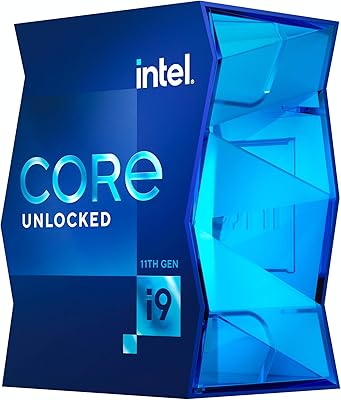
Intel Core i5-8600 Desktop Processor
71%
83%
Single-Core Performance
61%
Multithreaded Performance
74%
Gaming Performance
71%
Value for Money
88%
Thermal Efficiency
More
Intel Core i9-11900K Desktop Processor
70%
91%
Gaming Performance
93%
Single-Core Speed
67%
Multi-Threaded Performance
54%
Thermal Performance
84%
Overclocking Capability
More
Intel Core i3-13100F Desktop Processor
75%
91%
Value for Money
74%
Gaming Performance
88%
Everyday Productivity
83%
Thermal Performance
61%
Bundled Cooler Quality
More
Intel Core i3-9100 Desktop Processor
74%
83%
Single-Core Performance
54%
Multi-Core Performance
71%
Value for Money
63%
Gaming Performance
86%
Everyday Computing
More
Intel Core i7-10700F Desktop Processor
77%
91%
Multi-Threaded Performance
88%
Single-Core Responsiveness
84%
Value for Money
67%
Thermal Management
86%
Platform Compatibility
More
Intel Core i7-9700F Desktop Processor
71%
88%
Gaming Performance
91%
Single-Core Speed
74%
Multi-Core / Threaded Performance
86%
Thermal Efficiency
69%
Platform Compatibility
More
Intel Core i5-13600K Desktop Processor
79%
93%
Gaming Performance
88%
Multi-Threaded Throughput
61%
Thermal Management
91%
Value for Money
79%
Overclocking Headroom
More

FAQ

It works with any LGA1200 motherboard based on Intel's 400-series chipsets — that includes B460, H410, H470, Z490, and others in that family. What it will not work with is a 500-series board, even though those also use the LGA1200 socket. Always double-check your motherboard's CPU compatibility list before buying, just to be safe.

Yes, the i3-10100 includes integrated Intel UHD Graphics 630, so you can plug a monitor directly into your motherboard's video output and get a working display right away. It handles everyday tasks, video streaming, and light workloads without issue. For gaming beyond basic titles or anything GPU-intensive, you will want to add a discrete card eventually.

For everyday use at stock speeds, the bundled cooler does its job. It keeps temperatures in check during web browsing, office work, and typical multitasking. Where it starts to struggle is under prolonged heavy loads — sustained video encoding or gaming sessions can push it closer to its limits. If you plan to run the chip hard for extended periods, a budget aftermarket cooler is worth the small additional cost.

It holds up well for 1080p gaming, particularly when paired with a capable dedicated GPU. The 4 cores and 8 threads give it enough headroom to avoid becoming an obvious bottleneck in most modern titles. Where it starts to show its age is in games that are heavily CPU-bound or in competitive titles where you are pushing very high frame rates — in those cases, an i5 or Ryzen 5 would serve you better.

Unfortunately, no. The multiplier is locked on this chip, so you cannot push it beyond its factory boost clock of 4.3 GHz regardless of which motherboard you use. If overclocking is important to you, you would need to look at Intel's K-series processors instead, paired with a Z-series board that supports it.

For strictly office and productivity use, the gap between this desktop chip and a similarly aged i5 is modest in day-to-day feel. The i5-10400, for example, adds two more cores and is the more future-proof choice if your budget allows. For purely light use — browsing, documents, casual streaming — the i3-10100 is plenty and saves you money without a meaningful compromise.

The chip supports DDR4 memory, officially rated up to DDR4-2666 in dual-channel configuration. For the best balance of performance and cost, 16GB across two sticks (2x8GB) running in dual-channel is the sweet spot for most users. Going single-channel with one stick is supported but will noticeably reduce memory bandwidth and can impact performance in some workloads.

This is an important question and the honest answer is: not really. The LGA1200 socket only supports 10th and 11th generation Intel chips, and Intel moved to LGA1700 with the 12th generation onward. So if you want to upgrade to a significantly faster modern processor in the future, you will likely need a new motherboard too. It is best to go in knowing this is a relatively self-contained platform commitment.

It is a genuinely solid choice for a home office setup. Running a Zoom or Teams call while keeping a dozen browser tabs open, editing a spreadsheet, and managing emails is exactly the kind of workload this chip handles comfortably. The 8 threads help distribute that kind of concurrent task load without things bogging down noticeably.

The included stock cooler comes with thermal paste pre-applied to its base, so you do not need to purchase any separately for a standard installation. If you choose to use a third-party aftermarket cooler instead, that cooler will typically include its own thermal compound as well, so again you are covered in most cases.

Where to Buy