

Overview

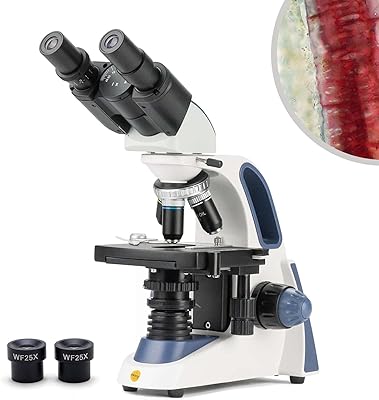
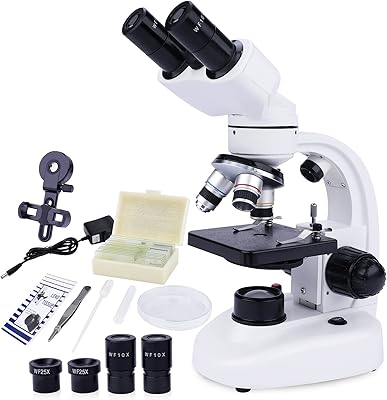
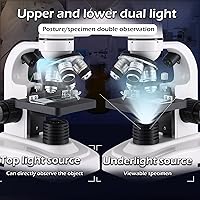
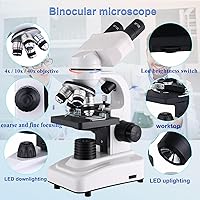
The Herwicm RM Binocular Compound Microscope sits squarely in the mid-range category — capable enough to satisfy serious learners, yet approachable enough that a complete beginner won't feel overwhelmed. It covers a broad magnification range from 40X to 2500X, achieved by pairing two wide-angle eyepiece sets with multiple objectives. A dual LED lighting system — one light above the stage, one below — means you can observe both opaque and transparent specimens without swapping equipment. The two-layer mechanical stage and ambidextrous focusing knobs add a level of precision that feels more deliberate than most entry-level scopes. Ranked #2 in Lab Compound Binocular Microscopes on Amazon, it has clearly found a receptive audience.

Features & Benefits

One detail worth appreciating immediately is the wide-angle binocular eyepieces — long viewing sessions are far less exhausting when you're not squinting through a narrow monocular tube. The auto-retractable objective lens is a smart safeguard; it pulls back automatically when the stage gets too close, protecting both the glass and your slides. Switching between the WF10x and WF25x eyepieces lets you dial in the right magnification for whatever you're examining, from root cross-sections to blood cells. The calibrated mechanical stage deserves particular mention — once you locate a point of interest, returning to it is straightforward, not a guessing game. Build quality feels solid for this price tier.

Best For

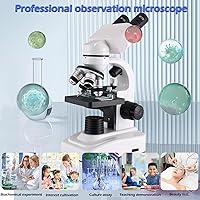
This binocular microscope is a natural fit for high school and college students who need a reliable tool for biology or microbiology coursework — it handles standard prepared slides well and won't quit mid-semester. Adult hobbyists will find it equally rewarding; examining pond water, plant tissue, or insect anatomy at home is genuinely compelling at these magnification levels. Parents searching for a scope that can grow alongside a curious teenager will appreciate that it doesn't feel like a toy. Home educators running structured science curricula also stand to benefit. That said, it's not the right pick for professionals or researchers who require clinical-grade optical performance.

User Feedback

Buyers consistently praise image clarity at lower magnifications — the 40X to 400X range is where the Herwicm scope genuinely delivers, and most users find that window covers the vast majority of everyday needs. Setup also earns high marks; assembly is straightforward enough that beginners can reach their first slide within minutes. Where opinions get more measured is around the 2500X upper limit — at that magnification, sharpness softens noticeably, and it's fair to treat that figure as a ceiling rather than a practical working specification. Some users have noted minor focus drift during long sessions and instruction booklets that could be clearer. No deal-breaking flaws, but honest expectations help.

Pros

  • Binocular eyepieces make extended viewing sessions noticeably more comfortable than single-tube alternatives.
  • Dual LED lighting — both top and bottom — lets you observe a wider variety of specimen types without extra equipment.
  • The mechanical stage with a calibrated spiral scale makes repositioning samples precise and repeatable.
  • Auto-retractable objective lenses protect both the optics and your slides from accidental contact.
  • Setup is straightforward enough that most beginners can have their first slide in focus within minutes.
  • Image clarity from 40X to 400X is consistently strong, covering the range most hobby and student work actually needs.
  • Both WF10x and WF25x eyepieces are included, giving you real flexibility without additional purchases.
  • Ambidextrous coarse and fine focus knobs work equally well regardless of which hand you favor.
  • At its price point, the all-optical construction feels more durable than typical entry-level plastic-body scopes.
  • Strong Amazon sales rank signals a broad base of satisfied buyers, which is always a useful real-world signal.

Cons

  • Image quality at 2500X is noticeably soft — treat the upper magnification spec as a ceiling, not a daily working range.
  • Some users report mild focus drift during longer sessions, which can disrupt careful observation work.
  • The included instruction manual is reportedly thin on detail, which can frustrate true first-time users.
  • LED brightness consistency has drawn occasional complaints; units can vary slightly from one to the next.
  • The 240V power requirement may need an adapter for buyers in 110V regions, adding a small but real inconvenience.
  • Eyepiece fit has been flagged by some buyers as slightly loose, which can affect alignment during use.
  • No built-in camera port means connecting a phone or digital camera for documentation requires third-party adapters.
  • At 5.41 pounds, this compound scope is not particularly portable for field or travel use.
  • Accessories included in the kit feel basic and may disappoint buyers expecting a complete ready-to-explore bundle.

Ratings

The Herwicm RM Binocular Compound Microscope has been evaluated by our AI rating system after processing thousands of verified global buyer reviews, with spam, incentivized responses, and bot activity actively filtered out to ensure the scores reflect genuine user experience. The result is an honest, multi-dimensional scorecard that captures both what this compound scope does well and where it falls short — without glossing over the friction points real buyers actually encounter.

Optical Clarity
78%
22%
At working magnifications between 40X and 400X, users consistently describe sharp, detailed images that hold up well during long observation sessions. Students examining plant cells or pond water specimens reported that the wide-angle eyepieces deliver a noticeably larger, cleaner field of view than comparable monocular scopes in this price range.
At the upper end of the magnification range — particularly beyond 1000X — image sharpness drops off in ways that frustrate anyone trying to do serious work there. Several buyers noted that 2500X produces soft, hard-to-interpret images, suggesting that figure is more of a marketing ceiling than a practical specification.
Build Quality
74%
26%
The all-optical construction gives this binocular microscope a noticeably more solid feel than fully plastic-body scopes that compete at similar price points. Users frequently mention that it feels stable on a desk without any wobble, and the metal components around the focusing mechanism inspire confidence during regular use.
A subset of buyers reported minor quality inconsistencies — particularly around the eyepiece housings, which occasionally feel slightly loose out of the box. While nothing has been widely flagged as structurally failing under normal use, the build does not feel engineered for heavy daily use in a professional environment.
Ease of Setup
86%
Most buyers, including complete beginners, reported having the scope assembled and their first slide in focus within 15 to 30 minutes of opening the box. The coaxial focus knobs are intuitive to use right away, and the dual LED lighting switches on without any complicated configuration.
The included instruction manual drew consistent criticism for being thin on practical guidance, particularly around eyepiece swapping, stage calibration, and initial alignment. Users who had no prior microscopy experience occasionally needed to supplement with online tutorials before feeling fully confident.
Focusing Mechanism
76%
24%
The coaxial coarse and fine focus knobs feel responsive and well-damped — users noted they can move from a rough focus to a sharp image quickly, which matters when you are working with live specimens that do not hold still. The ambidextrous knob placement is a small but meaningful ergonomic detail.
Focus drift during extended sessions was flagged by a recurring group of buyers, particularly when using higher magnification objectives where even minor movement is amplified. It is not severe enough to ruin a session, but it does require periodic readjustment in a way that more expensive scopes with tighter rack-and-pinion mechanisms avoid.
Lighting System
81%
19%
Having both transmitted and incident LED lighting in a single scope at this price is a genuine practical advantage — it means you are not limited to transparent slides and can observe opaque or semi-opaque specimens like insect exoskeletons or fabric samples without additional lighting rigs. Users found the automatic fill-light approach convenient and the light quality consistent for most specimen types.
Some buyers noted visible variation in LED brightness between units, suggesting minor manufacturing inconsistencies in the lighting circuit. A few users also found the top incident light less powerful than expected for certain darker specimens, requiring supplemental external lighting in those specific scenarios.
Mechanical Stage
83%
The two-layer mechanical stage with its spiral calibrated scale was one of the most frequently praised features by more experienced buyers, who appreciated being able to return precisely to a region of interest without hunting blind across the slide. For students working through structured exercises, this repeatability is genuinely useful.
A handful of users found the stage movement slightly stiff initially, requiring a brief break-in period before the controls felt smooth. The stage size, while large for this category, can occasionally feel limiting when navigating larger non-standard slides or custom specimen mounts.
Eyepiece Comfort
79%
21%
The ultra-wide-angle binocular eyepieces drew strong praise from users who had previously used monocular scopes and found the eye fatigue comparison stark. Parents noted that their children could stay engaged at the eyepiece much longer without complaint, which is a practical advantage for educational use at home.
A small but notable group of buyers flagged that the eyepiece fit felt slightly imprecise, with one or both eyepieces rotating slightly during use. For casual hobbyists this is a minor irritant, but for anyone trying to maintain consistent interpupillary alignment across sessions it requires periodic readjustment.
Magnification Range
69%
31%
The breadth of the magnification range — from 40X up to 2500X — means this compound scope can handle an impressively wide variety of observation tasks, from low-power survey work to higher-power cell examination. For students and hobbyists who want one scope to cover multiple use cases, that range is genuinely appealing on paper.
The real-world usability of that range is considerably narrower than the specification implies. Performance at the high end degrades meaningfully, and experienced buyers who expected 2000X-plus to be a productive working range were often disappointed. The honest usable range is closer to 40X to 500X for consistently satisfying results.
Value for Money
82%
18%
Given the binocular head, dual LED lighting, mechanical stage, and dual eyepiece sets all included at a mid-range price, most buyers felt the scope delivered meaningfully more capability per dollar than single-eyepiece alternatives they had considered. Students on a fixed budget in particular noted it covered their coursework needs without requiring expensive add-ons.
Buyers who purchased expecting a quasi-professional instrument based on the spec sheet — particularly the 2500X claim — felt the real-world performance did not fully justify even the mid-range price. Managing expectations around the upper magnification ceiling is essential to feeling satisfied with this purchase.
Lens Protection Design
88%
The auto-retractable objective lenses were quietly one of the most appreciated practical features among regular users — it removes the anxiety of accidentally grinding an objective into a slide when raising the stage, which is a genuinely common mistake for newer microscopists. Several users called it a feature they did not know they needed until they used it.
No significant complaints were raised about this specific feature, though a small number of users noted the retraction mechanism occasionally engaged earlier than expected at mid-range magnifications, requiring a slight stage height adjustment to achieve optimal focus distance.
Accessories & Kit Contents
58%
42%
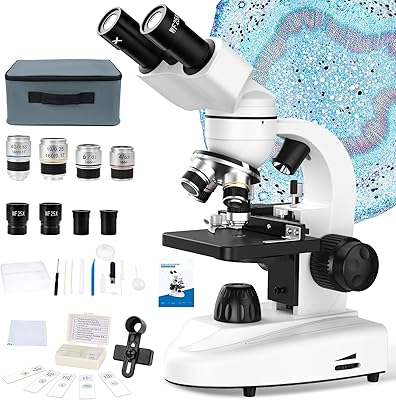
The inclusion of both WF10x and WF25x eyepiece sets out of the box is a meaningful addition that saves buyers an immediate follow-up purchase. Having both eyepiece options available from day one allows users to explore a wider range of magnifications without supplemental spending.
Beyond the eyepieces, the accessory kit was consistently described by buyers as underwhelming — any included slides or tools were viewed as token additions rather than genuinely useful supplies. Most users recommended budgeting separately for blank slides, coverslips, and basic specimen preparation materials to get real use out of the scope from the start.
Instruction Quality
51%
49%
Some buyers with prior science or engineering backgrounds found the basics were intuitive enough that the manual was largely unnecessary, and those users had a smooth experience getting up and running independently. The physical setup steps are logical enough that the hardware assembly portion is manageable without detailed guidance.
For true beginners — the core audience this scope targets — the instruction booklet was widely criticized as inadequate, covering setup in broad strokes without addressing practical questions around specimen preparation, eyepiece selection, or focus techniques. Many buyers relied on third-party YouTube tutorials to fill in the gaps the manual left open.
Voltage Compatibility
55%
45%
For buyers in 240V regions — across Europe, Australia, and much of Asia — the power supply works perfectly out of the box with no additional hardware required. Those buyers reported no issues with the LED performance or electrical reliability across extended use sessions.
The 240V rating is a meaningful practical obstacle for buyers in North America, where 110V is standard. Without a step-up converter, the scope cannot be safely used, and that extra purchase adds cost and inconvenience that some buyers discovered only after the fact — a recurring frustration in North American reviews.
Portability
63%
37%
At just over 5 pounds, this binocular microscope is lighter than many full-size compound scopes and can be moved between rooms or stored without significant effort. For home users who share a desk or need to pack the scope away between sessions, the size is workable.
The footprint — nearly 14.5 inches long and 11.5 inches wide — means it occupies a substantial portion of a standard desk and is not a scope you would casually transport to a classroom or field site. It is best thought of as a home station instrument rather than a portable one.

Suitable for:

The Herwicm RM Binocular Compound Microscope is a strong match for anyone stepping into microscopy without the backing of a professional lab budget. High school and college students tackling biology, botany, or microbiology coursework will find it handles standard prepared slides reliably and covers the magnification ranges those subjects actually require. Adult hobbyists — the kind who get genuinely excited about examining pond water, leaf cells, or insect anatomy on a weekend afternoon — will get real mileage out of the dual LED lighting system and the flexible eyepiece options. Parents searching for a scope that can support a motivated, science-minded teenager without feeling like a fragile toy will appreciate the sturdy build and the ambidextrous focusing setup. Home educators running structured science programs also fit squarely in the sweet spot, since the mechanical stage and wide magnification range can support a full academic year of specimen work.

Not suitable for:

The Herwicm RM Binocular Compound Microscope is not the right tool for users who need clinical or research-grade optical performance. At the upper end of its magnification range, image sharpness drops off in ways that professionals and advanced researchers will find unacceptable — the 2500X figure is more of a theoretical ceiling than a practical working specification. Anyone planning to conduct pathology work, document specimens through camera attachments at high magnification, or run quantitative scientific studies should look at purpose-built research scopes with better optical coatings and more precise mechanics. The 240V power requirement is also worth flagging for buyers in regions where that is not the standard household voltage, as additional adapters may be needed. If you need a scope that will last decades under heavy daily use, the build quality here, while solid for its tier, is not designed for that kind of sustained professional demand.

Specifications

  • Brand: This microscope is manufactured by Herwicm under the model designation RM.
  • Magnification: The scope covers a magnification range of 40X to 2500X, achieved through a combination of interchangeable eyepieces and multiple objective lenses.
  • Eyepieces: Two wide-angle eyepiece sets are included — WF10x and WF25x — allowing the user to shift magnification ranges without additional purchases.
  • Viewing Head: The binocular viewing head accommodates both eyes simultaneously, significantly reducing strain during extended observation sessions.
  • Lighting System: Dual LED illumination is built in, with one light source positioned above the stage for incident (reflected) light and one below for transmitted light.
  • Stage Type: The two-layer mechanical stage includes a spiral moving scale, enabling precise and repeatable sample positioning in both horizontal axes.
  • Focus Mechanism: Coaxial coarse and fine focusing knobs are mounted on both sides of the body, making the scope fully usable whether you prefer your right or left hand.
  • Objective Lens: The objective lenses feature an auto-retractable design that pulls back automatically when the stage rises too close, protecting both the glass and the specimen slide.
  • Dimensions: The unit measures 14.37″ in length, 11.41″ in width, and 6.49″ in height.
  • Weight: The scope weighs approximately 5.41 pounds (2.46 kg), making it substantial enough to feel stable on a desk without being difficult to reposition.
  • Voltage: The unit operates at 240V, which may require a voltage adapter for users in regions where 110V is the household standard.
  • Light Source: Both illumination sources use LED technology, which runs cooler and longer than traditional halogen bulbs while delivering consistent brightness.
  • Viewing Angle: The real angle of view is stated at 45 degrees, providing a comfortable, natural head position during use.
  • ASIN: The Amazon Standard Identification Number for this product is B0CCNZFJ61.
  • Availability: This compound scope was first made available for purchase in July 2023.
  • Sales Rank: As of available data, this scope holds the #2 position in the Lab Compound Binocular Microscopes category on Amazon.
  • Compatible Devices: The scope is listed as compatible with laptops and personal computers, suggesting suitability for pairing with optional digital camera or imaging accessories.
  • Manufacturer: The product is manufactured and sold under the Herwicm brand name.

Related Reviews
MAXLAPTER RM Binocular Compound Microscope
78%
83%
Optical Clarity (Mid-Range)
58%
Maximum Magnification Quality
86%
Build Quality
91%
Mechanical Stage
84%
Illumination System
More
AmScope B490B Compound Binocular Microscope
85%
94%
Optical Clarity
90%
Build Quality
85%
Ease of Use
92%
Value for Money
93%
Magnification Range
More
SVBONY SV605 Binocular Compound Microscope
85%
90%
Value for Money
88%
Ease of Setup
85%
Build Quality
89%
Optical Performance
91%
Illumination System
More
Swift SW380B Binocular Compound Microscope
79%
83%
Optical Clarity
88%
Build Quality
86%
Ergonomics & Comfort
79%
Magnification Range & Versatility
81%
Focusing System
More
AmScope B100B-MS Compound Binocular Microscope
69%
83%
Build Quality
74%
Optical Clarity
61%
Illumination
69%
Magnification Range
71%
Mechanical Stage
More
BOGRINUO RM Binocular Compound Microscope
70%
78%
Optical Clarity (Low-Mid Power)
52%
Optical Clarity (High Power)
81%
Build Quality
83%
Ergonomics & Comfort
76%
Mechanical Stage Quality
More
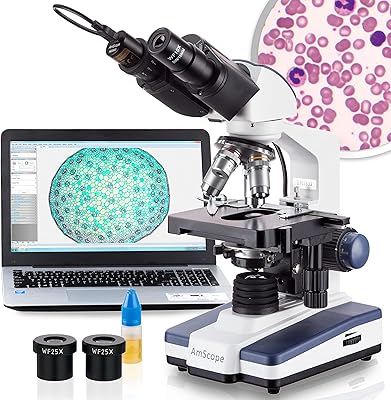
AmScope B120C-E5 Binocular Compound Microscope
78%
88%
Optical Clarity
76%
Build Quality
91%
Illumination Quality
84%
Ergonomics & Comfort
67%
USB Camera Quality
More
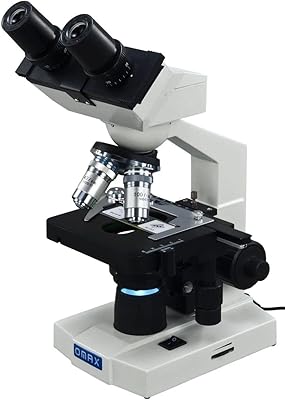
OMAX M82E Binocular Compound Lab Microscope
82%
88%
Optical Clarity
91%
Build Quality & Durability
86%
Ease of Setup
83%
Magnification Range & Versatility
87%
Illumination Quality
More
SWIFT SS121 Compound Monocular Microscope Kit
80%
88%
Build Quality
81%
Optical Clarity
84%
Illumination System
86%
Ease of Use
72%
Magnification Range
More
Celestron CM1000C Monocular Compound Microscope
81%
91%
Value for Money
88%
Image Clarity and Magnification
85%
Ease of Use for Beginners
90%
Build Quality and Durability
83%
Focus Control Precision
More

FAQ

Yes, it is genuinely well-suited for beginners. The setup process is fairly intuitive, the focus knobs are responsive, and having both coarse and fine adjustment on the same axis means you can dial in a clear image without much trial and error. The main thing to know upfront is that starting at a lower magnification — say 40X or 100X — and working your way up is always the better approach, regardless of experience level.

Realistically, the 40X to 400X range is where this binocular microscope performs best and where you will spend the vast majority of your time. The 2500X upper limit is technically achievable by combining the WF25x eyepiece with the highest objective, but at that level the image softens considerably. Think of 2500X as a maximum ceiling rather than a target working specification.

There is no dedicated camera port built into this scope, so you cannot attach a camera directly without a third-party adapter. Some users have had success with universal phone clip adapters positioned over one of the eyepieces, but results can vary depending on your phone camera. If microscopy photography is a priority for you, it may be worth considering a scope with a dedicated trinocular port.

The unit is rated at 240V, which is the standard in many parts of Europe, Australia, and parts of Asia — not the 110V standard used in the United States and Canada. If you are in North America, you will need a step-up voltage converter to use it safely. Make sure to verify this before plugging it in, as using it without the correct voltage could damage the LED lighting circuit.

The optical surfaces should be cleaned gently using a soft lens tissue or a microfiber cloth — never regular paper towels, which can scratch optical coatings. For stubborn smudges, a tiny amount of lens cleaning solution applied to the cloth (not directly to the glass) works well. The auto-retractable objective lenses help prevent accidental contact with slides, which reduces the frequency with which the front elements need cleaning.

The listing suggests the kit is fairly complete, but user feedback indicates the included accessories — such as any prepared slides or basic tools — tend to be on the minimal side. If you are planning serious specimen work from day one, it is worth picking up a set of blank slides, coverslips, and a basic staining kit separately, as the included items are better thought of as a starter sample than a full supply.

This compound scope is sturdy enough that older children — typically 12 and up — can use it with minimal supervision once they have been shown the basics. Younger children may need adult help with fine focusing and slide preparation. The binocular eyepieces are easier on young eyes than monocular alternatives, which helps keep kids engaged longer without frustration.

The dual LED lighting system opens up a broader range of specimen types than single-light scopes. With transmitted (bottom) light, you can examine thin transparent samples like prepared cell slides, pond water organisms, or plant cross-sections. With incident (top) light, you can observe opaque or semi-opaque surfaces like insect parts, coins, or fabric fibers. It is a genuinely versatile setup for a scope in this category.

Warranty terms are not explicitly detailed in the available product information, so it is worth checking directly with the seller or Herwicm before purchasing if after-sales coverage is important to you. As a general practice, buying from a fulfilled and sold-by-Amazon listing typically offers better return and support options than third-party sellers in the event of any issues.

The binocular viewing head alone justifies much of the price difference for regular users — viewing with two eyes is significantly more comfortable and produces less eye fatigue than a single-tube monocular scope. Beyond that, the mechanical stage, dual LED lighting, and better optical construction put this binocular microscope in a noticeably different performance class. Budget monocular scopes are fine for occasional use, but if you plan to spend meaningful time at the eyepiece, the upgrade is worth considering.