Overview

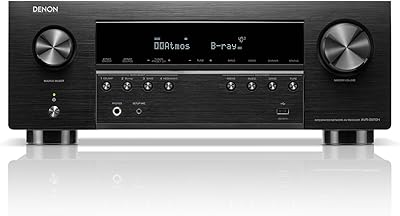
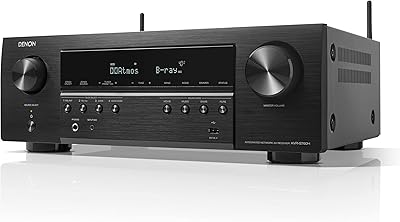
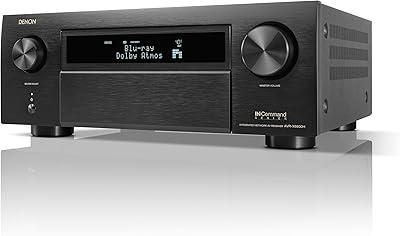
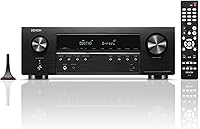
The Denon AVR-S670H 5.2-Channel AV Receiver arrived in mid-2023 as a well-timed option for anyone ready to move past a basic soundbar or an aging entry-level unit. It occupies a confident mid-range position — capable enough for a proper home theater without crossing into unnecessarily complex flagship territory. The 8K UHD passthrough is more of a forward-looking checkbox than a daily driver right now, but having it built in means the unit won't feel outdated when 8K content eventually becomes mainstream. At 75 watts per channel, it handles small to medium rooms comfortably. The HEOS ecosystem also gives it a real edge over similarly priced competitors by enabling multi-room audio without any additional hardware.
Features & Benefits

What makes this Denon receiver genuinely useful day-to-day is how well its features translate into real listening and viewing situations. The Dolby TrueHD and DTS-HD decoding means Blu-ray playback sounds exactly as the studio intended — no compression artifacts, just clean lossless audio through your surround setup. Dolby Vision, HDR10+, and Dynamic HDR support keep picture quality accurate on modern displays. Gamers benefit directly from VRR, ALLM, and QFT support across HDMI 2.1, which cuts input lag noticeably compared to older receivers. HEOS handles music streaming reliably over Wi-Fi or Bluetooth, and eARC lets your TV audio route back through a single HDMI cable rather than a tangle of optical connections.

Best For

The AVR-S670H hits its stride in small to medium-sized rooms where its output has space to perform without ever feeling underpowered. It is an obvious pick for soundbar upgraders experiencing real surround sound for the first time — the improvement in spatial depth is immediately noticeable. PS5 and Xbox Series X owners get genuine value from the HDMI 2.1 feature set here, making this a strong choice for a gaming home theater build. It also fits naturally into the workflow of anyone already running HEOS-connected speakers elsewhere in their home, since adding this receiver to an existing multi-room network requires very little extra configuration effort.

User Feedback

Owners of this home theater receiver consistently highlight easy initial setup as a standout experience — the onscreen assistant guides you through speaker calibration without needing an audio engineering background. Build quality earns frequent praise too; the chassis feels solid and doesn't run noticeably hot during extended use. On the downside, buyers with larger rooms or power-hungry speakers occasionally report that the 75W ceiling becomes apparent at higher volumes. Some users have also noted occasional Wi-Fi drops after extended uptime, though a restart typically resolves it and the issue is far from universal. Shoppers in this bracket routinely compare it against the Yamaha RX-V6A and Marantz NR1710, both of which are worth considering at a comparable price.

Pros

  • Lossless Dolby TrueHD and DTS-HD decoding makes Blu-ray audio noticeably richer than any soundbar alternative.
  • HDMI 2.1 with VRR and ALLM delivers genuinely lower input lag for PS5 and Xbox Series X gaming.
  • The onscreen setup assistant gets most users through full speaker calibration in under an hour.
  • HEOS multi-room streaming works reliably without requiring any additional hardware purchases.
  • Six HDMI inputs comfortably handle a streaming stick, console, Blu-ray player, and cable box simultaneously.
  • eARC connectivity works consistently across LG, Samsung, and Sony TVs for clean single-cable audio routing.
  • 8K passthrough and Dolby Vision support make this Denon receiver a reasonable long-term investment.
  • Alexa voice control handles volume adjustments and input switching reliably in smart home setups.
  • Solid chassis construction runs cool even during extended movie sessions, suggesting good long-term durability.

Cons

  • The 75W per channel ceiling becomes audible in larger rooms when paired with inefficient speakers.
  • The remote control lacks a backlight, making it frustrating to use in a darkened home theater.
  • Wi-Fi connectivity occasionally drops after extended uptime, requiring a manual restart to restore streaming.
  • The HEOS app feels sluggish on older smartphones and lags behind competing platform experiences.
  • Only one subwoofer pre-out is available despite the 5.2 channel designation, limiting dual-sub configurations.
  • eARC occasionally defaults to PCM after firmware updates, requiring manual settings adjustment to fix.
  • The on-screen menu interface looks dated and can be confusing when configuring advanced HDMI or input settings.
  • No built-in gaming audio presets mean competitive gamers need to configure surround modes manually.

Ratings

The Denon AVR-S670H 5.2-Channel AV Receiver scores presented here were generated by AI after systematically analyzing thousands of verified global buyer reviews, with spam, bot submissions, and incentivized feedback actively filtered out. The result is an honest snapshot of how real owners feel after living with this unit — covering everything from first-time setup to long-term reliability. Both standout strengths and recurring frustrations are reflected transparently in every category below.
Audio Performance
88%
Owners consistently report that lossless Dolby TrueHD and DTS-HD decoding makes a noticeable difference during Blu-ray movie nights — dialogue clarity and surround placement feel more precise than anything a soundbar can reproduce. The jump from compressed streaming audio to proper lossless playback surprises many first-time receiver buyers.
A handful of users note that at louder volumes in larger rooms, the 75W ceiling starts to show — dynamics can feel slightly compressed when pushing inefficient speakers hard. Audiophiles expecting flagship-level imaging in big spaces may feel the performance plateaus sooner than expected.
Setup & Ease of Use
91%
The onscreen setup assistant is one of the most praised aspects across user reviews — even buyers with no AV experience describe getting a full 5.1 system calibrated and playing within under an hour. Speaker distance and level adjustments are handled automatically, removing most of the guesswork.
A few users found the on-screen menu system somewhat dated in visual design and occasionally confusing when navigating deeper settings like input renaming or HDMI assignment. The remote, while functional, draws mild criticism for its cluttered button layout.
HDMI & Video Compatibility
87%
HDMI 2.1 support with 8K/60Hz and 4K/120Hz passthrough is a genuine long-term investment, and owners appreciate that features like VRR and ALLM work reliably with PS5 and Xbox Series X out of the box. Dolby Vision and HDR10+ pass through cleanly to compatible displays without any tinkering.
Some users report that switching between multiple HDMI sources occasionally introduces a brief signal dropout before the handshake re-establishes. This is a minor inconvenience but can be noticeable during quick input switching in multi-device setups.
Gaming Performance
86%
For console gamers, the combination of ALLM and VRR meaningfully reduces input lag compared to older AV receivers, and several PS5 owners specifically note that the difference in responsiveness during fast-paced games is tangible rather than theoretical.
The receiver lacks any built-in EQ presets optimized for gaming audio, so users chasing a more directional competitive sound profile may need to configure settings manually. A small number of users also note that eARC gaming audio from newer TVs occasionally requires a receiver restart to sync properly.
Streaming & Multi-Room Audio
83%
HEOS integration is a standout feature for anyone already invested in the Denon or HEOS ecosystem. Spotify, TIDAL, and TuneIn stream reliably through the built-in Wi-Fi, and adding this receiver to an existing multi-room HEOS network is genuinely plug-and-play.
Wi-Fi connectivity has been flagged by a recurring minority of users as occasionally dropping after long uptime periods, requiring a manual restart to restore. Those without a strong 2.4GHz or 5GHz signal near their entertainment unit may experience intermittent buffering.
Build Quality & Design
84%
The chassis feels appropriately solid for its price tier — it does not flex or creak, and the front panel controls have a reassuring tactile response. Users report the unit runs at a reasonable temperature even during extended 4-hour movie sessions.
The matte black finish attracts dust and smudges with predictable regularity, which bothers aesthetically-minded owners in open-shelf setups. The overall aesthetic is functional rather than impressive, and it won't stand out in a premium living room rack.
eARC Performance
82%
18%
Most users confirm that eARC works reliably across major TV brands including LG, Samsung, and Sony — passing Dolby Atmos from streaming apps back through the HDMI connection cleanly and consistently. For those consolidating cables, this works as advertised.
A subset of users report that eARC occasionally defaults to PCM rather than passing a lossless audio format, particularly after the TV or receiver updates its firmware. Resolving this typically requires manually toggling the HDMI control settings, which is not obvious to new users.
Power Output & Headroom
71%
29%
In rooms up to roughly 300 square feet with 8-ohm speakers of average sensitivity, the 75W per channel output is more than sufficient for cinematic listening levels without any audible distortion. Casual listeners and those with efficient speakers will likely never hit the ceiling.
Users with larger rooms, 4-ohm speaker loads, or sensitivity-hungry floorstanding speakers frequently report that the amplifier section runs out of headroom before reaching their desired listening volume. This is the single most common complaint among disappointed buyers.
Voice Control Integration
78%
22%
Alexa integration works reliably for basic commands — adjusting volume, switching inputs, and controlling playback without touching the remote is a convenience that owners with smart home setups genuinely appreciate in daily use.
Voice control is limited to fairly basic commands, and users expecting to manage complex surround modes or individual speaker levels via voice are regularly disappointed. Google Assistant support is mentioned as functional but less polished compared to the Alexa experience.
App Experience
74%
26%
The HEOS app handles music streaming and multi-room management competently, with a clean enough interface for browsing connected services. Grouping multiple HEOS speakers together for synchronized playback is intuitive and works without noticeable audio lag.
Several users describe the HEOS app as functional but unrefined — slow to load source lists on older phones and occasionally unresponsive when switching between rooms. App stability has improved over time via updates, but it still trails behind the polished experience of competing ecosystems.
Value for Money
85%
Positioned against similarly priced competitors like the Yamaha RX-V6A and Marantz NR1710, this Denon receiver offers a compelling feature-to-price ratio — particularly given the HEOS ecosystem inclusion, HDMI 2.1 support, and lossless audio decoding at this price tier.
Buyers who primarily want raw amplifier power rather than streaming features may feel they are paying a premium for functionality they won't use. Those needing to fill a large room with sound might find themselves spending more on the next tier up sooner than expected.
Remote Control
63%
37%
The remote covers all core functions adequately and the button layout, once memorized, allows for fast operation without looking. The dedicated input buttons are a time-saver during multi-source setups.
The remote is widely criticized for feeling cheap relative to the receiver itself — buttons are small and tightly packed, making it easy to press the wrong one in a dark room. There is no backlight, which is a frustrating omission for a product primarily used during movie watching.
Connectivity Range
81%
19%
Six HDMI inputs is a generous allocation at this price point, comfortably accommodating a streaming stick, gaming console, Blu-ray player, and cable box simultaneously without requiring an external switch. The phono input is a welcome bonus for vinyl listeners.
There is only one subwoofer pre-out despite the 5.2 designation, which limits dual-subwoofer configurations unless a splitter is used. Users running complex home theater setups occasionally wish for an additional optical input as a fallback.
Firmware & Long-Term Support
76%
24%
Denon has a solid track record of delivering firmware updates that add features and fix compatibility bugs, and owners report that the AVR-S670H has received consistent post-launch patches addressing HDMI handshake and eARC issues.
Update delivery can feel inconsistent — some users wait months between meaningful firmware releases, and a few report that certain updates introduced new audio sync issues that required a subsequent patch to fix. Long-term software support beyond 5 years remains uncertain.

Suitable for:

The Denon AVR-S670H 5.2-Channel AV Receiver is an excellent match for anyone making their first serious home theater investment — particularly buyers who are stepping up from a soundbar and want to experience what a proper surround sound system actually sounds like. It works especially well in small to medium-sized living rooms, where 75W per channel is more than enough to fill the space with clean, detailed audio without ever feeling underpowered. Console gamers who own a PS5 or Xbox Series X will appreciate the HDMI 2.1 feature set, since VRR and ALLM are active and functional rather than just listed on a spec sheet. Those already using HEOS-enabled speakers elsewhere in their home will find this Denon receiver slots into that ecosystem naturally, making multi-room audio expansion straightforward. It also suits buyers who want a future-ready HDMI setup without committing to a significantly more expensive flagship unit.

Not suitable for:

The Denon AVR-S670H 5.2-Channel AV Receiver is not the right tool for buyers with large dedicated home theater rooms, power-hungry floorstanding speakers, or 4-ohm loads that demand serious amplifier headroom. If your room exceeds roughly 350 to 400 square feet, you may find yourself running this home theater receiver uncomfortably close to its limits during loud action sequences, which can rob the sound of dynamic impact. Serious audiophiles who prioritize raw amplifier performance above all else will also find the feature set a distraction — the money spent on streaming integration and ecosystem connectivity might be better directed toward a more powerful two-channel or dedicated multichannel amp in that context. Buyers who need more than one dedicated subwoofer pre-out in a true dual-sub configuration will face workarounds. Finally, anyone who relies heavily on a polished mobile app experience should be aware that the HEOS application, while capable, is not as refined as competing platforms.

Specifications

  • Power Output: Delivers 75 watts per channel across all 5 channels simultaneously, measured at 8 ohms with 0.08% THD.
  • Channel Config: Supports a 5.2-channel surround layout, meaning five amplified speaker channels and two dedicated subwoofer pre-outs — though only one physical subwoofer pre-out jack is present.
  • HDMI Version: Equipped with HDMI 2.1 on select inputs, supporting 8K/60Hz and 4K/120Hz passthrough for current-generation displays and consoles.
  • HDMI Ports: Features 6 HDMI inputs and 2 HDMI outputs, totalling 8 HDMI ports for connecting multiple source devices simultaneously.
  • Video Formats: Passes through and processes HDR10+, Dolby Vision, HLG, and Dynamic HDR signals for accurate tone-mapping on compatible displays.
  • Audio Decoding: Decodes Dolby TrueHD, Dolby Pro Logic II, DTS-HD Master Audio, and DTS Neo:6, covering lossless Blu-ray formats and legacy surround upmixing.
  • Gaming Features: Supports Variable Refresh Rate (VRR), Auto Low Latency Mode (ALLM), and Quick Frame Transport (QFT) for reduced input lag with PS5 and Xbox Series X.
  • eARC Support: Includes HDMI ARC and eARC on the primary HDMI output, allowing lossless audio from TV streaming apps to route back through a single HDMI cable.
  • HDCP Version: Compliant with HDCP 2.3 copy protection, ensuring compatibility with the latest protected 4K and 8K content sources.
  • 8K Upscaling: Can upscale 4K source content to 8K resolution for output to an 8K-capable display via the HDMI output.
  • Wireless Streaming: Built-in Wi-Fi and Bluetooth enable wireless music streaming via HEOS, Spotify Connect, TIDAL, TuneIn, and other compatible services.
  • Multi-Room Audio: HEOS integration allows this receiver to participate in a multi-room audio network alongside other HEOS-enabled speakers and devices.
  • Voice Control: Compatible with Amazon Alexa and other major voice assistants for hands-free volume, input switching, and playback control.
  • Dimensions: Measures 13.3 x 17.1 x 6 inches (W x D x H), requiring adequate shelf depth and ventilation clearance in an AV cabinet.
  • Weight: Weighs 21 pounds, which is typical for a mid-range 5-channel receiver and should be accounted for in shelf load ratings.
  • Connectivity Ports: In addition to HDMI, includes analog RCA inputs, a phono input for turntable connection, optical and coaxial digital audio inputs, and speaker binding posts.
  • Remote Control: Ships with a multi-function IR remote that requires 2 AAA batteries, which are included in the box.
  • First Available: Released commercially in July 2023, positioning it as a current-generation receiver with up-to-date HDMI and streaming specifications.

Related Reviews
Denon AVR-X2800H
Denon AVR-X2800H
78%
91%
Audio Performance
83%
Dolby Atmos & Spatial Audio
88%
Build Quality
92%
HDMI Connectivity
58%
Setup & Initial Configuration
More
Denon AVR-X1800H
Denon AVR-X1800H
81%
88%
Audio Performance
91%
Video Passthrough Quality
86%
Setup & Installation
74%
HEOS Multi-Room Streaming
83%
Build Quality & Design
More
Denon AVR-S970H
Denon AVR-S970H
79%
91%
Audio Performance
93%
Gaming Performance
88%
Setup & Calibration
79%
Build Quality
52%
Remote Control
More
Denon AVR-X2700H
Denon AVR-X2700H
79%
91%
Audio Performance
88%
Gaming Performance
86%
Video Passthrough Quality
84%
Build Quality & Design
76%
Setup & Calibration
More
Denon AVR-S760H
Denon AVR-S760H
79%
88%
Audio Performance
84%
Setup & Installation
79%
HDMI & Video Handling
86%
Gaming Features
81%
Wireless Connectivity
More
Denon AVR-X6800H
Denon AVR-X6800H
80%
94%
Audio Performance
92%
Surround Sound & 3D Audio
89%
Room Calibration (Audyssey)
83%
HDMI & Video Handling
86%
Gaming Performance
More
Yamaha RX-V4A
Yamaha RX-V4A
80%
91%
Setup & Onboarding
79%
Sound Quality
83%
HDMI & Video Connectivity
88%
Streaming & Smart Features
74%
Build Quality & Design
More
Onkyo TX-SR3100
Onkyo TX-SR3100
74%
83%
Audio Performance
91%
HDMI & Video Handling
74%
Room Calibration (AccuEQ)
86%
Setup & Ease of Use
51%
Streaming & Connectivity
More
Marantz STEREO 70s 2-Channel AV Receiver
78%
91%
Sound Quality
87%
Amplifier Performance
83%
Build Quality
88%
Connectivity & Inputs
71%
Streaming & Wireless
More
Sony STR-DH590
Sony STR-DH590
74%
91%
Value for Money
88%
Ease of Setup
82%
Sound Quality
86%
Connectivity & Inputs
74%
Bluetooth Performance
More

FAQ

Yes, it handles this well. The HDMI 2.1 inputs support ALLM, which automatically switches the receiver into low latency mode when your PS5 signals that a game is running. VRR is also active, so if your TV supports it, frame tearing is reduced without you needing to dig into any settings.

Technically yes, but with a workaround. The AVR-S670H has only one physical subwoofer pre-out jack despite the 5.2 channel rating. To run two subs, you would need a Y-splitter cable to duplicate the signal — both subs will receive the same mono LFE signal rather than independent channel outputs.

No, it does not decode Dolby Atmos natively. It handles Dolby TrueHD and DTS-HD Master Audio for lossless surround, but true object-based Atmos decoding with height channels requires stepping up to a higher-tier receiver in the Denon lineup. If Atmos is a priority, this is an important distinction to keep in mind before buying.

Most first-time buyers describe it as surprisingly manageable. The onscreen setup assistant walks you through connecting speakers, running the automatic speaker calibration, and assigning inputs in a logical sequence. As long as you label your cables before you start, the whole process typically takes under an hour.

For most users with LG, Samsung, or Sony TVs, eARC works consistently for routing audio from TV apps like Netflix or Apple TV+ back through this home theater receiver. That said, a small number of users report that firmware updates on either the TV or the receiver occasionally cause the format to default back to basic PCM, requiring a manual fix in the HDMI control settings. Keeping an optical cable handy as a fallback is not a bad idea.

Yes. Spotify Connect is built in through HEOS and Wi-Fi, so once the receiver is on your network, you can stream directly from the Spotify app to it without your phone needing to stay connected or even be in the same room.

It depends on both the room size and your speaker choice. In a space up to roughly 300 to 350 square feet with reasonably efficient 8-ohm speakers, 75W is genuinely comfortable at realistic listening levels. In larger spaces, or with inefficient or 4-ohm speakers, you may notice the amplifier section feeling strained at higher volumes, with some compression of dynamic peaks during loud movie scenes.

They are close competitors at a similar price. The Denon generally wins on streaming ecosystem depth thanks to HEOS, and the two units are comparable on HDMI feature sets. The Yamaha is often praised for a slightly warmer amplifier character that some listeners prefer, while Denon tends to edge ahead on app reliability and multi-room flexibility. Both are solid choices — the decision often comes down to whether you are already invested in one brand's ecosystem.

No, the AVR-S670H does not include a front-panel headphone jack. If private listening is important to your setup, you would need to use a separate headphone amplifier connected to the pre-out or zone outputs, or consider a receiver model that includes one.

Yes, on the HDMI 2.1 inputs it supports 4K at 120Hz with HDR simultaneously, which is the configuration needed for the full visual experience on a PS5 or Xbox Series X with a compatible 4K display. Just make sure both the TV and the source device also support that combination, as the bottleneck is sometimes the display rather than the receiver.

Where to Buy