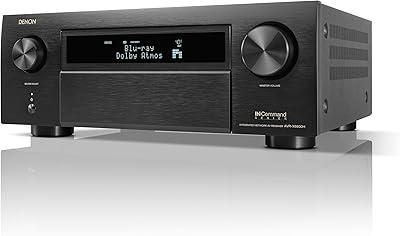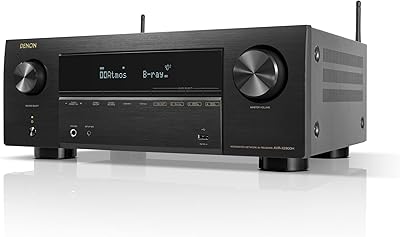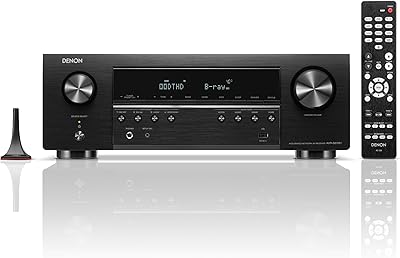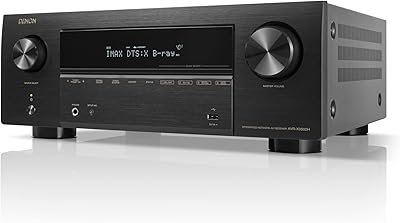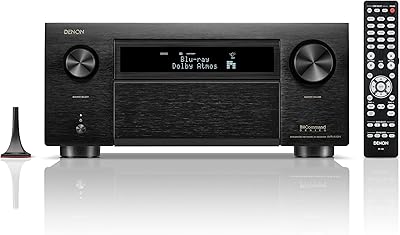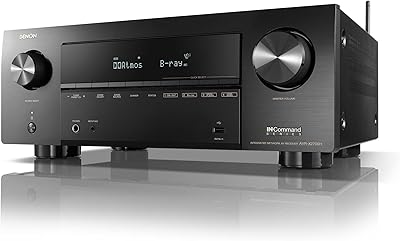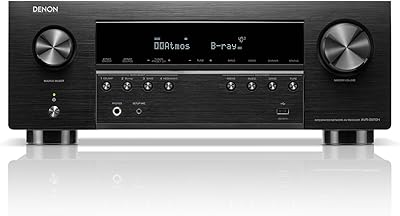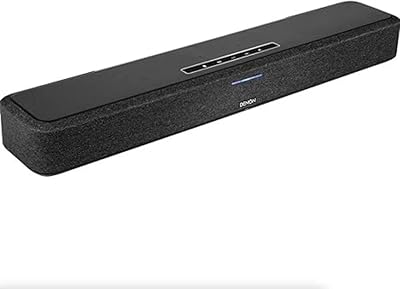
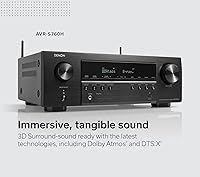

Overview

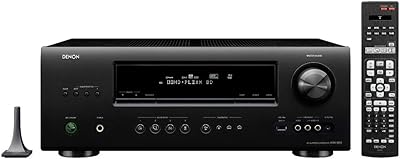
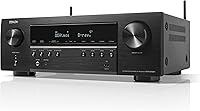
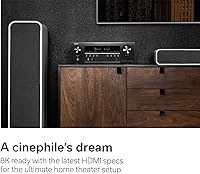
The Denon AVR-S760H sits squarely in the mid-tier of Denon's S-series lineup — capable enough for a serious home theater build, but priced so it doesn't demand a major financial commitment. Released in 2021, it brought 8K-ready HDMI inputs and expanded smart home integration to a bracket that previously felt underserved. Practically speaking, 8K content is still rare enough that most buyers won't lean on that capability for years — but having it built in means this Denon receiver won't feel dated when the format eventually gains traction. The real draw today is the combination of genuine surround sound performance and a surprisingly complete wireless feature set.

Features & Benefits

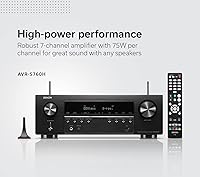
Three of the six HDMI inputs handle 4K at 120Hz, which is meaningful if you're running a PS5 or Xbox Series X — those consoles push frame rates that older receivers simply can't pass through. This mid-range AV receiver also supports Dolby Atmos Height Virtualization and DTS Virtual:X, delivering a convincing overhead sound stage without requiring in-ceiling speakers. Gamers get Variable Refresh Rate and Auto Low Latency Mode working together to cut lag noticeably. On the wireless side, HEOS multi-room audio lets you stream music to compatible speakers throughout the house with no extra hub. Alexa and Google Assistant handle hands-free volume and input switching. At 75 watts per channel, power covers most living room setups well, though a large room with inefficient speakers may push its limits.

Best For

This Denon receiver makes the most sense for someone stepping up from a soundbar or an aging 5.1 system who wants noticeably richer audio without navigating a high-end, complex setup. Console gamers will especially appreciate the low-latency gaming features — having VRR, ALLM, and QFT consolidated in one box alongside full surround sound is a practical win. If you're building around the HEOS ecosystem, the built-in support removes one more device from your rack. It's also a solid pick for buyers chasing HDMI 2.1 features at a mid-range price point, putting real future-proofing within reach. Those who use voice assistants regularly will find the Alexa and Google integration genuinely useful rather than a gimmick.

User Feedback

Across a wide base of verified buyers, setup experience draws consistent praise — most find the initial configuration approachable, and Audyssey MultEQ auto-calibration noticeably improves sound quality right out of the box without manual tweaking. The HEOS app earns solid marks for everyday reliability, and audio performance for the price tier is a recurring highlight. On the downside, a portion of users have encountered HDMI handshake issues — usually resolved with an input switch or power cycle, but frustrating when it happens. A few buyers in larger rooms also note that 75W feels thin when driving less-efficient speakers at volume. Overall, ratings skew strongly positive, with most complaints tied to specific edge-case setups rather than widespread defects.

Pros

  • Audyssey MultEQ auto-calibration noticeably improves sound from the first listening session without manual effort.
  • 4K/120Hz pass-through and VRR support make this Denon receiver one of the better-equipped options for next-gen console gaming.
  • Dolby Atmos Height Virtualization delivers convincing overhead audio without requiring ceiling speaker installation.
  • HEOS built-in enables whole-home audio streaming with no extra hardware or hub required.
  • Six HDMI inputs handle a full entertainment rack — consoles, streamers, and Blu-ray players — without a switcher.
  • Alexa and Google Assistant integration works reliably for everyday volume and input control.
  • Broad HDR format support — Dolby Vision, HDR10+, HLG — means no compatibility headaches with modern displays.
  • Setup is straightforward enough that most first-time receiver owners are up and running within an hour.
  • The feature-to-price ratio is difficult to match among competing 7.2-channel receivers at this tier.
  • AirPlay 2 and Wi-Fi connectivity cover wireless audio use cases that Bluetooth alone cannot handle reliably.

Cons

  • HDMI handshake failures are a documented pattern — some input-switching scenarios require a power cycle to resolve.
  • The HEOS and Denon apps crash or respond slowly often enough to be a recurring complaint, not an isolated one.
  • The included remote has no backlight, which is a real inconvenience in a darkened home theater environment.
  • 75W per channel becomes a noticeable limitation in larger rooms or with lower-sensitivity floor-standing speakers.
  • The onscreen menu interface feels dated compared to competitors and can slow down manual configuration tasks.
  • Voice control breaks entirely during any internet outage, reducing it from a feature to a dependency.
  • The AVR-S760H lacks Dirac Live and IMAX Enhanced, which rules it out for buyers who consider those non-negotiable.
  • The unit runs warm during long sessions and can produce faint fan noise in very quiet listening environments.
  • App-based control, while convenient when working, is inconsistent enough that some users revert to the remote permanently.
  • Buyers with niche speaker brands or atypical room configurations occasionally encounter auto-detection and compatibility quirks.

Ratings

Our AI rating system analyzed thousands of verified global user reviews for the Denon AVR-S760H, actively filtering out incentivized, bot-generated, and outlier feedback to surface what real buyers consistently experience. The scores below reflect both the genuine strengths that make this mid-range AV receiver a compelling choice and the real-world frustrations that some owners encounter. Nothing is glossed over — the highs and the friction points are weighted equally.

Audio Performance
88%
Most users report that surround sound output is noticeably richer than anything in the soundbar tier, with Dolby Atmos Height Virtualization creating a convincing overhead effect even in a standard speaker layout. For movie watching and music, the clarity at moderate volumes earns consistent praise from buyers who previously ran older 5.1 systems.
A subset of more critical listeners feel the mid-range AV receiver falls short of the spatial precision offered by pricier Denon tiers, particularly with complex orchestral content. At higher volumes the soundstage can feel slightly compressed depending on speaker pairing.
Setup & Installation
84%
The initial setup process draws some of the warmest feedback in the entire review pool — most buyers, including first-time receiver owners, report getting a working system running within an hour. The Audyssey MultEQ auto-calibration is frequently called out as a genuine time-saver that also delivers measurable sound improvement right away.
A minority of users found the onscreen menu navigation dated and occasionally confusing when trying to configure multi-zone or HEOS settings manually. The physical remote, while functional, does not match the polish of the receiver itself.
HDMI & Video Handling
79%
21%
Buyers running PS5 or Xbox Series X through this Denon receiver consistently highlight the 4K/120Hz pass-through as a practical differentiator at this price point. HDR format support across Dolby Vision, HDR10+, and HLG means the receiver works cleanly with virtually any current display without requiring extra configuration.
HDMI handshake failures are the single most common technical complaint in the review pool — some users report occasional signal drops or blank screens when switching inputs, usually requiring a power cycle to resolve. It appears more frequently with certain TV brands and HDMI cable quality.
Gaming Features
86%
Variable Refresh Rate and Auto Low Latency Mode working together is a combination that console gamers specifically call out as a reason they chose this unit over competing receivers. The reduction in input lag is noticeable during fast-paced gameplay, and the audio quality adds a layer most gamers haven't experienced outside of dedicated headsets.
A few users note that ALLM does not always trigger automatically with every TV and console combination, occasionally requiring manual mode switching. The gaming-focused feature set, while strong, is not quite as robust as what dedicated gaming monitors offer natively.
Wireless Connectivity
81%
19%
Wi-Fi, Bluetooth, and AirPlay 2 together cover essentially every wireless audio scenario a typical user would encounter. Buyers who stream from phones or laptops throughout the day appreciate that AirPlay 2 in particular maintains stable quality without the compression artifacts common in Bluetooth-only setups.
A handful of users report occasional Wi-Fi dropouts that require the receiver to be power-cycled rather than simply reconnecting. Bluetooth range is adequate but not exceptional — pairing works reliably within the same room but becomes inconsistent through walls.
HEOS Multi-Room Audio
77%
23%
For buyers already using HEOS-compatible speakers, the built-in integration removes the need for any additional hub or bridge hardware. Streaming services like Spotify and TuneIn connect reliably through the HEOS app, and multi-room grouping generally works as advertised once the initial setup is completed correctly.
The HEOS app itself draws mixed feedback — app stability issues, including occasional crashes and slow response times, appear repeatedly in the review pool. Users on Android report slightly more instability than iOS users, and app updates have historically introduced temporary new bugs alongside fixes.
Power Output
71%
29%
At 75 watts per channel, this mid-range AV receiver handles a typical living room with average-efficiency speakers without any strain. Buyers with moderately sized spaces running standard 8-ohm bookshelf or floor-standing speakers report clean, distortion-free output at comfortable listening levels.
Users with larger rooms or speakers rated below 90dB sensitivity note that the amplifier starts to feel underpowered during demanding cinematic scenes. A few buyers explicitly wish they had stepped up to a higher-wattage model after living with the unit in a dedicated home theater room.
Voice Control Integration
78%
22%
Alexa and Google Assistant integration works reliably for the everyday commands most users actually care about — volume adjustments, input switching, and playback control. Buyers who use voice assistants elsewhere in their home find the experience consistent with what they already expect from those platforms.
Voice control is dependent on a stable internet connection, which means any network hiccup temporarily breaks the feature. Some users also note that complex multi-step commands are not always interpreted correctly, limiting voice control to basic functions in practice.
Build Quality & Design
82%
18%
The physical construction of the AVR-S760H feels appropriately solid for its market tier — the chassis doesn't flex, the front panel buttons have a satisfying click, and the overall footprint fits neatly into most AV furniture. Several buyers coming from budget brands comment favorably on how premium it feels in person.
The ventilation design means the unit runs noticeably warm during extended sessions, and a few buyers report that fan noise becomes audible in very quiet room conditions. The aesthetic is functional but not particularly distinctive compared to competitors in the same tier.
Value for Money
89%
Across the entire review pool, value perception is the category that earns the strongest positive consensus. Buyers consistently note that the combination of 7.2 channels, HDMI 2.1 features, HEOS, and Atmos support at this price tier is difficult to match with competing brands offering comparable specifications.
A small group of buyers who experienced HDMI or app issues feel the value proposition erodes when they factor in the troubleshooting time involved. Those who ultimately needed to exchange or return units found the experience offset some of the initial pricing satisfaction.
Auto Calibration (Audyssey MultEQ)
83%
Users consistently describe Audyssey MultEQ as one of the most immediately impactful features in the box — running the calibration sequence noticeably corrects room acoustics and speaker timing without requiring manual EQ knowledge. First-time receiver owners especially appreciate that it makes the system sound intentional from day one.
Audiophiles with tuned listening rooms sometimes find the Audyssey corrections overly aggressive, preferring to bypass it entirely. The microphone included for calibration is functional but basic, and some users question its measurement precision compared to third-party calibration tools.
App Experience (Denon/HEOS)
66%
34%
When the HEOS and Denon apps function as intended, the control experience is genuinely convenient — adjusting levels, switching inputs, and managing multi-room audio from a phone is faster than using the remote for many tasks. Initial pairing and zone setup through the app is well-guided for new users.
App reliability is the most divisive topic in the review pool. Crashes, delayed responses, and occasional failures to detect the receiver on the local network appear frequently enough to be a pattern rather than isolated incidents. It is the single area where user frustration is most concentrated.
Remote Control
63%
37%
The included remote covers all core functions and has a logical layout that most users learn without referencing the manual. For buyers who primarily control the receiver through voice or the app, the remote serves as a reliable backup without any major complaints.
The remote feels cheap relative to the receiver itself, and several users note the button labeling is small and hard to read in dim home theater lighting. There is no backlight, which is an omission that feels out of place given the receiver's feature set.
Compatibility & Ecosystem Fit
85%
The breadth of supported formats — from HDR standards to audio codecs to streaming services — means this Denon receiver integrates cleanly into almost any existing home entertainment setup without requiring upgrades to other components. Buyers switching from Sony or Yamaha receivers generally report a smooth transition.
Users with less common speaker brands or older AV furniture occasionally report minor compatibility wrinkles, particularly around automatic speaker detection. IMAX Enhanced and Dirac Live are absent, which matters to a specific subset of buyers who consider those features non-negotiable.

Suitable for:

The Denon AVR-S760H is built for the buyer who is serious about home theater but isn't ready — or willing — to spend flagship money to get there. If you're stepping up from a soundbar or a basic 5.1 system from five or more years ago, the jump in audio immersion will feel substantial. Console gamers running a PS5 or Xbox Series X will find the 4K/120Hz pass-through, Variable Refresh Rate, and Auto Low Latency Mode genuinely useful in a way that older receivers simply can't deliver. It also fits well into households that are already building around the HEOS ecosystem, since the built-in support removes the need for any additional bridge hardware. Buyers who want their AV setup woven into a broader smart home — with Alexa or Google Assistant handling volume and input switching by voice — will find the integration reliable and practical. And for anyone who wants to hedge against format obsolescence, the 8K-ready inputs offer a reasonable degree of future-proofing at a price that doesn't feel like a gamble.

Not suitable for:

Buyers with larger dedicated home theater rooms, or those running speakers with lower sensitivity ratings, may find that the Denon AVR-S760H runs out of headroom sooner than expected — 75 watts per channel is honest and capable in a typical living room, but it isn't a powerhouse. Serious audiophiles who want Dirac Live room correction, IMAX Enhanced certification, or the kind of precision that comes with flagship Denon or Arcam hardware will find this receiver falls short of those benchmarks. If HDMI reliability is non-negotiable for your setup — particularly if you have a TV brand historically prone to handshake issues — the occasional signal dropout complaints in the review pool are worth taking seriously before committing. Users who want a polished, app-first control experience may also be frustrated; the HEOS and Denon apps work well enough most of the time, but they carry a reputation for instability that hasn't been fully resolved across software updates. Finally, buyers in very small rooms or those primarily using a stereo pair of speakers won't extract much value from a 7.2-channel architecture — a simpler integrated amplifier would likely serve them better at a lower cost.

Specifications

  • Channels: The receiver supports a 7.2-channel speaker configuration, allowing up to seven main speakers and two independent subwoofers simultaneously.
  • Power Output: Each channel delivers 75 watts of continuous power at 8 ohms, providing adequate headroom for most standard living room speaker setups.
  • HDMI Inputs: Six HDMI inputs are available on the rear panel, with three of those designated as 8K-capable ports supporting 8K/60Hz or 4K/120Hz pass-through.
  • HDMI Output: One HDMI output connects the receiver to a display, supporting the full range of HDR formats including Dolby Vision, HDR10+, HDR10, and HLG.
  • Video Upscaling: The built-in video processor can upscale lower-resolution content to 8K, though native 8K source material remains rare in consumer environments.
  • Audio Formats: Supported decoding formats include Dolby Atmos, Dolby Atmos Height Virtualization, DTS:X, and DTS Virtual:X for immersive three-dimensional audio reproduction.
  • Gaming Features: Variable Refresh Rate, Auto Low Latency Mode, and Quick Frame Transport are supported to reduce input lag and frame tearing during gameplay.
  • Wireless: Connectivity options include dual-band Wi-Fi, Bluetooth, and AirPlay 2, enabling flexible wireless audio streaming from phones, tablets, and computers.
  • Multi-Room Audio: HEOS is built into the receiver natively, allowing wireless music distribution to other HEOS-compatible speakers throughout the home without additional hardware.
  • Voice Control: The receiver is compatible with Amazon Alexa and Google Assistant for hands-free control of volume, input selection, and playback functions.
  • Auto Calibration: Audyssey MultEQ speaker calibration is included, using a supplied microphone to measure room acoustics and automatically optimize speaker timing and frequency response.
  • Streaming Services: Built-in support covers Spotify, Pandora, TuneIn, Deezer, and other streaming platforms accessible directly through the HEOS app without requiring a separate source device.
  • Impedance: The receiver is rated for 8-ohm speaker loads under standard testing conditions, with compatibility extending to 6-ohm speakers in typical real-world use.
  • Dimensions: The unit measures 17.1 inches wide, 13.4 inches deep, and 6 inches tall, fitting standard AV furniture shelves with adequate ventilation clearance above.
  • Weight: The receiver weighs 22.2 pounds, reflecting a solid internal build that is typical of Denon's mid-tier S-series hardware.
  • Power Supply: Two AAA batteries are required for the included remote control and are included in the box at the time of purchase.
  • Model Year: The AVR-S760H is a 2021 model within Denon's S-series lineup, positioned as a mid-range option between the entry-level S-series and the more advanced X-series.
  • HDR Support: All HDMI inputs support HDR10, HDR10+, Dolby Vision, and HLG, ensuring compatibility with the full range of HDR content from current streaming and disc sources.

Related Reviews
Denon AVR-X6800H
Denon AVR-X6800H
80%
94%
Audio Performance
92%
Surround Sound & 3D Audio
89%
Room Calibration (Audyssey)
83%
HDMI & Video Handling
86%
Gaming Performance
More
Denon AVR-X2800H
Denon AVR-X2800H
78%
91%
Audio Performance
83%
Dolby Atmos & Spatial Audio
88%
Build Quality
92%
HDMI Connectivity
58%
Setup & Initial Configuration
More
Denon AVR-X1800H
Denon AVR-X1800H
81%
88%
Audio Performance
91%
Video Passthrough Quality
86%
Setup & Installation
74%
HEOS Multi-Room Streaming
83%
Build Quality & Design
More
Denon AVR-S670H 5.2 Ch Home Theater Receiver
84%
88%
Value for Money
90%
Video Quality
87%
Ease of Setup
85%
Audio Quality
89%
Connectivity
More
Denon AVR-X3800H 9.4-Ch 8K UHD AV Receiver
85%
95%
Audio Quality
93%
Video Quality
72%
Setup & Installation
89%
Connectivity Options
77%
User Interface & Controls
More
Denon AVR-A10H
Denon AVR-A10H
81%
94%
Audio Performance
92%
Build Quality
96%
Channel Flexibility
58%
Setup & Ease of Use
89%
Gaming Performance
More
Denon AVR-S970H
Denon AVR-S970H
79%
91%
Audio Performance
93%
Gaming Performance
88%
Setup & Calibration
79%
Build Quality
52%
Remote Control
More
Denon AVR-X2700H
Denon AVR-X2700H
79%
91%
Audio Performance
88%
Gaming Performance
86%
Video Passthrough Quality
84%
Build Quality & Design
76%
Setup & Calibration
More
Denon Home 550 Wireless Soundbar
86%
91%
Sound Quality
87%
Ease of Setup
90%
Build Quality
94%
Wireless Connectivity
88%
Alexa Integration
More
Denon HEOS Amp Wireless Amplifier
86%
91%
Sound Quality
89%
Connectivity Options
94%
Ease of Setup
87%
Multi-Room Performance
78%
App Usability
More

FAQ

Yes, and it is genuinely one of the better-suited receivers at this price point for next-gen consoles. Three of the HDMI inputs support 4K at 120Hz, and both Variable Refresh Rate and Auto Low Latency Mode are on board to cut input lag. Most console gamers report a noticeable improvement in responsiveness compared to running audio through a TV or soundbar.

No — the Denon AVR-S760H supports Dolby Atmos Height Virtualization, which simulates overhead audio using your existing floor-level speakers. It is not identical to a true ceiling-speaker Atmos setup, but for most living room configurations the effect is convincing enough that many buyers never feel the need to add height channels.

For the majority of setups — a medium-sized living room, standard 8-ohm bookshelf or floor-standing speakers, typical listening volumes — 75 watts is more than adequate. Where it starts to feel limiting is in larger dedicated home theater rooms, or when paired with speakers that have lower sensitivity ratings below roughly 88dB. If that describes your situation, stepping up to a higher-wattage receiver is worth serious consideration.

It works well enough for most users most of the time, but it would be misleading to call it rock-solid. Crashes, slow response times, and occasional failures to detect the receiver on the local network appear frequently enough in user reviews to be a real pattern. iOS users tend to report a slightly more stable experience than Android users, and rebooting the app usually resolves most issues.

Realistically, not much — 8K content from streaming or disc sources is still extremely limited in 2024. The practical value today is the 4K/120Hz pass-through those same inputs support, which is directly useful for current gaming hardware. The 8K capability is better understood as insurance against future format adoption rather than an immediately usable feature.

Yes, and it is the most commonly cited technical frustration in the review pool. Some users experience signal dropouts or blank screens when switching inputs, typically resolved by cycling the power on the receiver or the connected device. It appears more frequently with certain TV brands and lower-quality HDMI cables — using certified Premium High Speed HDMI cables tends to reduce the frequency of these issues.

Yes — Alexa and Google Assistant work directly through their own respective ecosystems once the receiver is linked to your account, so you do not need the HEOS app running to issue voice commands. However, any voice control function requires an active internet connection, so a network outage will disable it entirely until connectivity is restored.

You plug the included microphone into the front panel, place it at your primary listening position, and the receiver runs a series of test tones through each speaker to measure distance, level, and room frequency response. The whole process takes about ten minutes. The short answer on whether it is worth doing is yes — most users report a clear improvement in sound quality compared to skipping it, and it removes the guesswork of manual speaker configuration entirely.

It will work, but it is not the most efficient use of the hardware. This mid-range AV receiver is optimized around multi-channel home theater and multi-room streaming scenarios. If stereo music listening is your primary use case and home theater is secondary or absent, a dedicated stereo integrated amplifier at a similar price point would likely deliver better sound quality for that specific purpose.

Through the built-in HEOS platform, the receiver connects natively to Spotify, Pandora, TuneIn, Deezer, Amazon Music, and several other services. You can also stream from any AirPlay 2 compatible app on an Apple device, or use Bluetooth for any audio source. For services not supported natively, connecting a streaming stick or set-top box via HDMI is the straightforward workaround.