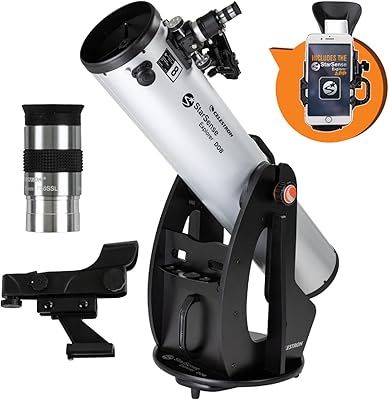
Overview

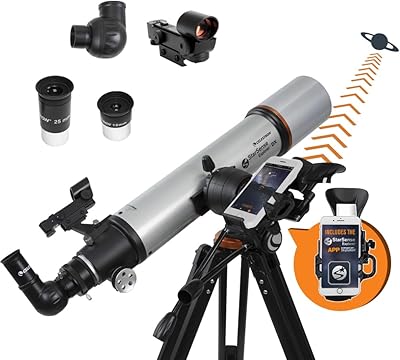
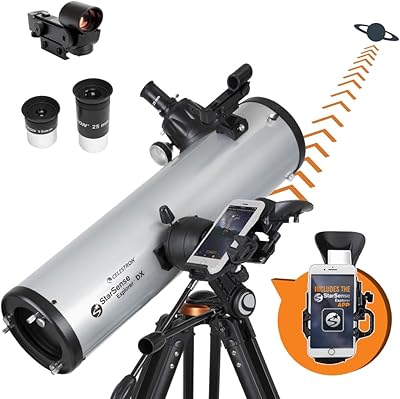
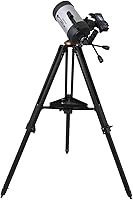
The Celestron StarSense Explorer DX 5″ Telescope sits in an interesting spot — serious enough for real astronomical work, yet approachable enough that a complete beginner can be up and running on their first night out. Unlike a standard refractor, the Schmidt-Cassegrain design folds a long optical path into a compact tube, giving you meaningful aperture without lugging around a five-foot-long scope. Celestron has been building telescopes in California since 1960, and that experience shows in the build quality and optics here. Think of this app-guided scope as the entry point to genuine planetary and lunar observing — not a toy, but not yet a research instrument either.
Features & Benefits

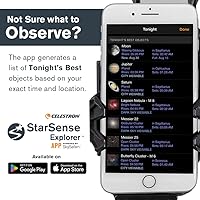
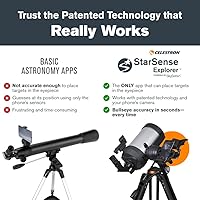
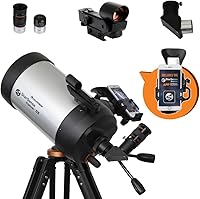
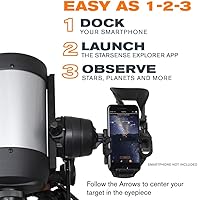
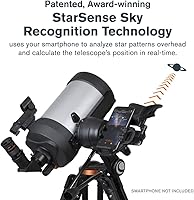
The StarSense sky recognition system is the standout feature — rather than relying on manual star-hopping or a separate finderscope, your phone's camera analyzes the actual star patterns overhead to calculate where the telescope is pointing. That means you just follow on-screen arrows until the bullseye turns green, then look through the eyepiece. The 125mm aperture with StarBright XLT coatings punches well above what many entry-level scopes can manage, and the 1250mm focal length at f/10 pairs nicely with the included 25mm and 10mm eyepieces for views ranging from wide-field to tight planetary detail. The altazimuth mount's dual-axis slow-motion controls let you nudge the scope smoothly once you are on target.

Best For

This Schmidt-Cassegrain telescope is a particularly strong fit for beginners who want guided stargazing without investing weeks into learning the night sky first. Urban and suburban observers will find it capable of solid views of the Moon, Saturn's rings, and Jupiter's cloud bands — though anyone expecting rich deep-sky color from city skies should manage expectations accordingly. It also works well as a step-up from basic refractors for someone who has outgrown a cheap department-store scope and wants real magnification. Gift buyers appreciate that the app removes the usual learning curve, making this app-guided scope genuinely usable right away rather than gathering dust after a frustrating first session.

User Feedback

With over 1,300 reviews averaging 4.1 stars, the StarSense Explorer DX 5″ earns its reputation — but the picture is not entirely rosy. Most owners are quick to praise app accuracy and how quickly they located Saturn or the Orion Nebula on their very first night out, and lunar views get consistent applause. On the other hand, a notable share of buyers wish for motorized tracking; keeping a target centered manually takes genuine patience at higher magnifications. A few users report occasional app connectivity hiccups or dock fit issues with bulkier phone cases. Mount stability also draws some criticism — at full extension, vibrations can linger longer than you would want.

Pros

  • The StarSense app lets complete beginners locate Saturn or the Orion Nebula on their very first night out.
  • Schmidt-Cassegrain optics deliver sharper planetary contrast than most refractors at a comparable price point.
  • The nightly curated target list takes the guesswork out of knowing what is actually visible from your location.
  • Compact tube design makes this app-guided scope easy to transport to darker observing sites.
  • StarBright XLT coatings noticeably improve image brightness and contrast compared to uncoated alternatives.
  • Works with both iPhone and Android — no separate phone adapter or extra accessories required.
  • Celestron backs the scope with a 2-year US warranty and access to knowledgeable, US-based support staff.
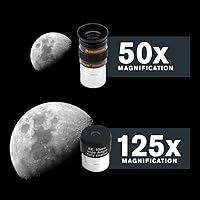
  • Lunar detail at 125x is genuinely impressive and consistently praised by owners across experience levels.
  • The manual altazimuth mount requires no batteries or motors, eliminating one common failure point in the field.

Cons

  • Manual tracking at high magnification is tiring — objects drift out of view every 30 seconds without constant adjustment.
  • The app becomes nearly useless under partial cloud cover or in heavy light pollution, disrupting star-pattern recognition.
  • Mount stability is underwhelming at full extension; vibrations from a light touch can take several seconds to settle.
  • No traditional finderscope is included, so a dead phone battery or app crash leaves you with no fallback navigation.
  • The included eyepieces are functional but optically modest; most users feel the urge to upgrade them within months.
  • There is no carrying case in the box, and sourcing a properly fitting one adds unexpected cost post-purchase.
  • Some Android users report persistent app crashes that Celestron support has been slow to resolve definitively.
  • The smartphone dock shows cosmetic and structural wear faster than the rest of the telescope.
  • International buyers face significantly weaker warranty coverage and support access than US-based owners.

Ratings

Our scores for the Celestron StarSense Explorer DX 5″ Telescope were generated by AI after systematically analyzing thousands of verified global buyer reviews, with spam, incentivized, and bot-flagged submissions actively filtered out before any score was calculated. The ratings reflect the full spectrum of real ownership experiences — from first-light excitement to months-later frustrations — so both genuine strengths and recurring pain points are represented transparently. Buyers who found this scope transformative and those who were let down by specific limitations both shaped what you see here.
Ease of Setup
88%
Most buyers report getting from unboxing to first target in under 30 minutes, which is genuinely impressive for a Schmidt-Cassegrain at this tier. The StarSense app walks you through alignment automatically, removing the single biggest frustration new telescope owners typically face on night one.
A small but consistent group of reviewers struggled with the smartphone dock fitting snugly against certain phone models, especially those with thicker cases. First-time users also occasionally misread the altazimuth mount adjustments before finding their footing.
App Navigation Accuracy
83%
When the sky is clear and the phone camera has a clean view overhead, the StarSense star-recognition system is genuinely impressive — buyers consistently describe landing on Saturn or the Orion Nebula within seconds of following the on-screen arrows. The nightly curated target list adds real value for users who have no idea where to start.
Partial cloud cover or heavy light pollution can confuse the app's star-pattern analysis, leading to off-target results that frustrate beginners who do not yet know how to manually correct. A handful of Android users report more frequent connectivity drops compared to iPhone users.
Optical Performance
79%
21%
The 125mm aperture with StarBright XLT coatings delivers noticeably crisper planetary views than similarly priced refractors — Saturn's rings separate cleanly, and Jupiter's equatorial bands are clearly visible even from suburban backyards. Lunar detail at 125x is a frequent highlight in buyer reviews.
Deep-sky objects like galaxies and faint nebulae require genuinely dark skies to look like anything more than fuzzy smudges at this aperture, and urban buyers are sometimes surprised by this reality. Chromatic fringing is minimal given the design, but edge-of-field sharpness trails off noticeably with the included eyepieces.
Mount Stability
61%
39%
For casual low-magnification observing — sweeping the Moon, checking out star clusters — the altazimuth mount holds steady enough and the dual-axis slow-motion controls give you a satisfying degree of fine adjustment once you are on a target.
At higher magnifications, vibrations from even a light touch take several seconds to settle, which genuinely disrupts the viewing experience. Multiple long-term owners flag that the mount legs feel undersized for the optical tube's weight, and stability worsens noticeably on uneven outdoor terrain.
Manual Tracking Experience
57%
43%
The slow-motion control knobs are well-positioned and give reasonably precise movement once you develop a feel for them. Observers targeting the Moon or bright planets find manual tracking manageable for short sessions without motor assistance.
At 125x magnification, celestial objects drift out of the field of view in roughly 30 seconds without adjustment, which newcomers find exhausting and disorienting. Buyers who researched GoTo motorized telescopes before purchasing often leave disappointed — this is a fundamentally different experience that demands patience and practice.
Build Quality & Materials
74%
26%
The optical tube itself feels solid and the focuser mechanism operates smoothly with no significant wobble. Celestron's overall fit and finish is consistent with their broader product line — this does not feel like a toy-grade instrument.
Some plastic components in the mount assembly feel noticeably less premium than the optical tube they support, and a subset of buyers report minor play developing in mount joints after a season of regular use. The smartphone dock, while functional, shows wear faster than expected.
Image Clarity on Planets
82%
18%
Planetary views are where this app-guided scope earns its strongest marks — Saturn resolves cleanly with Cassini Division visible under steady seeing, and Jupiter shows at least two prominent cloud belts reliably. Mars during opposition also draws consistent praise in buyer accounts.
Atmospheric seeing conditions heavily influence results, something buyers in humid or turbulent climates find frustrating since the scope's theoretical potential rarely fully materializes. Cooling time for the optical tube — around 30 to 45 minutes outside — is also needed before views sharpen appreciably.
Deep-Sky Performance
58%
42%
From a reasonably dark site, this Schmidt-Cassegrain telescope resolves globular clusters into individual stars and shows the Orion Nebula with clear structural detail. Buyers who travel even 20 miles outside city limits report dramatically improved deep-sky views.
Urban and suburban observers are frequently let down by washed-out, featureless blobs where galaxies and faint nebulae should appear. At 125mm aperture, this scope simply cannot compete with wider, faster instruments designed specifically for deep-sky work.
Portability
77%
23%
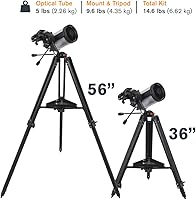
At just under 15 pounds assembled, this app-guided scope is manageable for solo transport to a backyard or a nearby dark site — it fits in a mid-size car trunk without major disassembly. The compact Schmidt-Cassegrain tube is a genuine advantage over longer refractors with equivalent focal lengths.
The tripod and mount assembly adds bulk beyond just the tube weight, and reassembling correctly in the dark is a minor but real inconvenience. Buyers hoping to carry this scope on hiking trails or pack it into checked luggage will find it impractical without a dedicated hard case.
Included Accessories
66%
34%
Two eyepieces covering 50x and 125x is a reasonable starter set that covers both wide-field orientation and tighter planetary work right out of the box. The smartphone dock eliminates the need to purchase a separate phone adapter, which most competing telescopes require.
The included eyepieces are functional but optically modest — most serious observers upgrade to better glass within a few months. There is no carrying case, no Barlow lens, and no Moon filter included, meaning useful accessories start adding to the total cost quickly.
App Dependency & Reliability
63%
37%
For buyers with modern smartphones and reliable mobile data or GPS, the StarSense app is genuinely well-designed and intuitive. Updates have improved compatibility and target accuracy since the original launch, which long-term users acknowledge.
The telescope is significantly less functional without the app — there is no traditional finderscope to fall back on, so phone battery death or a software update breaking compatibility creates a real problem mid-session. A few users on older Android devices report persistent crashes that Celestron support has been slow to resolve.
Value for Money
69%
31%
For buyers who will genuinely use the StarSense navigation system, the premium over a plain Schmidt-Cassegrain of similar aperture feels justified — the app removes a steep learning curve that causes many beginners to abandon cheaper telescopes entirely.
Buyers who are comfortable reading star charts or who expected motorized tracking at this price point often feel the StarSense app premium was not worth it for them personally. Comparable aperture telescopes with GoTo motors exist at similar or slightly higher prices, making the value calculus genuinely competitive.
Warranty & Customer Support
84%
Celestron's 2-year US warranty is above average for this product category, and their US-based support team receives consistent praise for being knowledgeable — not just reading from a script — when buyers call with optical or alignment questions.
International buyers outside the US find the warranty coverage and support access meaningfully weaker. App-related issues occasionally fall into a gray area between hardware and software support, with some buyers reporting a slow resolution process for connectivity problems.
Suitability for Beginners
86%
The combination of app-guided navigation and a curated nightly target list genuinely lowers the barrier to entry — most first-time users successfully locate multiple objects on their opening night, which creates the kind of early success that keeps beginners engaged long-term.
The manual tracking requirement still demands a learning curve that some complete beginners find discouraging once the novelty of the app wears off. Parents buying this as a gift for younger teens should factor in that an adult will likely need to assist during early sessions.
Long-Term Durability
71%
29%
The optical tube and mirror coatings hold up well over multiple years of regular use based on longer-term owner reports, and the focuser mechanism maintains its smooth operation without requiring adjustment. Celestron's core hardware has a strong track record in the amateur community.
Mount and tripod components show the most wear over time, with joint play and slight leg instability becoming more common after 12 to 18 months of outdoor use. The smartphone dock also shows cosmetic and structural wear faster than the rest of the telescope, which is frustrating given how central it is to the product experience.

Suitable for:

The Celestron StarSense Explorer DX 5″ Telescope is purpose-built for people who are genuinely curious about astronomy but have no intention of spending months learning star charts before they can enjoy the night sky. It works especially well for adults or older teenagers who want a capable, real-instrument experience without the steep learning curve that derails so many beginners. Suburban and urban observers will get reliable satisfaction from lunar sessions and bright planetary targets — Saturn's rings and Jupiter's cloud bands are achievable from a city backyard on a clear night. Gift buyers will appreciate that the app removes the usual first-night frustration that causes cheaper scopes to end up in closets, making this a gift that actually gets used. Anyone upgrading from a flimsy department-store refractor will immediately feel the difference in optical quality and build, and the compact Schmidt-Cassegrain tube means transport to a darker site on weekends is realistic without renting a truck.
Not suitable for:

If your heart is set on motorized GoTo tracking — where the telescope automatically slews to targets and keeps them centered — the Celestron StarSense Explorer DX 5″ Telescope will leave you wanting more, because the app only helps you find targets manually. Dedicated deep-sky observers or astrophotographers will also find this scope limiting: the manual altazimuth mount has no equatorial tracking capability, and the 125mm aperture, while solid for visual work, is modest for imaging faint galaxies or nebulae. Buyers who live under heavily light-polluted skies and dream of rich, colorful deep-sky views should calibrate expectations sharply downward — this app-guided scope performs best on bright objects, and urban skies clip its ceiling considerably. Anyone without a compatible modern smartphone is also in a difficult position, since the navigation system is entirely app-dependent and there is no traditional finderscope as a fallback. Finally, experienced amateur astronomers who already know the sky well will find little value in the StarSense premium and would be better served putting that budget toward improved optics or a motorized mount.
Specifications

  • Optical Design: Uses a Schmidt-Cassegrain configuration, which folds a long 1250mm focal path into a compact 330mm tube using a primary mirror and corrector plate.
  • Aperture: The objective lens diameter measures 125mm (4.92 inches), gathering enough light for clear views of planets, the Moon, and bright deep-sky objects.
  • Focal Length: The focal length is 1250mm, providing a focal ratio of f/10 — well suited for high-magnification planetary and lunar observing.
  • Magnification Range: With the two included eyepieces, usable magnification runs from 50x (25mm eyepiece) to 125x (10mm eyepiece), with a theoretical maximum of 295x using optional eyepieces.
  • Limiting Magnitude: Under ideal dark-sky conditions, the optics can resolve stars down to approximately magnitude 13, making faint deep-sky objects accessible from rural sites.
  • Optical Coating: All optical surfaces feature Celestron's StarBright XLT multi-layer coatings, which increase light transmission and improve contrast compared to standard single-layer coatings.
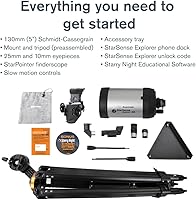
  • Included Eyepieces: The package includes two 1.25-inch barrel eyepieces: a 25mm for wide-field orientation and a 10mm for higher-magnification planetary detail.
  • Mount Type: A manual altazimuth mount with dual-axis slow-motion control knobs allows precise up-down and left-right adjustments once a target is acquired.
  • Navigation System: StarSense technology uses the rear-facing camera of a docked smartphone to analyze overhead star patterns and calculate the telescope's pointing position in real time.
  • App Compatibility: The StarSense Explorer app is available for both iOS and Android, and the integrated smartphone dock accommodates most phone sizes without requiring additional adapters.
  • Assembled Weight: The fully assembled telescope, including the optical tube, mount, and tripod, weighs approximately 14.6 lbs (6.62 kg).
  • Tube Length: The optical tube measures 330mm in length, making it significantly more compact than a refractor or Newtonian reflector with a comparable focal length.
  • Product Dimensions: When fully assembled and ready for use, the telescope occupies a footprint of approximately 34 inches deep by 32 inches wide, standing up to 52 inches tall.
  • Power Source: The telescope itself requires no external power source for operation; a single lithium metal battery is included to support the smartphone dock's orientation sensor.
  • Finderscope: No traditional optical finderscope is included; target acquisition is handled entirely through the StarSense app's on-screen directional arrow interface.
  • Lowest Magnification: The lowest useful magnification is approximately 18x, which corresponds to the widest practical exit pupil for the 125mm aperture under typical observing conditions.
  • Warranty: Celestron provides a 2-year limited warranty covering manufacturing defects, backed by a US-based customer support team available for unlimited technical assistance.
  • Manufacturer: Manufactured by Celestron, a California-based optics company founded in 1960 with a longstanding presence in the consumer and professional telescope market.
  • Model Number: The official Celestron model number for this telescope is 22462, and it was first made available for purchase in March 2021.

Related Reviews

Celestron StarSense Explorer DX 102AZ Refractor Telescope
77%
88%
Ease of Setup
81%
StarSense App Performance
84%
Optical Clarity
61%
Deep-Sky Performance
67%
Mount Stability
More
Celestron StarSense Explorer DX 130AZ
76%
91%
App Navigation & Sky Recognition
83%
Optical Performance
88%
Ease of Setup & Assembly
67%
Mount Stability & Build
58%
Collimation & Optical Alignment
More
Celestron StarSense Explorer LT 80AZ Refractor Telescope
77%
88%
App Navigation Experience
83%
Optical Clarity
91%
Ease of Setup
61%
Build Quality
86%
Value for Money
More
Celestron StarSense Explorer LT 114AZ
74%
88%
App Navigation Experience
83%
Optical Clarity
86%
Ease of Setup
61%
Mount Stability
79%
Value for Money
More
Celestron StarSense Explorer 8″ Dobsonian Telescope
79%
91%
Optical Performance
88%
App Navigation Accuracy
86%
Ease of Use
84%
Build Quality
79%
Value for Money
More
Celestron StarSense Explorer 8″ Dobsonian Telescope
81%
91%
Ease of Use
88%
Optical Performance
86%
StarSense App & Technology
89%
Mount Stability
83%
Value for Money
More
Nikon AF-S DX NIKKOR 55-300mm Zoom Lens
71%
78%
Image Sharpness
67%
Autofocus Performance
84%
Vibration Reduction
54%
Aperture Range
61%
Build Quality
More
Celestron NexStar 90SLT Computerized Telescope
73%
78%
Optical Performance
83%
GoTo Accuracy
81%
Ease of Setup
86%
Portability
67%
Build Quality
More
Celestron PowerSeeker 70EQ Refractor Telescope
71%
78%
Optical Clarity
83%
Mount Quality & Stability
61%
Ease of Assembly
74%
Accessory Bundle Value
86%
Portability
More
Celestron PowerSeeker 60AZ Refractor Telescope
71%
78%
Optical Clarity
62%
Mount & Tracking
54%
Tripod Stability
67%
Eyepiece Quality
83%
Value for Money
More

FAQ

None at all. The Celestron StarSense Explorer DX 5″ Telescope is specifically designed so that complete beginners can find real celestial objects on their very first night out. You dock your phone, open the app, and follow the on-screen arrows — no star charts, no prior knowledge required.
From a typical suburban location, you can expect sharp views of the Moon's craters and mountain ranges, Saturn's rings and Cassini Division, Jupiter's equatorial cloud bands and four Galilean moons, and Mars as a small but clearly disk-shaped object near opposition. Bright star clusters and the Orion Nebula are also achievable. Faint galaxies and dim nebulae will look washed out unless you travel to a genuinely dark site.

The telescope will function optically without a phone, but there is no traditional finderscope included, so locating targets manually requires either knowing the sky well or using a separate star map. For most beginners, the app is effectively essential — it is the core navigation tool this scope was designed around.

Most current iPhone and Android models fit without any issue. However, if your phone is in a particularly thick protective case, you may need to remove it for a secure dock fit. Very large or unusually wide phones can occasionally be a tight fit, so it is worth checking Celestron's compatibility notes for your specific model.

No, this app-guided scope uses a fully manual mount. The StarSense app tells you where to point it, but once you are on a target, keeping it centered requires manually adjusting the slow-motion control knobs as Earth rotates. At 125x magnification, targets drift out of view in about 30 seconds without adjustment, which takes some practice to manage comfortably.

Most buyers report being ready to observe in about 20 to 30 minutes on their first attempt. After a couple of sessions, setup typically drops to 10 to 15 minutes. The trickiest part for newcomers is usually leveling the tripod and ensuring the phone is correctly seated in the dock before launching the app.

Basic smartphone snapshots through the eyepiece — called afocal photography — are possible and produce decent lunar photos. However, this scope is not practical for serious astrophotography. The manual altazimuth mount has no equatorial tracking capability, so long-exposure deep-sky imaging is not feasible.

The app uses your phone's rear camera to photograph the patch of sky directly overhead, then analyzes the star patterns it sees and cross-references them against its built-in star catalog. This gives it a precise fix on the telescope's current position, which it updates continuously as you move the scope. It is more reliable than a simple GPS-and-compass approach because it is reading the actual sky rather than estimating from sensors.

A few upgrades make a noticeable difference: a quality 2x Barlow lens doubles your magnification options cheaply, and a Moon filter reduces glare during bright lunar sessions. A dedicated carrying bag or hard case is worth buying since nothing protective comes in the box. Many owners also upgrade to a better quality 6mm or 8mm eyepiece within a few months for tighter planetary views.

Yes, with one caveat. The app-guided navigation makes it genuinely engaging for teens, and the optical quality is serious enough that it will not feel like a toy after the first few uses. That said, a parent or adult will likely need to assist with initial setup and help troubleshoot the first night or two. Once the setup routine clicks, most teenagers are very capable of operating this scope independently.

Where to Buy