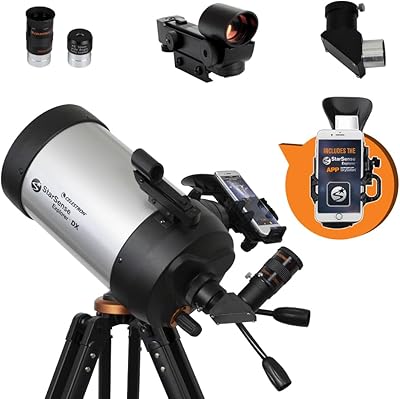
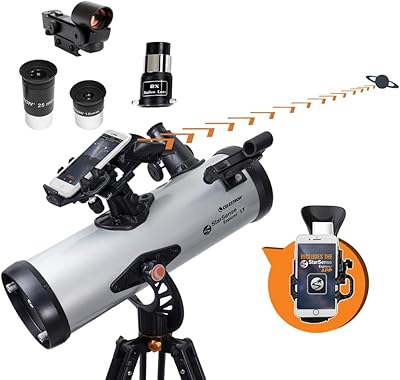
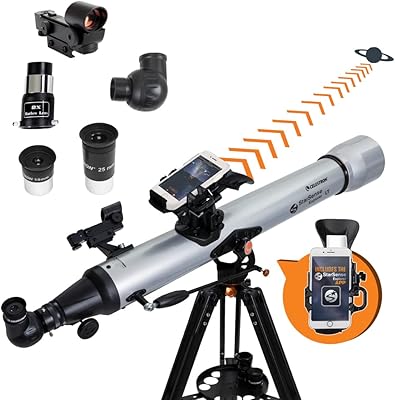
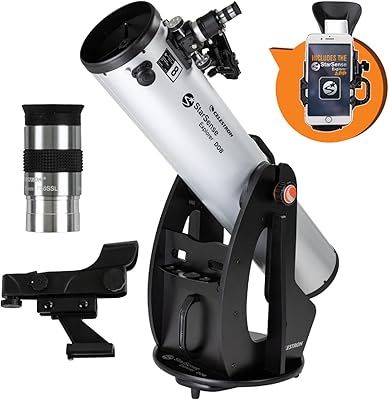
Overview

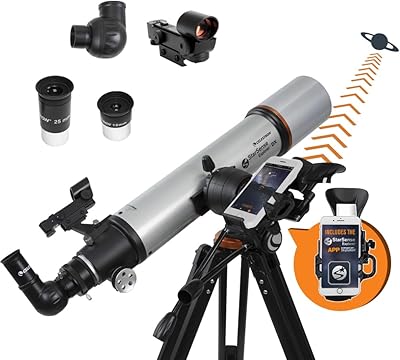
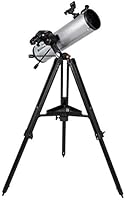
The Celestron StarSense Explorer DX 130AZ is a 130mm Newtonian reflector that takes a genuinely different approach to the age-old problem of beginner frustration: instead of star charts and manual alignment rituals, it hands the navigation work to your smartphone. At this price point, buyers reasonably expect more than a basic department-store scope, and the StarSense app is what separates it from the pack. The 130mm aperture pulls in enough light to reveal the Moon's craters in sharp detail, Jupiter's cloud bands, and Saturn's rings — though the manual altazimuth mount means the app tells you where to point, not where to track. Temper expectations accordingly.
Features & Benefits

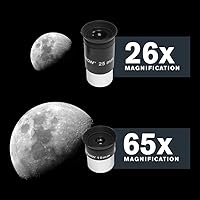
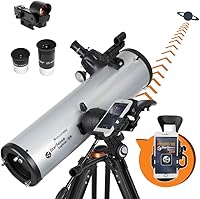
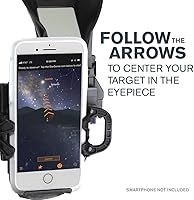
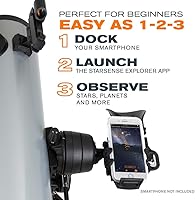
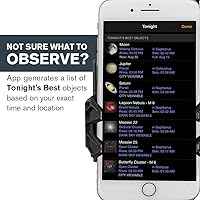
The StarSense DX 130's headline trick is its sky recognition technology — rather than requiring you to manually center alignment stars, the app photographs the sky through the docked phone's camera and cross-references star patterns to calculate exactly where the telescope is pointed. That genuinely works, and works fast. The 130mm reflector with high-reflectivity coatings produces clean, bright views at 26x through the 25mm eyepiece, with the 10mm bumping you to 65x for tighter planetary detail. The dual-axis slow-motion controls feel deliberate and steady, which helps when centering a target at higher power. The app's nightly target list, tailored to your location and time, is a practical bonus for casual sessions.

Best For

This app-enabled reflector makes the most sense for people who want to actually use a telescope, not just own one. Complete beginners — particularly those intimidated by polar alignment and manual star charts — will find the smartphone-guided approach genuinely approachable. It is also a strong gift choice; first-time stargazers tend to stick with it longer than traditional entry-level scopes that demand more upfront learning. Suburban and city-based observers will find the Moon, brighter planets, and some star clusters within reach, though deep-sky results improve noticeably away from light-polluted skies. This is not the right fit for astrophotography or for anyone who already knows their way around the night sky.

User Feedback

Owners of the StarSense DX 130 are largely positive, with the app's ease of use and quick setup time drawing consistent praise. Lunar and planetary views at lower magnifications earn strong marks, which tracks well with the optics' real strengths. The friction tends to show up in two places: collimation after transport is a recurring theme — some first-time owners assume blurry views mean a defective unit, when the mirrors simply need recentering — and the mount shows noticeable vibration at 65x that some find annoying. Celestron's customer support and two-year warranty are mentioned favorably across reviews. Experienced observers occasionally outgrow the manual setup faster than expected, once the app novelty wears off.

Pros

  • The StarSense app eliminates manual star alignment entirely, getting beginners to their first real target in minutes.
  • Saturn's rings and Jupiter's cloud bands are clearly visible through the 130mm reflector — genuinely rewarding for new observers.
  • Assembly takes under 30 minutes with no tools, and most buyers are outside observing on their first evening.
  • The app generates a personalized nightly target list based on your exact location and time, removing decision paralysis.
  • Lunar views through this beginner telescope are sharp and detailed enough to impress even skeptical adults.
  • Celestron's two-year warranty and US-based support team have a strong track record of responsive, knowledgeable service.
  • Dual-axis slow-motion controls make centering low-magnification targets smooth and satisfying.
  • The smartphone dock works stably across a wide range of iPhone and Android devices.
  • At 18 lb assembled, it moves from storage to backyard without requiring a second person or a cart.

Cons

  • Mirror collimation shifts during transport are common, and blurry views often confuse first-time owners who do not know the cause.
  • Noticeable vibration at 65x makes precise high-magnification viewing more frustrating than it should be at this price.
  • The manual mount has no tracking capability, so objects drift out of view within seconds at higher magnifications.
  • Only two eyepieces are included, leaving an awkward gap between 26x and 65x that requires an additional purchase to fill.
  • Deep-sky performance under suburban or city skies is genuinely limited — faint galaxies and dim nebulae disappoint most beginners.
  • The app requires a charged smartphone and GPS lock, adding a dependency that occasionally interrupts sessions.
  • Serious hobbyists tend to outgrow the manual altazimuth mount within a year, making it a potential stepping-stone cost.
  • Larger phones with thick protective cases can struggle to fit the dock securely without removing the case first.
  • No carrying case is included, making safe transport to dark-sky sites an extra expense and logistical challenge.

Ratings

The Celestron StarSense Explorer DX 130AZ was evaluated by our AI system after analyzing thousands of verified global buyer reviews, with spam, bot-generated, and incentivized submissions actively filtered out before scoring. The ratings below reflect an honest cross-section of real user experiences — from first-night successes to recurring frustrations — so prospective buyers get a transparent picture of both where this beginner telescope excels and where it falls short.
App Navigation & Sky Recognition
91%
The StarSense app's ability to orient itself using photographed star patterns — without any manual alignment stars — is consistently described as the single biggest reason buyers recommend this scope to others. Most users have it operational within minutes of stepping outside, even with zero astronomy background.
A handful of users in heavily light-polluted areas or during partly cloudy nights report the app struggling to lock onto enough stars for a confident fix. The system also depends on keeping your phone charged, which adds a variable some users find mildly inconvenient during longer sessions.
Optical Performance
83%
The 130mm aperture with high-reflectivity coatings delivers genuinely rewarding views of the Moon and brighter planets. Saturn's rings are clearly resolved even at 65x, and Jupiter's equatorial bands are visible with patience — which is more than most first-time buyers expect at this price tier.
Deep-sky performance is limited under suburban or city skies; objects like the Andromeda Galaxy appear as faint smudges rather than the dramatic images beginners picture. The 10mm eyepiece at 65x also exposes any collimation issues quickly, which can frustrate users who don't yet know how to recenter the mirrors.
Ease of Setup & Assembly
88%
Assembly typically takes under 30 minutes and requires no tools beyond what is included. The instructions are clear enough that most buyers — including those who describe themselves as not mechanically inclined — get the scope assembled and outside before the same evening's dark sky window closes.
The smartphone dock positioning requires some trial and error to get right the first time, and a few users note that the dock fit varies depending on phone case thickness. Nothing deal-breaking, but it can add 10 to 15 minutes to the first setup for people who like to get things exactly right.
Mount Stability & Build
67%
33%
The altazimuth mount's dual-axis slow-motion controls feel deliberate and give users enough fine adjustment to center targets without overshooting. For low-magnification planetary and lunar viewing, the mount is steady and functional — exactly what casual observers need.
At 65x magnification, vibration from minor bumps or even wind becomes noticeable, and centering a target precisely takes more patience than buyers at this price point expect. Several users mention the mount feeling plasticky under load, and a few found it inadequate once they started pushing toward higher magnification with aftermarket eyepieces.
Collimation & Optical Alignment
58%
42%
When properly collimated, the optics perform well above what the price suggests. Buyers who take the time to learn the collimation process — typically a 5-minute job with the included center-marked mirror — report consistently sharp views session after session.
This is the StarSense DX 130's most common frustration point. Mirrors shift during transport or initial assembly more often than owners expect, and many first-time buyers interpret blurry views as a defective unit rather than a collimation issue. The included instructions on collimation are minimal, leaving beginners to troubleshoot via online videos.
Value for Money
76%
24%
Compared to similarly priced telescopes without the guided navigation feature, this app-enabled reflector offers a meaningful upgrade in the actual likelihood that a beginner will use it regularly. The combination of solid optics, the StarSense system, and a two-year warranty makes the investment easier to justify.
Buyers who eventually want to progress beyond casual planetary viewing will find the manual mount a limiting factor, potentially requiring an additional investment in a motorized setup. For those who already have some astronomy experience, the premium tied to the app may not feel proportionate to the optical specs alone.
Smartphone Compatibility & Dock Design
79%
21%
The dock accommodates a wide range of iPhone and Android models, and the app runs smoothly on most devices made in the last four years. Users with mid-size phones report a snug, stable fit that holds securely even when repositioning the tube.
Larger phones with thick protective cases can be a tight fit, and a couple of reviewers note the dock arm feeling less rigid than expected over repeated use. The app also requires location permissions and a stable GPS fix, which occasionally causes delays when starting up in unfamiliar locations.
Target Discovery & App Curated List
84%
The nightly target list tailored by location and time is a practical feature that removes decision paralysis for casual users. On a clear suburban night, having a short, achievable list of objects within reach keeps observing sessions focused and rewarding, particularly for younger users.
The curated list skews toward brighter, easier targets, which is appropriate for beginners but can feel repetitive after a few months of regular use. Power users looking for more obscure deep-sky objects will quickly outpace what the app recommends without supplementing with separate star atlases.
Included Eyepieces & Magnification Range
72%
28%
The bundled 25mm and 10mm eyepieces cover the two most useful magnification steps for a beginner — wide-field orientation at 26x and closer inspection at 65x. Most users find the 25mm in particular delivers crisp, satisfying lunar views right out of the box.
Both eyepieces are basic 1.25-inch designs that experienced observers would replace quickly. The jump from 26x to 65x leaves a noticeable gap, and there is no mid-range eyepiece included to bridge the two, which means buyers who want smoother zooming progression need to budget for at least one additional eyepiece.
Portability & Weight
63%
37%
At 18 lb assembled, the StarSense DX 130 is manageable enough to carry from a garage to a backyard without a trolley. The tube and mount break down into a few components, making it storable in a standard closet without dedicated equipment storage.
It is not a grab-and-go scope for most people. Transporting it to a dark-sky site in a car requires careful padding to protect the mirrors from shifting — which then loops back into the collimation issue. Buyers living in apartments or without a car reported finding the size and weight a genuine barrier to regular use.
Customer Support & Warranty
86%
Celestron's US-based support team is consistently praised across reviews for being knowledgeable and patient with first-time telescope owners. The two-year warranty provides real peace of mind, and several buyers specifically mention having issues resolved quickly without the usual runaround.
Support response times during peak gift-giving seasons — particularly around the winter holidays — are slower, and a few users mention waiting several days for an email reply. Physical warranty claims involving shipping a large optical tube are cumbersome by nature, which some reviewers found off-putting.
Lunar & Planetary Viewing
87%
The Moon through the 130mm reflector is a genuinely impressive sight for newcomers — crater walls, mountain ridges, and shadow gradients are all clearly visible and regularly cited as the highlight of early observing sessions. Saturn and Jupiter also deliver reliable, recognizable detail that keeps beginners coming back.
Views of Mars and more distant planets like Uranus and Neptune are underwhelming at the included magnification range — tiny discs with minimal surface detail. Managing expectations around planetary viewing beyond the inner solar system is something the product marketing does not always communicate clearly.
Beginner Learning Curve
81%
19%
The app-guided workflow genuinely reduces the steepest part of the beginner learning curve — locating objects — to a matter of following onscreen arrows. Most users report their first successful night of planned viewing within one or two sessions, which builds confidence quickly.
The telescope still requires understanding of concepts like eyepiece magnification, dark adaptation, and collimation that the app does not teach. Buyers who expect a fully automated experience sometimes feel let down when they realize manual skill and patience are still required for satisfying results.
Long-Term Usability for Growing Hobbyists
54%
46%
The optical tube itself has real merit as a platform — the 130mm aperture and f/5 focal ratio are optically versatile, and swapping in better eyepieces extends its useful range for observers willing to invest incrementally.
The manual altazimuth mount is the ceiling that serious hobbyists hit relatively quickly. Without motorized tracking, even casual astrophotography is essentially off the table, and observers who progress past casual planetary sessions tend to want an equatorial or computerized alt-az mount within a year of purchase.

Suitable for:

The Celestron StarSense Explorer DX 130AZ is genuinely well-matched for anyone who has always been curious about stargazing but felt put off by the traditional learning curve — star charts, polar alignment, manual star-hopping — that keeps many beginners from ever getting past the first frustrating night. Teenagers and young adults who are already comfortable navigating their world through a smartphone will find the app-guided experience immediately intuitive, and parents buying this as a gift can feel reasonably confident it will not end up gathering dust after the first week. Suburban and city-based observers will get real value from this app-enabled reflector: the Moon, Saturn, Jupiter, and a handful of bright star clusters are all within reach on a clear night, even under moderately light-polluted skies. It also suits casual hobbyists who want a rewarding backyard activity a few times a month without committing to a steep technical education — if that sounds like you, the StarSense DX 130 is likely a smart match.
Not suitable for:

The Celestron StarSense Explorer DX 130AZ is not the right tool for anyone expecting a fully automated or hands-off experience — the app points you to targets, but you still manually move and hold the telescope, and there is no motorized tracking to keep an object in view once you find it. Aspiring astrophotographers should look elsewhere entirely; without a motorized equatorial mount, capturing anything beyond basic lunar shots is not realistic with this setup. Buyers who already own a telescope or have even a few months of stargazing experience will likely find the app's novelty wears off quickly, and the manual mount will feel limiting before long. If your primary interest is deep-sky objects — galaxies, faint nebulae, dense star fields — expect noticeably underwhelming results under anything other than genuinely dark skies, which is not what most buyers have in their backyard. Anyone planning to transport this scope to observing sites regularly should also know that the mirrors can shift in transit, requiring collimation before each outing — a straightforward skill, but one that demands patience and a short learning investment.
Specifications

  • Optical Design: Newtonian Reflector with parabolic primary mirror and high-reflectivity coatings for improved light throughput.
  • Aperture: 130mm (5.12″) objective lens diameter, providing sufficient light-gathering for clear lunar, planetary, and bright deep-sky views.
  • Focal Length: 650mm focal length yields a manageable, versatile field of view suitable for both wide-field and closer planetary observation.
  • Focal Ratio: f/5 focal ratio makes this a relatively fast optical system, well-suited for low-to-mid magnification viewing.
  • Included Eyepieces: Two 1.25″ eyepieces are included: a 25mm for 26x wide-field views and a 10mm for 65x closer inspection.
  • Magnification Range: With the included eyepieces, usable magnification runs from 26x to 65x; the theoretical maximum for this aperture is 307x.
  • Mount Type: Manual altazimuth mount with dual-axis slow-motion control knobs for precise horizontal and vertical target adjustments.
  • Navigation System: StarSense Explorer app uses the docked smartphone camera to analyze overhead star patterns and calculate the telescope's pointing position in real time.
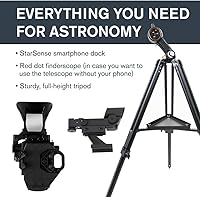
  • Smartphone Dock: Integrated dock is compatible with a wide range of iPhone and Android devices; fits phones within standard size ranges, with or without slim cases.
  • Finderscope: StarPointer red dot finderscope is included for coarse initial target acquisition before using the app for precision guidance.
  • Assembled Weight: The fully assembled telescope weighs 18 lb (8.16 kg), making it manageable for solo backyard transport but not ideal for frequent travel.
  • Dimensions: Assembled product dimensions measure 30″ deep by 32″ wide by 50″ tall, requiring adequate storage space when not in use.
  • Optical Tube Length: The optical tube measures 635mm in length, which determines the physical footprint of the scope on the mount.
  • Power Source: The telescope itself requires no external power; a battery (lithium metal, included) is required for the StarPointer finderscope, and the app runs on the user's phone battery.
  • Warranty: Covered by a 2-year US warranty backed by Celestron's US-based customer support team, with unlimited technical assistance included.
  • Limiting Magnitude: The 130mm aperture delivers a theoretical limiting magnitude of 13.1, meaning faint objects at or below that brightness threshold are not resolvable.
  • App Compatibility: The StarSense Explorer app is compatible with both iOS (iPhone) and Android smartphones and is available as a free download.
  • Lowest Magnification: The lowest useful magnification for this aperture is approximately 19x, ensuring a wide, usable exit pupil for comfortable viewing.

Related Reviews

Celestron StarSense Explorer DX 102AZ Telescope
80%
91%
Value for Money
88%
Ease of Use
85%
Image Quality
80%
App Experience
83%
Mount Stability
More
Celestron StarSense Explorer DX 5-inch Telescope
83%
93%
Ease of Setup
89%
App Experience
60%
Manual Tracking Precision
88%
Optical Quality
70%
Portability
More
Celestron StarSense Explorer LT 114AZ
74%
88%
App Navigation Experience
83%
Optical Clarity
86%
Ease of Setup
61%
Mount Stability
79%
Value for Money
More
Celestron StarSense Explorer LT 80AZ Telescope
84%
92%
Ease of Use
89%
App Integration
87%
Value for Money
68%
Tracking Stability
90%
Setup Process
More
Celestron StarSense Explorer 8-inch Dobsonian Telescope
85%
89%
Ease of Use
81%
Setup & Assembly
90%
StarSense App Experience
88%
Optical Performance
83%
Tracking & Adjustment
More
Celestron StarSense Explorer 12-inch Smartphone App-Enabled Dobsonian Telescope
83%
88%
Ease of Use
92%
Viewing Quality
86%
App Functionality
89%
Stability and Tracking
71%
Portability
More
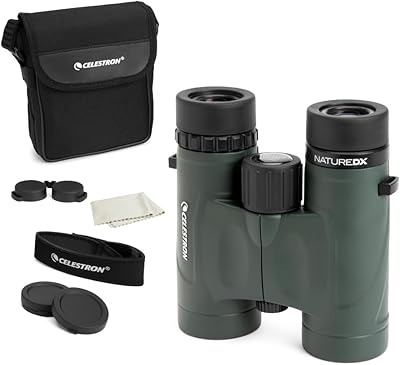
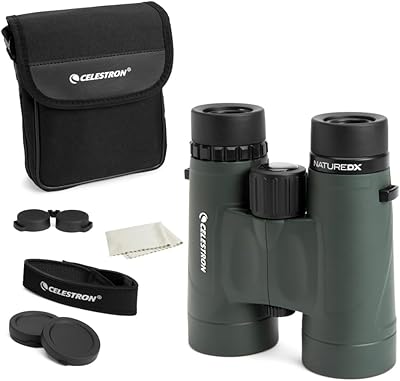
Celestron Nature DX 10x42 Binoculars
82%
86%
Optical Clarity
83%
Build Quality
89%
Weather Resistance
91%
Value for Money
88%
Ease of Focus
More
Celestron Nature DX 8x32 Binoculars
80%
83%
Optical Clarity
81%
Build Quality
86%
Weather Resistance
88%
Field of View
67%
Low-Light Performance
More
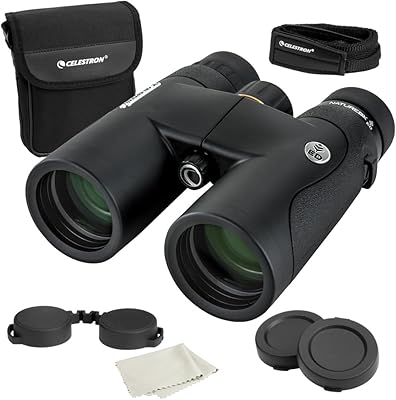
Celestron Nature DX ED 8x42 Binoculars
84%
88%
Optical Clarity
91%
Color Accuracy
83%
Low-Light Performance
86%
Build Quality
87%
Eye Relief & Comfort
More
Celestron SkyMaster 12x60
87%
95%
Optical Clarity
92%
Low-Light Performance
90%
Magnification Accuracy
88%
Build Quality
87%
Durability
More

FAQ

None at all. The Celestron StarSense Explorer DX 130AZ is specifically designed so that a complete beginner can set it up, launch the app, and be looking at real celestial objects within the same evening. The app handles the navigation by analyzing star patterns through your phone camera, so there is no need to learn star charts or manual alignment techniques before your first session.
The app guides you to objects but does not track them once found. This is a manual mount, so after you center a target and the bullseye turns green, you will need to manually nudge the scope with the slow-motion controls to keep the object in view as Earth rotates. At lower magnifications this is easy; at 65x it requires more frequent small adjustments.

Blurry views in a Newtonian reflector are most commonly caused by collimation — the alignment of the mirrors — being off. This happens easily during shipping or transport when the mirrors shift slightly inside the tube. It is not a defective unit; it is a normal part of reflector ownership. Look up a short collimation guide for Newtonian reflectors online, and you should be able to correct it in about five minutes using the adjustment screws on the secondary mirror holder.

The Moon is genuinely impressive — crater walls, mountain ridges, and shadow detail are all visible with clarity. Jupiter's main cloud bands and the four Galilean moons are clearly resolved, and Saturn's rings are unmistakable even at 65x. Bright star clusters and a few of the more prominent nebulae like the Orion Nebula are within reach. Faint galaxies and dim deep-sky objects will be much harder to detect under light-polluted suburban skies — expect softer, less dramatic results for those targets.

The dock is designed to fit a broad range of iPhone and Android smartphones within standard size ranges. Slim cases typically work fine, but thick or rugged cases may need to be removed for a secure fit. It is worth doing a quick test fit before your first night session so you are not fumbling with the dock in the dark.

Yes, the app is free to download on both iOS and Android, and there is no subscription required. It does need location permission and GPS access on your phone to generate the nightly target list and calibrate the sky recognition system correctly.

Not in any serious way. Without motorized tracking, even basic deep-sky astrophotography is not feasible — the Earth's rotation moves objects out of frame too quickly for meaningful exposures. You can take casual photos of the Moon by holding your phone up to the eyepiece, which works reasonably well, but anyone interested in real astrophotography will need a telescope with a motorized equatorial mount.

Most buyers report getting fully assembled and outside in 20 to 30 minutes, and no additional tools are required beyond what is included in the box. The main steps involve attaching the optical tube to the mount, setting up the tripod, and doing a quick alignment of the red dot finderscope. It is straightforward enough that you can realistically do it solo on the same evening the package arrives.

It depends largely on how often you move it. If the StarSense DX 130 stays in one place and is handled carefully, the mirrors may hold alignment for weeks. If you regularly transport it in a car or carry it up and down stairs, a quick collimation check before each session is a smart habit. The process itself only takes a few minutes once you are familiar with it.

It works well for kids around 10 to 12 and older, especially those who are comfortable using smartphones and have some patience for setup. The app-guided experience keeps the frustration level low, which is often the biggest barrier to kids actually engaging with a telescope. Younger children will likely need an adult alongside them for setup and to help manage the slow-motion controls, but the observing experience itself is intuitive enough to hold a curious kid's attention.