Overview

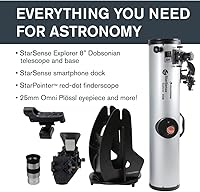
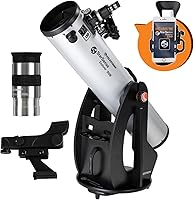
The Celestron StarSense Explorer 8″ Dobsonian Telescope is aimed squarely at beginners who've been put off by the traditional learning curve of finding things in the night sky. The standout spec here is the 203mm aperture — at this price tier, that's more light-gathering capability than most entry-level scopes can offer, and it makes a real difference when you're trying to spot faint nebulae or the rings of Saturn. Celestron has been building telescopes since 1960, and the 2-year US warranty with domestic support adds genuine confidence. One thing to be clear about upfront: this is a manual scope. The app guides you to targets; you physically move the tube. And at 43 pounds total, this Dobsonian is not something you'll casually haul out solo without a bit of planning.

Features & Benefits

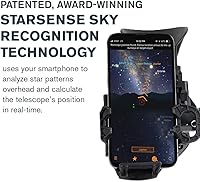
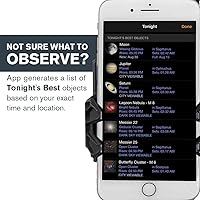
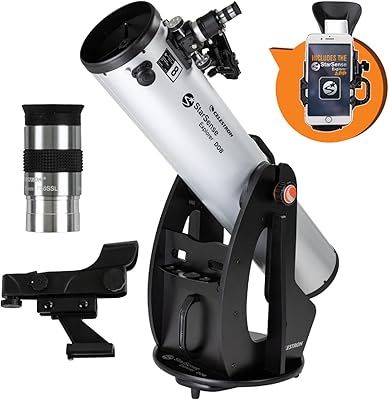
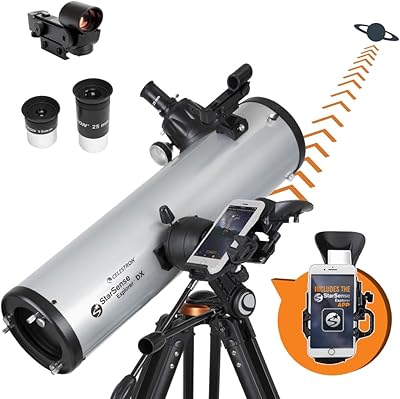
What sets the StarSense Explorer 8″ apart isn't just the optics — it's how the app actually works. Rather than relying solely on GPS, it uses star-pattern recognition to analyze what's overhead and pinpoint the tube's exact orientation in real time. That translates into a nightly curated list of the best visible objects for your specific location and sky conditions, which dramatically flattens the learning curve. Optically, the XLT-coated 203mm Newtonian reflector gathers 841 times more light than the naked eye — enough to reveal structure in galaxies and nebulae. The Dobsonian base is rock-solid and battery-free, with no alignment rituals or motors to troubleshoot. The included 25mm Plössl eyepiece at 48x is a solid starting point, and the standard 1.25-inch barrel makes upgrades easy.

Best For

This app-guided telescope hits its sweet spot with absolute beginners — people who want to skip months of learning right ascension and declination and just see Jupiter's moons on a Tuesday night. It's also a strong pick for parents gifting a scope to a curious teenager, or families who want something optically capable rather than toy-grade. City and suburban observers will appreciate that the app's curated list skews toward brighter targets that cut through light pollution. If you want serious aperture without GoTo complexity, this Dobsonian delivers well. That said, astrophotographers should look elsewhere — there's no motorized tracking, so long-exposure imaging simply isn't possible. Solo users should also factor in the bulk before buying; moving it between locations takes real effort.

User Feedback

Across roughly 150 reviews, the StarSense Explorer 8″ holds a 4.4-star rating, and the patterns are consistent. Beginners and gift recipients are the most enthusiastic — many report finding planets and star clusters on their first night out, which is a meaningful result for a scope at this level. Recurring criticisms are worth noting: the app occasionally needs re-calibration after moving the scope between locations, which can be mildly annoying in cold weather. The 43-pound total weight is flagged repeatedly by solo users as a genuine logistical consideration. And while the included eyepiece is functional, a number of owners recommend budgeting for a second one to add magnification range — solid advice for anyone planning regular sessions.

Pros

  • The StarSense app's star-pattern recognition gets beginners on target within minutes — no star charts or prior knowledge needed.
  • A 203mm aperture at this price tier delivers genuinely impressive views of planets, nebulae, and star clusters.
  • XLT-coated optics produce sharp, high-contrast images that outperform most competing entry-level reflectors.
  • The Dobsonian rocker base is rock-solid, battery-free, and requires zero electronic setup or polar alignment.
  • The nightly curated object list adapts to your exact location, making sessions productive even from light-polluted suburbs.
  • Standard 1.25-inch focuser barrel accepts a wide range of aftermarket eyepieces for easy future upgrades.
  • Celestron's 2-year US warranty and domestic support team add meaningful peace of mind for a purchase at this level.
  • No dedicated power source required — the scope itself runs entirely without batteries or cables.
  • Saturn's rings and Jupiter's cloud bands are clearly visible and consistently cited as first-night highlights by new owners.

Cons

  • Manual tracking means targets drift out of view at higher magnifications — constant nudging is required throughout a session.
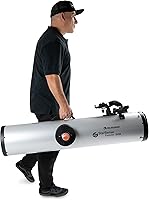
  • At 43-plus pounds total, this is not a scope you carry solo to a rooftop or up a flight of stairs with ease.
  • The app occasionally requires recalibration after repositioning the scope, which is frustrating on cold or rushed nights.
  • Only a single 25mm eyepiece is included — you'll want at least one more to get real versatility out of the optics.
  • A collimation tool is not included, yet periodic collimation is unavoidable with any Newtonian reflector over time.
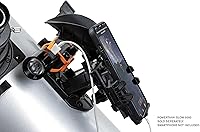
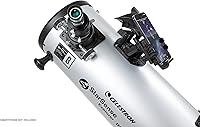
  • The smartphone dock feels noticeably less refined than the rest of the scope and fits some phone cases poorly.
  • Urban observers will hit the practical ceiling of what light pollution allows fairly quickly, even with good optics.
  • App battery drain during long sessions is a recurring complaint, especially in cold weather where phone batteries already underperform.
  • No carrying case or dedicated storage solution is included, making safe transport to dark-sky sites the owner's problem to solve.

Ratings

The Celestron StarSense Explorer 8″ Dobsonian Telescope was evaluated by our AI system after analyzing verified buyer reviews from global sources, with spam, bot-generated, and incentivized submissions actively filtered out. Scores reflect the real consensus — strengths and frustrations weighted equally — so you get an honest picture of what owners actually experience night after night.

Ease of Use
91%
The StarSense app is the single biggest reason beginners succeed on their very first night out. Users consistently report pointing the scope at the sky, letting the app read star patterns overhead, and landing on Jupiter within minutes — no star charts, no polar alignment, no prior experience required.
The app occasionally loses its calibration after the scope is moved between locations, requiring a fresh alignment outdoors. On cold or windy nights, this extra step frustrates users who just want to start observing immediately.
Optical Performance
88%
The 203mm XLT-coated Newtonian reflector punches well above its class at this price point. Saturn's rings, Jupiter's cloud bands, and the Orion Nebula all resolve with satisfying clarity and contrast — views that genuinely impress first-timers who had low expectations coming in.
At f/5.9, the focal ratio is fast enough that stars toward the field edge can show slight coma without a quality eyepiece. The included 25mm Plössl is adequate but doesn't fully exploit the mirror's potential, nudging experienced users toward an upgrade relatively quickly.
StarSense App & Technology
86%
Unlike basic augmented-reality apps that rely purely on GPS and compass data, StarSense uses actual sky-pattern recognition to fix the scope's orientation in real time. The curated nightly object list based on your precise location is genuinely useful and cuts the usual guesswork out of planning a session.
A small but consistent share of reviewers report the app struggling under partly cloudy skies or near strong ambient light sources, since it needs to read actual stars. Android users have occasionally reported slightly more stability issues than iPhone users across firmware updates.
Mount Stability
89%
The Dobsonian rocker-box base is one of the most inherently stable mount designs available at any price. Users appreciate that nudging the tube to a target doesn't introduce vibration, and there are no wobbly tripod legs to contend with — the scope stays where you put it.
Because it's a manual altazimuth mount with no tracking motor, a target drifts out of the field of view at higher magnifications after just a minute or two. Users who expected automated tracking — even slow, non-GoTo tracking — are often caught off guard by this limitation.
Value for Money
83%
For a scope that combines an 8-inch aperture, quality XLT coatings, and a genuinely functional app-navigation system, the price represents reasonable value compared to purchasing a similar-aperture scope plus a quality GoTo mount separately. Gift buyers in particular feel the investment is justified by the low frustration threshold.
Buyers who discover they also need a second eyepiece, a collimation tool, and potentially a dew shield will find the real total cost notably higher than the sticker price. Those seeking motorized tracking will need to look at significantly more expensive options, making the value equation less clear for intermediate users.
Setup & Assembly
84%
Assembly is straightforward — the optical tube seats into the rocker base without tools, and first-time owners generally report being fully set up and outside within 20 minutes of unboxing. The lack of electronic components to configure is a genuine advantage here.
The scope's two-piece nature (tube plus base) means carrying two separate, heavy components outside for each session. For users without ground-floor access or a dedicated storage space close to the door, the setup routine gets old faster than expected.
Portability & Weight
58%
42%
The tube and base do separate for transport, which makes fitting it into an SUV or hatchback manageable. Users who drive to dark-sky sites specifically report it as a workable option provided they have help loading and unloading.
At 43-plus pounds combined, this is not a scope most people carry solo without strain. Apartment dwellers who need to store it indoors and haul it to a balcony or rooftop regularly find the weight genuinely inconvenient, and several reviewers admit it ends up used less often than intended because of this friction.
Build Quality & Durability
81%
19%
The optical tube feels solid and the focuser operates smoothly without noticeable wobble. Celestron's manufacturing quality at this tier is well-regarded, and the rocker base holds its shape over time without developing the creaks or play that cheaper wooden Dobsonians sometimes develop.
The smartphone dock is functional but feels like the least refined component of the package — a couple of users report it fitting certain phone cases less securely than expected. The included dust caps and accessories are serviceable rather than premium.
Included Eyepiece Quality
67%
33%
The 25mm Plössl at 48x is a reasonable starter eyepiece that delivers acceptable views of bright planets and the Moon. For someone using a telescope for the first time, it provides a clear enough image to generate genuine excitement about what they're seeing.
The single included eyepiece severely limits the scope's versatility out of the box — 48x is fine for wide fields but inadequate for splitting double stars or examining planetary detail. Most owners end up budgeting for at least one more eyepiece fairly soon after purchase.
App Reliability & Stability
74%
26%
For most users most of the time, the StarSense app works as advertised and makes the experience genuinely accessible. Regular updates have addressed earlier bugs, and the curated object list improves the session experience beyond just pointing assistance.
Recalibration requirements after repositioning the scope are a recurring friction point. A subset of users also note the app drains phone battery faster than expected during long sessions, and operating in cold weather — where battery life already suffers — compounds this issue.
Optics Collimation
71%
29%
A well-collimated 8-inch Newtonian at this focal ratio delivers impressively sharp views, and many users report the scope arriving in good collimation out of the box, requiring no immediate adjustment.
Newtonian reflectors require periodic collimation, and this scope is no exception. Beginners who aren't aware of this can unknowingly view through a slightly miscollimated instrument for weeks. A collimation tool isn't included, which is an oversight given the beginner-focused positioning.
Deep-Sky Performance
77%
23%
From reasonably dark suburban skies, the 203mm aperture resolves enough detail in bright nebulae, open clusters, and nearby galaxies to be genuinely rewarding. The Orion Nebula, Andromeda Galaxy, and Hercules Cluster all show real structure rather than just smudges.
Urban observers will find the app's curated list sensibly avoids faint targets that the light pollution simply overwhelms, which is practical but also limiting. Deep-sky performance scales heavily with sky darkness, and users in dense city cores will hit the scope's practical ceiling fairly quickly.
Warranty & Customer Support
87%
Celestron's 2-year US warranty and US-based support team are consistently mentioned as confidence-builders, particularly for buyers spending a meaningful amount on their first scope. The brand's 60-plus years of history reassures buyers that replacement parts and expertise are genuinely accessible.
A handful of reviewers note that support response times can be slower during peak seasons like post-holiday periods. The warranty also doesn't cover user-induced collimation issues or cosmetic damage, which can surprise owners expecting broader coverage.
Lunar & Planetary Viewing
92%
This is where the StarSense Explorer 8″ genuinely shines. Saturn's rings are resolved crisply even from suburban backyards, Jupiter's equatorial bands are clearly visible, and the lunar surface detail at moderate magnification is striking enough to hold the attention of even skeptical first-timers.
Without a motor drive, keeping a planet centered at higher magnifications requires constant manual nudges, which can feel disruptive during moments of good atmospheric seeing. A Barlow lens for higher magnification isn't included, so squeezing the best planetary views out of the scope requires an additional purchase.

Suitable for:

The Celestron StarSense Explorer 8″ Dobsonian Telescope was built for people who are genuinely curious about the night sky but have no intention of spending months learning to navigate it manually. If you're a first-time buyer who wants to see Saturn's rings or Jupiter's moons on your very first night outside — not after weeks of practice — this scope removes almost every barrier standing between you and that experience. It's also an excellent pick for parents gifting a serious but accessible telescope to a teenager, or for families who want backyard stargazing to actually work rather than end in frustration. Suburban and urban observers will find the app's curated nightly lists particularly valuable, since it steers you toward bright targets that cut through light pollution rather than wasting your time on objects that are simply invisible from your skies. Buyers who want real 8-inch aperture performance without paying for a motorized GoTo system will also find this Dobsonian hits a sensible balance between optical capability and mechanical simplicity.

Not suitable for:

The Celestron StarSense Explorer 8″ Dobsonian Telescope is a poor match for anyone expecting a motorized or automated tracking experience — the app guides you to a target, but keeping it centered as Earth rotates requires you to nudge the tube manually, which becomes genuinely disruptive at higher magnifications. Astrophotographers should look elsewhere entirely; without a motor drive, long-exposure imaging is not possible with this setup. Solo users living in apartments above the ground floor should think carefully before buying: at over 43 pounds split between two separate pieces, hauling this scope up stairs and out to an observing spot regularly will wear on your enthusiasm quickly. Advanced amateur astronomers who already know their way around the sky and want equatorial tracking, fine slow-motion controls, or digital setting circles will find this Dobsonian underpowered for their needs. And if your budget is already stretched to its limit here, factor in that you'll almost certainly want additional eyepieces and a collimation tool before long — the out-of-box accessory kit doesn't cover everything a regular observer needs.

Specifications

  • Optical Design: Newtonian reflector with a parabolic primary mirror and XLT high-reflectivity coatings for improved light transmission.
  • Aperture: 203mm (8″) primary mirror diameter, gathering 841 times more light than the unaided human eye.
  • Focal Length: 1200mm focal length with a focal ratio of f/5.9, suited for both wide-field and moderate magnification viewing.
  • Included Eyepiece: One 25mm Plössl eyepiece delivering 48x magnification, with a standard 1.25-inch barrel compatible with aftermarket upgrades.
  • Focuser: Standard rack-and-pinion focuser with a 1.25-inch barrel accepting all common eyepiece and accessory sizes.
  • Mount Type: Manual altazimuth Dobsonian rocker-box base requiring no batteries, motors, or electronic alignment procedures.
  • Optical Tube Size: Optical tube measures 44″ in length by 9.5″ in diameter (1117.6mm x 241.3mm).
  • Base Dimensions: Rocker base measures 27″ x 19″ x 19″ (650mm x 482.6mm x 482.6mm) when assembled for use.
  • Total Weight: Combined system weight is 43.4 lbs — optical tube at 20.6 lbs (9.34 kg) and base at 22.8 lbs (10.34 kg).
  • Finderscope: StarPointer red-dot finderscope included as a manual backup aiming tool independent of the smartphone app.
  • App Compatibility: StarSense Explorer app is compatible with both iPhone and Android smartphones via a dedicated adjustable dock on the optical tube.
  • Navigation Tech: StarSense technology uses real-time sky-pattern recognition — not GPS or compass alone — to determine the telescope's precise pointing orientation.
  • Power Source: The telescope itself operates entirely without external power; the StarSense app runs on the user's own smartphone battery.
  • Optics Coating: Celestron XLT coatings applied to all optical surfaces for enhanced reflectivity and contrast across the visible spectrum.
  • Warranty: Backed by a 2-year US warranty with unlimited support from Celestron's US-based customer service team.
  • Manufacturer: Made by Celestron, a California-based optics company with over 60 years of telescope manufacturing experience.
  • Light Gathering: The 203mm aperture collects 841 times more light than the naked eye, making faint nebulae and galaxies genuinely visible.
  • Item Model: Official Celestron model number 22470, also listed under ASIN B0CCXCG79B on major retail platforms.

Related Reviews

Celestron StarSense Explorer 8″ Dobsonian Telescope
79%
91%
Optical Performance
88%
App Navigation Accuracy
86%
Ease of Use
84%
Build Quality
79%
Value for Money
More
Celestron StarSense Explorer LT 80AZ Refractor Telescope
77%
88%
App Navigation Experience
83%
Optical Clarity
91%
Ease of Setup
61%
Build Quality
86%
Value for Money
More
Celestron StarSense Explorer LT 114AZ
74%
88%
App Navigation Experience
83%
Optical Clarity
86%
Ease of Setup
61%
Mount Stability
79%
Value for Money
More
Celestron StarSense Explorer DX 102AZ Refractor Telescope
77%
88%
Ease of Setup
81%
StarSense App Performance
84%
Optical Clarity
61%
Deep-Sky Performance
67%
Mount Stability
More
Celestron StarSense Explorer DX 5″ Telescope
73%
88%
Ease of Setup
83%
App Navigation Accuracy
79%
Optical Performance
61%
Mount Stability
57%
Manual Tracking Experience
More
Celestron StarSense Explorer DX 130AZ
76%
91%
App Navigation & Sky Recognition
83%
Optical Performance
88%
Ease of Setup & Assembly
67%
Mount Stability & Build
58%
Collimation & Optical Alignment
More
Celestron NexStar 8 SE Computerized Telescope
70%
93%
Optical Clarity
78%
GoTo Accuracy
71%
Build Quality
67%
Setup Experience
62%
Portability
More
Sky-Watcher Flextube 200 Dobsonian 8-inch Collapsible Telescope
82%
88%
Ease of Setup
90%
Portability
82%
Optical Performance
85%
Build Quality
83%
Stability during Use
More
Celestron PowerSeeker 70AZ Refractor Telescope
75%
78%
Optical Clarity
88%
Ease of Setup
82%
Mount Usability
61%
Tripod Stability
83%
Value for Money
More
Celestron NexStar 90SLT Computerized Telescope
73%
78%
Optical Performance
83%
GoTo Accuracy
81%
Ease of Setup
86%
Portability
67%
Build Quality
More

FAQ

None at all. The Celestron StarSense Explorer 8″ Dobsonian Telescope was specifically designed to solve the beginner's biggest problem — finding things in the sky. You dock your phone, open the app, and it uses star-pattern recognition to figure out exactly where the scope is pointed. Then it just shows you arrows on screen to guide you to your target. Most users are successfully viewing planets within 15 minutes of stepping outside for the first time.
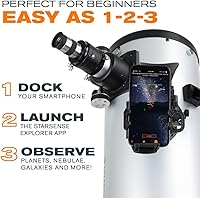
Yes, the StarSense Explorer app is available for both iOS and Android. The physical smartphone dock on the tube is adjustable and fits a wide range of phone sizes. That said, a small number of Android users have reported occasional stability differences between app updates, so it is worth checking recent user reviews for your specific device if you are on Android.

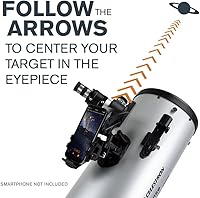
You move the tube yourself — there is no motorized tracking on this scope. The app guides you to the target with on-screen arrows, and when the bullseye goes green you are on it. After that, as Earth rotates, the object will slowly drift out of the field of view, and you nudge the tube to re-center it. At lower magnifications this drift is slow and manageable, but at higher magnifications it happens faster and requires more frequent corrections.

Not in any practical sense. Long-exposure deep-sky imaging requires a motorized equatorial mount that compensates for Earth's rotation over minutes or hours, and this Dobsonian has neither. You could capture quick snapshots of the Moon or bright planets by holding a phone to the eyepiece — a technique called afocal photography — but that is the realistic ceiling here. If astrophotography is your goal, you need a different setup entirely.

The total system weight is about 43 pounds, split between the optical tube at roughly 21 pounds and the rocker base at around 23 pounds. One person can absolutely set it up — the two pieces are manageable separately. The bigger challenge is carrying both pieces a meaningful distance, like from a car park to a dark-sky field, or up a flight of stairs. If you are a solo observer who plans to transport it regularly, factor that logistics question into your decision.

From a typical suburban backyard, the 203mm aperture will show you Saturn's rings, Jupiter's cloud bands and moons, the Moon in impressive detail, Mars when it is well-placed, and bright showpieces like the Orion Nebula, the Pleiades, and the Hercules Globular Cluster. Faint galaxies beyond Andromeda and very diffuse nebulae will be harder to see through suburban skies, but the app helpfully steers you toward targets that are actually achievable for your conditions on any given night.

The StarSense app needs to actually see stars in order to calibrate — it uses real sky-pattern recognition rather than relying purely on GPS or a compass. Partly cloudy skies can cause it to struggle or fail to lock on. You need a reasonably clear patch of sky overhead for the initial calibration to work. Once calibrated for a session, brief cloud cover is less of an issue since the app retains your orientation until you move the scope significantly.

All Newtonian reflectors need collimation periodically — it is just part of owning this type of telescope. If the scope arrives well-aligned and you handle it carefully, you may go months without needing to adjust anything. When it does need attention, the process is straightforward once you have done it once or twice, but it does require a collimation tool that is not included in the box. A basic laser collimator or a Cheshire eyepiece costs relatively little and is worth picking up alongside the scope.

The included 25mm Plössl at 48x is a decent starting point — good enough to deliver satisfying views of the Moon and bright planets out of the box. You will not feel cheated on your first night. That said, having only one magnification option gets limiting fairly quickly. Most experienced owners suggest budgeting for a shorter eyepiece — something in the 10mm to 15mm range — to add higher magnification for planetary detail, along with a Barlow lens as a cost-effective way to double your magnification options.

It is one of the better options available for exactly that use case. The app removes the steep learning curve that causes most beginner telescopes to end up in a closet after a few frustrating nights. The 8-inch aperture means the views are impressive enough to keep someone genuinely engaged rather than disappointed. The main caveat for gifting is the size — make sure the recipient has somewhere to store it and the means to move it, because at 43-plus pounds it is not a small item.

Where to Buy