Overview

The Celestron StarSense Explorer DX 102AZ Refractor Telescope is one of the more thoughtful entries in the beginner telescope market, built around a genuinely useful idea: let your smartphone do the hard part of finding objects in the sky. Where traditional scopes demand you learn star-hopping or wrestle with a manual finder, the StarSense app handles celestial navigation for you. Celestron has been making optics since 1960 and backs this scope with a 2-year US warranty, which matters at this price tier. Just know going in — this is a manual altazimuth mount, not a motorized one, and your views will improve considerably under darker skies.
Features & Benefits

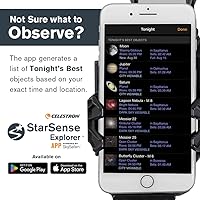
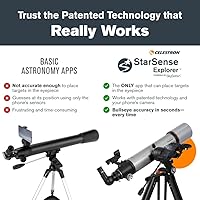
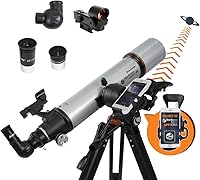
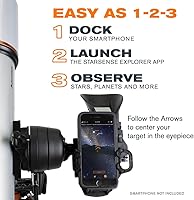
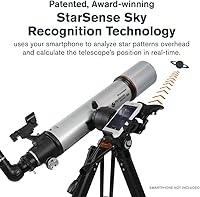
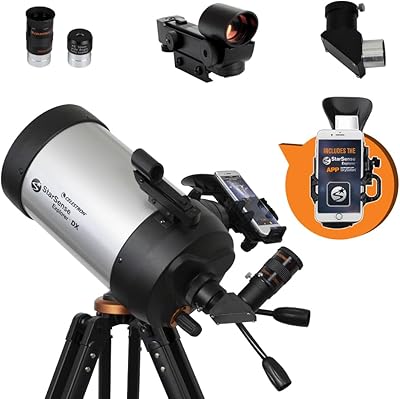
The centerpiece here is how the StarSense app actually works: it uses your phone's camera to analyze star patterns overhead and pinpoints where your telescope is pointing — no manual alignment ritual required. The physical smartphone dock clips into the optical path, so it is a proper part of the system rather than an afterthought. Optically, the 102mm refractor punches well for lunar and planetary work; Saturn's rings and Jupiter's cloud bands are genuinely satisfying targets. Two eyepieces — 25mm for wide fields and 10mm for closer looks — cover most beginner needs. Each night, the app also builds a personalized sky tour based on your location and current time, which makes knowing what to point at surprisingly easy.

Best For

This app-guided refractor is most squarely aimed at beginners who have tried a cheaper telescope before and given up after failing to find anything in the dark. If fumbling with a finderscope sounds frustrating, this scope removes that barrier almost entirely. It is also a strong gift pick — the kind of telescope that actually comes out of the box and gets used. Suburban and semi-urban stargazers will find it capable for the Moon, bright planets, and objects like the Orion Nebula. That said, if you are an experienced observer or want motorized tracking, the StarSense Explorer 102 is not really designed with you in mind — and that is perfectly fine, because its audience is clear.

User Feedback

Across more than 1,400 reviews and a 4.1-star average, the general consensus is positive — especially from first-time users who found objects on their very first night out. Out-of-the-box usability is the most consistent praise. On the critical side, a handful of users with older Android phones report app glitches and compatibility hiccups, so checking your device against the app's requirements before buying is worth the two minutes. Some reviewers also note that at higher magnifications the mount can feel a little wobbly, a trade-off common with lightweight manual setups. Experienced stargazers occasionally point out the 102mm aperture hits limits on faint galaxies. Packaging and accessories earn frequent compliments, which is always a reassuring sign for a gift purchase.

Pros

  • First-time users routinely locate planets and nebulae on their very first night out, with no prior astronomy knowledge needed.
  • The StarSense app removes the need for manual star alignment — a process that defeats most beginners before they even start observing.
  • Lunar views are genuinely impressive; crater detail and surface texture are clearly visible at mid-magnification on a steady night.
  • Saturn's rings and Jupiter's cloud bands are both cleanly resolved through the StarSense Explorer 102, which never gets old for new stargazers.
  • The physical smartphone dock integrates the phone directly into the optical path, making sky recognition far more reliable than app-only competitors.
  • Dual-axis slow-motion controls let you nudge targets into view smoothly, which feels far more refined than a basic alt-az friction head.
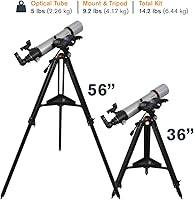
  • At 14.2 lbs assembled, this beginner telescope is manageable enough to carry to a darker observing spot without dedicated transport gear.
  • The included 25mm and 10mm eyepieces cover the two most useful magnification ranges for beginners without requiring any immediate additional purchases.
  • Celestron backs the purchase with a 2-year US warranty and accessible customer support, which is reassuring at this price tier.
  • The app generates a curated nightly target list based on your actual location, so you always have a clear answer to the question of what to look at tonight.

Cons

  • Older Android devices often struggle with app compatibility, which can cripple the core navigation feature entirely.
  • The mount develops noticeable wobble at magnifications above roughly 150x, making high-power planetary sessions less steady than they should be.
  • Chromatic aberration — color fringing — appears around bright targets like the Moon and Venus due to the achromatic lens design at this focal ratio.
  • The focuser has some play and does not hold critical focus reliably during extended sessions as outdoor temperatures fluctuate.
  • Phones in thick protective cases often need to be removed before fitting into the dock, which is a minor but recurring inconvenience.
  • The app's nightly target curation stays conservative and becomes repetitive within a few months, offering little growth for users who progress quickly.
  • The tripod legs feel hollow and the plastic mount components show wear relatively fast for a scope at this price point.
  • International buyers outside the US may face inconsistent warranty and support experiences through regional distributors.
  • There is no motorized tracking, so objects drift out of view continuously and must be manually re-centered — a limitation worth understanding before buying.
  • Dedicated eyeglass wearers may find the short eye relief on the included 10mm eyepiece uncomfortable during extended viewing sessions.

Ratings

The Celestron StarSense Explorer DX 102AZ Refractor Telescope earns a strong overall standing across more than 1,400 verified global reviews, and the scores below reflect an AI-assisted analysis that actively filtered out incentivized and bot-generated feedback to surface what real buyers actually experienced. The ratings transparently capture both the genuine strengths that make this scope a standout for newcomers and the friction points that prevent it from being a universal recommendation.
Ease of Setup
88%
Most first-time users report being outside and observing within 30 to 45 minutes of opening the box, with no tools or technical knowledge required. The tripod assembly is straightforward, and unlike reflectors, this refractor needs no collimation — a meaningful advantage for anyone who just wants to look at the sky, not tune hardware.
A small number of buyers found the instruction manual thin on detail for assembling the smartphone dock correctly the first time. Those who skipped the manual and went straight to setup occasionally had to backtrack, which frustrated gift recipients setting it up without prior context.
StarSense App Performance
81%
19%
When it works as intended, the star-pattern recognition is genuinely impressive — point the scope roughly skyward, let the app analyze the field, and within seconds it knows exactly where you are aimed. For beginners who would otherwise spend an entire session struggling to find a single object, this is the core reason to choose this scope over cheaper alternatives.
App reliability is not universal. Users with older Android devices — particularly those running Android 8 or below — report inconsistent recognition, freezing, or failed syncs. Even on supported phones, a few reviewers noted the app occasionally loses orientation after bumping the scope, requiring a quick re-scan that can interrupt a smooth observing session.
Optical Clarity
84%
Lunar views through this app-guided refractor are sharp and rewarding — crater detail is visible at mid-magnification, and the Moon looks genuinely spectacular on a clear night. Planetary performance is solid too, with Saturn's rings and Jupiter's equatorial bands both cleanly resolved using the included 10mm eyepiece under steady seeing conditions.
At the edges of the field of view, some chromatic aberration appears around bright objects like the Moon and Venus — a known trait of f/6.5 achromatic refractors at this price point. It does not ruin the experience, but more discerning observers will notice the faint color fringing around high-contrast targets.
Deep-Sky Performance
61%
39%
Bright showpiece objects — the Orion Nebula, the Andromeda Galaxy's core, and open clusters like the Pleiades — are genuinely satisfying through the StarSense Explorer 102 from a suburban backyard. The app also curates accessible targets based on your location, which helps beginners avoid frustration by steering them toward achievable objects.
The 102mm aperture has a real ceiling. Faint galaxies, globular cluster resolution, and dim planetary nebulae remain mostly out of reach, especially under light-polluted skies. Users who graduate past beginner curiosity and start chasing fainter targets tend to find this scope the limiting factor, not their experience level.
Mount Stability
67%
33%
For low to mid-magnification viewing — roughly up to 100x — the altazimuth mount is stable enough to enjoy a steady image. The dual-axis slow-motion controls are a genuine quality-of-life improvement over basic pan-and-tilt heads, letting you nudge targets into view without overcorrecting and losing them entirely.
Push the magnification above 150x and the mount's limitations become obvious. Vibrations from touching the focuser or brushing the tube can take several seconds to settle, which gets annoying during planetary sessions where fine detail demands a rock-steady view. Reviewers in windy conditions reported this as a consistent frustration.
Smartphone Dock & Integration
79%
21%
The physical dock is a cleverly designed piece of hardware — it snaps the phone into the optical path rather than sitting alongside it, which is why the star-recognition technology works as well as it does. The dock fits a reasonable range of phone sizes and feels secure during use, not like an afterthought accessory.
Phones in thick protective cases often require removal before fitting into the dock, which some buyers found inconvenient. The dock mechanism also shows some cosmetic looseness over time with repeated attachment and removal, and a handful of reviewers noted fitment issues with larger-format Android devices.
Included Eyepieces
76%
24%
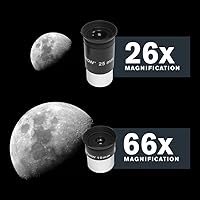
Both the 25mm and 10mm eyepieces that ship with this beginner telescope are more than adequate for getting started — the 25mm is the right choice for sweeping wide-field views of open clusters and the full lunar disk, while the 10mm brings planets noticeably closer without pushing the optics too hard.
Neither eyepiece is high-end glass. The eye relief on the 10mm is short enough that eyeglass wearers may struggle to see the full field comfortably. Most serious observers will want to invest in at least one quality Plossl or wide-angle eyepiece once they outgrow the basics.
Portability
82%
18%
At 14.2 lbs fully assembled, this is one of the more manageable setups in its aperture class. Breaking it down into tube, mount head, and tripod takes only a few minutes, and everything fits into a reasonably sized car trunk — important for anyone planning to drive to a darker observing site outside the suburbs.
It is not a grab-and-go scope in the truest sense. The assembled footprint is fairly tall and wide, and carrying it any real distance — say, across a field to find a dark patch — requires two trips or a carry bag sold separately. Casual apartment balcony users may find the setup slightly cumbersome for short sessions.
Value for Money
77%
23%
Compared to similarly priced telescopes without app guidance, the StarSense technology genuinely justifies a premium. Buyers who previously owned a frustrating entry-level scope frequently comment that this one actually gets used — and a telescope that stays in the closet is worth nothing, regardless of its optical specs.
At this price tier, buyers reasonably expect motorized tracking or a higher-quality focuser, neither of which is included. Those who research the competition will find reflectors with larger apertures for less money — the price premium here is almost entirely for the StarSense convenience, which not every buyer will value equally.
Focuser Quality
63%
37%
The rack-and-pinion focuser is functional and smooth enough for casual lunar and planetary sessions. Hitting sharp focus on bright objects is quick, and the focuser does not introduce noticeable image shift during adjustment — a problem that plagues some budget competitors.
The focuser has noticeable play in it and does not hold focus reliably during long sessions as temperatures drop and the tube flexes slightly. Astrophotography through this scope is essentially impractical because of this, and even visual observers occasionally notice that a precisely focused view drifts slightly after a few minutes.
App-Generated Sky Tour
83%
The nightly target list the app generates is one of the underappreciated features for absolute beginners. Rather than staring blankly at a star chart, users get a short, curated list of what is actually visible from their exact location tonight — removing the most common beginner question of simply not knowing what to look for.
The list skews conservatively toward bright, easy targets, which is the right call for newcomers but can feel repetitive once you have been using the scope for a few months. There is no built-in learning curve — power users eventually find the curation too limited and migrate to dedicated astronomy planning apps anyway.
Build Quality & Materials
74%
26%
The optical tube feels solid and well-finished, and the coatings on the objective lens are visibly applied with care — an area where Celestron's manufacturing experience shows. The overall construction conveys a sense of durability that cheaper entry-level scopes at lower price points simply do not match.
The tripod legs are aluminum and feel hollow underfoot, and the plastic components on the mount head show wear marks relatively quickly with regular outdoor use. Nothing structurally fails, but the materials quality is not quite commensurate with the asking price when examined closely next to competitors.
Warranty & Customer Support
86%
Celestron's 2-year US warranty is one of the more generous coverage policies in this category, and the company's US-based support team has a strong reputation for actually resolving issues. Multiple reviewers specifically mentioned positive experiences with replacement parts and firmware support for the app, which builds confidence in a longer-term ownership experience.
The warranty is US-specific, which means international buyers are working with regional distributors whose support quality varies considerably. A few non-US reviewers noted difficulty obtaining warranty service, which is worth factoring in if you are purchasing from outside North America.

Suitable for:

The Celestron StarSense Explorer DX 102AZ Refractor Telescope is built almost perfectly for people who are genuinely curious about astronomy but have zero patience for the steep learning curve that traditionally comes with it. If you have ever bought a cheap telescope, failed to find anything in the dark, and given up within a week, this is the scope that fixes that exact problem. It is equally strong as a gift for a teenager, a curious adult, or anyone who grew up wanting to look at Saturn but never had the right tool. Suburban stargazers who mostly observe from a backyard or a local park will find the 102mm aperture more than sufficient for the Moon, bright planets, and prominent nebulae. The smartphone-guided navigation removes the single biggest barrier to enjoying astronomy — knowing where to point — and that alone makes this beginner telescope worth serious consideration for casual, recreational sky-watching.
Not suitable for:

The Celestron StarSense Explorer DX 102AZ Refractor Telescope is not the right choice for buyers who have already moved past the beginner stage and are actively chasing faint galaxies, globular cluster resolution, or demanding deep-sky objects. The 102mm aperture simply does not gather enough light for that kind of work, especially from light-polluted urban skies where the limiting magnitude shrinks considerably. If motorized tracking is on your must-have list — because you want objects to stay centered without manual nudging, or you are interested in basic astrophotography — this scope will frustrate you, as the mount is entirely manual and not designed for that use case. Buyers with older Android phones should also verify compatibility before purchasing, since the StarSense app does not perform reliably on all devices and a malfunctioning app effectively removes the core reason to choose this scope over a cheaper alternative. Finally, if your priority is maximum aperture per dollar, a reflector telescope at a similar or lower price will outperform this app-guided refractor on raw light-gathering, even if the user experience is considerably less polished.
Specifications

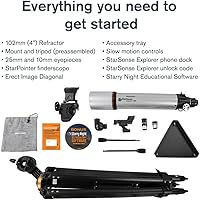
  • Optical Design: The telescope uses a refractor design with a multi-coated achromatic objective lens for improved contrast and light transmission.
  • Aperture: The objective lens measures 102mm (4-inch) in diameter, providing enough light-gathering for lunar, planetary, and bright deep-sky viewing.
  • Focal Length: The optical tube has a focal length of 660mm, producing a balanced combination of magnification and field of view.
  • Focal Ratio: The scope operates at f/6.5, making it a mid-range focal ratio well-suited to both wide-field and moderate-magnification observations.
  • Included Eyepieces: Two eyepieces are included — a 25mm for wide-field viewing and a 10mm for higher magnification targets like planets.
  • Max Magnification: The highest theoretically useful magnification with this optical system is 240x, though atmospheric conditions typically limit practical use below that.
  • Mount Type: The scope ships with a manual altazimuth mount featuring dual-axis slow-motion control knobs for precise pointing adjustments.
  • Finderscope: A StarPointer red dot finderscope is included to assist with initially orienting the tube toward a target region of the sky.
  • App Compatibility: The StarSense Explorer app is free to download and supports both iPhone (iOS) and Android smartphones, though older Android devices may have limited compatibility.
  • Tube Length: The optical tube measures 812.8mm in length, which affects portability and the choice of carry bag if one is purchased separately.
  • Product Dimensions: The fully assembled telescope measures approximately 38.98 x 16.93 x 8.98 inches, making it a mid-sized setup suitable for backyard use.
  • Assembled Weight: The complete assembled unit weighs 14.2 lbs (6.44 kg), manageable for one person to carry short distances in two trips.
  • Power Source: The telescope operates entirely without external power; no batteries or charging are required for the optics or mount mechanics.
  • Smartphone Dock: A physical smartphone dock is integrated into the optical tube assembly, positioning the phone's camera to capture and analyze the star field overhead.
  • Warranty: Celestron provides a 2-year limited warranty for US buyers, backed by a US-based customer support team available for technical assistance.
  • Manufacturer: Celestron is headquartered in Torrance, California, and has manufactured telescopes and optical equipment since 1960.
  • Release Date: The product was first made available in January 2020, and has accumulated over 1,400 customer reviews in that time.
  • Battery Requirement: One lithium metal battery is required and included, used to power the StarPointer red dot finderscope.

Related Reviews
Celestron StarSense Explorer DX 5″ Telescope
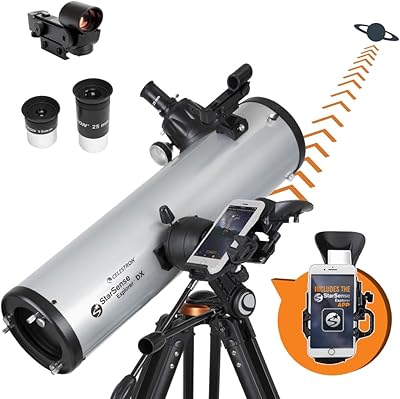
73%
88%
Ease of Setup
83%
App Navigation Accuracy
79%
Optical Performance
61%
Mount Stability
57%
Manual Tracking Experience
More
Celestron StarSense Explorer DX 130AZ
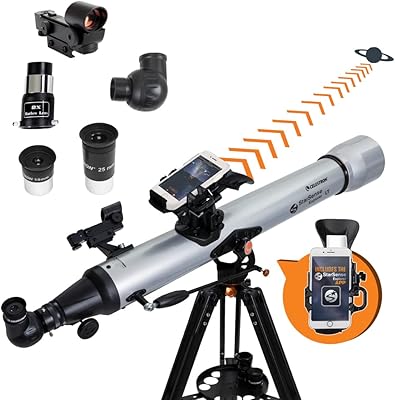
76%
91%
App Navigation & Sky Recognition
83%
Optical Performance
88%
Ease of Setup & Assembly
67%
Mount Stability & Build
58%
Collimation & Optical Alignment
More
Celestron StarSense Explorer LT 114AZ
74%
88%
App Navigation Experience
83%
Optical Clarity
86%
Ease of Setup
61%
Mount Stability
79%
Value for Money
More
Celestron StarSense Explorer LT 80AZ Refractor Telescope
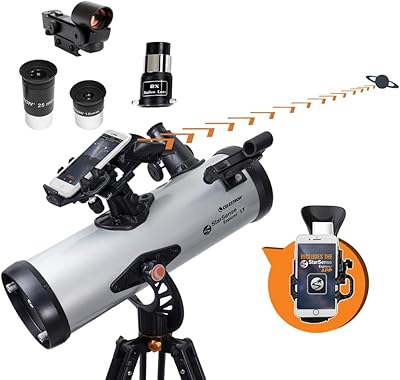
77%
88%
App Navigation Experience
83%
Optical Clarity
91%
Ease of Setup
61%
Build Quality
86%
Value for Money
More
Celestron StarSense Explorer 8″ Dobsonian Telescope
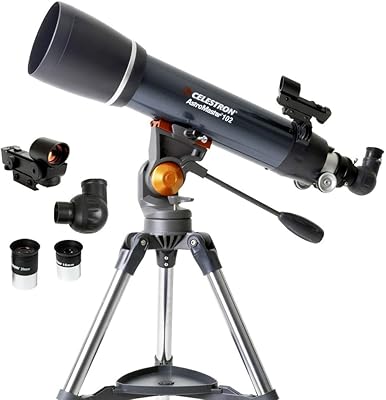
79%
91%
Optical Performance
88%
App Navigation Accuracy
86%
Ease of Use
84%
Build Quality
79%
Value for Money
More
Celestron StarSense Explorer 8″ Dobsonian Telescope
81%
91%
Ease of Use
88%
Optical Performance
86%
StarSense App & Technology
89%
Mount Stability
83%
Value for Money
More
Celestron AstroMaster 102AZ Refractor Telescope
77%
78%
Optical Clarity
91%
Ease of Setup
74%
Mount Usability
71%
Tripod Stability
83%
Value for Money
More
Celestron Travel Scope 60DX Portable Refractor Telescope
76%
76%
Optical Performance
63%
Build Quality
91%
Portability
89%
Ease of Setup
54%
Tripod Stability
More
Celestron Travel Scope 50 Refractor Telescope
75%
74%
Optical Clarity
91%
Portability & Weight
88%
Ease of Setup
58%
Build Quality & Materials
53%
Tripod Stability
More
Celestron Travel Scope 70
79%
83%
Optical Clarity
91%
Portability & Weight
67%
Build Quality
93%
Ease of Setup
54%
Tripod Stability
More

FAQ

It works with both iPhone and Android phones, but compatibility is not universal across all Android devices. Newer iPhones and recent Android flagships perform the most reliably. If you are running Android 8 or older, it is worth checking the StarSense Explorer app page for a current compatibility list before buying — a few users with older hardware have run into syncing issues that undermine the whole experience.

Most people are outside and observing within 30 to 45 minutes on the first night. The tripod assembly is intuitive, and unlike reflector telescopes, this refractor does not require any collimation — you just attach the mount, secure the optical tube, dock your phone, and follow the app prompts. The included instructions cover the basics, though the manual is not the most detailed if you run into trouble.

Yes, and this is genuinely one of its strongest performances. Under a steady sky at around 100x magnification, Saturn's rings are clearly defined and the planet's disk is well-resolved. It is one of those views that genuinely surprises first-time observers — most people do not expect it to look that good.

No, the mount is entirely manual. Once you find an object and center it in the eyepiece, it will slowly drift out of view as the Earth rotates, and you will need to nudge it back using the slow-motion control knobs. This is standard behavior for manual altazimuth mounts and is easy to manage at lower magnifications, though it gets more noticeable above 100x.

The app uses your phone's camera to photograph the star field visible overhead and then analyzes the pattern of stars it sees to determine exactly where the telescope is pointed. It combines that with your phone's GPS location and clock to build a real-time map of the sky. The result is that you never need to manually identify a star or perform a traditional alignment — the scope figures out its own orientation automatically.

From a typical suburban location, you will get excellent views of the Moon at almost any magnification, Saturn and its rings, Jupiter with its four bright moons and cloud bands, Mars as a reddish disk when it is near opposition, and bright deep-sky objects like the Orion Nebula and the Andromeda Galaxy's core. Fainter targets — dim galaxies, faint globular clusters — will be harder or impossible under significant light pollution, so expectations there should stay realistic.

It depends on the case. Slim cases usually fit fine, but bulkier protective cases — especially those with raised edges or extended battery packs — often need to come off before the phone seats properly in the dock. It is a minor inconvenience but worth knowing if you use a heavy-duty case daily.

The included 25mm and 10mm eyepieces are genuinely usable and more than sufficient for getting started. You do not need to upgrade immediately. That said, if you find yourself wanting wider fields of view or more comfortable eye relief — particularly if you wear glasses — a quality 32mm wide-angle eyepiece makes a nice addition after a few months of use.

Refractors are relatively low-maintenance compared to reflectors because there are no mirrors to collimate. Occasional gentle cleaning of the eyepiece lenses with a proper optical cloth is the main upkeep task. The objective lens rarely needs cleaning if you keep the lens cap on when not in use, but if dust accumulates, a blower brush followed by a lens tissue with a drop of optical cleaning fluid is the safe approach.

It is one of the better options in this category specifically because the app removes the biggest frustration point for beginners — not being able to find anything. The packaging also receives consistently positive feedback, so it presents well. The one caveat for gift-givers is to confirm the recipient has a compatible smartphone before purchasing, since the navigation system is central to the experience.

Where to Buy