Celestron StarSense Explorer LT 114AZ
Overview
The Celestron StarSense Explorer LT 114AZ takes a genuinely different approach to beginner telescopes — instead of handing you a star chart and wishing you luck, it turns your smartphone into a live navigation guide. That single idea changes the experience considerably. Celestron has been making optics since 1960, so there is real engineering behind the hardware, not just a gimmick wrapped around a mediocre tube. This smart telescope sits at a mid-range price point that puts it squarely in gift territory — thoughtful enough to impress, practical enough to actually get used after the unboxing excitement fades.
Features & Benefits
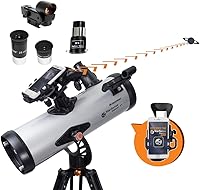
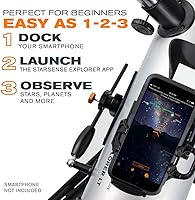
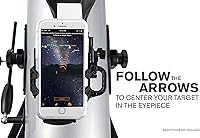
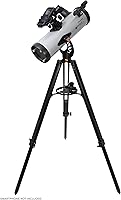
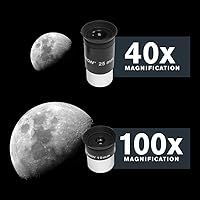
The real centerpiece is the StarSense Explorer app, which uses your phone's camera to scan the sky and identify star patterns — then overlays directional arrows to steer you toward whatever you want to see. No memorizing constellations required. The 114mm reflector tube does solid optical work; the Moon is stunning, and Jupiter's cloud bands and Saturn's rings come through clearly. Two eyepieces (25mm and 10mm) cover comfortable low and medium magnification for most sessions. The altazimuth mount moves smoothly and includes a slow-motion altitude control rod, helping you nudge the scope precisely without overshooting your target.
Best For
This app-guided reflector was clearly designed with the first-time buyer in mind — someone who wants a rewarding night outside without spending weeks studying astronomy basics first. It works equally well as a gift, since kids and adults can both navigate the app without any hand-holding. City and suburban dwellers will appreciate that the curated object list adjusts to local conditions, suggesting targets actually visible from your backyard. That said, experienced observers who already know the sky and want serious deep-sky capability will likely find this a stepping stone rather than a long-term instrument.
User Feedback
Most owners of this smart telescope point to the same highlights: the app locks onto targets faster than expected on the first try, and the lunar and planetary views are genuinely satisfying. On the critical side, a recurring complaint involves tripod wobble at higher magnifications, making it hard to stay on target. Collimation — aligning the reflector's mirrors — also catches new owners off guard, since refractor users never encounter it. A handful of reviewers note that phone compatibility varies; oversized handsets or thick cases don't always seat securely in the dock. Overall sentiment leans positive, though dedicated beginners often find themselves wanting more aperture within a year.
Pros
- The StarSense app identifies star patterns overhead and guides you to targets with on-screen arrows — no chart-reading required.
- First-time users commonly report locating planets or nebulae within minutes of setup on their very first night out.
- The 114mm reflector delivers genuinely impressive lunar views, with crater detail that consistently surprises new owners.
- Saturn's rings and Jupiter's cloud bands are clearly visible on steady nights, providing the kind of wow moment that keeps beginners hooked.
- The altazimuth mount includes a slow-motion altitude control rod that makes fine adjustments far less frustrating than on cheaper tripods.
- Two eyepieces in the box cover a practical magnification range without requiring an immediate accessory purchase.
- Celestron backs this app-guided reflector with a two-year US warranty and reachable, knowledgeable support staff.
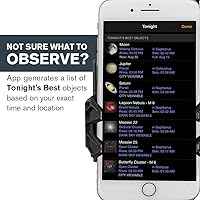
- The app curates a nightly list of visible targets based on your actual location and sky conditions, not a generic catalog.
- At just over 10 pounds, it is light enough for one person to move from indoors to the backyard without help.
Cons
- The tripod legs flex noticeably at higher magnifications, causing image shake that can last several seconds after any touch.
- Collimation — aligning the reflector mirrors — catches most first-time owners completely off guard and needs to be repeated after transport.
- Larger smartphones and phones in thick cases often do not seat securely in the dock without removing the case first.
- The app object library cycles through its highlights relatively quickly, leaving regular users wanting deeper catalog access or manual coordinate entry.
- Faint deep-sky objects like distant galaxies are technically reachable on paper but frustratingly dim in real suburban viewing conditions.
- The focuser and mount joints are plastic, and some owners report the slow-motion control rod loosening with regular use over time.
- No Barlow lens is included, so users chasing more magnification need to buy additional accessories fairly early on.
- The app occasionally requires multiple calibration attempts outdoors before the star-recognition locks in reliably, which is frustrating on cold nights.
Ratings
Our AI-generated ratings for the Celestron StarSense Explorer LT 114AZ were built by analyzing thousands of verified global buyer reviews, with spam, bot-submitted, and incentivized feedback actively filtered out before scoring. The result is a balanced picture that reflects what real owners consistently love — and where this app-guided reflector genuinely falls short. Both the highlights and the frustrations are represented honestly across every category below.
App Navigation Experience
Optical Clarity
Ease of Setup
Mount Stability
Value for Money
Collimation & Maintenance
Smartphone Compatibility
Image Brightness
Build Quality & Materials
Included Accessories
Portability
App Object Library
Customer Support & Warranty
Suitable for:
The Celestron StarSense Explorer LT 114AZ is purpose-built for people who are genuinely curious about the night sky but have no idea where to start — and that is a much larger group than most telescope marketing acknowledges. If you have ever looked up at a clear night, wondered which bright dot is Saturn, and then given up because traditional scopes felt too technical, this is the telescope that actually solves that problem. It works particularly well as a family purchase where both adults and older children can share the experience without one person having to act as the designated expert. Suburban and city-based observers will appreciate that the app tailors its suggestions to what is actually visible from your location, rather than pointing you toward objects swallowed by light pollution. Gift buyers — especially for milestone occasions like birthdays or holidays — will find it lands well because the first successful stargazing session happens on night one rather than after weeks of frustrating trial and error. The two-year warranty and accessible US-based support also make it a lower-risk purchase for buyers who are not yet confident enough to troubleshoot optics on their own.
Not suitable for:
The Celestron StarSense Explorer LT 114AZ is a poor fit for anyone who already knows their way around the night sky and is looking to push deeper into faint galaxies, planetary detail, or astrophotography. The 114mm aperture is honest entry-level hardware — rewarding for showpiece objects, but genuinely limited once you move past the Moon, the brightest planets, and a handful of well-known nebulae and clusters. Observers who prefer a fully manual, learn-by-doing approach to astronomy may find the app-first design more cumbersome than liberating, since the experience is optimized around the smartphone workflow rather than traditional star-hopping. Anyone expecting a rock-solid mount for high-magnification planetary study should also look elsewhere — the tripod wobble issue documented by real owners is not a minor quirk at 100x and above. Buyers who plan to grow into intermediate astronomy within a year or two may find the underlying hardware becomes the bottleneck sooner than expected, making a modest additional investment in a sturdier manual scope potentially better value over the longer term.
Specifications
- Optical Design: The telescope uses a Newtonian Reflector configuration, which gathers light via a primary parabolic mirror rather than glass lenses.
- Aperture: The primary mirror measures 114mm (4.5″) in diameter, determining how much light the scope collects and how bright objects appear.
- Focal Length: The optical tube has a focal length of 1000mm, which governs the base magnification produced with any given eyepiece.
- Focal Ratio: At f/9, the optical system is on the slower end for a Newtonian reflector, producing well-contained, relatively low-distortion images at moderate magnifications.
- Magnification Range: The included 25mm eyepiece delivers 40x magnification and the 10mm eyepiece delivers 100x, with a theoretical maximum of 269x under ideal conditions.
- Included Eyepieces: Two 1.25″ barrel eyepieces are included in the box: a 25mm for wide, low-power views and a 10mm for closer planetary and lunar detail.
- Mount Type: The telescope ships on a manual altazimuth mount equipped with an altitude slow-motion control rod for precise up-and-down adjustments.
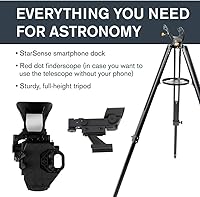
- Finderscope: A reflex finderscope is included for rough pointing, though in practice the StarSense smartphone dock replaces it as the primary navigation tool.
- Smartphone Dock: The integrated dock accepts iPhone and Android handsets and positions the phone's camera to face skyward for real-time star-pattern analysis.
- App Compatibility: The StarSense Explorer app is available for both iOS and Android and communicates with the dock using the phone's camera and onboard sensors.
- Tube Length: The optical tube measures 24 inches in length, which affects both portability and the minimum tripod height needed for comfortable viewing.
- Assembled Weight: The fully assembled telescope weighs 10.4 lb, light enough for a single adult to carry to a backyard or nearby dark-sky site.
- Product Dimensions: When assembled, the full setup occupies approximately 36″ x 36″ x 60″ of space, requiring a clear outdoor area for comfortable use.
- Power Requirements: The StarSense dock requires one lithium metal battery (included in the box) to operate the phone-positioning and navigation system.
- Warranty: Celestron provides a 2-year US warranty covering manufacturing defects, backed by a US-based customer support team available for technical assistance.
- Limiting Magnitude: Under dark skies, the 114mm aperture is capable of revealing objects down to approximately magnitude 12.8, covering the Moon, planets, and brighter deep-sky objects.
- Lowest Magnification: The lowest useful magnification for this aperture is approximately 16x, which produces the widest practical field of view for sweeping star fields.
- Brand Origin: Celestron was founded in California in 1960 and remains one of the most recognized telescope manufacturers in the consumer astronomy market.
Related Reviews
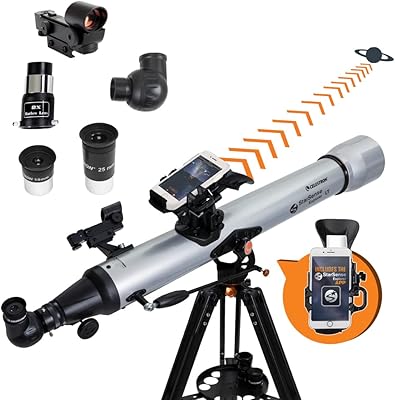
Celestron StarSense Explorer LT 80AZ Refractor Telescope
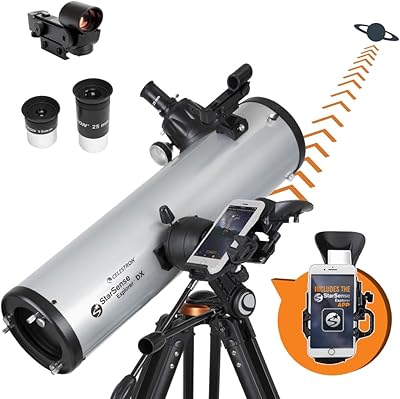
Celestron StarSense Explorer DX 130AZ
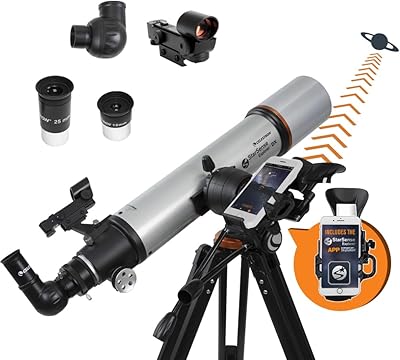
Celestron StarSense Explorer DX 102AZ Refractor Telescope
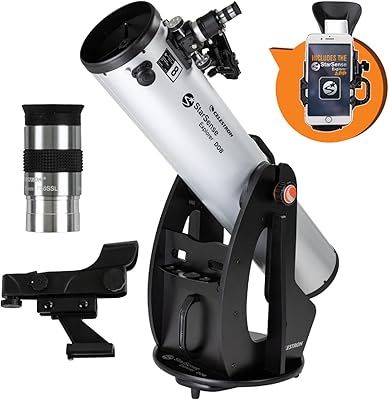
Celestron StarSense Explorer 8″ Dobsonian Telescope
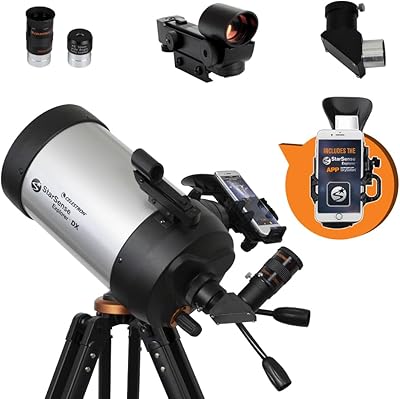
Celestron StarSense Explorer DX 5″ Telescope
Celestron StarSense Explorer 8″ Dobsonian Telescope
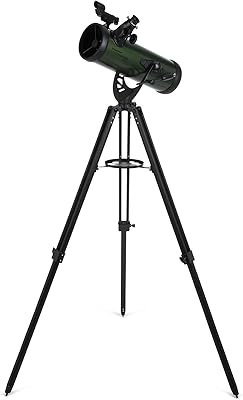
Celestron ExploraScope 114AZ Reflector Telescope
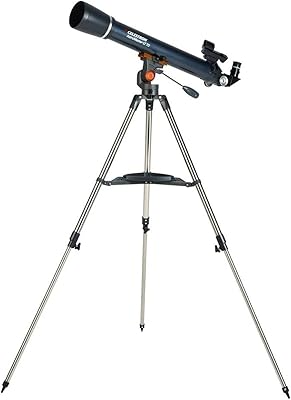
Celestron AstroMaster LT 70AZ Refractor Telescope

BuddyPhones Explore Plus