Overview

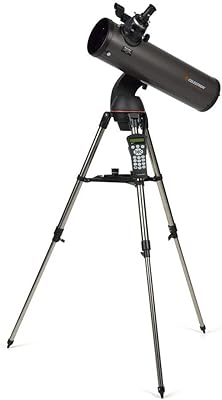
The Celestron NexStar 90SLT Computerized Telescope sits in an interesting spot — serious enough to satisfy a curious adult, yet accessible enough to not overwhelm a first-timer. Its Maksutov-Cassegrain optical tube is compact, folding a 1250mm focal length into a tube just 21 inches long, which makes it surprisingly easy to carry to a dark field or a campsite. The 90mm aperture handles planetary and lunar observing well — Saturn's rings resolve cleanly, and the Moon becomes a richly detailed landscape. Deep-sky performance is more limited, and that is worth knowing upfront. This scope has been around long enough to build a large, active community, meaning finding tips, accessories, and honest advice is never difficult.
Features & Benefits

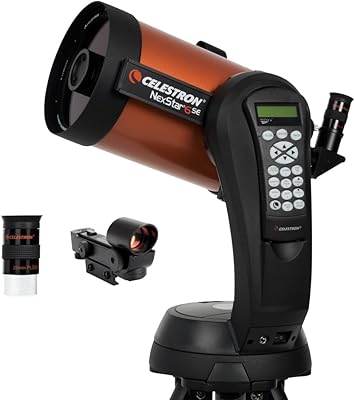
The SkyAlign alignment system is genuinely one of this computerized scope's strongest selling points. Point the tube at any three bright objects — a planet, a bright star, the Moon — confirm them in the hand controller, and the mount knows exactly where it sits in the sky. From there, the GoTo controller handles navigation, slewing to targets and keeping them tracked as Earth rotates. The Maksutov-Cassegrain design keeps the tube short without sacrificing focal length, which matters when packing for a trip. The included red-dot finder makes initial centering quick, and the bundled Starry Night software is a solid bonus for planning sessions indoors. A two-year warranty with US-based support rounds things out nicely.

Best For

This GoTo telescope is a particularly good match for suburban stargazers who spend most of their time on planets, double stars, and the Moon rather than hunting faint galaxies. It travels well too — the whole kit fits in a car trunk, making it a genuine option for camping trips or visits to a dark sky site. Parents looking for a first serious scope for a teenager will find it hits the right balance: capable enough to reward patience, but not so complex that it becomes discouraging. Anyone currently using a department-store refractor will notice an immediate quality jump in both optics and usability.

User Feedback

Owners of the NexStar 90SLT consistently praise the sharp views of planets and the accuracy of the GoTo system once alignment clicks into place. The most common frustration is the aperture hitting its limits on dim deep-sky targets — galaxies and nebulae appear faint and underwhelming, which is a real trade-off worth accepting before you buy. Battery drain during long sessions also comes up regularly; a rechargeable battery pack largely solves it. The stock tripod is functional but feels basic, and it tends to be the first component experienced users upgrade. Alignment takes a little practice at first, but most owners find it becomes second nature within a few outings.

Pros

  • The GoTo system points to targets with reliable accuracy, even for complete beginners on their first night out.
  • SkyAlign requires no prior star knowledge — three bright objects are all you need to get fully oriented.
  • Planetary views are genuinely rewarding; Saturn's rings and Jupiter's bands are crisp and well-defined.
  • The compact Maksutov-Cassegrain tube makes this one of the easier mid-range scopes to pack and carry.
  • A 40,000-object database gives you years of exploration without running out of targets.
  • Setup from car to first star typically takes under 15 minutes once you have done it a couple of times.
  • The bundled Starry Night software adds real value for planning sessions and learning the sky indoors.
  • A two-year warranty backed by US-based support is reassuring for a purchase at this price level.
  • The long production history means a large community of users sharing tips, mods, and honest advice.

Cons

  • Deep-sky objects like galaxies and nebulae are dim and underwhelming through the 90mm aperture.
  • Battery drain during longer observing sessions is a recurring complaint; a rechargeable pack is a near-necessity.
  • The stock tripod feels flimsy under the mount and is a frequent first upgrade for serious users.
  • First-time alignment can be frustrating; expect a learning curve of a few outings before it feels natural.
  • The single-arm altazimuth fork mount is not suitable for astrophotography beyond basic lunar snapshots.
  • The included Plossl eyepiece is adequate but entry-level; most users want additional eyepieces fairly quickly.
  • There is no fine-speed manual control knob, so nudging objects precisely without the handset takes practice.
  • Users with light-polluted skies will find the aperture limitation even more pronounced on hazy nights.

Ratings

The scores below for the Celestron NexStar 90SLT Computerized Telescope were generated by our AI engine after analyzing thousands of verified global user reviews, with spam, bot activity, and incentivized feedback actively filtered out. The results reflect a balanced picture of where this computerized scope genuinely delivers and where real buyers have run into frustration. Both the highlights and the honest shortcomings are represented transparently so you can make a confident decision.

Optical Performance
78%
22%
For planetary and lunar targets, users consistently describe sharp, high-contrast views that reward patience. Saturn's rings, Jupiter's equatorial bands, and crisp lunar craters are well within reach on a steady night, and many owners say the views exceeded their expectations at this level.
The 90mm aperture hits a ceiling quickly when observers turn to faint deep-sky objects. Galaxies and nebulae appear dim and detail-poor, which is a recurring disappointment for users who expected more versatile optical performance across all sky targets.
GoTo Accuracy
83%
Once properly aligned, the GoTo system places targets reliably within the field of view, even at higher magnifications. Owners who take the three-star alignment seriously report that the hand controller rarely misses, and tracking during planetary sessions is smooth and consistent.
GoTo accuracy degrades noticeably when alignment is rushed or when the tripod is set up on uneven ground. A small number of users also report that the hand controller occasionally needs a firmware reset after prolonged storage to maintain its pointing precision.
Ease of Setup
81%
19%
The SkyAlign system is genuinely approachable for beginners — no star charts, no compass, no prior knowledge needed. Most users describe getting from unboxing to first tracked object in under half an hour, which is a meaningful advantage over manually aligned alternatives in this price range.
The first one or two sessions involve a real learning curve, particularly identifying which bright objects to use for alignment. Several users note that the instruction manual glosses over this step, leaving beginners to rely on online forums or community videos to fill the gaps.
Portability
86%
The Maksutov-Cassegrain tube design keeps the whole kit compact and manageable for a single person. Owners regularly pack this GoTo telescope into a car trunk for camping trips or dark-sky excursions without needing a dedicated equipment case or a second pair of hands.
At just over 15 pounds fully assembled, it is not quite a grab-and-go instrument in the lightest sense. Hikers or observers walking to remote sites more than a short distance from their car will find the combined weight of the tripod and tube a meaningful consideration.
Build Quality
67%
33%
The optical tube itself feels well-constructed and durable, and the sealed Maksutov-Cassegrain design keeps dust and moisture away from the optics without regular maintenance. Long-term owners report the tube showing no degradation in optical quality after years of regular use.
The single-arm fork mount and the included tripod both feel noticeably less substantial than the optical tube they support. Vibrations from touching the scope take several seconds to dampen, and the tripod leg locks have drawn complaints about loosening during transport.
Tripod Stability
54%
46%
The tripod functions adequately for casual observing sessions where you are not frequently nudging the scope or sharing views with excited family members. For stationary high-magnification viewing on a calm night with no wind, stability is acceptable enough to use without frustration.
It is the most criticized component in user feedback by a wide margin. At higher magnifications any accidental touch sends the image bouncing for an uncomfortable amount of time, and the legs lack the rigidity experienced observers expect. Upgrading the tripod is practically a rite of passage for owners within the first year.
Battery Life
58%
42%
For shorter sessions of an hour or less, the battery supply is perfectly adequate and the included battery means you can observe straight out of the box without a separate purchase. Casual weekend observers who do a quick planetary session and pack up report no issues.
Extended sessions of two hours or more regularly drain the battery before observers are ready to stop, which is a genuine operational inconvenience. A rechargeable external power pack connected to the mount's DC port is the standard community workaround, but it is an added cost that Celestron does not highlight upfront.
Hand Controller
74%
26%
The hand controller gives access to over 40,000 objects through a straightforward menu structure, and most users find navigating to planets and popular targets intuitive within a few sessions. The backlit buttons are easy to use in the dark without disturbing your night vision excessively.
The controller's interface feels dated compared to modern smartphone-connected alternatives, and the menu navigation for less common objects can be slow and counterintuitive. A handful of users have also reported button contacts becoming intermittent after a couple of years of regular outdoor use.
Included Accessories
63%
37%
The bundled Starry Night Special Edition software is a legitimate bonus — it is a capable planning and simulation tool that helps newer observers build their sky knowledge before heading outside. The StarPointer red-dot finder is also a functional choice for initial alignment centering.
The single included Plossl eyepiece provides just one magnification option, and most owners find themselves wanting at least a medium-power and a higher-power eyepiece within a few weeks. The accessory tray is basic and the eyepiece quality, while usable, leaves room for improvement.
Value for Money
72%
28%
For observers whose main targets are planets and the Moon, the combination of capable optics and a reliable GoTo system at this price point is hard to beat. The two-year warranty and US-based support add genuine value beyond the hardware itself and give buyers confidence in the investment.
Buyers who discover the aperture limitations and the tripod shortcomings early may feel the price is not fully justified without budgeting for additional accessories. Compared to a manual Dobsonian at a similar price point offering significantly more aperture, the GoTo convenience comes at a meaningful optical trade-off.
Tracking Performance
79%
21%
The motorized altazimuth drive does a solid job of keeping objects centered during visual observing sessions, which is particularly useful when sharing views with multiple people or observing at higher magnifications where objects drift out of view quickly without tracking.
As an altazimuth rather than equatorial mount, the tracking introduces field rotation over time, which rules out any serious long-exposure astrophotography. Observers used to equatorial tracking will notice the limitation, and even for visual work the tracking can drift slightly during extended observations.
Software & Connectivity
68%
32%
The included Starry Night software provides a genuinely useful indoor planning experience and is well-regarded as a desktop astronomy application. The mount also supports PC connection for those who want to control it through third-party planetarium software like Stellarium.
There is no native Wi-Fi or Bluetooth connectivity, so smartphone integration requires a separate serial adapter, which adds cost and setup complexity. The hand controller firmware update process is also more involved than users accustomed to modern plug-and-play devices tend to expect.
Customer Support
82%
18%
Celestron's US-based support team receives consistently positive feedback for being knowledgeable and responsive, particularly for alignment troubleshooting and warranty claims. The long production history of this scope also means a rich library of community resources complements the official support channel.
International buyers occasionally report longer response times and more complicated warranty processes than their US counterparts experience. A minority of users also note that support interactions can sometimes default to scripted troubleshooting steps before escalating to more tailored guidance.

Suitable for:

The Celestron NexStar 90SLT Computerized Telescope is a strong match for anyone stepping into astronomy who wants real capability without the frustration of learning manual star charts from scratch. If your primary targets are the Moon, the planets, and bright double stars, the 90mm Maksutov-Cassegrain optics will genuinely impress you on clear nights — Saturn's rings and Jupiter's cloud bands are well within reach. It is a particularly smart choice for suburban observers who deal with light pollution, since planetary viewing is far less sensitive to sky brightness than deep-sky work. Travelers and campers will appreciate the compact tube and relatively light overall kit, which fits in a car trunk without drama. Parents shopping for a motivated teenager who has outgrown a toy scope will find this hits a productive balance between capability and approachability. The large online community and long production run also mean support, accessory advice, and how-to guides are easy to find.

Not suitable for:

The Celestron NexStar 90SLT Computerized Telescope is not the right tool for observers whose main goal is exploring faint galaxies, nebulae, or star clusters. A 90mm aperture simply does not gather enough light to make most deep-sky objects satisfying — they will appear as dim, featureless smudges under average suburban skies, which can be genuinely disappointing if that is what you are chasing. Experienced observers who already understand the sky and prefer the tactile engagement of manual star-hopping may find the GoTo system more limiting than liberating. The included tripod, while functional, does not inspire confidence during long sessions and will likely frustrate anyone who has used a more substantial mount. Those planning extended overnight observing sessions should also know that battery consumption is real, and carry a backup or rechargeable solution accordingly. If you are an astrophotographer, even a casual one, this altazimuth GoTo mount is not designed for long-exposure imaging work.

Specifications

  • Optical Design: The telescope uses a Maksutov-Cassegrain configuration, which folds a long optical path into a short, sealed tube for compact portability.
  • Aperture: The primary mirror measures 90mm in diameter, providing enough light-gathering for clear views of planets, the Moon, and bright double stars.
  • Focal Length: The optical system has a focal length of 1250mm, delivering high magnification well suited to planetary observation.
  • Focal Ratio: At f/13.9, this is a slow focal ratio, meaning the scope is optimized for high-contrast planetary and lunar work rather than wide-field viewing.
  • Tube Length: The optical tube measures 21 inches long, significantly shorter than a refractor of equivalent focal length, which aids transport and storage.
  • Mount Type: The scope rides on a single-arm altazimuth GoTo fork mount that automatically slews to and tracks celestial objects via a motorized drive.
  • GoTo Database: The hand controller stores a database of more than 40,000 objects, including planets, stars, galaxies, nebulae, and star clusters.
  • Alignment System: Celestron's SkyAlign procedure requires the user to center any three bright objects in the eyepiece, after which the mount calculates its orientation automatically.
  • Finderscope: A StarPointer red-dot finderscope is included to help quickly center objects in the field of view during the alignment process.
  • Eyepiece: The included eyepiece is a 1.25-inch Plossl, a standard entry-level design that is compatible with the wide range of aftermarket 1.25-inch eyepieces.
  • Power Source: The mount runs on a single Lithium Metal battery (included), though an external rechargeable power pack is recommended for extended sessions.
  • Assembled Dimensions: Fully assembled, the telescope stands approximately 16″ deep by 32″ wide by 54″ tall, making it practical for indoor storage and car transport.
  • Weight: The complete setup weighs 15.18 pounds, light enough for one person to carry short distances without assistance.
  • Included Software: A download code for Starry Night Special Edition astronomy software is included, providing an interactive sky simulation and session-planning tool for desktop use.
  • Warranty: Celestron covers this telescope with a two-year limited warranty and provides access to US-based technical support for the life of the product.

Related Reviews
Celestron NexStar 127SLT Computerized Telescope
75%
88%
Optical Performance
83%
GoTo Accuracy
81%
Ease of Setup
61%
Mount Stability
86%
Portability
More
Celestron NexStar 130SLT
75%
88%
Ease of Setup
83%
GoTo Accuracy
81%
Optical Performance
74%
Build Quality & Durability
86%
Portability
More
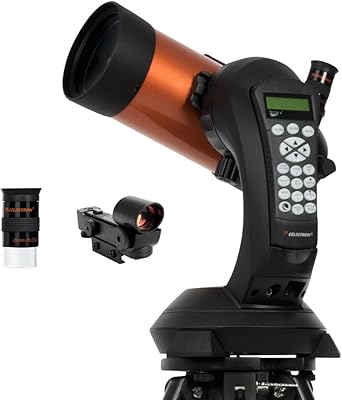
Celestron NexStar 4SE Computerized Telescope
73%
88%
GoTo Accuracy
84%
Optical Clarity
86%
Ease of Setup
81%
Portability
73%
Build Quality
More
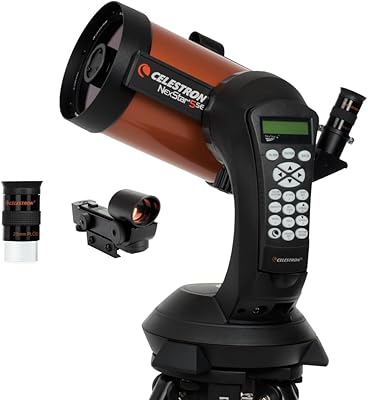
Celestron NexStar 5SE Computerized Telescope
75%
88%
Optical Performance
82%
GoTo Accuracy
84%
Ease of Setup
79%
Build Quality
83%
Portability
More
Celestron NexStar 6SE Computerized Telescope
72%
88%
Optical Performance
83%
GoTo Mount Accuracy
86%
SkyAlign Ease of Use
61%
Mount Stability
81%
Portability & Setup Time
More
Celestron SkyProdigy 130 Computerized Telescope
85%
92%
Ease of Setup
89%
Automatic Alignment Technology
82%
Image Quality
88%
Build Quality
85%
Battery Life
More
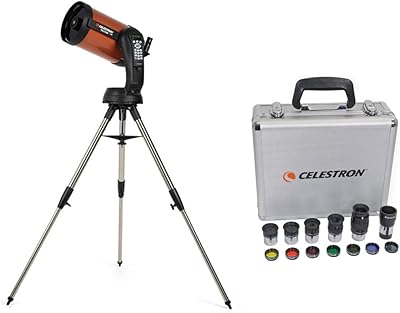
Celestron CPC 800 XLT Computerized Telescope
76%
93%
Optical Clarity
84%
GoTo Accuracy
88%
GPS Alignment System
86%
Build Quality
38%
Portability
More
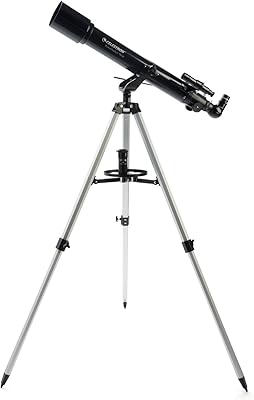
Celestron NexStar 8 SE Computerized Telescope
70%
93%
Optical Clarity
78%
GoTo Accuracy
71%
Build Quality
67%
Setup Experience
62%
Portability
More
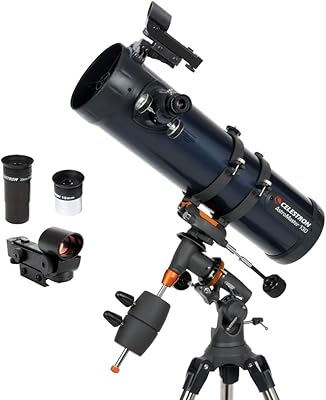
Celestron PowerSeeker 70AZ Refractor Telescope
75%
78%
Optical Clarity
88%
Ease of Setup
82%
Mount Usability
61%
Tripod Stability
83%
Value for Money
More
Celestron PowerSeeker 114EQ Reflector Telescope
73%
83%
Optical Performance
61%
Mount Quality
57%
Ease of Setup
74%
Included Accessories
81%
Value for Money
More

FAQ

Realistically, plan for about 20 to 30 minutes the first time while you get familiar with the hand controller and SkyAlign steps. Once you have done it two or three times, most users get that down to under 15 minutes. The biggest time sink early on is simply learning which bright objects you are pointing at.

Yes, clearly. Saturn's rings are visible at moderate magnification and, on a steady night, you can also make out the gap between the rings and the planet's disc. It is one of the most rewarding views this GoTo telescope reliably delivers.

Honestly, it is limited for deep-sky work. The 90mm aperture does not gather enough light to make most galaxies and nebulae look like the photographs you see online. Bright showpieces like the Orion Nebula or the Andromeda Galaxy are visible, but expect soft, dim impressions rather than dramatic detail. If deep-sky is your primary interest, you would want a larger aperture.

It works well once you nail the alignment. The NexStar 90SLT consistently puts objects within the field of view and keeps them centered as the Earth rotates, which is genuinely useful for sharing views with family or sketching at the eyepiece. The key is taking the three-star alignment seriously rather than rushing through it.

Battery life varies depending on how much the motors slew, but many users find a single set of batteries lasts only a couple of hours of active use. Picking up an external rechargeable battery pack that connects to the mount's power port is a very worthwhile early investment if you plan on sessions longer than an hour or two.

It is one of the better choices at this level for a motivated young observer. The Celestron NexStar 90SLT Computerized Telescope removes the steep manual learning curve that frustrates many beginners, so a curious kid can actually spend time looking at things instead of searching for them. That said, it helps to have a patient adult around for the first couple of alignment sessions.

For basic lunar and planetary snapshots using a smartphone adapter held up to the eyepiece, yes. For anything more serious — long-exposure deep-sky photography — no. The altazimuth mount causes field rotation during long exposures, which ruins the image. If astrophotography is a goal, you would need an equatorial GoTo mount instead.

It is functional straight out of the box — the included eyepiece, red-dot finder, and hand controller are all you need for a first session. Over time most users add a second or third eyepiece for different magnification ranges, and a rechargeable battery pack, but those are upgrades rather than necessities.

The tripod is functional but it is the weakest part of the package. Light to moderate touches will cause some vibration that takes a few seconds to settle. It is manageable for visual observing, but it does not feel premium. Many users upgrade the tripod after a few months once they decide they are in the hobby for the long term.

No. The hand controller is entirely self-contained and does not require a phone, tablet, or computer to navigate the database and slew to objects. The included Starry Night software is a separate desktop program for planning sessions before you head outside, not a requirement for operating the mount itself.

Where to Buy