Overview

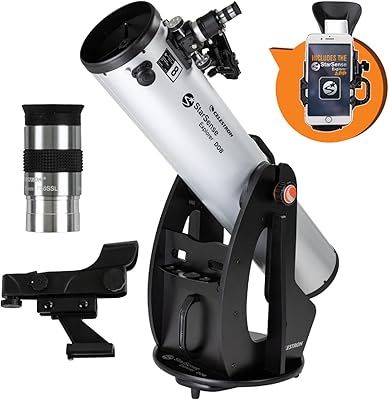
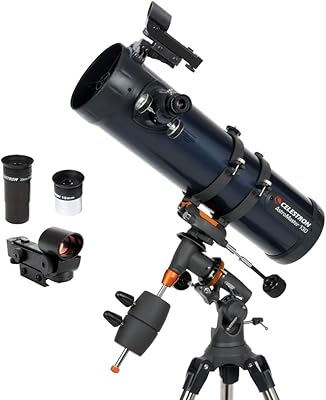
The Celestron StarSense Explorer 8″ Dobsonian Telescope is Celestron's answer to one of astronomy's oldest frustrations: pointing a scope at something you simply cannot find. Celestron has been building optics in California since 1960, and this instrument carries that pedigree — but with a genuinely modern twist. Dock your smartphone, launch the StarSense app, and it uses sky-pattern recognition to determine exactly where your tube is pointing, then guides you with on-screen arrows. The 8-inch aperture is a real step up from the 60mm or 70mm scopes that so often disappoint first-timers, unlocking deep-sky objects smaller instruments can't reach. Just know upfront: this is a backyard instrument, not something you casually toss in a car.

Features & Benefits

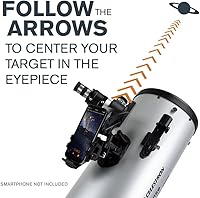
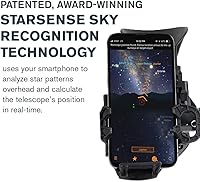
What separates the StarSense Explorer 8-inch from similarly priced manual scopes is how it handles navigation. Rather than relying on GPS coordinates alone, the StarSense app photographs the actual sky above you, matches star patterns, and pinpoints where your tube is pointing with real accuracy. You still physically nudge the scope using the rocker-box base — smooth and wobble-free — but the bullseye indicator turns green once you're centered on target, removing most of the guesswork. Optically, the 203mm Newtonian reflector with XLT coatings gathers 841 times more light than the naked eye. On a clear night, Saturn's rings are unmistakable and the Orion Nebula shows genuine structure. The included 25mm Plössl eyepiece delivers 48x magnification straight out of the box.

Best For

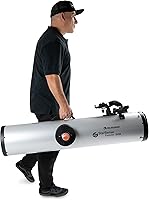
This app-guided telescope is built for beginners who want real results without a semester of study. Families with curious teenagers, adults picking up stargazing as a weekend hobby, and suburban observers frustrated by light pollution will all find it genuinely useful — the app prioritizes targets visible from your exact location. That said, it demands honest self-assessment before buying. At over 43 pounds split between the optical tube and base, setup takes effort, and this is not a scope you grab spontaneously. Worth mentioning: mirrors may occasionally need collimation, which sounds intimidating but is a straightforward process once you do it once. If you have a backyard and patience to learn, this Dobsonian punches well above its class.

User Feedback

Owners of this Dobsonian largely agree on the strengths: the app is fast, target acquisition that once took beginners twenty minutes now takes under two, and optical clarity at this aperture consistently impresses. Where feedback gets more mixed is around practicality. The weight catches some buyers off guard — a few admit they underestimated how involved the setup would be. Others mention the app occasionally needs recalibration in hazy or heavily light-polluted conditions. Celestron's support team earns positive mentions more often than you'd expect in online reviews, which reflects well on the warranty experience. One recurring request: a second, higher-magnification eyepiece included in the box. The 25mm is a fine starting point, but keen observers will want more reach fairly quickly.

Pros

  • Sky-pattern recognition navigation is genuinely accurate, not just a GPS estimate based on your coordinates.
  • The 203mm aperture reveals Saturn's rings, lunar craters, and deep-sky objects that smaller starter scopes simply cannot show.
  • The rocker-box Dobsonian base is stable, smooth to move, and requires zero batteries or motors to operate.
  • The on-screen bullseye turns green when you are on target, giving beginners clear, immediate feedback.
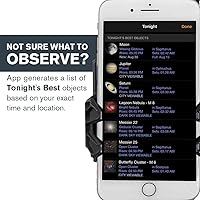
  • The StarSense app works on both iPhone and Android and generates a personalized nightly target list automatically.
  • Build quality is noticeably solid for this price tier — optical tube and base both feel substantial and well-made.
  • Celestron's US-based support team and two-year warranty provide real backup if anything goes wrong.
  • No complex alignment rituals or motorized systems means fewer things that can break or need regular calibration.
  • The 8-inch aperture gives experienced observers enough light-gathering to grow into for years, not just months.

Cons

  • At over 43 pounds total, setup and transport require real planning — this is not a spontaneous-use instrument.
  • Only one eyepiece is included; most users will want to buy a second, higher-magnification option fairly quickly.
  • The app occasionally needs recalibration in humid conditions or areas with significant light pollution, which can interrupt a session.
  • Mirror collimation may be needed periodically, which can feel daunting for complete beginners encountering it for the first time.
  • The StarSense dock is designed for a specific phone orientation and may not fit every smartphone case without removal.
  • There is no motorized tracking, so objects drift out of view at higher magnifications and need constant manual correction.
  • Storage requires dedicated space — the optical tube alone is 44 inches long and nearly 10 inches in diameter.
  • The app relies on your phone battery, meaning a cold night of extended use can drain your device faster than expected.

Ratings

Our AI rating system analyzed verified global user reviews for the Celestron StarSense Explorer 8″ Dobsonian Telescope, actively filtering out incentivized, bot-generated, and duplicate submissions to surface what real buyers actually experience. The scores below reflect a balanced synthesis of genuine praise and recurring frustrations — nothing is smoothed over to make the product look better than it is. Where this app-guided telescope genuinely excels and where it falls short are both transparently represented in the categories below.

Optical Performance
91%
The 203mm aperture with XLT-coated mirrors consistently impresses users who have previously owned smaller refractors or budget reflectors. Observers report clearly seeing Saturn's ring structure, Jupiter's equatorial bands, and the core of the Andromeda Galaxy from suburban backyards — performance that justifies the investment at this aperture class.
A small number of users note that the single included 25mm eyepiece limits the range of magnification available out of the box, meaning planetary detail requires an additional purchase. Under poor atmospheric seeing conditions, the 8-inch aperture can also amplify atmospheric turbulence more than smaller scopes would.
App Navigation Accuracy
88%
The sky-pattern recognition approach genuinely outperforms GPS-only planetarium apps for pointing accuracy, and most users report locking onto targets within seconds of following the on-screen arrows. Beginners who expected to spend weeks learning star-hopping describe finding the Orion Nebula on their very first night as a real revelation.
In humid conditions or heavily light-polluted skies, the app occasionally struggles to capture enough star patterns for accurate calibration and may require a manual restart of the alignment process. A handful of users also report needing to recalibrate mid-session when clouds temporarily obscure the sky.
Ease of Use
86%
The guided bullseye system, combined with the nightly target list curated to your location, removes virtually all the decision fatigue that derails first-time telescope owners. Families report that even younger teenagers can independently locate and observe objects after just one guided session.
The app is intuitive but requires a functioning smartphone with adequate battery — cold observing nights can drain phones faster than expected, cutting sessions short. First-time assembly also takes longer than the packaging implies, and orienting the focuser and mounting the smartphone dock correctly adds friction to the initial experience.
Build Quality
84%
The optical tube feels substantial and well-constructed, with a focuser that draws smoothly without slipping — a detail that matters when you are trying to hold a target steady at higher magnification. The rocker-box base is solid wood and composite construction that absorbs vibration effectively on flat surfaces.
Some users note that the altitude tension adjustment can feel slightly loose after extended use and benefits from a minor re-tightening. The smartphone dock, while functional, feels like the least premium component on an otherwise well-built instrument.
Value for Money
79%
21%
For buyers who have previously lost interest in cheap, frustrating starter telescopes, the guided navigation dramatically increases the chance that this scope actually gets used regularly — which makes the higher price feel justified. The optical quality-to-aperture ratio is competitive with non-app Dobsonians in the same size class.
The premium over a comparable non-app 8-inch Dobsonian is meaningful, and buyers who are already comfortable star-hopping may feel they are paying for a feature they do not need. The absence of a second eyepiece at this price point is a recurring complaint that feels like a missed opportunity.
Portability & Storage
51%
49%
The scope does separate into two distinct pieces — tube and base — which makes moving it manageable with two people and allows it to fit in most mid-size SUVs or station wagons when laid flat. Setting up in a fixed backyard location largely sidesteps the portability issue for users who identify a regular observing spot.
At over 43 pounds combined, this is one of the most common sources of post-purchase regret among buyers who did not fully anticipate what transporting it involves. Apartment dwellers or those without a car suitable for large equipment frequently report leaving the scope assembled and unused because the effort of moving it is too high.
Setup & Assembly
73%
27%
Once you have done the initial assembly twice, the process of putting the tube on the base and getting the app calibrated becomes reasonably quick — many users report a 10-to-15-minute routine for repeated sessions. Celestron's included documentation is clearer than what comes with many comparable instruments.
First-time setup can take the better part of an hour, and the instructions for the smartphone dock alignment could be more explicit for complete novices. Users who need to collimate the mirrors for the first time — which the manual covers only briefly — often turn to third-party YouTube videos rather than the included guide.
Mount Stability
87%
The Dobsonian rocker-box design is widely regarded in the amateur astronomy community as one of the most vibration-resistant mount types available, and this implementation lives up to that reputation. Even at 200x magnification, nudging the tube to re-center a target does not introduce the vibration shaking common with cheaper tripod-mounted scopes.
Because the mount is purely manual and has no tracking capability, objects drift out of the eyepiece field in a matter of seconds at higher magnifications, requiring constant small corrections. This is an inherent trait of any non-motorized altazimuth mount rather than a defect, but it does add a repetitive task that some users find distracting.
App Features & UX
82%
18%
The curated nightly target list that adapts to your location and current sky conditions is a genuinely useful feature, not just a gimmick — it gives beginners a structured observing session rather than aimless wandering. The interface is clean, responds quickly, and does not require an account or subscription to use core features.
The app has occasional bugs on older Android devices, and a small number of users report crashes that require re-alignment from scratch. Celestron has pushed updates since launch, but the experience is not yet as polished as dedicated planetarium apps that have had years of refinement.
Accessories Included
62%
38%
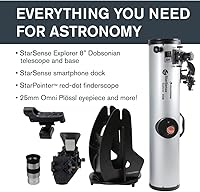
The 25mm Plössl eyepiece is a legitimate quality starting point — far better than the low-grade eyepieces often bundled with budget telescopes — and the StarPointer red-dot finderscope is useful for initial orientation before handing off to the app.
One eyepiece is genuinely not enough for a scope at this aperture and price level; most users find themselves buying a 10mm or 12mm eyepiece within the first month. The absence of a moon filter is also notable — the full moon through 203mm of aperture without a filter is bright enough to be uncomfortable and can temporarily affect night vision.
Collimation & Maintenance
69%
31%
The collimation process for a Newtonian reflector is a manageable, learnable skill, and the mirrors on this scope hold alignment reasonably well between sessions when handled carefully. Users who invest 20 minutes watching a tutorial report that maintaining proper collimation becomes a simple, low-effort habit.
The scope ships with no collimation tool included, which feels like an oversight given that the mirrors will eventually need alignment and complete beginners may not know what to purchase. After transport — especially over rough roads — recollimation is often necessary before a session, adding a step that can frustrate users who just want to observe.
Customer Support & Warranty
89%
Celestron's US-based support team draws genuinely positive feedback in user reviews, with multiple buyers reporting fast, knowledgeable responses to collimation questions, app troubleshooting, and parts requests. The 2-year warranty is above average for the category and reflects the brand's long-term confidence in the product.
International buyers outside the US have less direct access to support and may face longer resolution times for warranty claims. A small number of users report that replacement parts for the smartphone dock can have multi-week lead times if the unit arrives damaged.
Night Sky Coverage
85%
The app's location-aware target list performs well across different hemispheres, and users in both the northern and southern hemispheres confirm that the sky-recognition system calibrates correctly for their sky orientation. The scope genuinely delivers on its promise of covering planets, nebulae, clusters, and galaxies in a single session.
From heavily urban environments with severe light pollution, the app's calibration can be inconsistent because too few stars are visible for pattern matching. In these conditions, only the brightest targets — the Moon, Venus, Jupiter, Saturn — are comfortably within reach, which limits the scope of the experience somewhat.

Suitable for:

The Celestron StarSense Explorer 8″ Dobsonian Telescope is an ideal match for adults and families who are genuinely curious about astronomy but have no intention of spending months learning to read star charts before seeing anything rewarding. If you have a backyard or a nearby open space, and you want to move from casual moon-gazing to spotting Saturn's rings or the Andromeda Galaxy within your first few sessions, this app-guided telescope is built precisely for that progression. Teens and younger adults who are already comfortable with smartphones will adapt to the StarSense workflow almost instantly, and parents will appreciate that the guided experience keeps frustration low enough to hold a young person's interest past the first night. Suburban observers dealing with moderate light pollution will also find value here, since the app intelligently curates targets based on what is actually visible from your location on a given night. For anyone who wants serious optical performance without the complexity of a motorized or computerized mount, this Dobsonian occupies a genuinely practical sweet spot.

Not suitable for:

The Celestron StarSense Explorer 8″ Dobsonian Telescope is the wrong tool for anyone expecting a grab-and-go experience — at over 43 pounds split across two separate pieces, this is a scope you set up deliberately in one place, not something you haul to a dark-sky site on a whim. Astrophotographers should look elsewhere entirely; without a motorized tracking mount, long-exposure imaging is simply not possible with this setup. If you live in an apartment or have no regular access to outdoor space, the logistical reality of storing and deploying an instrument this large will quickly outweigh the observing rewards. Budget-conscious buyers who expect the included 25mm eyepiece to cover all their needs may feel the pinch fairly soon, since the optics genuinely reward a second, higher-magnification eyepiece that does not come in the box. Finally, anyone who wants fully automatic pointing — where the telescope physically slews to a target on its own — will be disappointed; the app guides you, but your hands still do the moving.

Specifications

  • Optical Design: The telescope uses a Newtonian reflector configuration, which offers excellent light-gathering efficiency at an affordable price compared to refractors of equivalent aperture.
  • Aperture: The primary mirror measures 203mm (8 inches) in diameter, gathering 841 times more light than the unaided human eye.
  • Focal Length: The optical tube has a focal length of 1200mm, giving the scope a focal ratio of f/5.9.
  • Included Eyepiece: A 25mm Plössl eyepiece is included, delivering 48x magnification straight out of the box with a reasonably wide field of view.
  • Mirror Coatings: The primary and secondary mirrors feature Celestron's XLT high-reflectivity coatings, designed to maximize light transmission and image contrast.
  • Mount Type: The scope ships with a manual altazimuth Dobsonian rocker-box base that moves smoothly in both altitude and azimuth without any motors or external power.
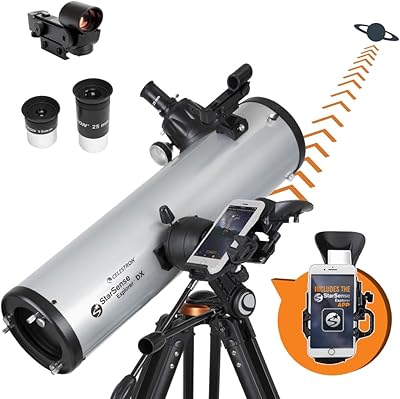
  • Finderscope: A StarPointer red-dot finderscope is included for basic naked-eye alignment before using the StarSense app for precise navigation.
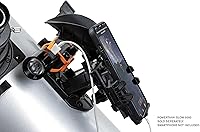
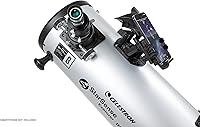
  • App Compatibility: The StarSense Explorer app is compatible with both iOS and Android smartphones and connects via the included adjustable dock mounted on the optical tube.
  • Tube Dimensions: The optical tube measures 44 inches long by 9.5 inches in diameter (approximately 1117mm x 241mm).
  • Base Dimensions: The Dobsonian rocker-box base measures 27 x 19 x 19 inches (650mm x 483mm x 483mm) when assembled.
  • Optical Tube Weight: The optical tube alone weighs 20.6 lbs (9.34 kg), and should be handled as a separate piece during transport and setup.
  • Base Weight: The rocker-box base weighs 22.8 lbs (10.34 kg), bringing the total instrument weight to approximately 43.4 lbs combined.
  • Power Source: The Dobsonian mount operates entirely without external power; one lithium metal battery is required for the StarPointer red-dot finderscope only.
  • Warranty: Celestron covers this telescope with a 2-year US warranty and provides unlimited support from their US-based customer service team.
  • Manufacturer: Celestron is headquartered in Torrance, California, and has been manufacturing telescopes and optical instruments since 1960.
  • Light Gathering: The 203mm aperture provides 841x the light-gathering power of the human eye, enabling clear views of faint deep-sky objects under dark or suburban skies.
  • Max Magnification: Practical maximum usable magnification for this aperture is approximately 406x under ideal atmospheric conditions, though most observers use far lower power for the best views.
  • Product Dimensions: The fully assembled telescope measures approximately 49 x 18.5 x 19 inches when the tube is mounted on the base.

Related Reviews

Celestron StarSense Explorer 8″ Dobsonian Telescope
81%
91%
Ease of Use
88%
Optical Performance
86%
StarSense App & Technology
89%
Mount Stability
83%
Value for Money
More
Celestron StarSense Explorer DX 102AZ Refractor Telescope
77%
88%
Ease of Setup
81%
StarSense App Performance
84%
Optical Clarity
61%
Deep-Sky Performance
67%
Mount Stability
More
Celestron StarSense Explorer LT 114AZ
74%
88%
App Navigation Experience
83%
Optical Clarity
86%
Ease of Setup
61%
Mount Stability
79%
Value for Money
More
Celestron StarSense Explorer LT 80AZ Refractor Telescope
77%
88%
App Navigation Experience
83%
Optical Clarity
91%
Ease of Setup
61%
Build Quality
86%
Value for Money
More
Celestron StarSense Explorer DX 5″ Telescope
73%
88%
Ease of Setup
83%
App Navigation Accuracy
79%
Optical Performance
61%
Mount Stability
57%
Manual Tracking Experience
More
Celestron StarSense Explorer DX 130AZ
76%
91%
App Navigation & Sky Recognition
83%
Optical Performance
88%
Ease of Setup & Assembly
67%
Mount Stability & Build
58%
Collimation & Optical Alignment
More
Celestron NexStar 8 SE Computerized Telescope
70%
93%
Optical Clarity
78%
GoTo Accuracy
71%
Build Quality
67%
Setup Experience
62%
Portability
More
Sky-Watcher Flextube 200 Dobsonian 8-inch Collapsible Telescope
82%
88%
Ease of Setup
90%
Portability
82%
Optical Performance
85%
Build Quality
83%
Stability during Use
More
Celestron PowerSeeker 70EQ Refractor Telescope
71%
78%
Optical Clarity
83%
Mount Quality & Stability
61%
Ease of Assembly
74%
Accessory Bundle Value
86%
Portability
More
Celestron NexStar 6SE Computerized Telescope
72%
88%
Optical Performance
83%
GoTo Mount Accuracy
86%
SkyAlign Ease of Use
61%
Mount Stability
81%
Portability & Setup Time
More

FAQ

None at all. The whole point of this setup is to remove the learning curve that trips up most beginners. You dock your phone, let the StarSense app analyze the sky above you, and then follow the on-screen arrows to your target. You still physically move the tube yourself, but the app tells you exactly which direction to nudge it until the bullseye turns green.

The app supports both iPhone and Android devices, so most modern smartphones will work fine. Just make sure your phone fits the adjustable dock on the tube — very large phones with thick cases may need the case removed to seat properly. It is worth checking the Celestron website for the current list of confirmed compatible devices before buying.

Quite a lot, honestly. On a clear night you can see Saturn's rings and the Cassini Division within them, Jupiter's cloud bands and its four large moons, the craters and mountain ranges of the Moon in crisp detail, and deep-sky objects like the Orion Nebula and the Andromeda Galaxy. From a dark-sky location the views open up considerably; from suburban areas you will still get excellent planetary and lunar views.

The initial assembly is straightforward but does take some time — expect 30 to 45 minutes for the first setup as you get familiar with the parts. After that, breaking it down into the tube and base and reassembling it is much quicker. The weight is the main challenge: the tube and base together top 43 pounds, so having a second person handy for the first setup is genuinely helpful.

Not in any practical sense, no. The Dobsonian mount is entirely manual with no tracking motor, meaning the sky drifts through the field of view constantly. You can capture quick snapshots of the Moon by holding a phone up to the eyepiece, but long-exposure deep-sky photography requires a motorized equatorial mount, which is a completely different type of equipment.

Collimation is the process of aligning the telescope's mirrors so they all point in precisely the right direction. The Celestron StarSense Explorer 8″ Dobsonian Telescope may need occasional collimation, particularly after transport. It sounds intimidating, but it is actually a simple procedure once you have done it once — Celestron provides a guide, and there are clear video tutorials available online. A basic collimation cap or a Cheshire eyepiece (inexpensive accessories) makes the job even easier.
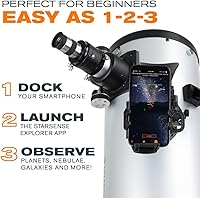
Yes, the core sky-navigation function of the StarSense app works offline once the app is installed, because it analyzes the sky using your phone's camera rather than pulling data from the internet. You will need a connection for initial download, updates, and some supplementary content, but you do not need cell signal or Wi-Fi out in the field.

With a bit of initial guidance from an adult, yes. The app-driven navigation makes target-finding accessible to younger users who would otherwise struggle to interpret star charts. The main consideration is the physical size — moving and lifting the tube safely requires some adult supervision, especially at first. The observing experience itself is well within reach for a motivated young teenager.

The included 25mm Plössl eyepiece gets you started, but most observers find themselves wanting a second eyepiece fairly quickly — something in the 10mm to 12mm range for higher magnification on planets. A moon filter is also a worthwhile early addition, since the full moon through an 8-inch aperture can be uncomfortably bright. Beyond that, the scope is genuinely ready to use as shipped.

A comparably sized manual Dobsonian without the StarSense system would likely cost less, but you would need to learn star-hopping or use a physical star atlas to find targets. For someone comfortable doing that, it is a reasonable alternative. For a beginner who wants to spend their time actually observing rather than searching, the app-guided approach on this Dobsonian closes the gap between opening the box and having a rewarding experience dramatically faster.

Where to Buy