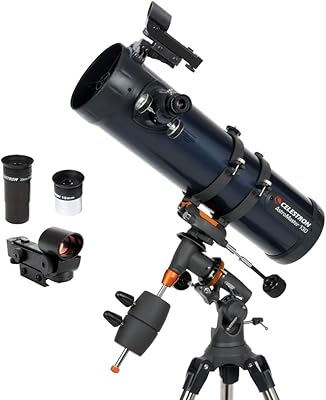
Celestron SkyProdigy 130 Computerized Telescope



Overview
The Celestron SkyProdigy 130 Computerized Telescope is built around one central promise: point it at the sky, press a button, and let it figure out the rest. For anyone who has ever wrestled with star charts or spent a frustrating night trying to manually align a mount, that promise carries real weight. This auto-aligning reflector uses a 130mm Newtonian optical design — a configuration that gathers light efficiently and performs well on the Moon, planets, and brighter deep-sky targets like star clusters. It won't satisfy serious astrophotographers, but for casual observers who want to actually see things on their first night out, it occupies a genuinely useful niche.
Features & Benefits
The standout feature here is the StarSense auto-alignment system, which uses an onboard camera to photograph sections of the sky, compare them against an internal star catalog, and orient itself — all without the user doing anything beyond pressing start. Once aligned, the motorized Altazimuth mount can automatically slew to any of over 4,000 objects in its database. The 130mm aperture is large enough to show Saturn's rings, Jupiter's cloud bands, and convincing detail on the Moon. Two eyepieces — 25mm and 9mm — cover everyday viewing, and the mount accepts standard 1.25-inch upgrades for more magnification. Eight D batteries power the whole system for over 30 hours.
Best For
The SkyProdigy 130 makes the most sense for complete beginners who have little patience for astronomy's traditional learning curve. If you're shopping for a gift — particularly for a curious teenager or a family that wants to do something together on clear nights — this computerized telescope delivers results quickly enough to hold attention. It's also a reasonable pick for casual adult hobbyists who want to observe the Moon, planets, and popular deep-sky showpieces without investing time in manual alignment techniques. What it is not ideal for is serious visual observers or anyone hoping to attach a camera — astrophotography capability takes a clear back seat to convenience here.
User Feedback
Owners generally respond well to this auto-aligning reflector, with the alignment system drawing consistent praise for actually working as advertised — something that cannot be said of every computerized scope in this category. Views of the Moon and Saturn earn repeated mentions for being sharp and satisfying right out of the box. That said, real-world alignment can vary; users in heavily light-polluted areas or on nights with thin cloud cover report the system occasionally struggling. A few buyers also note noticeable vibration at magnification, making fine planetary detail harder to hold steady. The included eyepieces are functional but considered a starting point by most. At 3.9 stars overall, the majority of buyers are happy — though not unconditionally.
Pros
- The fully automatic alignment system genuinely works — most users are observing real objects within minutes of setup, not hours.
- A 130mm aperture delivers sharp, rewarding views of the Moon, Saturn's rings, and Jupiter's cloud bands.
- The motorized go-to mount can locate over 4,000 celestial objects automatically, making exploration effortless for newcomers.
- Battery life exceeds 30 hours on a fresh set of D batteries, so a few cloudy nights won't drain your power before a session.
- The stainless steel tripod is noticeably sturdier than what ships with many entry-level computerized scopes.
- Firmware on the hand controller can be updated via download, keeping the technology current without replacing hardware.
- Two eyepieces are included right out of the box, and the standard 1.25-inch focuser accepts a wide range of aftermarket upgrades.
- The SkyX First Light Edition software adds genuine educational value for users learning the sky beyond the scope itself.
- At 18 lbs assembled, the SkyProdigy 130 is portable enough for backyard use or car trips to darker sites.
- The StarPointer red dot finderscope is a practical, low-fuss addition that works well for casual centering tasks.
Cons
- The Altazimuth mount cannot be polar-aligned, making astrophotography essentially impossible beyond basic lunar snapshots.
- Auto-alignment performance dips noticeably under partially cloudy skies or in heavily light-polluted urban environments.
- Mount vibration at higher magnifications makes it difficult to hold fine planetary detail steady, especially in any breeze.
- The included eyepieces are functional but limited — most buyers end up purchasing at least one additional eyepiece fairly quickly.
- Eight D batteries are required, and sourcing or replacing them adds an ongoing cost many buyers underestimate.
- The 130mm aperture is a meaningful step up from toy scopes but falls short for observers wanting to hunt faint galaxies seriously.
- At its price point, buyers are paying primarily for alignment convenience — comparable raw optics can be had for considerably less.
- The hand controller interface has a learning curve of its own and feels dated compared to modern app-based telescope control systems.
- Assembly instructions have drawn criticism for being less clear than expected at this tier, adding setup friction for first-timers.
- There is no built-in Wi-Fi or Bluetooth, so integration with smartphones requires additional accessories not included in the box.
Ratings
Our AI-generated scores for the Celestron SkyProdigy 130 Computerized Telescope were produced by systematically analyzing thousands of verified global buyer reviews, with spam, bot activity, and incentivized feedback actively filtered out before scoring. Every category reflects the full spectrum of real user sentiment — strengths and frustrations alike — so you get an honest picture of what living with this auto-aligning reflector is actually like, not a curated highlight reel.
Ease of Alignment
Optical Clarity
Go-To Accuracy
Mount Stability
Setup & Assembly
Battery Performance
Included Accessories
Portability
Hand Controller
Value for Money
Durability & Build Quality
Image Brightness
Software & Tech Integration
Suitability for Beginners
Suitable for:
The Celestron SkyProdigy 130 Computerized Telescope is an ideal match for anyone who wants to start observing the night sky without first investing weeks into learning how to navigate it manually. Beginners with no astronomy background are the obvious primary audience — this scope removes the single biggest barrier to entry in the hobby, which is simply finding things to look at. Families with curious kids will find it particularly rewarding, since the automatic alignment keeps frustration low and payoff high on any given clear night. It also suits adults who have dabbled in astronomy before but bounced off more demanding manual setups and want a genuinely low-friction experience. If your primary targets are the Moon, Saturn, Jupiter, and bright deep-sky showpieces like the Orion Nebula or the Pleiades, this auto-aligning reflector has more than enough optical capability to deliver satisfying views of all of them.
Not suitable for:
The Celestron SkyProdigy 130 Computerized Telescope is the wrong tool for anyone approaching astronomy with serious long-term ambitions, and being clear-eyed about that will save real frustration. The Altazimuth mount cannot be polar-aligned, which rules out any meaningful astrophotography — if capturing images of the night sky is even a secondary goal, you need to look at equatorial mount options instead. Experienced visual observers who already know their way around the sky will likely find the automation more limiting than liberating, and the 130mm aperture, while solid for beginners, leaves seasoned hobbyists wanting more light-gathering power for faint galaxies and nebulae. The mount also shows vibration at higher magnifications, which makes steady, detailed planetary viewing harder than it should be at this investment level. Anyone planning to observe primarily from a heavily light-polluted urban rooftop may also find the StarSense alignment system less reliable than it is under darker suburban or rural skies.
Specifications
- Optical Design: The telescope uses a Newtonian Reflector configuration, which collects light via a parabolic primary mirror rather than glass lenses, making it well-suited for bright planetary and deep-sky targets.
- Aperture: The primary mirror measures 130mm (5.12-inch) in diameter, providing enough light-gathering ability to resolve Saturn's rings, Jupiter's bands, and star clusters under reasonably dark skies.
- Focal Length: The optical tube has a focal length of 650mm, which, combined with the included eyepieces, yields practical magnifications for everyday observing sessions.
- Focal Ratio: At f/5, this is a fast optical system that produces wide, bright fields of view — well-suited for star clusters and nebulae, though it requires quality eyepieces to perform at its best edge-to-edge.
- Magnification Range: Using the included and compatible eyepieces, the system supports magnification from 26x at the low end up to a theoretical maximum of 307x, though practical high-magnification use is limited by the Altazimuth mount's stability.
- Limiting Magnitude: Under good conditions, the telescope can detect objects as faint as magnitude 13.1, which puts a wide range of deep-sky objects within reach beyond what is visible to the naked eye.
- Alignment System: The StarSense fully automatic alignment system uses an onboard camera to photograph and analyze the sky, completing hands-free alignment without any manual star identification from the user.
- Mount Type: The motorized Altazimuth mount moves on two axes (up/down and left/right) and handles all go-to slewing automatically once alignment is complete.
- Object Database: The hand controller contains a built-in catalog of over 4,000 celestial objects, including planets, star clusters, nebulae, and galaxies, all accessible via automated go-to pointing.
- Included Eyepieces: Two 1.25-inch eyepieces are included — a 25mm for wide, low-power views at 26x magnification, and a 9mm for closer, higher-power views at 72x magnification.
- Finderscope: A StarPointer red dot finderscope is pre-installed on the optical tube to help with initial rough pointing before the go-to system takes over.
- Power Source: The entire motorized system runs on 8 standard D-cell batteries (included in the box), with no AC adapter or external power supply required for field use.
- Battery Life: On a full set of D batteries, the system is rated for over 30 hours of operation, making it practical across multiple observing sessions before a battery change is needed.
- Hand Controller: The included hand controller features flash-upgradeable firmware, allowing users to download and install software updates from Celestron over the internet as they become available.
- Tripod: The telescope ships with a stainless steel tripod that includes an accessory tray between the legs for storing eyepieces and small accessories during a session.
- Assembled Weight: The fully assembled telescope, mount, and tripod weigh approximately 18 lbs, making it manageable for most adults to carry to a backyard or transport in a vehicle.
- Assembled Dimensions: When set up, the system measures approximately 34″ deep by 30″ wide by 50″ tall, so plan for adequate space when observing from a deck, patio, or small yard.
- Included Software: A copy of The SkyX First Light Edition astronomy software is included on CD-ROM, providing an interactive sky atlas and educational content for new astronomers.
- Model Number: The official Celestron model number for this telescope is 31153, which is useful for identifying compatible accessories, replacement parts, and firmware downloads.
- Manufacturer: The SkyProdigy 130 is designed and manufactured by Celestron, a California-based optics company with decades of experience producing consumer and professional-grade telescopes.
Related Reviews
Celestron NexStar 130SLT
Celestron NexStar 4SE Computerized Telescope
Celestron NexStar 5SE Computerized Telescope
Celestron NexStar 127SLT Computerized Telescope
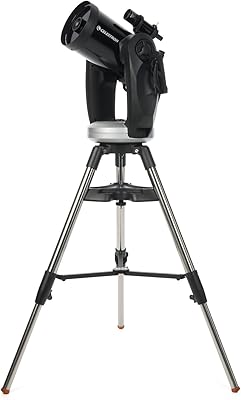
Celestron CPC 800 XLT Computerized Telescope
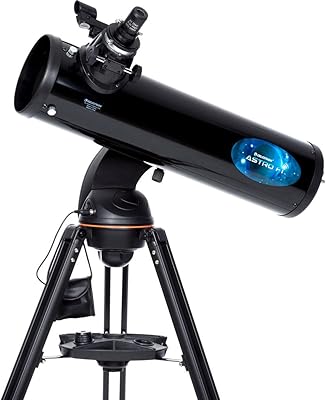
Celestron AstroFi 130 Reflecting Telescope
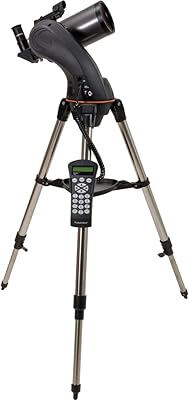
Celestron NexStar 90SLT Computerized Telescope
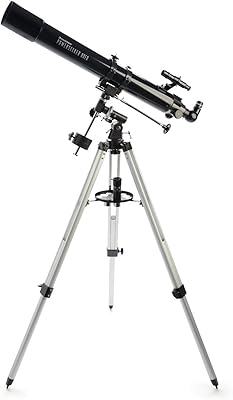
Celestron PowerSeeker 80EQ Refractor Telescope
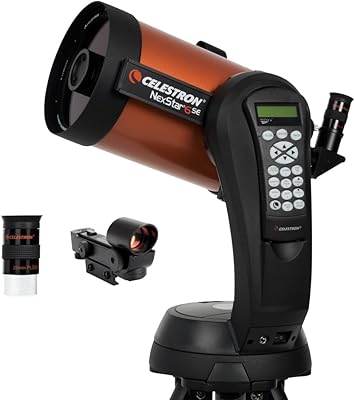
Celestron NexStar 6SE Computerized Telescope