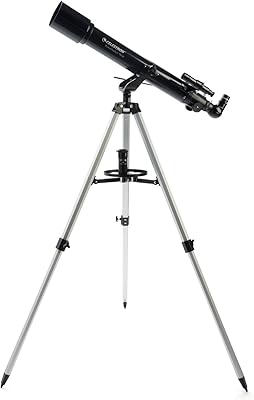
Celestron NexStar 130SLT
Overview
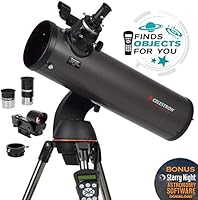
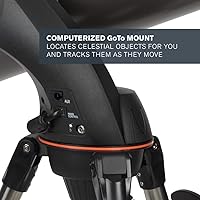
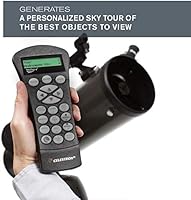
The Celestron NexStar 130SLT is a computerized Newtonian reflector that sits comfortably in the mid-range space between toy-store scopes and serious amateur equipment. Its biggest draw is the SkyAlign GoTo system, which lets you align on three bright objects and then hands you a database of over 4,000 targets — no star charts required. As the largest-aperture model in Celestron's SLT family, it punches noticeably harder than its siblings when it comes to light gathering. The design has been on the market since 2005, which speaks to its staying power. Just keep expectations realistic: this is a visual observing scope, not a platform built for astrophotography.
Features & Benefits
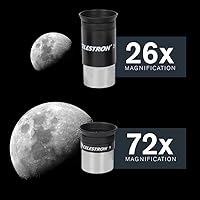
The 130mm aperture is the heart of what makes this GoTo telescope worth considering. That light-gathering surface translates directly into views: Saturn's rings come through with clear definition, Jupiter shows distinct cloud bands, and the Moon can keep you busy for hours. The automatic tracking feature keeps objects centered as Earth rotates, which is surprisingly useful once you realize how fast things drift at higher magnifications. Two eyepieces (20mm and 9mm) cover a useful range right out of the box, and the included Starry Night software adds a solid planning tool for pre-session research. Running on eight AA batteries, it's genuinely portable and self-contained — no AC outlets needed at a dark-sky site.
Best For
This computerized reflector is tailor-made for people who want to actually see things on their first night out rather than spend an hour hunting down a single object manually. It works especially well for families with curious kids — picture a clear autumn night, the scope set up in the backyard, and a ten-year-old watching Saturn inch across the eyepiece while the hand controller does all the work. Campers heading to low-light areas will appreciate how quickly it breaks down and fits in a car. If you're upgrading from a flimsy department-store scope, the difference will feel immediate. Dedicated astrophotographers, though, should look elsewhere — the altazimuth mount simply wasn't designed for long exposures.
User Feedback
Owners consistently praise how fast the alignment process is — most people have the scope tracking live objects within ten minutes of opening the box, which is a big deal for beginners. The hand controller gets positive marks for being genuinely intuitive. On the downside, battery drain on cold nights comes up repeatedly, so keeping a fresh set on hand is practical advice. A fair number of users also mention that the stock eyepieces, while usable, leave something to be desired at higher power — a mid-range 6mm or Barlow lens goes a long way. This GoTo telescope earns strong marks overall for visual observing, but anyone hoping to photograph the night sky will quickly hit the hardware's ceiling.
Pros
- The SkyAlign GoTo system locates objects automatically, cutting out the frustrating trial-and-error of manual star-hopping.
- Saturn's rings and Jupiter's cloud bands are visible with satisfying clarity on a steady night.
- Automatic tracking keeps targets centered, so everyone in the family gets a proper look without rushing.
- At under 12 lbs, this computerized reflector is light enough for a solo trip to a dark-sky site.
- A 4,000-plus object database means you will not run out of targets for a long time.
- Battery-powered operation means no extension cords or power inverters needed in the field.
- The included Starry Night software adds genuine value for session planning and sky education.
- A two-year warranty and US-based technical support provide real peace of mind for new buyers.
- The 130mm aperture is noticeably more capable than anything typically sold in department stores.
- Setup from carry to first-object is achievable in under 20 minutes once you know the process.
Cons
- The stock eyepieces are functional but most owners end up upgrading within a few months.
- Battery drain accelerates in cold temperatures, making a portable power tank a near-essential add-on purchase.
- The plastic focuser feels cheap relative to the price and introduces imprecision at high magnifications.
- Single-arm altazimuth vibration during slewing can be annoying, especially at higher zoom levels.
- No built-in Wi-Fi or Bluetooth means smartphone integration requires additional hardware.
- If the tripod shifts or is bumped, the entire alignment sequence must be repeated from scratch.
- Field rotation limits even casual planetary imaging to very short exposures.
- The hand controller interface feels noticeably dated compared to app-driven telescope systems.
- Faint galaxies and dim nebulae are underwhelming at 130mm, particularly under suburban skies.
- The warranty claim process involves shipping bulky optics, which is logistically inconvenient and slow.
Ratings
The Celestron NexStar 130SLT has accumulated a substantial body of verified buyer feedback across global markets, and our AI-driven scoring model has processed those reviews — actively filtering out incentivized, duplicate, and bot-generated submissions — to surface what real owners actually experience. The scores below reflect a honest cross-section of both the strengths that keep this computerized reflector among the top-ranked beginner scopes and the friction points that prevent it from scoring higher in certain categories. Nothing has been glossed over.
Ease of Setup
GoTo Accuracy
Optical Performance
Build Quality & Durability
Portability
Value for Money
Computerized Hand Controller
Included Accessories
Tracking Performance
Battery Life
Astrophotography Capability
Software Bundle
Customer Support & Warranty
Learning Curve
Suitable for:
The Celestron NexStar 130SLT is purpose-built for curious beginners and casual family astronomers who want rewarding views without a steep technical learning curve. If your goal is to see Saturn's rings clearly, trace Jupiter's cloud bands, or explore the cratered lunar surface on a Friday night in the backyard, this scope delivers on all of those experiences reliably. It is especially well-matched to parent-child pairs where one person sets up the scope and the other takes turns at the eyepiece — the automated tracking keeps the object centered long enough for everyone to get a proper look. Campers and travelers who want to take advantage of dark rural skies will appreciate how quickly it assembles and how easily it fits in a car. Adults who once owned a frustrating entry-level scope and gave up on the hobby will likely find this GoTo telescope the reboot that actually sticks.
Not suitable for:
Buyers with serious astrophotography ambitions should look elsewhere before considering the NexStar 130SLT, because the altazimuth GoTo mount introduces unavoidable field rotation that makes anything beyond casual Moon snapshots genuinely difficult. Experienced amateur astronomers who already understand the sky and want maximum aperture for their money will find that a manual Dobsonian at a similar price point gives considerably more light-gathering power without the motorized overhead. Anyone hoping to observe very faint deep-sky objects — distant galaxies, faint planetary nebulae, or globular clusters beyond the brightest examples — will hit the optical limits of a 130mm aperture fairly quickly, regardless of how good the mount is. Urban observers with heavily light-polluted skies will also feel constrained, since the scope's potential is most fully realized under moderately dark conditions. Finally, buyers who want a scope that integrates natively with a smartphone app without extra accessories may find the hand controller interface feeling dated compared to modern Wi-Fi-enabled alternatives.
Specifications
- Optical Design: The telescope uses a Newtonian reflector design with a 130mm primary mirror that gathers substantially more light than smaller entry-level scopes.
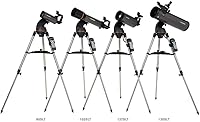
- Aperture: The primary mirror measures 130mm (approximately 5.1 inches) in diameter, making it the largest aperture in Celestron's SLT computerized lineup.
- Focal Length: The optical tube has a focal length of 650mm, yielding a fast focal ratio of f/5 that works well for both planetary and wide-field viewing.
- Included Eyepieces: The package includes a 20mm eyepiece for lower-power, wider views and a 9mm eyepiece for higher magnification on planets and the Moon.
- Mount Type: The scope rides on a single-arm altazimuth GoTo mount that motorizes both axes and handles automatic slewing and object tracking.
- Alignment System: SkyAlign technology requires the user to center any three bright objects — no prior sky knowledge needed — and the mount calculates its orientation automatically.
- Object Database: The hand controller stores a catalog of over 4,000 celestial objects including planets, stars, nebulae, galaxies, and star clusters.
- Optical Tube Length: The Newtonian tube measures 635mm in length, keeping the assembled profile compact enough to fit in most car boots without disassembly.
- Finderscope: A StarPointer red-dot finderscope is included and mounts to the optical tube to assist with initial target acquisition during alignment.
- Power Source: The mount runs on eight AA batteries housed in the base, with no AC adapter required, making it fully self-contained for remote observing locations.
- Assembled Weight: The complete system — optical tube, mount, and tripod — weighs approximately 11.4 lbs, light enough for one person to carry in two trips.
- Tripod: An adjustable stainless steel tripod supports the mount and includes a spreader tray for accessory storage and added stability during use.
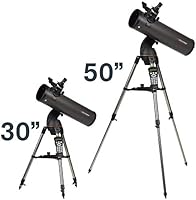
- Assembled Dimensions: When fully set up, the scope occupies a footprint of approximately 38″ deep by 56″ wide by 38″ high depending on tripod extension.
- Eyepiece Compatibility: The focuser accepts standard 1.25-inch eyepieces and is also compatible with 2-inch eyepieces using the appropriate adapter.
- Focus Mechanism: Focusing is achieved via a manual rack-and-pinion focuser built into the rear of the optical tube.
- Bonus Software: A download code for Starry Night astronomy software is included, providing an interactive sky simulation and session-planning tool for desktop use.
- Warranty: Celestron provides a two-year limited warranty supported by a US-based technical support team available for unlimited consultations.
- Manufacturer: Celestron has designed and sold telescopes from its base in California since 1960, giving the brand over six decades of optics heritage.
Related Reviews
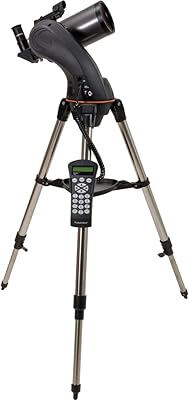
Celestron NexStar 90SLT Computerized Telescope
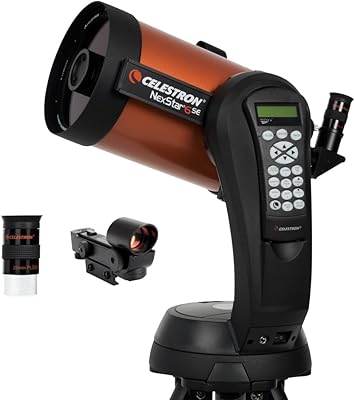
Celestron NexStar 6SE Computerized Telescope
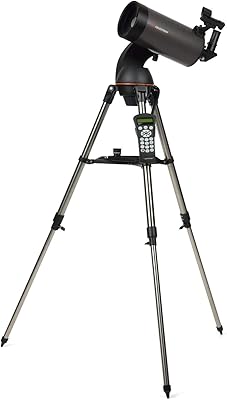
Celestron NexStar 127SLT Computerized Telescope
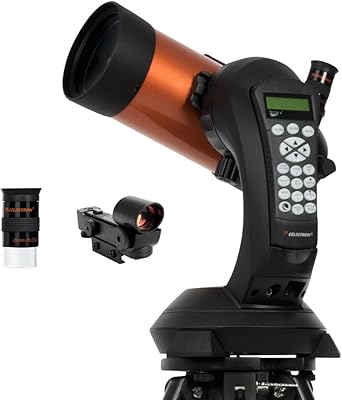
Celestron NexStar 4SE Computerized Telescope
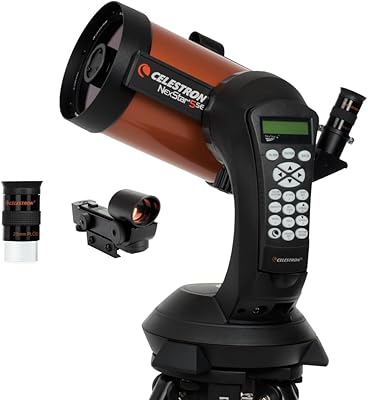
Celestron NexStar 5SE Computerized Telescope
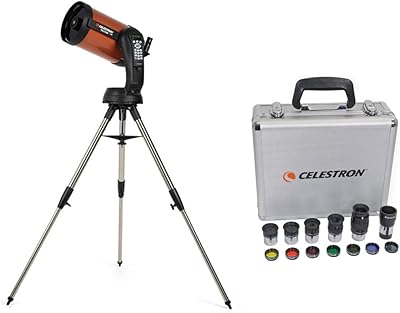
Celestron NexStar 8 SE Computerized Telescope
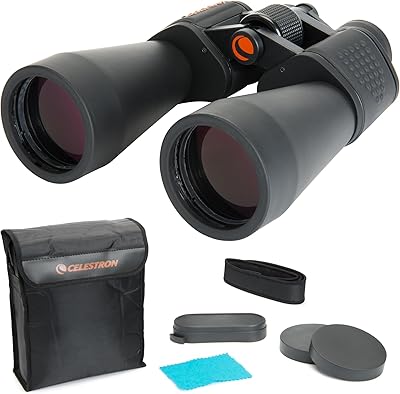
Celestron SkyMaster 12x60
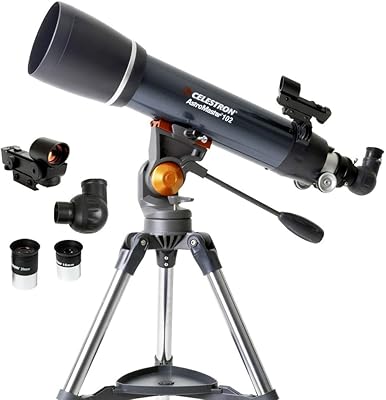
Celestron AstroMaster 102AZ Refractor Telescope
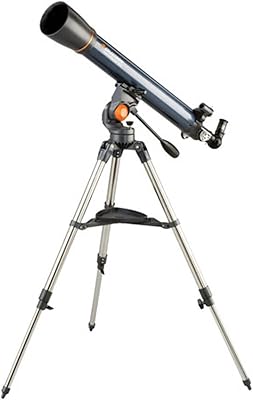
Celestron AstroMaster 90AZ Refractor Telescope