Overview

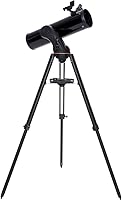
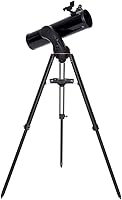
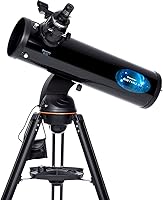
The Celestron AstroFi 130 Reflecting Telescope sits in an interesting spot — it's a classic Newtonian reflector at heart, but with a built-in WiFi connection that lets you drive it entirely from your phone. That combination sets it apart from the sea of manual beginner scopes on the market. The target audience is pretty clear: someone who wants genuine optics and real views, but doesn't want to spend months learning to star-hop manually. The computerized alt-azimuth mount handles the heavy lifting of finding objects, while the app guides you through the sky. Expect strong optical performance for this tier, though the initial app setup can take some patience to work through.
Features & Benefits

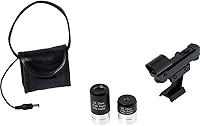
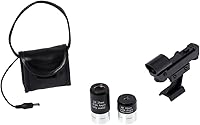
The 130mm aperture is where this Celestron reflector earns its keep — it pulls in noticeably more light than the 60mm or 70mm refractors most beginners start with, translating into crisper, brighter views of the Moon's craters and planetary detail on Jupiter or Saturn. The fully coated glass optics do their job well at this level. WiFi connectivity ties into Celestron's free SkyPortal app, which handles automated alignment and points the mount toward whatever object you select — a genuinely useful feature for anyone who's spent a frustrated half-hour hunting a specific nebula. Two Kellner eyepieces and a red dot finderscope round out a starter kit that won't immediately send you shopping for extras. The accessory tray's rubberized phone slot is a thoughtful practical touch.

Best For

The AstroFi 130 is a natural fit for tech-savvy beginners who'd rather tap a screen to locate a galaxy than flip through a star atlas at midnight. Families will find the app-guided experience genuinely engaging — it turns a potentially confusing hobby into something approachable on the first night out. Urban and suburban observers benefit especially from the computerized mount, which helps compensate for the challenge of navigating a washed-out, light-polluted sky. It also makes a strong case as a step-up scope for anyone who's outgrown a small refractor or a basic department-store telescope. As a gift, the complete included kit means the recipient can be outside observing the same evening without additional purchases.

User Feedback

Owners consistently praise lunar and planetary views as a real highlight — crisp Moon detail and recognizable features on Jupiter tend to generate the most enthusiasm. The app-guided alignment draws mixed reactions though; while it works well once connected, initial pairing hiccups are a recurring complaint worth being aware of. The single fork arm mount can feel a bit unsteady at higher magnifications, which a handful of users find limiting. Collimation is another topic that catches some buyers off guard — Newtonian mirrors can shift during shipping, and the adjustment process isn't always intuitive for first-timers. Power dependency is worth planning for as well: this WiFi telescope requires either a 12V DC adapter or eight AA batteries before you head out to a dark-sky site.

Pros

  • The 130mm aperture delivers genuinely bright, detailed views of the Moon, Jupiter, and Saturn that smaller beginner scopes simply cannot match.
  • App-guided alignment via the SkyPortal app takes the guesswork out of locating hundreds of celestial objects on your first night out.
  • Fully coated glass optics provide solid light transmission for this price tier, noticeably improving contrast on planetary targets.
  • The included two-eyepiece starter kit and red dot finderscope mean you can observe right out of the box without immediate extra purchases.
  • The computerized alt-azimuth mount is a real confidence builder for beginners who would otherwise struggle to find targets manually.
  • The rubberized phone slot on the accessory tray is a small but genuinely useful touch for real-world outdoor use.
  • Compatible with both iOS and Android, so the app works across most households without needing a specific device.
  • Overall owner satisfaction trends positive, with most complaints centered on setup rather than the quality of what you actually see through the eyepiece.

Cons

  • Initial WiFi pairing between the scope and the SkyPortal app can be inconsistent and may require multiple attempts to get right.
  • The single fork arm mount feels underdeveloped at higher magnifications, introducing wobble that affects the viewing experience.
  • Newtonian reflectors can arrive out of collimation from shipping, and the adjustment process is not beginner-friendly without a guide or tutorial.
  • Power dependency — eight AA batteries or a 12V DC adapter — requires advance preparation every time you plan a session away from home.
  • At 17 pounds with a bulky footprint, this is not a grab-and-go scope for spontaneous dark-sky trips.
  • The alt-azimuth mount cannot perform the tracking needed for astrophotography, even basic planetary imaging.
  • The included Kellner eyepieces are functional but represent the floor of optical quality — most users will want to upgrade them over time.
  • App-dependent control means a drained phone battery or a software update can disrupt an observing session at an inconvenient moment.

Ratings

The scores below reflect an AI-driven analysis of verified global user reviews for the Celestron AstroFi 130 Reflecting Telescope, with spam, bot activity, and incentivized feedback actively filtered out to surface what real buyers actually experience. This Celestron reflector earns consistently positive marks for its optical performance and app-guided convenience, though real pain points around setup, mount stability, and power dependency are transparently reflected in the numbers.

Optical Performance
86%
Owners across skill levels consistently report that lunar and planetary views exceed expectations for this aperture class. The Moon's surface detail — craters, ridges, ray systems — draws particular praise, and Jupiter's cloud bands and Saturn's rings are clearly resolved even under suburban skies. The fully coated optics hold up well against comparably priced competitors.
At higher magnifications, atmospheric turbulence and the limits of a 130mm mirror become more apparent, and some users notice slight coma toward the edge of the field — a known characteristic of fast Newtonian designs. Deep-sky performance is solid but underwhelming without a genuinely dark observing site.
App & Connectivity
71%
29%
The SkyPortal app's ability to point the mount at thousands of objects with a single tap is genuinely impressive for beginners who would otherwise spend most of a session hunting targets manually. Compatibility across both iOS and Android is reliable once the initial connection is established, and the in-app planetarium database is well-populated.
Initial WiFi pairing between the AstroFi 130 and a smartphone is the single most cited frustration among owners — dropped connections, failed handshakes, and app crashes during alignment are reported regularly. This is a meaningful barrier for users who expected a plug-and-play experience on their first night out.
Mount Stability
62%
38%
For casual visual observing at moderate magnifications — say, around 65x to 100x — the single fork arm alt-azimuth mount does its job adequately, holding the optical tube steady enough for comfortable planetary viewing. The motorized axes respond smoothly when tracking is functioning correctly, which is a genuine convenience over fully manual mounts.
Wobble becomes noticeable above around 150x, particularly in any wind or when adjusting the focuser, and the lightweight fork arm construction feels undersized relative to the optical tube's length and weight. Users who push the scope to its theoretical maximum magnification frequently report vibration damping times that interrupt the viewing experience.
Ease of Setup
67%
33%
Physical assembly of the optical tube, mount, and tripod is straightforward and well-documented, and most buyers report having the hardware together within 30 to 45 minutes on the first attempt. The included StarPointer finderscope is simple to align and provides a practical starting point for orienting the tube toward alignment stars.
The three-star alignment process required to initialize the computerized mount is where many beginners hit a wall — identifying the correct alignment stars and pointing accurately enough for the system to accept them is harder than the instructions imply. Users in light-polluted areas where fewer stars are visible report the greatest difficulty here.
Value for Money
78%
22%
The combination of a 130mm aperture, computerized alt-azimuth mount, integrated WiFi, and a complete starter accessory kit at this price tier represents a genuinely competitive package when compared against manual alternatives of similar aperture. For buyers who want guided sky navigation without spending significantly more, the value proposition holds up well.
Buyers who later discover the mount's limitations or who outgrow the app-guided approach relatively quickly may feel the premium over a comparable manual scope wasn't justified by long-term utility. The included Kellner eyepieces, while functional, are a cost-saving measure that most engaged users eventually replace.
Build Quality
69%
31%
The optical tube itself feels solid and well-constructed, and the focuser mechanism operates smoothly without excessive play. The accessory tray is a practical addition that feels integrated rather than bolted on, and the rubber-lined phone slot is a genuinely considered design detail for outdoor sessions.
The tripod and single fork arm assembly is where the construction feels less confident — the materials are noticeably lighter than what more expensive computerized mounts offer, and the overall rigidity of the system doesn't inspire full confidence when carrying or repositioning the scope in the dark.
Portability
59%
41%
At 17 pounds, the AstroFi 130 is manageable for backyard-to-patio use, and the tripod legs fold down into a reasonably compact form for storage. Most owners who use it primarily in their own yard report no real issues moving it in and out of a garage or shed on a regular basis.
Transporting this WiFi telescope to a remote dark-sky location requires deliberate planning — the bulk and weight make it an awkward one-person carry, and you'll need a dedicated power solution beyond AA batteries for extended sessions away from home. It's not a spontaneous grab-and-go instrument.
Collimation
54%
46%
Once properly collimated, the optical performance of this Celestron reflector is genuinely rewarding, and the collimation adjustment screws on the primary mirror are accessible without specialized tools for users who take the time to learn the process.
A notable share of units arrive with mirrors out of alignment from shipping, which can produce frustratingly blurry views right out of the box before the buyer understands what collimation even means. There is no collimation cap or laser collimator included, and the instructions provide only minimal guidance on the process.
Power & Battery Life
57%
43%
The option to run on standard AA batteries means this telescope can technically operate completely off-grid without purchasing additional accessories, which is useful for occasional outings where access to a power outlet isn't available.
Eight AA batteries drain faster than most users expect, particularly in cooler temperatures where battery performance drops noticeably, and the cost of regular battery replacement adds up over time. Many regular users migrate to a 12V power bank fairly quickly, which adds another item to the gear checklist for every outing.
Included Accessories
73%
27%
The two included Kellner eyepieces cover a practical magnification range for getting started, and the StarPointer red dot finderscope is a functional choice that experienced users will recognize as a reliable alignment aid. The package is complete enough that a first-time buyer genuinely doesn't need to purchase anything additional to begin observing.
The Kellner eyepieces, while usable, represent the budget end of the eyepiece spectrum, and the difference becomes apparent when compared to even modestly better Plössl or wide-angle alternatives. There's no carrying case, no collimation tool, and no moon filter included — all accessories that would meaningfully improve the out-of-box experience.
App Features & Database
77%
23%
The SkyPortal app's built-in database covers tens of thousands of objects including planets, stars, star clusters, nebulae, and galaxies, with descriptive information that adds genuine educational value for beginners exploring the sky for the first time. The augmented reality sky view mode is a useful orientation tool.
The app's interface occasionally feels dated compared to more modern astronomy applications, and some users report that the object descriptions and tour features are less polished than third-party stargazing apps. Updates and bug fixes have been inconsistent over the product's lifecycle.
Beginner Friendliness
72%
28%
The core concept — point your phone at a star map, tap a target, and watch the mount move to it — is genuinely accessible for absolute beginners and makes the first few observing sessions feel rewarding rather than frustrating. Families with children find the interactive app approach particularly engaging as an introduction to astronomy.
The gap between the marketed experience and the actual first-night reality catches many buyers off guard — collimation checks, alignment star identification, and WiFi troubleshooting are all tasks that require more background knowledge than the packaging implies. Complete beginners benefit significantly from watching setup tutorials before their first session.
Tracking Accuracy
68%
32%
Once the three-star alignment is completed successfully, the mount's tracking keeps objects centered for several minutes at a time, which is long enough for comfortable visual observing sessions without constant manual correction. For planets and the Moon, this level of tracking is practically sufficient for casual use.
Tracking drift becomes more apparent at higher magnifications, where objects wander out of the field of view faster than expected. The alt-azimuth drive also produces field rotation over extended sessions, which is a fundamental limitation of the mount type rather than a manufacturing defect, but it's still a constraint users should understand.

Suitable for:

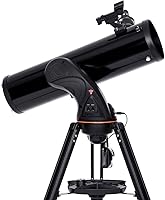
The Celestron AstroFi 130 Reflecting Telescope is a strong match for beginners and casual hobbyists who want meaningful views of the night sky without the steep learning curve of manual star-finding. If you're the kind of person who gravitates toward tech as a shortcut to results — and there's absolutely nothing wrong with that — the app-driven alignment system is going to feel like a natural fit. Families with curious kids will find the smartphone-controlled experience keeps everyone engaged far longer than a purely manual scope would. It's also a practical step-up choice for anyone who started on a small department-store refractor and felt limited by it; the 130mm aperture opens up a noticeably richer view of planets, the Moon, and brighter deep-sky objects. Urban and suburban observers benefit particularly from the computerized mount, which helps zero in on targets even when you can't easily read the sky by eye. And as a gift, the included accessory kit means there's very little left to buy before the first night out.
Not suitable for:

The Celestron AstroFi 130 Reflecting Telescope is likely to frustrate buyers who want a purely portable, off-grid observing experience — it relies on either a 12V DC power source or eight AA batteries, which requires planning ahead every time you head out. Serious hobbyists who already understand optics, mounts, and star charts will probably find the WiFi-dependent control system more of a novelty than a genuine productivity tool, and may feel constrained by the single fork arm mount's stability at higher magnifications. This is also not the right scope for anyone who wants to start astrophotography in any meaningful way; the alt-azimuth mount lacks the tracking precision that camera work demands. If you're prone to frustration with tech setup — app pairing, firmware quirks, alignment calibration — the first night experience could feel more like troubleshooting than stargazing. Finally, buyers expecting a truly grab-and-go package may be surprised by the 17-pound weight and the assembly involved before you're ready to observe.
Specifications

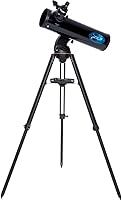
  • Optical Design: This telescope uses a Newtonian reflector design, which gathers light via a parabolic primary mirror rather than glass lenses, offering excellent value for aperture at this price tier.
  • Aperture: The primary mirror has a 130mm (roughly 5.1-inch) diameter, giving it significantly more light-gathering ability than the 60–70mm refractors common at entry level.
  • Focal Length: The optical tube has a focal length of 635mm, resulting in a fast focal ratio of approximately f/4.9 that supports wide, bright fields of view.
  • Mount Type: The scope sits on a computerized single fork arm alt-azimuth mount that motorizes both horizontal and vertical axes for automated object tracking and location.
  • Connectivity: An integrated WiFi module broadcasts its own network, allowing direct connection to the free Celestron SkyPortal app on iOS and Android devices without a home router.
  • Included Eyepieces: Two 1.25″ Kellner eyepieces are included in the box, providing a functional starting range of magnifications for Moon, planetary, and wide-field viewing.
  • Finderscope: A StarPointer red dot finderscope is pre-mounted on the optical tube to help orient the telescope toward a target area before fine-tuning with the app or eyepiece.
  • Optical Coatings: All optical surfaces feature fully coated glass, which improves light transmission and contrast compared to uncoated or partially coated budget optics.
  • Focus Mechanism: Focusing is manual, achieved by turning a rack-and-pinion focuser knob on the rear of the optical tube to bring objects into sharp view at the eyepiece.
  • Power Source: The computerized mount requires either a 12V DC 1A power adapter (tip positive) or eight AA batteries, both of which can power the motors and WiFi module during sessions.
  • Product Dimensions: The assembled telescope measures approximately 38″ deep by 38″ wide by 56″ tall, making it a mid-size instrument that needs dedicated storage space.
  • Weight: The complete setup weighs 17 pounds, which is manageable for backyard use but requires deliberate planning for transport to remote dark-sky sites.
  • Accessory Tray: A built-in accessory tray below the mount head includes storage for eyepieces and a rubber-lined slot sized to hold a smartphone or small tablet during observing sessions.
  • App Compatibility: The Celestron SkyPortal app is free to download and supports current iOS and Android operating systems, providing a database of thousands of stars, planets, and deep-sky objects.
  • Tube Length: The optical tube measures 635mm in length and is constructed with a standard cylindrical open-tube Newtonian layout that requires occasional collimation maintenance.

Related Reviews
Celestron SkyProdigy 130 Computerized Telescope
85%
92%
Ease of Setup
89%
Automatic Alignment Technology
82%
Image Quality
88%
Build Quality
85%
Battery Life
More
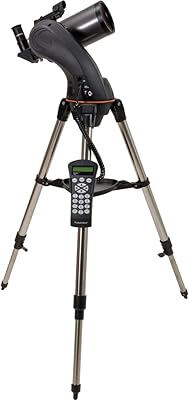
Celestron AstroFi 102 Wi-Fi Maksutov Telescope
85%
88%
Ease of Setup
91%
Wi-Fi Control
85%
Image Clarity
90%
Portability
70%
Manual Focus Adjustment
More
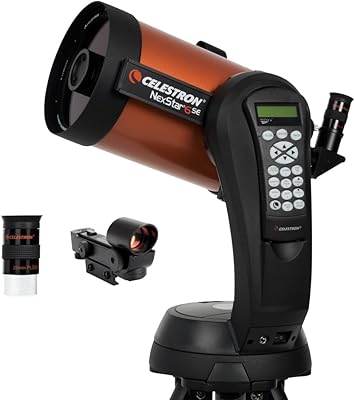
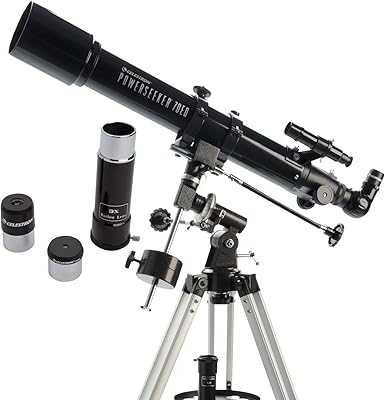
Celestron NexStar 6SE Computerized Telescope
72%
88%
Optical Performance
83%
GoTo Mount Accuracy
86%
SkyAlign Ease of Use
61%
Mount Stability
81%
Portability & Setup Time
More
Celestron PowerSeeker 70AZ Refractor Telescope
75%
78%
Optical Clarity
88%
Ease of Setup
82%
Mount Usability
61%
Tripod Stability
83%
Value for Money
More
Celestron PowerSeeker 60AZ Refractor Telescope
71%
78%
Optical Clarity
62%
Mount & Tracking
54%
Tripod Stability
67%
Eyepiece Quality
83%
Value for Money
More
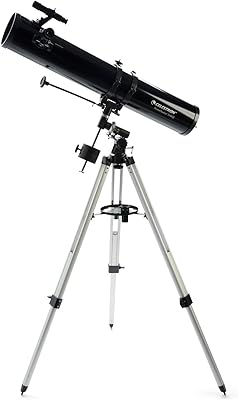
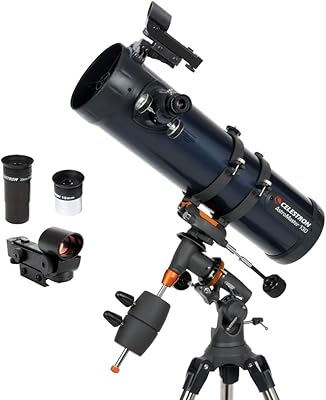
Celestron PowerSeeker 114EQ Reflector Telescope
73%
83%
Optical Performance
61%
Mount Quality
57%
Ease of Setup
74%
Included Accessories
81%
Value for Money
More
Celestron AstroMaster 90AZ Refractor Telescope
75%
83%
Optical Clarity
91%
Ease of Setup
78%
Mount Usability
62%
Tripod Stability
76%
Value for Money
More
Celestron AstroMaster 102AZ Refractor Telescope
77%
78%
Optical Clarity
91%
Ease of Setup
74%
Mount Usability
71%
Tripod Stability
83%
Value for Money
More
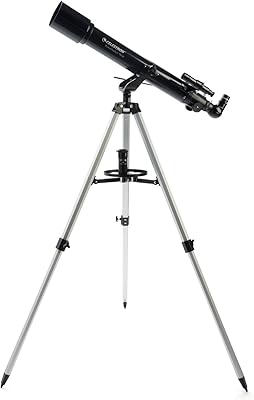
Celestron AstroMaster 114EQ Reflector Telescope
70%
83%
Optical Performance
78%
Mirror & Coating Quality
81%
Equatorial Mount
51%
Collimation Consistency
58%
Included Eyepieces
More
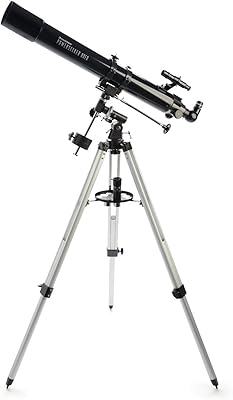
Celestron PowerSeeker 80EQ Refractor Telescope
75%
83%
Optical Clarity
67%
Mount Usability
88%
Portability
84%
Value for Money
72%
Build Quality
More

FAQ

No, and this is actually one of the more practical aspects of the setup. The AstroFi 130 creates its own dedicated WiFi network directly from the scope, so your phone connects to it the same way you'd connect to any hotspot. You don't need your home router or any internet connection out in the field.

Most buyers can get it physically assembled within 30 to 45 minutes following the included instructions. The trickier part tends to be the app alignment process, which requires pointing the scope at a few known stars so the mount can orient itself. Give yourself a full evening the first time — trying to rush the alignment in the dark leads to most of the frustrations you'll read about in reviews.

The Moon is genuinely impressive — you can spend an entire session just exploring craters and mountain ranges. Jupiter's cloud bands and its four largest moons are visible, and Saturn's rings are clearly distinguishable. Brighter star clusters and some nebulae like Orion are achievable too, though deep-sky objects require dark skies and realistic expectations about the level of detail compared to photography.

It might, and this catches a lot of beginners off guard. Newtonian reflectors use mirrors that can shift during shipping, so the optical alignment may be slightly off when you unbox it. Collimation sounds intimidating but it's a learnable skill — Celestron provides guidance, and there are good video tutorials online. It's not a dealbreaker, but plan to check it before your first serious session.

Not in any serious capacity. The alt-azimuth mount doesn't have the equatorial tracking that astrophotography requires, and the single fork arm isn't designed for the stability camera work demands. You can snap basic shots of the Moon by holding a phone up to the eyepiece, but for actual imaging you'd need a different platform.

It runs on either eight AA batteries or a 12V DC adapter. The AA option is convenient but won't last as many hours as you might hope during a long session, especially in cold weather where battery performance drops. A lot of regular users end up carrying a portable 12V power bank to get more reliable runtime at dark-sky sites.

With adult supervision and help on setup and alignment, yes. The app interface actually makes it more accessible for kids than a manual scope — tap an object on the screen and the mount moves to it, which keeps younger observers engaged. The physical scope is a bit heavy for a child to carry or reposition independently, so expect to be involved in the setup each time.

The optics are roughly comparable at this aperture and price range, so the main tradeoff is the computerized WiFi mount versus the money you'd save going manual. A manual scope of the same aperture might come on a sturdier mount for the same price, but you'd be doing all the star navigation yourself. The AstroFi 130 is genuinely better for people who want to spend their time observing rather than hunting.

The two included Kellner eyepieces cover the basics for getting started, and many owners use them happily for months. That said, a wider field eyepiece for deep-sky browsing and a higher-quality mid-power eyepiece are reasonable first upgrades if you find yourself wanting more. You don't need to buy anything on day one.

At moderate magnifications it handles well enough, but at higher power the single fork arm does introduce some wobble, especially if there's any wind or if you nudge the scope to adjust your view. It's a known limitation — the mount is designed for accessibility and portability rather than rock-solid stability. For visual observing at sensible magnifications it's fine, but don't expect the rigidity of a much heavier equatorial mount.

Where to Buy