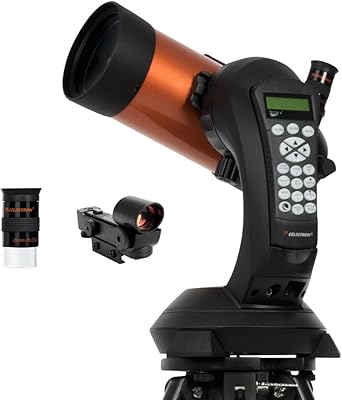
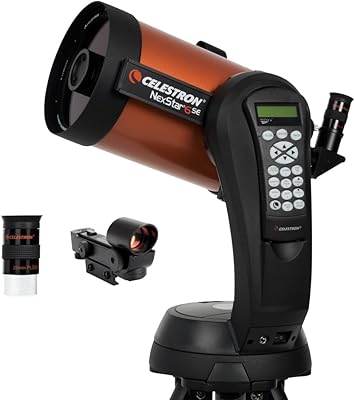
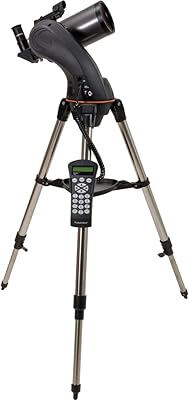
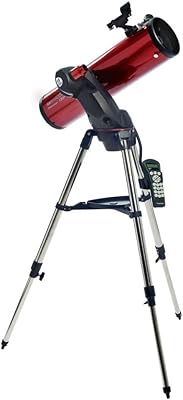
Overview

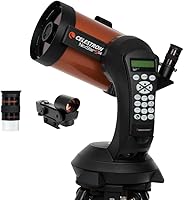
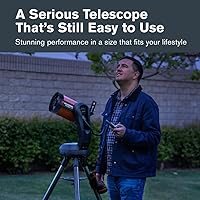
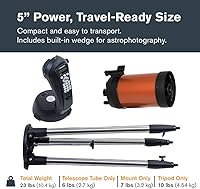
The Celestron NexStar 5SE Computerized Telescope sits at an interesting crossroads—capable enough to satisfy a hobbyist pushing past their first cheap refractor, yet approachable enough that you won't spend half the night fighting the setup. Celestron has been building scopes in California since 1960, and that iconic orange tube has become something of a landmark in backyard astronomy circles. The single fork arm alt-az mount keeps the whole package reasonably compact at 17.6 pounds, which means it can live in a closet and actually make it outside on a weeknight. The 5-inch aperture hits a practical sweet spot—meaningfully more light-gathering than a 70mm or 90mm starter scope, without the bulk that makes larger instruments a chore.
Features & Benefits

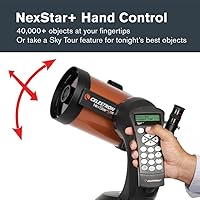
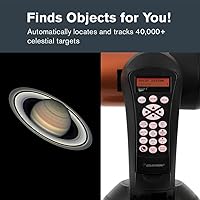
The NexStar 5SE's headline feature is its GoTo computerized mount, paired with the NexStar+ hand controller. In practice, this means you pull up a menu, select Saturn, and the scope slews there on its own—no star-hopping, no printed charts. The SkyAlign process is genuinely quick: center any three bright objects in the eyepiece, confirm each one, and the mount calculates your position in a matter of minutes. The Schmidt-Cassegrain optical design keeps the tube surprisingly short for a 1250mm focal length, which helps with portability. One important caveat: batteries and an AC adapter are sold separately, which catches a lot of buyers off guard. Plan for that before your first night out.

Best For

This GoTo scope is a natural fit for intermediate beginners who have outgrown a basic manual telescope and want automation to take the frustration out of finding objects. Under city or suburban skies—where navigating by star patterns is genuinely difficult—the ability to dial up a target and have the mount find it is a real advantage. It is also a reasonable starting point for astrophotography; the built-in wedge allows polar alignment for longer exposures, though expectations should stay realistic. This is not a dedicated imaging platform. If you want to manually star-hop or you are a serious deep-sky imager who needs precise equatorial tracking, this scope probably is not the right tool. For everyone else, it is a capable, expandable setup.

User Feedback

Owners of this computerized telescope consistently highlight how striking the Moon and Jupiter look through the eyepiece for the first time—the views genuinely hold up. Build quality draws praise too; the mount feels solid and the optics tend to stay collimated through normal use. That said, a few recurring complaints surface. Vibration from the single fork arm becomes noticeable at higher magnifications, particularly on breezy nights. The missing power supply frustrates a surprising number of buyers who discover the omission only after unpacking in the dark. Astrophotography users appreciate the wedge but note that tracking consistency can be hit or miss for faint deep-sky targets. On the support side, Celestron's US-based team and two-year warranty earn mostly positive marks.

Pros

  • SkyAlign gets the mount aligned in minutes using any three bright objects—no star chart knowledge needed.
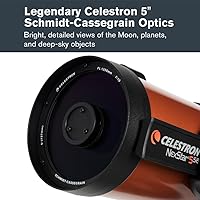
  • The 5-inch Schmidt-Cassegrain optics deliver crisp, detailed views of the Moon, planets, and brighter deep-sky targets.
  • At under 18 pounds, the NexStar 5SE is genuinely portable for a computerized scope in this aperture class.
  • A 40,000-plus object database means you will never run out of targets, even years into the hobby.
  • The built-in wedge opens the door to polar alignment and entry-level astrophotography without extra hardware.
  • Celestron's accessory ecosystem is wide, so the scope can grow with your skills and budget over time.
  • SkyAlign works even if you cannot name the stars you are centering—a real confidence boost for newer observers.
  • Celestron backs it with a two-year warranty and US-based technical support, which owners report is genuinely responsive.
  • The Schmidt-Cassegrain design keeps the optical tube short and manageable despite a long 1250mm focal length.

Cons

  • No power supply is included in the box—you must budget separately for batteries or an AC adapter before first use.
  • The single fork arm mount transmits vibration noticeably at higher magnifications, especially on even mildly breezy nights.
  • Tracking accuracy can be inconsistent for astrophotography, making it unreliable for serious long-exposure deep-sky imaging.
  • The alt-az GoTo system, while convenient, requires a power source every session—a dead battery pack ends your night early.
  • At f/10, the focal ratio is slow, which limits wide-field viewing and makes this a poor choice for sweeping star fields.
  • The included 25mm eyepiece is adequate but uninspiring; most users will want to invest in additional eyepieces fairly quickly.
  • Manual focus operation can be fiddly, particularly when making small adjustments at high magnification.
  • Software alignment drift over long sessions is a known issue—some users report needing to re-sync the mount mid-night.

Ratings

Our AI scoring engine analyzed thousands of verified owner reviews for the Celestron NexStar 5SE Computerized Telescope from buyers worldwide, actively filtering out incentivized, duplicate, and bot-generated submissions to surface what real users actually experience. The scores below reflect a balanced synthesis of genuine praise and recurring frustrations—nothing is smoothed over to make the product look better than it is.
Optical Performance
88%
Owners consistently describe lunar sessions as genuinely stunning—crater walls, rilles, and mountain shadows come through with clarity that surprises first-time users. Planetary detail on Jupiter and Saturn draws repeat praise, with cloud bands and ring structure visible even from light-polluted suburbs.
At f/10, the scope struggles to impress on faint, extended deep-sky objects like large emission nebulae. Users chasing those targets under suburban skies often find the views underwhelming compared to faster, wider-field instruments at similar apertures.
GoTo Accuracy
82%
18%
When alignment is done carefully, the GoTo system places targets reliably in the eyepiece field—a genuine confidence boost for newer observers who would otherwise spend frustrating minutes hunting manually. Returning to previously found objects mid-session is quick and repeatable.
Pointing accuracy degrades noticeably if the initial SkyAlign stars are not centered precisely, and some users report drift over long sessions that requires a mid-night re-sync. Cold temperatures also seem to affect tracking consistency, which frustrates observers in northern climates during winter.
Ease of Setup
84%
SkyAlign is widely praised as one of the least intimidating alignment systems available—even complete beginners report getting aligned and observing within fifteen minutes on their first attempt. The single-arm fork mount simplifies assembly since there are no counterweights to balance.
The hand controller interface feels dated and the button layout has a learning curve that trips up users who are used to app-based controls. A few owners also note that the manual is vague on certain steps, leaving newcomers to rely on community forums for clarification.
Build Quality
79%
21%
The optical tube itself feels solid and well-machined, and the iconic orange finish holds up through years of backyard use without fading or peeling based on long-term owner reports. Most mechanical parts feel appropriately robust for a scope in this class.
The single fork arm is the most common structural complaint—it feels less rigid than a dual-arm design and introduces flex that becomes apparent at higher magnifications. Some owners have also noted that the plastic housing around the hand controller feels cheaper than the rest of the package.
Portability
83%
At 17.6 pounds with a compact Schmidt-Cassegrain tube, the NexStar 5SE fits comfortably in a hatchback and can be carried to a backyard or balcony by one person without strain. The relatively small footprint means it stores in a closet or corner without dominating a room.
Without a purpose-made carrying case—sold separately—transporting the scope safely is awkward, as the fork arm and tube together make an irregular shape that does not pack neatly. Users who drive to dark-sky sites frequently invest in a case early, adding to the total cost.
Astrophotography Capability
63%
37%
The integrated wedge is genuinely appreciated by entry-level imagers who want to try polar-aligned tracking without buying a separate equatorial mount. Planetary imaging with a smartphone adapter or dedicated planetary camera produces satisfying results that many owners share proudly.
For anything beyond planetary or Moon shots, the single fork arm mount lacks the rigidity and precision needed for consistent long-exposure deep-sky imaging. Users who got into the hobby expecting to shoot galaxies and nebulae frequently report disappointing field rotation and tracking drift even with the wedge engaged.
Value for Money
74%
26%
For users who actually use the GoTo system regularly, the combination of solid optics, computerized tracking, and a reputable brand name represents a defensible purchase at this price tier. The scope has retained relevance for over two decades, which speaks to a durable value proposition.
The omission of any power supply at this price point is the single most common complaint across user reviews and genuinely stings. Buyers expecting a ready-to-use package on night one are often caught off guard, and the cost of a proper power solution adds meaningfully to the real-world total.
Vibration Stability
58%
42%
On a calm night with the scope sitting on firm, level ground, vibrations from focusing or accidentally touching the tube settle within a few seconds—acceptable for casual visual use at moderate magnifications.
Any wind, a slightly uneven surface, or a nudge at high magnification produces shake that takes long enough to settle that it interrupts the viewing experience. Users attempting to observe above 200x report this as a persistent nuisance, and it is a hard limitation tied to the single-arm fork design.
Hand Controller & Software
71%
29%
The NexStar+ controller gives access to a well-organized database that covers everything from planets and bright double stars to Messier and NGC deep-sky objects, giving newer observers plenty of structured targets to work through over many sessions.
The physical controller hardware feels like a design that has not been meaningfully updated in years—small buttons, a dim display, and no wireless or Bluetooth connectivity out of the box. Users accustomed to modern app ecosystems find the interface clunky, and third-party wireless adapters require additional spending to address this.
Included Accessories
54%
46%
The 25mm eyepiece provides a reasonable starting magnification for orientation and wide-field lunar views, and the StarPointer red dot finderscope is functional for initial sky orientation once you know roughly where to look.
The accessory bundle is thin for a scope at this price—one eyepiece gives very limited versatility, no power source is included, and no carry case is provided. Most buyers end up spending significantly more within the first few months to fill these gaps.
Tracking Performance
76%
24%
In alt-az mode, the motorized tracking keeps objects centered for visual use without constant manual adjustment—a real quality-of-life improvement over non-tracking mounts, especially when sharing views with family or guests.
Tracking rate accuracy can wander over extended sessions, and some users note that the mount requires periodic star re-syncing to maintain precision. At higher magnifications, even small tracking errors become visible as objects drifting toward the edge of the field.
Long-Term Reliability
81%
19%
The NexStar 5SE has been in production since 2003, and many longtime owners report their units still functioning well after a decade or more of regular use. Celestron's parts and support infrastructure for this model is well established as a result of its longevity.
Older units have occasionally developed hand controller communication errors or motor issues, and sourcing specific replacement parts can require navigating Celestron's support process. The electronics, while generally reliable, are aging in design and not trivially user-serviceable.
Customer Support & Warranty
77%
23%
Celestron's US-based support team is well-regarded in the amateur astronomy community, and the two-year warranty provides meaningful coverage for what is a significant purchase. Owners who have contacted support for alignment calibration or technical issues generally report helpful, knowledgeable responses.
Warranty claim turnaround times receive mixed feedback, with some users waiting several weeks for resolution. The process of diagnosing and returning a mount for service is also inconvenient given the size and weight of the package.

Suitable for:

The Celestron NexStar 5SE Computerized Telescope is built for the kind of person who is genuinely curious about the night sky but does not want to spend months learning to navigate it manually before seeing anything rewarding. It rewards hobbyists who are stepping up from a cheap department-store scope and want something that will actually hold their interest long-term. Urban and suburban observers especially benefit, since the GoTo mount removes the guesswork of star-hopping under washed-out skies—just select a target and the scope finds it. At 17.6 pounds with a compact optical tube, it is portable enough for balcony sessions or a short drive to darker skies without requiring a vehicle dedicated to hauling equipment. It also works well for someone who wants to experiment with astrophotography on a budget, as the built-in wedge provides a path toward polar alignment and longer exposures without buying an entirely separate mount.
Not suitable for:

The Celestron NexStar 5SE Computerized Telescope is a poor match for anyone who wants to learn the sky the traditional way—manually star-hopping and understanding celestial navigation—since the automation actively sidesteps that process. Purists who prefer a fully manual, no-batteries-required setup will find the computerized dependency frustrating rather than freeing. Serious astrophotographers chasing faint nebulae or galaxies with long exposure times will quickly hit the limits of the single fork arm mount, which lacks the rigidity and precision tracking that dedicated equatorial imaging rigs provide. The 5-inch aperture, while solid for planetary and lunar work, leaves experienced observers wanting more light-gathering power for fainter deep-sky objects. And anyone expecting a complete out-of-the-box experience should know upfront that no power supply is included—a frustrating oversight at this price point that requires an extra purchase before the first night out.
Specifications

  • Optical Design: The telescope uses a Schmidt-Cassegrain optical system, which folds a long focal path into a compact tube by bouncing light between a primary and secondary mirror.
  • Aperture: The primary mirror measures 127mm (5 inches) in diameter, providing meaningful light-gathering capability for lunar, planetary, and brighter deep-sky targets.
  • Focal Length: The optical system delivers a 1250mm focal length, making it well-suited for high-magnification planetary and lunar observation.
  • Focal Ratio: At f/10, the telescope operates at a relatively slow focal ratio, which favors detailed planetary views over wide-field deep-sky sweeping.
  • Tube Length: The optical tube measures 330mm in length, considerably shorter than a Newtonian reflector of equivalent focal length, aiding portability.
  • Mount Type: The scope rides on a computerized altitude-azimuth single fork arm mount with automatic slewing and object tracking via the NexStar+ hand controller.
  • Hand Controller: The included NexStar+ hand controller provides access to a database of over 40,000 celestial objects, with automated GoTo slewing to any selected target.
  • Alignment System: SkyAlign allows the mount to be aligned by centering any three bright objects in the eyepiece, requiring no prior knowledge of star names or sky orientation.
  • Included Eyepiece: A single 25mm eyepiece is included in the box, yielding approximately 50x magnification as a starting point for observation.
  • Finderscope: A StarPointer red dot finderscope is included for initial sky orientation, powered by a CR2032 battery that comes installed.
  • Power Sources: The mount accepts 8 AA batteries, a 12V DC AC adapter, or a Celestron PowerTank external battery—none of these power sources are included with purchase.
  • Item Weight: The complete assembled system weighs approximately 17.6 pounds, making it transportable for solo users without requiring a dedicated vehicle setup.
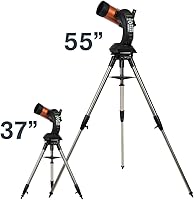
  • Dimensions: The assembled footprint measures 32″ deep by 34″ wide by 52″ tall, which should be factored into storage and transport planning.
  • Astrophotography: An integrated wedge allows the mount to be polar-aligned, reducing field rotation during long-exposure imaging for entry-level astrophotography applications.
  • Focus Mechanism: Focusing is performed manually via a rear-mounted focuser knob, with no electronic or motorized focus control included as standard.
  • Warranty: Celestron provides a two-year limited warranty along with access to US-based technical support for the lifetime of the product.
  • Model Number: The official Celestron item model number is 11036, with the ASIN B000GUHOYE on Amazon, where it has been listed since June 2003.

Related Reviews

Celestron NexStar 127SLT Computerized Telescope
75%
88%
Optical Performance
83%
GoTo Accuracy
81%
Ease of Setup
61%
Mount Stability
86%
Portability
More
Celestron NexStar 130SLT
75%
88%
Ease of Setup
83%
GoTo Accuracy
81%
Optical Performance
74%
Build Quality & Durability
86%
Portability
More
Celestron NexStar 4SE Computerized Telescope
73%
88%
GoTo Accuracy
84%
Optical Clarity
86%
Ease of Setup
81%
Portability
73%
Build Quality
More
Celestron NexStar 90SLT Computerized Telescope
73%
78%
Optical Performance
83%
GoTo Accuracy
81%
Ease of Setup
86%
Portability
67%
Build Quality
More
Celestron NexStar 6SE Computerized Telescope
72%
88%
Optical Performance
83%
GoTo Mount Accuracy
86%
SkyAlign Ease of Use
61%
Mount Stability
81%
Portability & Setup Time
More
Celestron SkyProdigy 130 Computerized Telescope
85%
92%
Ease of Setup
89%
Automatic Alignment Technology
82%
Image Quality
88%
Build Quality
85%
Battery Life
More
Celestron CPC 800 XLT Computerized Telescope
76%
93%
Optical Clarity
84%
GoTo Accuracy
88%
GPS Alignment System
86%
Build Quality
38%
Portability
More
Celestron NexStar 8 SE Computerized Telescope
70%
93%
Optical Clarity
78%
GoTo Accuracy
71%
Build Quality
67%
Setup Experience
62%
Portability
More
Celestron PowerSeeker 70EQ Refractor Telescope
71%
78%
Optical Clarity
83%
Mount Quality & Stability
61%
Ease of Assembly
74%
Accessory Bundle Value
86%
Portability
More
Celestron PowerSeeker 60AZ Refractor Telescope
71%
78%
Optical Clarity
62%
Mount & Tracking
54%
Tripod Stability
67%
Eyepiece Quality
83%
Value for Money
More

FAQ

Not really. The SkyAlign system is specifically designed for people who cannot name a single constellation. You just power the mount on, point it at any three bright things in the sky—stars, planets, even the Moon—center each one in the eyepiece, and the mount figures out where it is. From there, you scroll through the hand controller's menu and let the GoTo system do the finding.

Lunar detail is genuinely impressive—craters, ridges, and mountain ranges stand out clearly. Jupiter's cloud bands and its four Galilean moons are easy targets, and Saturn's rings are one of those views that never gets old. For deep-sky objects, brighter globular clusters like M13 and galaxies like M31 are visible, though do not expect photographic color or detail. Faint nebulae require dark skies and some patience.

No, and this trips up a lot of buyers. The NexStar 5SE requires either 8 AA batteries, a 12V DC AC adapter, or a compatible Celestron PowerTank—and none of these come in the box. Before your first session, plan to pick up at least one power option. A PowerTank or rechargeable external battery pack is worth the investment if you intend to observe away from an outlet.

The Celestron NexStar 5SE Computerized Telescope can handle entry-level planetary imaging and brighter deep-sky targets reasonably well. The built-in wedge lets you polar-align the mount, which reduces field rotation during longer exposures. That said, the single fork arm is not as rigid or precise as a dedicated equatorial mount, so do not expect it to perform like a purpose-built imaging rig. It is a good starting point, but serious imagers will eventually want to upgrade the mount.
In practice, most users get through alignment in five to ten minutes once they are familiar with the process. The first few times might take a little longer while you get the feel for centering objects precisely in the eyepiece. After a handful of sessions it becomes second nature and feels almost automatic.

At 17.6 pounds assembled, one person can manage it without much trouble for short moves—carrying it from a car to a backyard, or out onto a balcony. The single fork arm design keeps the profile compact. If you are trekking any real distance, a dedicated carrying case makes life easier since the scope and mount together are an awkward shape to carry by hand.

It can be, especially at higher magnifications. The single fork arm is inherently less stable than a dual-arm or equatorial design, so any tap or nudge will produce some shake. On a calm night with firm ground it settles quickly, but on a windy evening or a wooden deck it becomes more noticeable. Keeping magnification at sensible levels and using a sturdy surface helps a lot.

A reliable power source is the first priority—either a Celestron PowerTank or a quality 12V battery pack. After that, a second or third eyepiece in the 10–15mm range opens up more magnification options for planetary work. A Barlow lens is a cost-effective way to multiply what you already have. Many users also add a proper carry case early on to protect the investment during transport.

Celestron's two-year warranty is solid for this category of product, and their US-based support team has a generally positive reputation among hobbyists. Users who have had issues—whether alignment problems or mechanical concerns—report that Celestron is reasonably responsive. That said, like any warranty, the experience can vary. Keeping your purchase receipt and registering the product directly with Celestron is worthwhile.

The NexStar 5SE design has been on the market since 2003, which is actually a point in its favor—it means the platform is well understood, widely supported, and has a large community of users sharing tips and accessories. The core optics and GoTo technology have not fundamentally changed in ways that make older versions obsolete. If anything, the longevity reflects that Celestron got the formula right early and has not needed to reinvent it.

Where to Buy