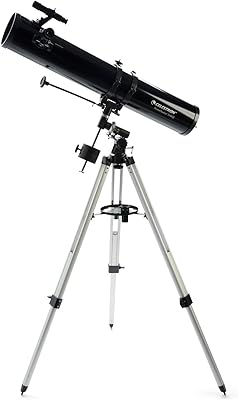
Celestron ExploraScope 114AZ Reflector Telescope
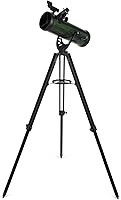
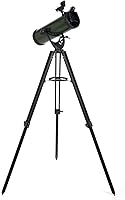
Celestron ExploraScope 114AZ Reflector Telescope — image 1
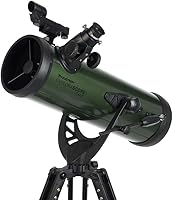
Celestron ExploraScope 114AZ Reflector Telescope — image 2
Celestron ExploraScope 114AZ Reflector Telescope — image 3
Celestron ExploraScope 114AZ Reflector Telescope — image 4
Celestron ExploraScope 114AZ Reflector Telescope — image 5
Celestron ExploraScope 114AZ Reflector Telescope — image 6
Celestron ExploraScope 114AZ Reflector Telescope — image 7
Celestron ExploraScope 114AZ Reflector Telescope — image 8
78%
22%

Overview

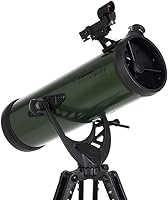
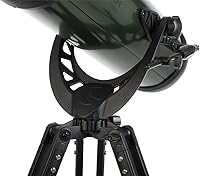
The Celestron ExploraScope 114AZ Reflector Telescope sits in an interesting spot — it is not a toy, but it is not intimidating either. With a 114mm parabolic mirror, this reflector telescope gathers noticeably more light than the small refractors commonly found in big-box stores, making it a genuine step up for anyone ready to take stargazing seriously. Celestron chose an altazimuth mount deliberately: it is intuitive, requires no polar alignment, and gets you outside and observing within minutes. Assembly requires no tools at all, which matters more than you might think when you are eager to catch a clear night. Expect strong lunar and planetary views; deep-sky expectations should stay measured.

Features & Benefits

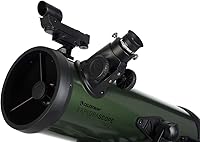
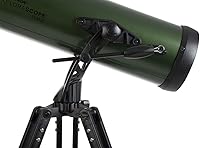
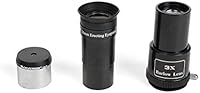
The 114mm fully coated mirror is the heart of this Celestron scope, and it does a solid job pulling in light from the moon, Saturn's rings, and Jupiter's cloud bands. Two eyepieces — a 20mm for wide-field views and a 4mm for close-up work — come included, along with a 3x Barlow lens that effectively triples your magnification options without buying anything extra. The StarPointer red dot finderscope makes locating objects far less frustrating than a traditional finder for beginners. Slow-motion control rods on both axes let you track objects smoothly, while the adjustable-height tripod with an accessory tray keeps your gear organized and the whole setup stable at just 6.7 pounds.

Best For

This reflector telescope makes the most sense for someone who has outgrown a cheap beginner scope and wants real optical performance without stepping into complicated computerized equipment. It is a particularly good fit for families with teenagers — the quick setup removes friction, and the mount is approachable enough that kids can operate it independently. Casual observers who spend most of their time on the moon and planets will get consistent satisfaction from this Celestron scope. If you need automated tracking or are chasing faint galaxies, this is not the right tool. But for backyard planetary observing at an accessible price, it is genuinely hard to beat.

User Feedback

Owners of the ExploraScope 114AZ tend to rave about lunar and Saturn views — sharp, detailed, and impressive for a first serious scope. The tool-free assembly earns consistent praise, especially from buyers who expected a much steeper learning curve. That said, the 4mm eyepiece draws real criticism; at high magnification it can produce soft, underwhelming images, and many users eventually upgrade their eyepiece collection. The rack-and-pinion focuser can feel stiff and hard to adjust precisely, which younger users find particularly frustrating. A few buyers have also noted the tripod wobbles on grass or uneven terrain. Overall, casual observers are happy; those chasing faint galaxies or expecting premium accessories tend to feel let down.

Pros

  • The 114mm mirror delivers genuinely sharp views of the moon, Saturn, and Jupiter right out of the box.
  • No tools are needed for assembly, making setup fast and frustration-free for beginners.
  • The included 3x Barlow lens triples your effective eyepiece options without spending extra money.
  • The StarPointer red dot finderscope makes locating targets far easier than traditional optical finders for new users.
  • Slow-motion control rods on both axes allow smooth, shake-free pointing adjustments during observing sessions.
  • At just 6.7 pounds, this reflector telescope is light enough to carry outside solo and store without hassle.
  • The altazimuth mount requires zero polar alignment, so you can start observing in minutes on any clear night.
  • Celestron has a long track record in optics, and support resources like manuals and community guides are widely available.
  • The adjustable tripod accommodates observers of different heights, including kids and adults sharing the same session.

Cons

  • The included 4mm eyepiece produces noticeably soft images at high magnification and will likely need replacing.
  • The rack-and-pinion focuser can feel stiff and imprecise, which is especially frustrating for younger users.
  • Tripod stability suffers on grass or uneven surfaces, causing vibrations that disrupt high-magnification views.
  • Deep-sky targets like faint galaxies and nebulae are largely out of reach at this aperture and without motorized tracking.
  • There is no motorized or computerized tracking, so objects drift out of view quickly at higher magnifications.
  • The optical tube can require periodic collimation, which beginners may not anticipate or know how to perform.
  • Included eyepiece quality overall feels budget-grade relative to what the rest of the scope is capable of delivering.
  • The ExploraScope 114AZ offers no upgrade path for GoTo or motorized tracking without replacing the mount entirely.

Ratings

Our AI rating system analyzed thousands of verified global purchases of the Celestron ExploraScope 114AZ Reflector Telescope, actively filtering out incentivized, bot-generated, and outlier reviews to surface what real buyers consistently experience. The scores below reflect an honest synthesis of both the genuine strengths and the recurring frustrations that owners report after extended use. Nothing has been softened — if a category has a real problem, the score shows it.

Optical Performance
83%
For a scope in this price tier, the primary mirror consistently delivers views that surprise first-time owners. The moon is a showstopper — craters and ridgelines are sharply defined — and Saturn's rings are clearly visible on a steady night, which is the moment most beginners fall in love with astronomy.
Deep-sky performance is where expectations need to be managed carefully. Faint galaxies and dim nebulae are largely underwhelming, appearing as vague smudges rather than the dramatic images beginners might hope for, and atmospheric turbulence affects high-magnification views more than many new users anticipate.
Ease of Setup
91%
Tool-free assembly is one of the most consistently praised aspects across user feedback. Families report getting the scope assembled and pointed at the moon within 15 to 20 minutes of opening the box, with no prior experience needed — a real advantage on a spontaneous clear night.
The instruction manual is described by many buyers as vague and poorly illustrated, which means first-timers sometimes spend extra time guessing at steps that should be obvious. Celestron's online video guides fill the gap, but they should not have to.
Mount Usability
78%
22%
The altazimuth mount is genuinely beginner-friendly — it moves intuitively in the directions you expect, and there is no polar alignment ritual standing between you and the sky. The slow-motion control rods make fine adjustments possible without accidentally knocking the scope off target.
At higher magnifications, the lack of any tracking mechanism means objects drift out of the field of view quickly, requiring constant manual correction. Experienced observers used to equatorial mounts will find this limiting, and it makes extended high-power planetary sessions more work than they should be.
Included Accessories
62%
38%
The accessory bundle is more generous than many competing scopes at this level. Getting two eyepieces and a 3x Barlow lens out of the box gives beginners a practical magnification range to experiment with immediately, and the red dot finderscope is genuinely useful for learning to navigate the sky.
The 4mm eyepiece is the weakest link — buyers regularly describe the high-magnification views it produces as soft, low-contrast, and disappointing compared to what the mirror itself is capable of. The Barlow is functional but not optically refined, and most serious users end up replacing both within a few months.
Focuser Quality
57%
43%
The rack-and-pinion focuser does its job at low to mid magnifications, and casual lunar observers rarely complain about it in normal use. For the moon and wide-field planetary views, it is adequate and does not require any adjustment out of the box.
At high magnification, the focuser becomes a genuine source of frustration. Multiple users describe it as stiff, difficult to adjust in small increments, and prone to overshooting the focus point — particularly problematic for younger users or anyone with limited hand dexterity trying to nail fine planetary detail.
Build Quality
71%
29%
The optical tube feels solid and the overall construction is more substantial than toy-grade scopes. The aluminum tripod holds up well under normal use, and the accessory tray is a practical touch that keeps eyepieces off the ground during a session.
Some plastic components on the mount feel noticeably budget-grade, and the tripod leg locks can loosen over time with repeated adjustment. On cold nights, the material quality feels more apparent, and a few buyers report the red dot finderscope bracket loosening after extended use.
Tripod Stability
63%
37%
On a flat hard surface — a driveway, patio, or concrete path — the tripod performs well enough for comfortable viewing. Vibrations from touching the scope settle within a couple of seconds, which is acceptable for casual sessions.
On grass, gravel, or any uneven terrain, stability drops noticeably. Touching the focuser or control rods can send visible vibrations through the image, and at higher magnifications this becomes genuinely disruptive. Observers who plan to use the scope in a garden or field should factor this in.
Portability
88%
At 6.7 pounds total, this reflector telescope is one of the lighter options in its aperture class. Carrying it from a closet to the backyard takes one trip and no real effort, which removes the friction that causes heavier scopes to sit unused for weeks at a time.
The tube is 24 inches long, which means it does not fit neatly into most bags or backpacks. For transport in a car it is fine, but anyone hoping to take it hiking or on public transit will find the form factor awkward without a dedicated case.
Value for Money
79%
21%
Judged purely on optical capability per dollar, this Celestron scope is competitive. The 114mm aperture at this price point is difficult to match, and the included accessory kit means there is no immediate additional spend required to get real observing sessions going.
The weak eyepieces and focuser mean that buyers who want to unlock the mirror’s full potential will need to spend extra on upgrades relatively quickly. When you factor in a decent eyepiece set, the total cost climbs, which shifts the value calculation somewhat.
Beginner Friendliness
86%
The combination of a no-tool setup, intuitive altazimuth mount, and red dot finderscope makes this one of the more approachable serious telescopes available. Most beginners report being able to find the moon and bright planets independently within their first or second session.
Collimation — the process of realigning the mirror — is not covered adequately in the manual, and new users are often caught off guard when image quality degrades after the scope is moved or bumped. It is not difficult once learned, but the lack of guidance leaves many beginners confused.
Target Acquisition
81%
19%
The StarPointer red dot finderscope is a meaningful advantage for newcomers. Aligning a bright dot with a target in the sky is far more instinctive than using a traditional optical finderscope, and most users report a shorter learning curve when it comes to actually finding objects.
The finderscope bracket can shift out of alignment if the scope is handled roughly, and recalibrating it is an extra step that trips up some beginners. The red dot is also harder to see in brightly lit suburban environments where light pollution washes out the contrast.
Lunar Viewing
93%
This is where the ExploraScope 114AZ genuinely earns its keep. The level of lunar detail visible — mountain ranges, crater walls, ray systems — consistently impresses first-time users and remains a rewarding target even after months of ownership. It is the scope’s clearest strength.
Very little to criticize here, though the included eyepieces do limit how much of that detail you can extract at the highest magnifications. A quality 6mm eyepiece instead of the bundled 4mm would push lunar performance noticeably further.
Planetary Viewing
77%
23%
Saturn’s rings, Jupiter’s equatorial bands, and Mars during opposition are all clearly visible and rewarding targets. On nights with steady seeing, the ExploraScope 114AZ can produce crisp planetary images that hold up well for a scope at this level.
Getting the best out of planetary viewing depends heavily on atmospheric conditions and eyepiece quality — both of which are outside the scope’s control. The bundled eyepieces cap the experience, and observers in light-polluted urban areas will find contrast and sharpness harder to achieve.

Suitable for:

The Celestron ExploraScope 114AZ Reflector Telescope is a strong match for anyone taking their first real step into amateur astronomy — particularly those who have already been frustrated by the blurry, dim views of a cheap department-store refractor. Parents shopping for a curious teenager will find it hits a sweet spot: capable enough to reward genuine interest, yet simple enough that a motivated 12-year-old can set it up and use it independently. The no-tool assembly and intuitive altazimuth mount mean you are actually outside observing on a clear night rather than wrestling with a manual indoors. Casual stargazers whose primary targets are the moon, Saturn, Mars, and Jupiter will get consistently satisfying views that feel genuinely rewarding. It is also a thoughtful gift choice — Celestron is a recognizable, trusted name, and the included accessories mean the recipient does not have to buy anything extra to get started.

Not suitable for:

The Celestron ExploraScope 114AZ Reflector Telescope is the wrong tool for observers who have already moved past the basics and want to hunt faint deep-sky objects like distant galaxies or dim nebulae — the 114mm aperture simply cannot gather enough light for that kind of work, and the manual altazimuth mount offers no tracking capability to compensate. Serious hobbyists who plan to do astrophotography should look elsewhere entirely; without motorized tracking, long-exposure imaging is not realistic with this setup. If the person using the scope has limited hand strength or patience, the rack-and-pinion focuser can be a source of real frustration, particularly when trying to dial in the 4mm eyepiece at high magnification. Anyone expecting the bundled eyepieces to perform at a premium level will likely feel underwhelmed and need to budget for upgrades. Those who observe primarily on soft ground or uneven terrain may also find the tripod less stable than they would like.

Specifications

  • Optical Design: This telescope uses a Newtonian reflector design, which uses a parabolic primary mirror rather than lenses to gather and focus light.
  • Aperture: The primary mirror measures 114mm in diameter, giving it meaningfully more light-gathering ability than typical entry-level refractors.
  • Focal Length: The approximate focal length is 1000mm, resulting in a focal ratio of roughly f/8.8 for controlled, detailed planetary views.
  • Included Eyepieces: Two eyepieces are included: a 20mm for wider, lower-magnification views and a 4mm for higher-magnification close-up observing.
  • Barlow Lens: A 3x Barlow lens is included, which triples the effective magnification of each eyepiece without requiring separate purchases.
  • Mount Type: The scope ships with a manual altazimuth mount, allowing straightforward up-down and left-right movement with no polar alignment required.
  • Control Rods: Slow-motion control rods on both the altitude and azimuth axes allow fine, shake-free adjustments while tracking objects across the sky.
  • Finderscope: A StarPointer red dot finderscope is included to help users quickly locate and center objects before viewing through the main eyepiece.
  • Focus Mechanism: Focusing is achieved via a manual rack-and-pinion focuser, which requires hand adjustment to bring objects into sharp view.
  • Tripod: An adjustable-height aluminum tripod with an integrated accessory tray supports the optical tube and keeps eyepieces and accessories within reach.
  • Tube Length: The optical tube measures 24 inches in length, making it compact enough for easy transport and indoor storage.
  • Assembled Size: Fully assembled, the telescope measures approximately 34″ deep by 34″ wide by 54″ tall at a mid-height tripod setting.
  • Weight: The complete setup weighs 6.7 pounds, light enough for a single adult or older teenager to carry and set up unaided.
  • Power Source: The telescope itself is fully manual; the only battery required is one CR2032 cell for the StarPointer red dot finderscope, which is included.
  • Model Number: The official Celestron model number for this telescope is 22103, which is useful when sourcing replacement parts or compatible accessories.
  • Brand: Celestron, the manufacturer, is a well-established optics company with decades of experience producing telescopes for the consumer and enthusiast market.

Related Reviews
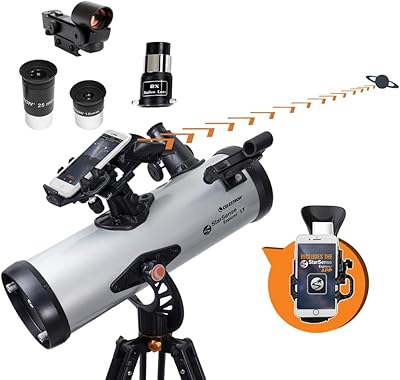
Celestron Omni XLT 150 Reflector Telescope
84%
91%
Optical Clarity
89%
Ease of Setup
85%
Mount Precision
88%
Build Quality
84%
Included Accessories
More
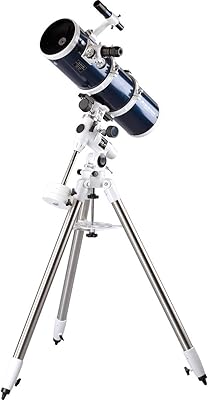
Celestron StarSense Explorer LT 114AZ
74%
88%
App Navigation Experience
83%
Optical Clarity
86%
Ease of Setup
61%
Mount Stability
79%
Value for Money
More
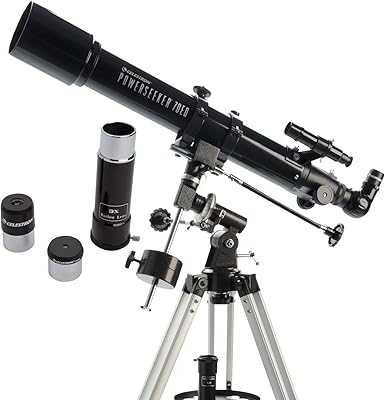
Celestron PowerSeeker 80EQ Refractor Telescope
75%
83%
Optical Clarity
67%
Mount Usability
88%
Portability
84%
Value for Money
72%
Build Quality
More
Celestron AstroMaster 114EQ Reflector Telescope
70%
83%
Optical Performance
78%
Mirror & Coating Quality
81%
Equatorial Mount
51%
Collimation Consistency
58%
Included Eyepieces
More
Celestron AstroMaster 102AZ Refractor Telescope
77%
78%
Optical Clarity
91%
Ease of Setup
74%
Mount Usability
71%
Tripod Stability
83%
Value for Money
More
Celestron AstroMaster 90AZ Refractor Telescope
75%
83%
Optical Clarity
91%
Ease of Setup
78%
Mount Usability
62%
Tripod Stability
76%
Value for Money
More
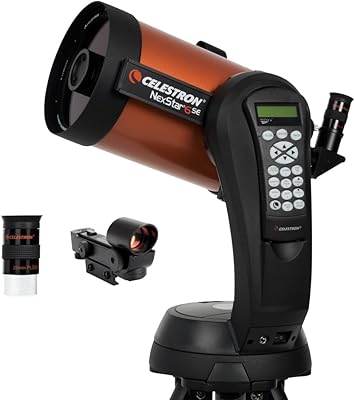
Celestron PowerSeeker 70EQ Refractor Telescope
71%
78%
Optical Clarity
83%
Mount Quality & Stability
61%
Ease of Assembly
74%
Accessory Bundle Value
86%
Portability
More
Celestron PowerSeeker 70AZ Refractor Telescope
75%
78%
Optical Clarity
88%
Ease of Setup
82%
Mount Usability
61%
Tripod Stability
83%
Value for Money
More
Celestron NexStar 90SLT Computerized Telescope
73%
78%
Optical Performance
83%
GoTo Accuracy
81%
Ease of Setup
86%
Portability
67%
Build Quality
More
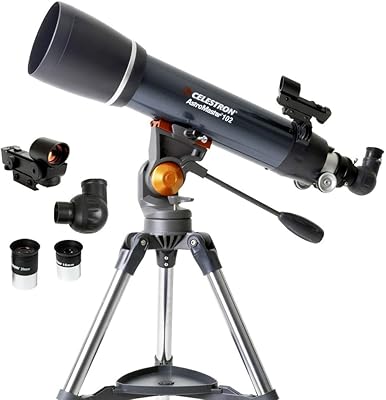
Celestron NexStar 6SE Computerized Telescope
72%
88%
Optical Performance
83%
GoTo Mount Accuracy
86%
SkyAlign Ease of Use
61%
Mount Stability
81%
Portability & Setup Time
More

FAQ

Most buyers get it assembled and pointing at the sky in under 20 minutes on the first attempt — often faster. There are no tools required, and the parts connect in a fairly logical sequence. The included instructions are basic, but Celestron has video guides online that make the process even clearer.

Yes, with a short introduction from an adult. The altazimuth mount is intuitive — it moves the way you expect — and the red dot finderscope makes locating bright objects like the moon or planets straightforward. The focuser can be a little stiff for smaller hands, but most kids manage it fine once they get the feel for it.

The moon is genuinely impressive — craters, mountain ranges, and surface detail are all visible. Saturn's rings and Jupiter's cloud bands are clearly distinguishable on steady nights. Bright objects like the Orion Nebula show up as a fuzzy patch, but do not expect detailed deep-sky views; faint galaxies and most nebulae are beyond what this aperture can reveal meaningfully.

Reflector telescopes do go out of collimation over time, especially after being moved or transported. The ExploraScope 114AZ is no different. It may arrive needing a minor adjustment. Collimating it is not difficult once you learn the process — Celestron has a free guide, and there are plenty of beginner tutorials online — but it is something first-time owners should know to expect rather than be surprised by.

No, the included kit is genuinely functional out of the box. The 20mm eyepiece, 3x Barlow, and red dot finderscope are enough to get real viewing sessions going. Many users eventually upgrade the eyepiece set — particularly replacing the 4mm — but nothing extra is strictly necessary at the start.

At lower magnifications it is fine, but honestly, it struggles at its full rated magnification. Images can look soft or lack contrast compared to what the mirror is capable of delivering. It is functional enough to learn with, but if you get serious about planetary detail, a quality aftermarket eyepiece in the 5–6mm range will give noticeably better results.

Not in any practical sense. The manual altazimuth mount has no tracking motor, which means objects drift out of frame within seconds at higher magnifications. You can capture basic moon shots through a smartphone held up to the eyepiece, but long-exposure deep-sky photography is simply not possible with this setup.

On a flat, solid surface like a patio or driveway, the tripod is stable enough for comfortable viewing. On grass or uneven ground, there is a noticeable wobble when you nudge the scope, and it takes a few seconds to settle. It is manageable, but if most of your observing will be on soft terrain, this is worth being aware of.

A rough rule of thumb is that a telescope can handle about 50 times its aperture in millimeters under ideal conditions, which would put this scope’s ceiling around 200-250x. In practice, atmospheric conditions and eyepiece quality usually cap useful views at 150x or less. Pushing beyond that typically results in dim, blurry images rather than more detail.

The difference is substantial. A 114mm mirror collects roughly two to three times more light than a 70mm lens, which translates directly into brighter, sharper images and the ability to see fainter objects. Beyond raw aperture, the optical coatings and overall build quality are meaningfully better than budget toy-grade scopes. If someone has tried a cheap refractor and been disappointed, this is a genuine upgrade that produces noticeably better results.

Where to Buy