Overview

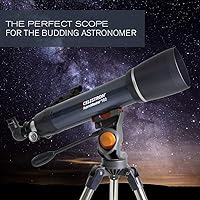
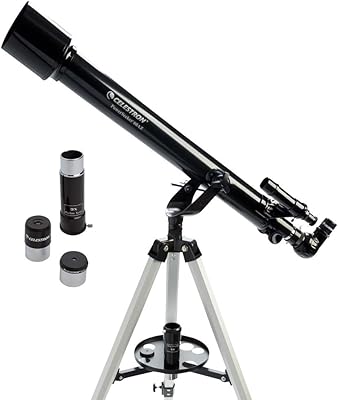
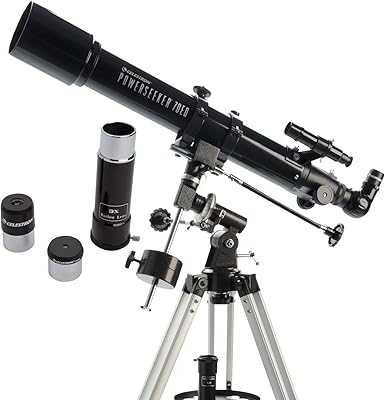
The Celestron AstroMaster 102AZ Refractor Telescope is a short-tube refractor built for beginners and casual observers who want a genuine first look at the night sky without drowning in technical complexity. Celestron has been crafting optics since 1960, and that long track record matters — you're not buying from an unknown brand. At its mid-range price, this beginner telescope sits in a useful sweet spot: meaningfully more capable than a department-store scope, yet approachable enough for a first-time buyer. It also works as a terrestrial viewer for wildlife and landscapes. Just keep expectations realistic — it's a strong entry-level performer, not a deep-sky specialist.
Features & Benefits

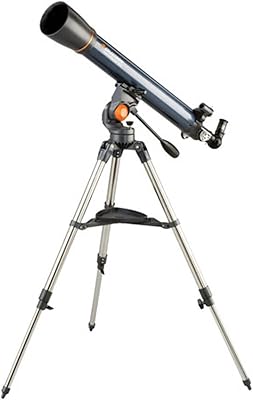
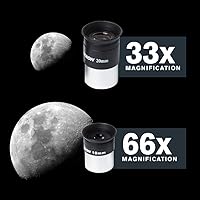
The heart of this Celestron refractor is its 102mm coated glass lens — think of aperture like a bucket collecting light; a wider bucket means brighter, sharper images. The compact 380mm tube and f/6.5 focal ratio keep the whole instrument easy to carry and store, which matters more than people realize when astronomy has to compete with a busy schedule. Navigating the sky is handled through a manual alt-azimuth mount with a panhandle control, letting you sweep left, right, up, and down intuitively. Two eyepieces give you 33x and 66x magnification straight away, and an included red dot finderscope simplifies locking onto a target before you zoom in. No tools required for assembly — a genuine plus.

Best For

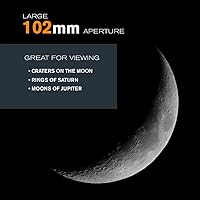
This beginner telescope is a natural fit for anyone taking their first steps in stargazing, whether that's a curious adult or a child around ten years old or older. The intuitive mount and fast setup keep the experience enjoyable rather than frustrating — which is exactly what you want when introducing someone to astronomy. The AstroMaster 102AZ performs best on bright nearby targets: the Moon is stunning, Saturn's rings are visible, and open star clusters are rewarding. Faint deep-sky objects like nebulae are largely out of reach, so calibrate expectations accordingly. Nature watchers also get real value here, since the optics handle daytime terrestrial viewing — birdwatching included — without any modification.

User Feedback

Owners of the AstroMaster 102AZ tend to agree on a few things. Lunar views impress consistently — sharp crater detail is one of the most frequently mentioned highlights, and it typically comes through on the very first night. Quick assembly also earns praise; most buyers report being set up and observing well within twenty minutes. The tripod, for its price tier, is considered solidly stable by most. Where criticism appears, it centers on two areas: chromatic aberration, that faint color fringing around bright objects at higher magnification, and the finderscope occasionally drifting out of alignment after moving the scope. Wind can introduce some mount wobble too. Overall, a 4.3-star average reflects a scope that genuinely meets its beginner audience where they are.

Pros

  • Sharp, detailed Moon views that impress on the very first night out.
  • Tool-free assembly gets most users observing in under twenty minutes.
  • The 102mm lens gathers enough light to show Saturn's rings and Jupiter's cloud bands clearly.
  • Compact short-tube design fits in a car trunk and stores in a closet without hassle.
  • Manual alt-azimuth mount is intuitive enough for children to navigate independently.
  • Dual-purpose design works well as a daytime spotting scope for wildlife and landscapes.
  • Celestron's two-year warranty and US-based support add real peace of mind.
  • Two eyepieces plus a finderscope and star diagonal included — no immediate extra spending required.
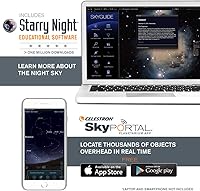
  • Free astronomy software download helps beginners learn the sky alongside actual observing.
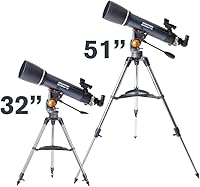
  • Adjustable tripod height accommodates both seated and standing viewers of different ages.

Cons

  • Chromatic aberration — color fringing around bright objects — becomes noticeable above moderate magnification.
  • The focuser can develop looseness over time, particularly with heavier aftermarket eyepieces.
  • Red dot finderscope drifts out of alignment more easily than a traditional optical finder would.
  • No carry bag or protective case is included, making repeated transport more awkward than it should be.
  • Mount lacks slow-motion controls, so fine adjustments and object tracking feel imprecise.
  • Tripod wobbles meaningfully in wind or on uneven outdoor surfaces, disrupting high-magnification views.
  • The included eyepieces are functional but optically basic — serious observers will want to replace them.
  • High-magnification performance disappoints; image quality softens noticeably when pushing past 80x.
  • Instruction manual lacks clarity on finderscope alignment, creating confusion for total beginners.
  • Buyers who progress quickly in the hobby are likely to outgrow this scope within a year or two.

Ratings

The scores below reflect an AI-driven analysis of verified global user reviews for the Celestron AstroMaster 102AZ Refractor Telescope, with spam, bot-generated, and incentivized feedback actively filtered out before scoring. Each category was weighted against the real-world expectations of the beginner and casual observer audience this scope is built for. Both the genuine strengths and the recurring frustrations are represented honestly — no score has been rounded up to flatter the product.

Optical Clarity
78%
22%
For a first telescope, the views it delivers of the Moon are genuinely impressive — crater rims and mountain ranges snap into focus in a way that feels rewarding rather than underwhelming. Star clusters and bright planets like Saturn and Jupiter also come through clearly at moderate magnification, which is exactly the use case most buyers have in mind.
Chromatic aberration — that faint purple or blue fringing around bright objects — becomes noticeable when you push past the 66x eyepiece, especially on the Moon or Venus. It is a known limitation of short-tube refractors at this price tier, and buyers expecting pristine high-magnification views will be disappointed.
Ease of Setup
91%
The no-tools assembly is one of the most consistently praised aspects across thousands of reviews. Most first-time owners report going from opening the box to looking at the sky in under twenty minutes, which removes the biggest barrier for beginners — getting frustrated before even seeing anything.
A small but consistent group of users mentions that the instruction manual could be clearer, particularly for aligning the red dot finderscope. Those without any prior optics experience occasionally spend extra time on this step before the scope is properly calibrated and ready to use.
Mount Usability
74%
26%
The manual alt-azimuth mount with its panhandle control makes pointing the scope feel natural right away — moving up, down, left, and right is intuitive enough that even kids can navigate to a target independently after just a few minutes of practice.
The mount lacks any fine-tune slow-motion controls, so tracking a moving object or making small precise adjustments can feel clunky. On a breezy evening outdoors, any nudge to the tripod introduces noticeable vibration that takes a few seconds to settle, which interrupts the viewing experience more than users expect.
Tripod Stability
71%
29%
For its price range, the adjustable aluminum tripod is considered sturdy by most users. The height adjustment accommodates both seated and standing viewers, which is genuinely useful when sharing the scope across a family with kids and adults of different heights.
In moderate wind or on uneven ground, the tripod introduces enough wobble to be frustrating, especially at higher magnifications where even small vibrations get amplified. A few users recommend placing a weight bag on the tripod spreader tray to improve stability outdoors.
Value for Money
83%
Relative to other beginner telescopes in its class, the AstroMaster 102AZ includes a genuine 102mm lens, two usable eyepieces, a finderscope, and a diagonal — accessories that cheaper scopes often skimp on or omit entirely. Buyers generally feel the package justifies the mid-range price without needing immediate upgrades.
Some experienced hobbyists feel that a comparable investment in a slightly smaller but higher-quality refractor, or an entry-level reflector with more aperture, would deliver better optical performance. The value case is strongest for pure beginners; those planning to grow quickly in the hobby may outgrow it sooner than expected.
Portability
87%
The short optical tube is a real-world advantage — it fits into a car trunk without drama, can be set up on an apartment balcony without dominating the space, and stores in a closet between sessions without feeling like a commitment. At around 14 lbs fully assembled, it is manageable for most adults to carry solo.
There is no dedicated carry bag or case included, so transporting it repeatedly requires improvised solutions. Users who take the scope to star parties or dark-sky sites note that protecting the eyepieces and tube during transport is trickier than it should be given the otherwise portable form factor.
Included Accessories
76%
24%
Getting two eyepieces, a star diagonal, and a red dot finderscope out of the box means a total beginner can start observing without spending another dollar. The free astronomy software download is a genuine bonus that helps new observers learn what they are actually looking at in the sky.
Neither eyepiece is particularly high-end — the optical quality is functional but not exceptional, and experienced users tend to replace them quickly with aftermarket options. The red dot finderscope, while useful, is basic and can lose its alignment more easily than a traditional optical finder would.
High-Magnification Performance
54%
46%
The scope can technically reach much higher magnifications than the included eyepieces provide, and some users who purchase a quality Barlow lens report acceptable planetary views under steady atmospheric conditions when the image is still bright enough to be useful.
At high magnification the short focal ratio works against image quality — views become noticeably softer and chromatic aberration worsens. Most reviewers who pushed past 100x came away underwhelmed, and this is one of the most commonly cited reasons buyers eventually upgrade to a different optical design.
Daytime Terrestrial Viewing
82%
18%
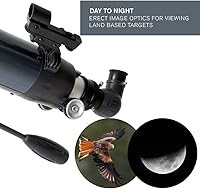
With the erect image diagonal installed, the scope produces correctly oriented views that make it perfectly usable for birdwatching, landscape observation, or spotting distant wildlife. Several users specifically mention using it as a high-powered spotting scope during the day when the night sky is not accessible.
The wide field of view that makes it pleasant for sky-sweeping can feel limiting at distance for dedicated terrestrial use, where a narrower, higher-magnification instrument would pull in more detail. It works well in this role, but a purpose-built spotting scope would outperform it for regular day use.
Build Quality
69%
31%
The optical tube feels solid and the lens coatings hold up well with normal handling. Celestron's manufacturing quality control is consistently decent at this tier, and most users report no out-of-box defects or collimation issues — which is a real concern with budget alternatives.
Some plastic components on the focuser and mount joints feel less premium than the price might suggest, and a handful of reviewers report the focuser rack developing looseness after extended use. It is not fragile, but it does not feel like a long-term instrument built to last decades of heavy use.
Beginner Learning Curve
88%
Among beginner telescopes, this one is particularly forgiving. The alt-azimuth mount removes the complexity of polar alignment entirely, and the wide field of view makes finding objects — especially the Moon — less of a frustrating hunt. Most new users report a genuinely positive first night.
Finding fainter targets like galaxies or globular clusters still requires some sky knowledge and patience, which can frustrate buyers expecting a point-and-discover experience. Without the free software or a star map app, casual users may struggle to know where to point the scope at all.
Focuser Quality
63%
37%
The rack-and-pinion focuser gets the job done for most targets and responds predictably, allowing sharp focus on the Moon and planets without excessive overshooting. For beginners who are new to manual focusers, it is easy enough to learn quickly.
The focuser feels noticeably budget-grade compared to mid-range competitors — it can develop play or wobble over time, and nailing precise focus at high magnification takes more patience than it should. A few users with heavier aftermarket eyepieces note that the focuser struggles to hold position under added weight.
Brand & Warranty Support
86%
Celestron's two-year US warranty and domestic support team are cited positively by buyers who needed assistance. The brand's decades-long presence in the optics space means replacement parts and accessories are widely available, which is not always the case with cheaper off-brand alternatives.
Some international buyers note that warranty support outside the US is less straightforward to navigate. A small number of US-based reviewers also report that warranty claims can take longer to resolve than expected, particularly during peak gifting seasons when support queues are longer.

Suitable for:

The Celestron AstroMaster 102AZ Refractor Telescope is genuinely well-matched for anyone taking their first serious step into stargazing without wanting to wrestle with complicated equipment on night one. Parents looking for a meaningful gift for a curious child aged ten or older will find it hits a practical balance between capability and simplicity — the mount is intuitive enough for kids to operate independently after just a few minutes. Adults who have always been curious about astronomy but felt intimidated by the hobby will appreciate how quickly this scope goes from box to backyard, with no tools and no prior experience required. It also earns its place for anyone who wants a dual-purpose outdoor optics instrument, since the erect image diagonal makes it equally usable for birdwatching or scanning distant landscapes during daylight. Casual observers primarily interested in the Moon, Saturn, Jupiter, or bright star clusters will find this beginner telescope consistently rewarding without feeling like they need to upgrade immediately.
Not suitable for:

The Celestron AstroMaster 102AZ Refractor Telescope is not the right choice for anyone who has already spent time with a starter scope and is actively looking to push deeper into the sky. Observers chasing faint targets — nebulae, distant galaxies, or dim globular clusters — will run into the optical limits of a short-tube 102mm refractor fairly quickly, and the frustration of seeing soft, dim results can sour the experience. Buyers who prioritize high-magnification planetary detail should also look elsewhere, because the f/6.5 focal ratio introduces chromatic aberration that becomes hard to ignore above 80x or so. Anyone planning to do astrophotography will find the manual alt-azimuth mount entirely unsuitable, as tracking objects for long exposures requires motorized equatorial equipment. Finally, if you live somewhere with persistent high winds or uneven terrain and plan to observe outdoors frequently, the tripod stability may become a recurring source of frustration that interrupts sessions more than it should.
Specifications

  • Lens Diameter: The objective lens measures 102mm (4.0″), providing a wide light-gathering aperture well-suited for bright celestial targets and terrestrial viewing.
  • Focal Length: The optical system has a focal length of 660mm, determining how much the eyepieces magnify the incoming image.
  • Focal Ratio: At f/6.5, this is a fast short-tube refractor design that favors wide fields of view over extreme close-up planetary magnification.
  • Tube Length: The optical tube measures 380mm, keeping the overall instrument compact enough to transport in most mid-size vehicles without disassembly.
  • Magnification: The two included eyepieces deliver 33x magnification (20mm) and 66x magnification (10mm) straight out of the box.
  • Max Magnification: The theoretical upper magnification limit is 240x, though image quality degrades noticeably well before that ceiling is reached.
  • Limiting Magnitude: Under dark skies, this telescope can reveal stars and objects down to magnitude 13.7, covering the Moon, planets, and many bright deep-sky targets.
  • Lens Coating: The objective lens features fully coated glass optics designed to maximize light transmission and reduce internal reflections for cleaner views.
  • Mount Type: The scope uses a manual alt-azimuth mount with a panhandle control, allowing smooth vertical and horizontal movement without any motorized components.
  • Finderscope: A StarPointer red dot finderscope is mounted on the tube to help users locate and center targets before looking through the main eyepiece.
  • Included Eyepieces: Two eyepieces are included in the box: a 20mm for lower magnification wide-field views and a 10mm for higher magnification closer inspection.
  • Star Diagonal: An erect image star diagonal is included, correcting the image orientation so that both astronomical and daytime terrestrial views appear right-side-up.
  • Tripod: The adjustable-height aluminum tripod assembles without tools and accommodates both seated and standing observers at different heights.
  • Assembled Weight: The fully assembled telescope weighs approximately 14.1 lbs (6.4 kg), making it manageable for most adults to carry and set up solo.
  • Dimensions: Assembled product dimensions measure 36″ deep by 30″ wide by 51″ tall, occupying a moderate footprint during use.
  • Power Source: The telescope is entirely manually operated with no motors or electronics required for viewing, though the red dot finderscope uses one included lithium metal battery.
  • Warranty: Celestron provides a 2-year US warranty covering manufacturing defects, backed by an unlimited US-based customer support team.
  • Software Included: A free download of a top-rated astronomy software program is included with purchase to help users identify celestial objects and plan observing sessions.
  • Manufacturer: Made by Celestron Acquisition LLC, a California-based optics company with a continuous history in telescope manufacturing since 1960.
  • Item Weight: The product shipping weight is listed at 12.87 lbs, reflecting the scope components without all packaging materials included in the assembled weight figure.

Related Reviews

Celestron AstroMaster 114EQ Reflector Telescope
70%
83%
Optical Performance
78%
Mirror & Coating Quality
81%
Equatorial Mount
51%
Collimation Consistency
58%
Included Eyepieces
More
Celestron AstroMaster 90AZ Refractor Telescope
75%
83%
Optical Clarity
91%
Ease of Setup
78%
Mount Usability
62%
Tripod Stability
76%
Value for Money
More
Celestron AstroMaster LT 70AZ Telescope
84%
91%
Ease of Use
88%
Optical Quality
92%
Setup and Installation
85%
Portability
80%
Build Quality
More
Celestron AstroMaster 130EQ-MD Reflector Telescope
74%
83%
Optical Performance
78%
Motor Drive Tracking
74%
Mount & Tracking Mechanics
69%
Build Quality
61%
Tripod Stability
More
Celestron StarSense Explorer DX 102AZ Refractor Telescope
77%
88%
Ease of Setup
81%
StarSense App Performance
84%
Optical Clarity
61%
Deep-Sky Performance
67%
Mount Stability
More
Celestron Travel Scope 60DX Portable Refractor Telescope
76%
76%
Optical Performance
63%
Build Quality
91%
Portability
89%
Ease of Setup
54%
Tripod Stability
More
Celestron Travel Scope 50 Refractor Telescope
75%
74%
Optical Clarity
91%
Portability & Weight
88%
Ease of Setup
58%
Build Quality & Materials
53%
Tripod Stability
More
Celestron Travel Scope 70
79%
83%
Optical Clarity
91%
Portability & Weight
67%
Build Quality
93%
Ease of Setup
54%
Tripod Stability
More
Celestron NexStar 6SE Computerized Telescope
72%
88%
Optical Performance
83%
GoTo Mount Accuracy
86%
SkyAlign Ease of Use
61%
Mount Stability
81%
Portability & Setup Time
More
Celestron PowerSeeker 80EQ Refractor Telescope
75%
83%
Optical Clarity
67%
Mount Usability
88%
Portability
84%
Value for Money
72%
Build Quality
More

FAQ

Most people get fully set up in fifteen to twenty minutes on their very first attempt. The tripod legs extend and lock without any tools, the optical tube attaches to the mount with a single bolt, and the eyepieces simply slide in. The only step that occasionally takes a little extra time is aligning the red dot finderscope, but that is a one-time adjustment.

Yes — Saturn's rings are visible and recognizable at 66x magnification using the included 10mm eyepiece, and that view alone tends to be a memorable moment for first-time observers. You will not resolve the Cassini Division or see fine ring structure at this magnification, but the rings are unmistakably there. Adding a quality Barlow lens can push the magnification further on nights with steady atmospheric conditions.

It is genuinely well-suited for kids around ten and older. The alt-azimuth mount moves in the same intuitive directions as pointing your hand — up, down, left, right — so children pick it up quickly without needing to understand astronomical coordinate systems. The Moon is easy to find and always impressive, which keeps younger observers engaged rather than frustrated.

Chromatic aberration shows up as a faint purple or blue fringe around very bright objects — most noticeably around the Moon or Venus. On the Celestron AstroMaster 102AZ Refractor Telescope it becomes visible when you push above the magnification of the included eyepieces, but at 33x and 66x it is subtle enough that most beginners barely notice it. It is a known optical characteristic of short-tube refractors at this price point, not a defect.
Absolutely. The included erect image star diagonal flips the view to the correct orientation for daytime use, so birds and landscapes appear right-side-up rather than inverted. The wide field of view actually works well for scanning open areas. It is not as ergonomic as a dedicated spotting scope, but it does the job surprisingly well.

On flat, calm ground the tripod is solid enough for comfortable viewing. Where it shows its limits is in moderate wind or on uneven outdoor surfaces — at higher magnifications, any small vibration gets amplified and takes a couple of seconds to settle. A practical workaround many users recommend is hanging a small bag of weight from the tripod spreader tray to lower the center of gravity.

Some of the brightest nebulae — like the Orion Nebula — are visible as a faint glow, but do not expect dramatic detail. Distant galaxies are largely beyond what this beginner telescope can show satisfyingly, appearing as small faint smudges even under dark skies. The scope is genuinely best pointed at the Moon, planets, and bright open star clusters rather than faint deep-sky objects.

Basic lunar photos are possible by simply holding a smartphone camera up to the eyepiece — a technique called afocal photography — and many users get decent Moon shots this way. For anything more serious, like planetary or deep-sky astrophotography, the manual alt-azimuth mount is not appropriate since it cannot track objects to compensate for Earth's rotation. You would need a motorized equatorial mount for that kind of work.

The included eyepieces are functional and perfectly usable for a beginner — they will not hold you back from enjoying the Moon, planets, or star clusters. They are not premium optics, and experienced observers tend to replace them fairly quickly, but there is no need to spend extra money before you have even used the scope. Start with what is included and upgrade only if you feel genuinely limited.

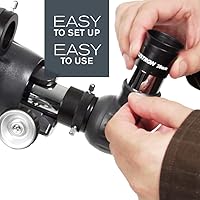
The red dot finderscope projects a small illuminated dot onto a small window, letting you aim the telescope roughly at your target before fine-tuning through the main eyepiece. To align it, point the main scope at an easy target like the Moon, then adjust the finderscope's position until the dot sits on the same object. It can drift out of alignment after moving the scope around, but realigning takes under two minutes once you have done it once.

Where to Buy