Overview

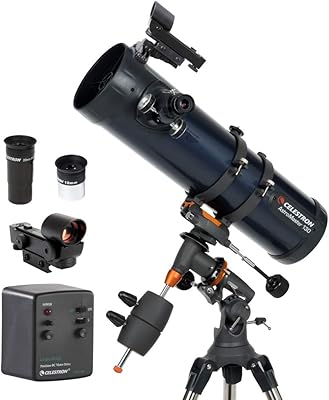
The Celestron AstroMaster 114EQ Reflector Telescope sits at an interesting crossroads — built squarely for beginners, yet it brings a 114mm aperture and a genuine equatorial mount to the table, two things you rarely find bundled together at this price tier. That aperture advantage over typical entry-level refractors means noticeably more light reaches your eye, translating into sharper lunar views and brighter planetary detail. The included accessories — two eyepieces, a red dot finderscope, and a free software download — give newcomers enough to get started without immediately spending more. One thing to understand upfront: this is a manual scope, no computerized tracking, no GoTo system. You point it yourself, which is part of the learning process.
Features & Benefits

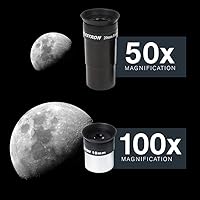
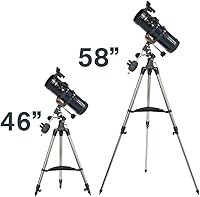
The heart of this beginner Newtonian scope is its 114mm aluminized mirror, coated with SiO2 for improved reflectivity and durability — that combination of aperture and coating quality gives you enough light-gathering to make Saturn's rings genuinely visible on a clear night. The CG-2 equatorial mount includes dual slow-motion knobs for right ascension and declination, letting you track objects smoothly as Earth rotates rather than constantly wrestling the tube. Out of the box, the 20mm and 10mm eyepieces yield 50x and 100x magnification — workable starting points for most beginners. The tripod adjusts without tools and handles different observer heights, while the StarPointer red dot finderscope makes locating targets far less frustrating than guessing blind.

Best For

This reflector telescope is aimed squarely at people ready to move beyond casual stargazing and start doing structured sky observation. Teenagers and adults both find it approachable — the adjustable tripod handles varying heights, and once you spend a session getting familiar with the mount movements, the controls feel intuitive rather than overwhelming. If your main targets are the Moon and planets, you will get consistent satisfaction here. Families looking for one shared scope that both kids and adults can use will find it practical as a household instrument. Celestron's two-year US warranty and access to live support staff also make this a low-risk commitment for first-time telescope buyers.

User Feedback

Most owners come away impressed with the optics — lunar craters look genuinely crisp, and Saturn's rings tend to be the moment that turns a casual user into a committed amateur astronomer. The equatorial mount draws consistent praise for feeling solid without being intimidating, though buyers note it takes a session or two to get comfortable with the dual-axis movements. The criticism most worth flagging honestly: collimation is often off fresh from the box, and a misaligned mirror will noticeably blur your views. It is fixable and not hard to learn, but budget about 20 minutes before your first night out. Some users also report that the included eyepieces feel limiting fairly quickly, and the finderscope occasionally needs calibration right out of the box.

Pros

  • The 114mm aperture gathers significantly more light than typical entry-level refractors, producing noticeably sharper planetary views.
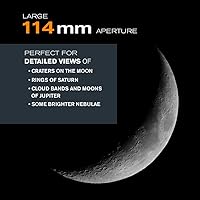
  • Saturn's rings and Jupiter's cloud bands are clearly visible under decent sky conditions, which is a major milestone for beginners.
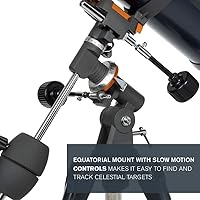
  • The CG-2 equatorial mount lets you track objects smoothly using slow-motion knobs rather than constantly nudging the tube.
  • Tool-free assembly means you can go from unpacking to observing in a short time, even on your first night.
  • The adjustable tripod works comfortably for both seated children and standing adults without awkward compromises.
  • Celestron's two-year US warranty and live support team provide genuine peace of mind for first-time telescope owners.
  • The aluminized SiO2-coated mirror holds up well over time and delivers consistent reflectivity session after session.
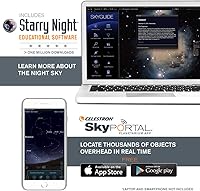
  • The included astronomy software gives beginners a practical way to plan observations and learn star patterns between sessions.
  • At this price tier, getting both an equatorial mount and a 114mm aperture in one kit represents strong overall value.
  • The StarPointer red dot finderscope makes acquiring bright targets like the Moon and planets much less frustrating for newcomers.

Cons

  • Collimation is frequently off straight from the box, requiring mirror alignment before you get the views you paid for.
  • The two included eyepieces feel limiting fairly quickly, and most users find themselves buying upgrades within a few months.
  • At 17 lbs fully assembled, this beginner Newtonian scope is not practical to transport regularly to dark-sky locations.
  • The red dot finderscope often needs calibration before first use, which is an undocumented extra step for new buyers.
  • Learning to use an equatorial mount effectively takes several sessions — it is not intuitive for complete beginners on night one.
  • There is no motorized tracking, so keeping a high-magnification object centered requires constant manual adjustment.
  • Light pollution significantly reduces performance on deep-sky objects, limiting usefulness for urban and suburban observers.
  • The included eyepieces are functional but optically modest — edge sharpness and eye relief are noticeably average.
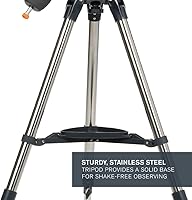
  • The tripod, while stable for casual use, can transmit vibrations when nudged or used on uneven ground.

Ratings

The scores below for the Celestron AstroMaster 114EQ Reflector Telescope were generated by our AI rating engine after analyzing thousands of verified global user reviews, with spam, bot-submitted, and incentivized feedback actively filtered out before scoring. Each category reflects the honest consensus of real buyers — not a curated highlight reel — so both the genuine strengths and the recurring frustrations are represented transparently in every score.
Optical Performance
83%
For a beginner-tier instrument, the views this reflector telescope delivers of the Moon and bright planets consistently impress first-time users. Crater detail on the lunar surface is crisp, and Saturn's rings resolve clearly at 100x on a steady night, which is the moment most buyers cite as their favorite early experience.
Performance drops noticeably on faint deep-sky targets, where the 114mm aperture and suburban sky conditions combine to limit meaningful detail. Users attempting to observe distant galaxies are often disappointed, and the optical experience degrades quickly if collimation has drifted even slightly.
Mirror & Coating Quality
78%
22%
The aluminized mirror with SiO2 overcoating holds up well over regular use, maintaining reflectivity without tarnishing noticeably within the first year or two of ownership. Several long-term owners report that the mirror surface still looks clean and performs consistently after two or three seasons of regular backyard use.
Some buyers have reported that the mirror arrives with minor alignment issues from the factory, which affects image sharpness right out of the box before any user-caused handling. The coating quality, while adequate, is not in the same league as higher-end instruments, and edge-of-field sharpness with wider eyepieces can be soft.
Equatorial Mount
81%
19%
The CG-2 equatorial mount is one of the strongest reasons to choose this beginner Newtonian scope over similarly priced alt-azimuth alternatives. Once polar-aligned, the dual slow-motion knobs let users track planets across the sky smoothly, which makes sustained high-magnification viewing significantly more enjoyable than constantly re-centering a target manually.
The learning curve for first-time equatorial mount users is real — many buyers spend their first session confused about which knob does what, and polar alignment is not intuitive without some prior reading. The mount also transmits vibrations from accidental bumps more than some users expect, requiring a minute or so for the image to settle.
Collimation Consistency
51%
49%
Once properly collimated, the optical system performs noticeably better, and users who took the time to learn the process report significantly sharper planetary views as a direct result. There is a genuine satisfaction in getting collimation right, and it builds useful knowledge about how reflector telescopes actually work.
This is the most consistently flagged frustration across user feedback — the mirrors frequently arrive out of alignment, and many buyers do not realize this is the cause of their blurry views. For complete beginners, discovering and diagnosing a collimation problem without prior knowledge can be genuinely discouraging in the first few sessions.
Included Eyepieces
58%
42%
The 20mm eyepiece with built-in erect image corrector is a practical starter piece that delivers a workable field of view for finding and centering targets, and the 10mm eyepiece provides enough magnification to enjoy clear planetary views on calm nights.
Most users outgrow both included eyepieces within a few months and find themselves shopping for a quality 6mm or 9mm option fairly quickly. Optical quality at the edge of the field is mediocre, and eye relief on the 10mm in particular can feel cramped for eyeglass wearers during extended sessions.
Tripod & Stability
74%
26%
The adjustable-height tripod handles different observer heights gracefully, which is a practical benefit for families where adults and children share the scope. Setup is genuinely tool-free, and the tripod feels solid enough for calm-night backyard sessions without introducing excessive vibration during normal use.
On slightly uneven ground or when observers lean into the eyepiece awkwardly, the tripod can wobble and introduce image shake that takes several seconds to settle. A few users in windier climates report that even mild gusts cause enough vibration to interrupt viewing at higher magnifications.
StarPointer Finderscope
63%
37%
The red dot finderscope makes locating bright targets like the Moon, Jupiter, and Saturn considerably easier than trying to aim a telescope blind, and most users appreciate having it included at this price point. Once calibrated, it points reliably and the brightness-adjustable dot suits most ambient lighting conditions.
A meaningful number of users find the finderscope arrives needing calibration before it is useful, which is an undocumented step that can frustrate first-night observers. Battery life in the LED is finite and easy to forget to switch off, and a few users have noted the mounting bracket feels less rigid than the rest of the scope's hardware.
Setup & Assembly
86%
The box-to-backyard experience is one of the genuine highlights of this beginner Newtonian scope — most users report being fully assembled and ready to observe within 20 to 30 minutes on their very first attempt, with no tools required at any step. The process is logical and the main components connect intuitively even without reading the manual in detail.
While the physical assembly is easy, first-time equatorial mount users often feel lost after assembly is complete because aligning the mount correctly for tracking is a separate and less obvious step. The included instruction materials are considered basic by many buyers, and supplementing with online resources is effectively required to get full use out of the mount.
Value for Money
77%
23%
Pairing a 114mm aperture with a true equatorial mount at this price tier is uncommon, and most buyers who do their research before purchasing recognize they are getting a meaningful optical and mechanical package for a mid-range beginner budget. The two-year warranty and US-based support team add tangible value that cheaper no-name alternatives cannot match.
The overall value proposition takes a hit when you factor in the cost of eyepiece upgrades that most users pursue within months, and the collimation issue means some buyers invest additional time or money resolving a problem that arguably should not exist at delivery. Buyers expecting a fully complete, no-compromise kit out of the box may feel the price should include better accessories.
Build Quality & Durability
72%
28%
The optical tube and mount body feel solid for a beginner instrument, and the aluminized mirror shows no significant degradation under normal storage and handling conditions across multiple seasons. Celestron's reputation for reliable hardware at this tier is generally confirmed by long-term owners who continue using the AstroMaster 114EQ years after purchase.
Some plastic components on the focuser and mount feel noticeably budget-grade under closer inspection, and a handful of users report that the focuser drawtube develops slight slippage over time at heavier eyepiece weights. The overall construction is appropriate for the price but does not convey the confidence of a premium instrument.
Portability
44%
56%
The scope is manageable for transport within a household or to a nearby backyard, and the tripod folds down to a relatively compact form that fits into a car trunk without too much difficulty for occasional use.
At 17 lbs fully assembled and without a dedicated carrying case, this reflector telescope is not realistically a grab-and-go instrument for dark-sky trips. Users who want to drive to remote observing sites regularly find the lack of a padded case and the scope's overall bulk a genuine inconvenience over time.
Astronomy Software
61%
39%
The free software download provides a genuinely useful learning tool for beginners who want to plan sessions, learn constellation patterns, and identify objects before heading outside. New astronomers report that using it between sessions accelerates their sky knowledge meaningfully compared to learning with no guide at all.
The software feels like an optional extra rather than a tightly integrated part of the experience, and tech-savvy buyers often prefer free mobile apps like Stellarium over the included download. A few users have reported minor compatibility friction with newer operating systems, which required additional troubleshooting steps to resolve.
Customer Support & Warranty
88%
Celestron's two-year US warranty and access to live, US-based support staff is a consistent positive in user feedback, particularly for first-time telescope owners who run into collimation questions or mount alignment confusion early on. Several buyers specifically mentioned that support staff walked them through issues patiently and resolved problems without pushback on warranty claims.
International buyers outside the US find the warranty coverage and support access less straightforward, with longer resolution timelines reported. A small number of users mention that replacement part availability can be slow depending on the component needed, which can leave a scope unusable for longer than expected during warranty service.

Suitable for:

The Celestron AstroMaster 114EQ Reflector Telescope is an excellent fit for anyone taking their first serious step into amateur astronomy — particularly teenagers and adults who want a capable instrument without the steep learning curve of a fully manual research-grade scope or the expense of a computerized one. If your primary targets are the Moon, Saturn, Jupiter, and bright star clusters, this reflector telescope will consistently deliver satisfying views that keep you coming back outside on clear nights. Families benefit from the adjustable tripod and straightforward controls, making it practical for both a curious 12-year-old and a parent sharing the experience. First-time buyers who value brand reliability and post-purchase support will appreciate Celestron's two-year warranty and access to US-based help when setup questions inevitably arise. The included software also gives new astronomers a structured way to learn the sky between sessions, which genuinely accelerates the learning curve.
Not suitable for:

The Celestron AstroMaster 114EQ Reflector Telescope is not the right choice for observers who want to point at an object and have the telescope find it automatically — there is no GoTo motor, no computerized alignment, and no app-driven tracking here. Experienced amateur astronomers who have already outgrown a beginner scope will find the 114mm aperture limiting for faint deep-sky objects like distant galaxies or dim nebulae, where larger mirrors make a significant difference. This beginner Newtonian scope also requires periodic collimation — a process of realigning the mirrors — which can frustrate buyers expecting a purely plug-and-play experience right out of the box. Anyone living in a light-polluted urban area hoping to observe faint objects beyond the solar system may find the results disappointing, since aperture alone cannot overcome severe light pollution. Buyers looking for a lightweight travel scope should also look elsewhere, as the AstroMaster 114EQ tips the scales at 17 lbs fully assembled.
Specifications

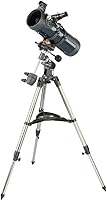
  • Optical Design: This telescope uses a Newtonian Reflector design, which relies on a curved primary mirror rather than glass lenses to gather and focus light.
  • Aperture: The primary mirror measures 114mm (4.48 inches) in diameter, giving it strong light-gathering capability for a beginner-class instrument.
  • Focal Length: The optical tube has a focal length of 1000mm, which influences both magnification potential and the field of view achievable with different eyepieces.
  • Focal Ratio: The telescope operates at f/8.7, a relatively long focal ratio that favors planetary and lunar observation over wide-field deep-sky viewing.
  • Magnification Range: Usable magnification spans from 16x at the lowest practical setting up to 269x at the theoretical maximum, with included eyepieces delivering 50x and 100x.
  • Mirror Coating: The primary mirror features aluminized coating with a silicon dioxide (SiO2) overcoat, which improves reflectivity durability and resistance to tarnishing over time.
  • Limiting Magnitude: Under good conditions, this reflector telescope can resolve objects down to approximately magnitude 12.8, making many star clusters and brighter nebulae accessible.
  • Mount Type: The CG-2 equatorial mount allows the telescope to track celestial objects along the sky's natural arc using two manual slow-motion control knobs.
  • Included Eyepieces: Two eyepieces are included in the box: a 20mm eyepiece with a built-in erect image corrector and a 10mm eyepiece for higher magnification views.
  • Finderscope: A StarPointer red dot finderscope is attached to the optical tube to help users quickly locate and center objects before viewing through the main eyepiece.
  • Tripod: The adjustable-height aluminum tripod requires no tools to assemble and can be set to different heights to accommodate seated or standing observers.
  • Total Weight: The fully assembled telescope system weighs approximately 17 lbs, which should be factored in when considering portability and storage.
  • Product Dimensions: The packaged unit measures 15.5 inches deep by 15.5 inches wide by 27 inches tall, reflecting the size of the optical tube and mount combined.
  • Power Source: The StarPointer finderscope is battery-powered and requires one lithium metal battery, which is included in the box at purchase.
  • Warranty: Celestron covers this beginner Newtonian scope with a 2-Year US Warranty and provides access to US-based customer support for troubleshooting and guidance.
  • Software Included: Buyers receive a free download code for a well-regarded astronomy software program, useful for planning observations and learning constellation and object locations.
  • Focus Type: Focusing is achieved entirely through manual adjustment of the focuser drawtube, with no motorized or electronic focusing assistance included.
  • Manufacturer Origin: Celestron is a California-based optics company with over six decades of experience producing telescopes and astronomy accessories for consumer and professional markets.

Related Reviews
Celestron AstroMaster 90AZ Refractor Telescope
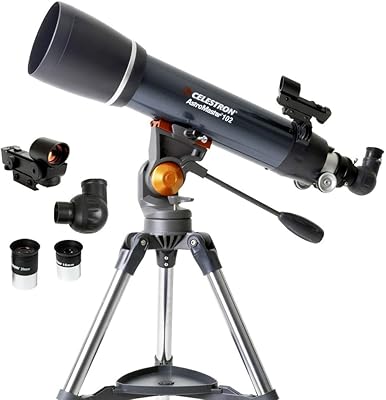
75%
83%
Optical Clarity
91%
Ease of Setup
78%
Mount Usability
62%
Tripod Stability
76%
Value for Money
More
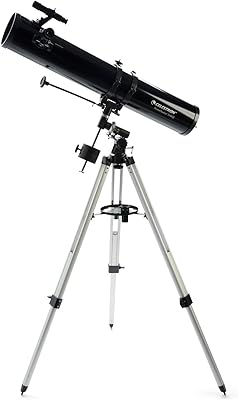
Celestron PowerSeeker 114EQ Reflector Telescope
73%
83%
Optical Performance
61%
Mount Quality
57%
Ease of Setup
74%
Included Accessories
81%
Value for Money
More
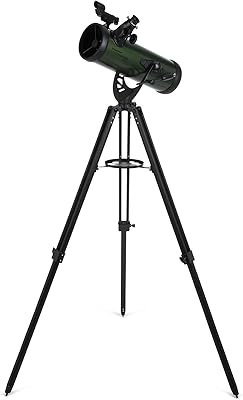
Celestron AstroMaster 102AZ Refractor Telescope
77%
78%
Optical Clarity
91%
Ease of Setup
74%
Mount Usability
71%
Tripod Stability
83%
Value for Money
More
Celestron AstroMaster 130EQ-MD Reflector Telescope
74%
83%
Optical Performance
78%
Motor Drive Tracking
74%
Mount & Tracking Mechanics
69%
Build Quality
61%
Tripod Stability
More
Celestron AstroMaster LT 70AZ Telescope
84%
91%
Ease of Use
88%
Optical Quality
92%
Setup and Installation
85%
Portability
80%
Build Quality
More
Celestron ExploraScope 114AZ Reflector Telescope
78%
83%
Optical Performance
91%
Ease of Setup
78%
Mount Usability
62%
Included Accessories
57%
Focuser Quality
More
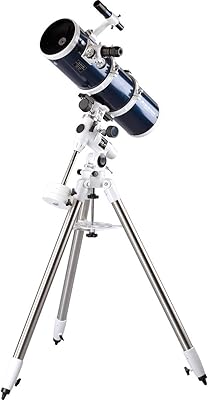
Celestron Omni XLT 150 Reflector Telescope
84%
91%
Optical Clarity
89%
Ease of Setup
85%
Mount Precision
88%
Build Quality
84%
Included Accessories
More
Celestron NexStar 6SE Computerized Telescope
72%
88%
Optical Performance
83%
GoTo Mount Accuracy
86%
SkyAlign Ease of Use
61%
Mount Stability
81%
Portability & Setup Time
More
Celestron PowerSeeker 70EQ Refractor Telescope
71%
78%
Optical Clarity
83%
Mount Quality & Stability
61%
Ease of Assembly
74%
Accessory Bundle Value
86%
Portability
More
Celestron NexStar 90SLT Computerized Telescope
73%
78%
Optical Performance
83%
GoTo Accuracy
81%
Ease of Setup
86%
Portability
67%
Build Quality
More

FAQ

Yes, and it is one of the highlights of owning this beginner Newtonian scope. On a clear, steady night with the 10mm eyepiece giving 100x magnification, Saturn's rings are distinctly visible and separated from the planet's disk. It is genuinely one of those moments that makes the purchase feel worthwhile.

Assembly is straightforward and does not require any tools. Most users get the tripod, mount, and optical tube assembled and ready to point at the sky within 20 to 30 minutes on their first attempt. The main learning curve is understanding how the equatorial mount moves, not the physical setup itself.

Collimation is the process of aligning the telescope's mirrors so they work together correctly to produce a sharp image. On the AstroMaster 114EQ, the mirrors are sometimes slightly misaligned when the scope arrives, which can result in blurry views even at lower magnifications. It sounds intimidating but is actually a 10 to 20 minute process that most beginners learn quickly using a free online guide or a collimation cap.

It can work well for a motivated young observer, especially with an adult involved in setup and initial alignment. The mount takes some patience to learn, so it suits curious kids who are genuinely interested rather than those expecting an instant, point-and-shoot experience. The adjustable tripod also helps accommodate shorter users comfortably.

The included accessories cover the basics well enough to get started. The two eyepieces handle low and medium magnification, and the red dot finderscope helps with target acquisition. That said, many users find themselves wanting a wider-field eyepiece or a better quality 6mm eyepiece within a few months as they gain experience and start pushing for more detail.

A standard alt-azimuth mount moves up-down and left-right, which is intuitive but makes tracking stars awkward as they drift across the sky. An equatorial mount, like the CG-2 on this scope, is tilted to match Earth's rotational axis, so you can follow a star or planet with a single smooth motion using one knob rather than constantly correcting two axes simultaneously. It takes a session or two to get comfortable, but it genuinely makes extended viewing much easier.

Technically yes, but it is not well-suited for it. The image through a Newtonian reflector is rotated, which makes terrestrial viewing disorienting. The 20mm eyepiece includes an erect image corrector that helps somewhat, but the scope's bulk and mount design make it far less practical than a dedicated spotting scope or binoculars for ground-level use.

You can still enjoy lunar views and bright planets like Jupiter and Saturn from a suburban backyard or even a city rooftop. Where light pollution really hurts is with faint deep-sky objects — galaxies, dim nebulae, and globular clusters become much harder or impossible to resolve when the sky background is bright. For the best deep-sky results, you need reasonably dark skies.

The Orion Nebula is a strong yes — it shows visible structure even from moderately light-polluted areas with the AstroMaster 114EQ. Andromeda is trickier; you can detect it as a faint smudge under darker skies, but do not expect detailed spiral arm structure. For galaxies, managing your expectations is important — most appear as soft, fuzzy patches rather than the dramatic images seen in photography.

The CG-2 equatorial mount is compatible with Celestron's single-axis motor drive, which can be purchased separately and attaches to the right ascension axis to automate the tracking motion. It will not turn this into a GoTo scope, but it does remove the need to constantly nudge the knob to keep a planet centered during longer viewing sessions, which many users find worthwhile after a few months of manual operation.

Where to Buy