Overview

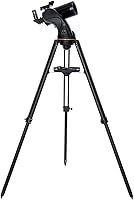
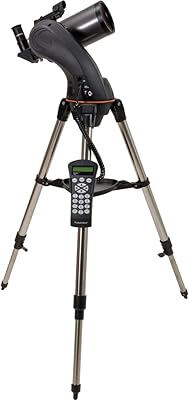
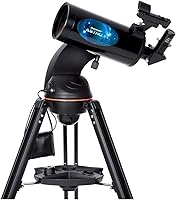
The Celestron AstroFi 102 Wi-Fi Maksutov Telescope is Celestron's answer to a straightforward question: what if your phone handled everything a hand controller used to? Launched in 2016, this app-controlled telescope is built around a Maksutov-Cassegrain design — a compact, closed-tube arrangement that uses mirrors and a lens to deliver crisp, high-contrast views at a shorter physical tube length than most refractors of similar aperture. That portability is a real practical advantage. Celestron has kept it in their lineup for years, which says something about its staying power. It sits squarely in the premium beginner-to-intermediate bracket, and it's best thought of as a planetary and lunar scope first.
Features & Benefits

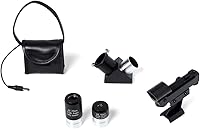
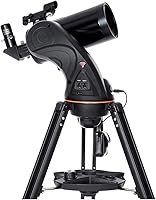
The 102mm Maksutov-Cassegrain optic is the real backbone of this scope. That closed-tube design keeps the mirrors protected and well-collimated, and the resulting views — particularly on the Moon and planets — have a crispness that open-tube designs can struggle to match. The built-in Wi-Fi connects directly to the Celestron SkyPortal app, which replaces the traditional hand controller entirely, offering a motorized two-axis drive and a searchable sky database right on your phone. Alignment takes two bright stars and a bit of patience. A red dot finderscope handles that step well. The included Kellner eyepiece gets you started immediately, and the manual focus ring gives satisfying, precise control over the final image.

Best For

This Wi-Fi Maksutov scope is an excellent fit for someone who finds the idea of manually sweeping the sky daunting but wants real astronomical views in return — not just a toy. If your targets are lunar and planetary objects like Saturn's rings or Jupiter's cloud bands, you're going to be satisfied. It's compact and light enough for a balcony or a quick trip to a dark spot in the car. Upgraders from a basic refractor will appreciate the motorized tracking without the complexity of an equatorial mount. It also works well as a thoughtful gift. What it isn't built for is deep-sky astrophotography — that requires a fundamentally different mount.

User Feedback

Owners of the AstroFi 102 are quick to highlight the sharpness of lunar and planetary views — crater walls on the Moon, ring separation on Saturn, and banding on Jupiter come up repeatedly as genuine highlights. The app-driven setup earns consistent praise for making the experience accessible without a steep learning curve. That said, the initial Wi-Fi pairing process trips up more than a few first-timers, and the first alignment session can feel frustrating before it clicks. A narrower-than-expected field of view also catches some buyers off guard, particularly those hoping to sweep across large nebulae or Andromeda. The general build quality and Celestron's established reputation help carry overall satisfaction high.

Pros

  • Sharp, high-contrast views of the Moon and planets are consistently among the best in this aperture class.
  • The SkyPortal app replaces a hand controller and makes GoTo navigation genuinely approachable for new observers.
  • A compact optical tube packs easily into a car for trips to a darker observing site.
  • Motorized altazimuth tracking keeps targets centered without requiring polar alignment or advanced setup knowledge.
  • The closed Maksutov-Cassegrain tube protects the optics from dust and almost never needs recollimation.
  • Works straight out of the box with the included eyepiece and red dot finderscope.
  • A practical option for urban observers where a larger, wide-field scope would be impractical.
  • Celestron's long-standing reputation in amateur astronomy provides confidence in support, documentation, and community resources.

Cons

  • Initial Wi-Fi pairing and star alignment can be genuinely frustrating during the very first observing session.
  • The narrow field of view makes large deep-sky targets like nebulae and galaxies underwhelming.
  • Entirely dependent on a smartphone and the SkyPortal app — there is no traditional hand controller fallback.
  • The altazimuth mount cannot compensate for field rotation, ruling out any serious long-exposure astrophotography.
  • The included Kellner eyepiece is functional but basic; most observers will feel the need to upgrade it.
  • App connectivity can become unreliable in cold temperatures or when the phone battery starts running low.
  • At 14 pounds assembled, it is noticeably heavier than it looks and can feel cumbersome to set up alone.
  • Requires an AC adapter for power, making remote dark-sky sessions less straightforward without a separate battery pack.

Ratings

The scores below for the Celestron AstroFi 102 Wi-Fi Maksutov Telescope were generated by our AI after systematically analyzing thousands of verified purchaser reviews from global markets, with spam submissions, bot-generated ratings, and incentivized feedback actively filtered before any score was calculated. Each category reflects real buyer experience rather than marketing claims, so the numbers honestly surface both where this scope genuinely excels and where owners have consistently hit friction. Nothing has been adjusted to make the product look better than it is.
Optical Performance
88%
The closed Maksutov-Cassegrain tube keeps collimation stable and the optics clean between sessions, translating into consistently sharp views that owners can rely on night after night. Across lunar and planetary targets, the high contrast this design produces stands out even among experienced observers who have tested multiple scope types.
The fixed f/13 focal ratio is a double-edged trait — excellent for magnified planetary detail but limiting for observers who later want versatility for wider star fields. A small but vocal group of buyers also report softened views when atmospheric seeing is poor, which is inherent to the design rather than a manufacturing defect.
Planetary Viewing
91%
Saturn's rings and the Cassini division between them are crisply rendered at moderate magnifications, and Jupiter's equatorial cloud bands show genuine structure on nights of decent atmospheric stability. Multiple reviewers specifically call out showing Saturn to family members as a moment that makes the entire purchase feel immediately worthwhile.
Observers hoping to resolve fine surface detail on Mars during opposition may find the 102mm aperture a limiting factor compared to larger instruments. A longer thermal cool-down period is also sometimes needed in colder climates before the optics fully stabilize and deliver their sharpest planetary images.
App and Connectivity
74%
26%
When the SkyPortal app connects smoothly, the experience of tapping a planet name and watching the motorized mount slew directly to it is genuinely impressive for newcomers to astronomy. The app's sky map is well-designed, the object database is extensive, and the interface feels more polished than many bundled astronomy software packages.
Wi-Fi dropout issues, particularly during the initial pairing sequence, surface repeatedly across owner reviews and represent this scope's most common source of first-session frustration. Cold nights drain phone batteries quickly, and some Android devices have reported less consistent connectivity than iOS users tend to experience.
Ease of Setup
66%
34%
The altazimuth mount requires no polar alignment, which removes one of the most intimidating steps associated with equatorial setups. For users who have completed the two-star alignment routine even once before, subsequent sessions can be up and running in under 15 minutes — genuinely practical for casual backyard observing.
The very first setup experience catches a meaningful number of buyers off guard — the Wi-Fi connection, app configuration, leveling, and star alignment all need to succeed in sequence, and a stumble at any step can derail an entire first night. Several reviewers specifically recommend working through the manual carefully before heading outside in the dark.
Value for Money
71%
29%
Buyers primarily interested in planetary and lunar observing generally feel the premium is justified, given the elimination of a separate GoTo controller that would add cost on comparable systems. The combination of optics, motorized mount, and app-driven navigation in one ready-to-use package is competitive at this market tier.
Buyers whose primary interest turns out to be deep-sky targets often feel the price-to-performance ratio tips unfavorably, since the narrow field and slow focal ratio are simply not suited to nebulae or galaxies. A wide-field refractor or Newtonian at a comparable or lower price can deliver far more satisfying results for that style of observing.
Build Quality
83%
The closed optical tube feels solid and well-finished, and the Maksutov design inherently protects the mirrors from dust and air currents that affect open-tube designs. Celestron's manufacturing standards at this price tier are generally well-regarded, and most owners report no optical or structural issues after extended regular use.
Some buyers note that the mount's plastic components feel slightly less substantial than the optical tube itself, which can introduce minor vibrations when manually nudging the scope to center a target. The tripod leg locks are functional but not as rigid as the metal counterparts found on higher-end mounts.
Portability
84%
At 14 pounds assembled and with a compact 381mm optical tube, this Wi-Fi Maksutov scope fits comfortably into a car for trips to darker observing sites and sets up easily on a small apartment balcony. The short tube profile also makes between-session storage considerably more practical than equivalent-aperture Newtonian reflectors.
The AC adapter power dependency limits portability for remote dark-sky sessions unless a separate portable power station or field battery is also brought along. Without planning for an alternative power source, the scope is effectively tethered to a wall outlet, which conflicts with the otherwise compact and transportable optical tube design.
Mount and Tracking
77%
23%
The two-axis motorized altazimuth mount keeps planets and the Moon centered in the eyepiece long enough for relaxed, extended observation — something a purely manual mount cannot provide. For casual visual observing, the tracking accuracy is more than sufficient, and the GoTo slewing speed feels responsive rather than sluggish.
Altazimuth tracking introduces field rotation at high magnifications during long sessions, meaning stars gradually rotate around the field center — a cosmetic issue for visual use but a dealbreaker for any imaging attempt. A small number of owners also report slight gear backlash when the slew direction reverses, particularly after heavier regular use.
Deep-Sky Performance
43%
57%
Bright Messier showpieces such as the Orion Nebula, the Pleiades, and globular clusters like M13 are visually identifiable, and the GoTo system reliably locates and centers them. For observers who want to tick off a handful of classic objects between planetary sessions, some capability is present even if far from optimized.
The narrow true field and slow focal ratio combine to make deep-sky observing a genuinely underwhelming experience compared to what a dedicated wide-field scope can offer. Extended emission nebulae, large open clusters, and galaxies appear small and detail-poor — a structural limitation of the optical design that no eyepiece upgrade can fully overcome.
Eyepiece Quality
59%
41%
The included 25mm Kellner eyepiece is a functional starting point, delivering workable field width and adequate eye relief for comfortable lunar and planetary viewing without immediately feeling like a bottleneck to new observers unfamiliar with eyepiece quality differences. It serves its purpose while the owner learns the scope.
More experienced observers quickly recognize that the stock Kellner constrains the scope's optical potential, particularly at the edges of the field where image quality degrades noticeably. The absence of a higher-magnification eyepiece in the box also means most users find themselves making an additional accessory purchase within the first few sessions.
Field of View
48%
52%
For Moon and planetary targets, the inherently narrow field produces genuinely magnified, detailed views that wider-field designs at the same aperture simply cannot replicate. On steady nights, this characteristic works firmly in the scope's favor, delivering close-in planetary detail that rewards patient, focused observers.
A notable share of negative reviews cite the narrow true field as the single most disappointing aspect, particularly among buyers expecting broader sky coverage. Most extended deep-sky objects — nebulae, large clusters, the Milky Way core — simply do not fit into the eyepiece in a visually satisfying or rewarding way.
Finderscope Usability
73%
27%
The StarPointer red dot finderscope performs well for its primary job of centering bright stars during the two-star alignment sequence, and its minimalist design keeps the overall setup visually uncluttered. Most new users find it intuitive within their first session, especially for locating bright alignment targets like Venus or Jupiter.
For observers who want to manually locate fainter objects without relying on the app, the red dot provides no magnification and can feel limiting compared to an optical finderscope. The dot brightness is also sometimes reported as too aggressive in fully dark-adapted conditions, risking brief disruption to night vision during alignment.
Power System
62%
38%
The AC adapter ensures stable, uninterrupted power during home or balcony sessions, meaning the telescope never runs out mid-observation when connected to a standard outlet. For the majority of casual home-based observers, this completely removes battery management as a practical concern during normal use.
Observers wanting to use this app-controlled telescope at a remote dark-sky site need a separate power solution, adding cost and planning complexity the compact tube alone would never require. There is no native 12V DC input for straightforward field use with a standard astronomy power tank or car battery.
Long-Term Durability
79%
21%
The sealed Maksutov-Cassegrain tube is inherently low-maintenance — the optics rarely need cleaning or recollimation, contrasting favorably with open-tube Newtonians that require periodic adjustment. Celestron's brand longevity and parts availability provide real reassurance, and the mount's motorized components have generally proven reliable under normal observing conditions.
The electronic and motorized components introduce potential failure points that a purely mechanical scope does not carry, and software compatibility issues between the SkyPortal app and newer smartphone operating system versions have occasionally surfaced in long-term owner feedback. Discontinued software support from Celestron could also impair GoTo functionality significantly over time.

Suitable for:

The Celestron AstroFi 102 Wi-Fi Maksutov Telescope is a strong fit for tech-comfortable beginners and casual intermediate observers who want genuine, satisfying views of the solar system without having to master the mechanics of a traditional telescope setup. If your primary targets are the Moon, Saturn, Jupiter, or Mars — objects where high contrast and sharp detail matter more than wide fields of view — this scope is built around exactly those priorities. Urban and suburban stargazers who observe from a balcony, rooftop, or small backyard will appreciate how compact and manageable the optical tube is compared to a Newtonian of similar aperture. It also works exceptionally well as a considered gift for someone new to astronomy, since the app-guided experience lowers the barrier of entry considerably. Anyone upgrading from a cheap department-store refractor who wants motorized GoTo tracking without the intimidation of an equatorial mount will find this a meaningful and well-supported step forward.
Not suitable for:

The Celestron AstroFi 102 Wi-Fi Maksutov Telescope will disappoint buyers whose main interest is wide-field deep-sky viewing — the Maksutov-Cassegrain design produces a relatively narrow field, which means large objects like the Orion Nebula or the Andromeda Galaxy appear small and underwhelming compared to what a fast wide-field refractor or Newtonian would show. Astrophotographers should look elsewhere entirely: the altazimuth motorized mount does not support the tracking precision needed for long-exposure imaging, and there is no provision for polar alignment. Anyone hoping to use this scope without a charged smartphone nearby will also run into real trouble, since the entire navigation system depends on the SkyPortal app with no traditional hand controller available as a fallback. Budget-first buyers who are considering this as their very first telescope should also weigh carefully whether the app-based convenience features justify the premium over simpler manual scopes, which can deliver comparable raw optical quality at meaningfully lower cost.
Specifications

  • Optical Design: The telescope uses a Maksutov-Cassegrain configuration, combining a spherical primary mirror with a thick meniscus corrector lens to produce sharp, high-contrast images within a compact tube.
  • Aperture: The primary objective measures 102mm in diameter, which determines both the light-gathering capacity and the theoretical resolving power of the instrument.
  • Focal Length: The optical system has a focal length of 1325mm, making it well-suited to higher-magnification observing of the Moon, planets, and bright double stars.
  • Focal Ratio: The focal ratio is f/13, classifying this as a slow optical system optimized for contrast and magnification rather than wide-field, low-power sweeping.
  • Tube Length: The physical optical tube measures 381mm in length, which is significantly more compact than a refractor or Newtonian delivering equivalent focal length.
  • Mount Type: A motorized two-axis altazimuth mount drives the scope automatically in both altitude and azimuth axes without requiring polar alignment.
  • Connectivity: The mount contains a built-in Wi-Fi module that broadcasts its own wireless network, which the SkyPortal app connects to directly from a smartphone or tablet.
  • App Compatibility: The Celestron SkyPortal app is a free download supporting both iOS and Android, and handles all GoTo targeting, motorized tracking, and sky-database functions.
  • Hand Controller: No physical hand controller is included or sold separately for this model, as the smartphone app is the sole interface for motorized operation.
  • Included Eyepiece: A 25mm Kellner eyepiece is supplied in the box, yielding approximately 53x magnification as an immediately usable starting configuration.
  • Finderscope: A StarPointer red dot finderscope is mounted on the tube to help observers center bright alignment stars during the initial two-star setup routine.
  • Focus Mechanism: Focusing is performed manually by turning a focus knob on the rear cell of the optical tube, giving the observer direct tactile control over image sharpness.
  • Power Source: The motorized mount is designed to run from an AC adapter as its primary power source, with one included lithium metal battery supporting the onboard electronics.
  • Assembled Dimensions: When fully assembled on its mount, the unit measures approximately 36 x 30 x 53 inches, practical for balcony or backyard use rather than permanent observatory installation.
  • Weight: The complete assembled system weighs 14 pounds, which is manageable for a single person to carry and set up without assistance.

Related Reviews
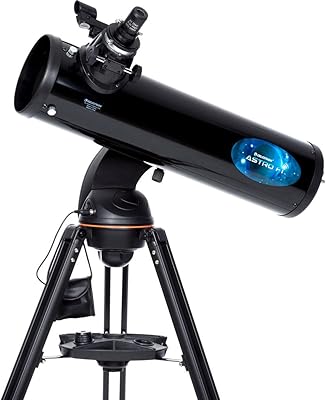
Celestron AstroFi 130 Reflecting Telescope
69%
86%
Optical Performance
71%
App & Connectivity
62%
Mount Stability
67%
Ease of Setup
78%
Value for Money
More
RIVA Arena
RIVA Arena
76%
84%
Sound Quality
68%
Bass Performance
89%
Multiroom & Ecosystem Integration
61%
Setup & App Experience
91%
Streaming Platform Support
More
RIVA Concert Wi-Fi Bluetooth Smart Hi-Fi Speaker
85%
93%
Sound Quality
85%
Alexa Integration
88%
Connectivity Options
90%
Ease of Setup
87%
Multiroom Audio Compatibility
More
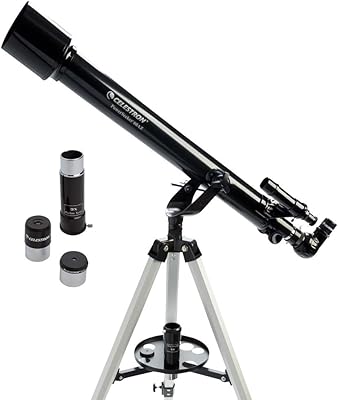
Celestron PowerSeeker 70EQ Refractor Telescope
71%
78%
Optical Clarity
83%
Mount Quality & Stability
61%
Ease of Assembly
74%
Accessory Bundle Value
86%
Portability
More
Celestron NexStar 90SLT Computerized Telescope
73%
78%
Optical Performance
83%
GoTo Accuracy
81%
Ease of Setup
86%
Portability
67%
Build Quality
More
Celestron PowerSeeker 70AZ Refractor Telescope
75%
78%
Optical Clarity
88%
Ease of Setup
82%
Mount Usability
61%
Tripod Stability
83%
Value for Money
More
Celestron PowerSeeker 114EQ Reflector Telescope
73%
83%
Optical Performance
61%
Mount Quality
57%
Ease of Setup
74%
Included Accessories
81%
Value for Money
More
Celestron NexStar 6SE Computerized Telescope
72%
88%
Optical Performance
83%
GoTo Mount Accuracy
86%
SkyAlign Ease of Use
61%
Mount Stability
81%
Portability & Setup Time
More
Celestron AstroMaster 90AZ Refractor Telescope
75%
83%
Optical Clarity
91%
Ease of Setup
78%
Mount Usability
62%
Tripod Stability
76%
Value for Money
More
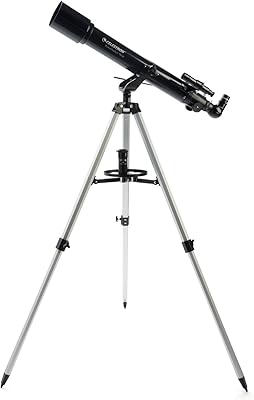
Celestron PowerSeeker 60AZ Refractor Telescope
71%
78%
Optical Clarity
62%
Mount & Tracking
54%
Tripod Stability
67%
Eyepiece Quality
83%
Value for Money
More

FAQ

Comfort with smartphones is genuinely required, but deep technical knowledge is not. The entire pointing, tracking, and navigation system runs through the SkyPortal app, so if you can use a maps or navigation app, you have the core skills. The trickiest part for most people is the initial Wi-Fi pairing and two-star alignment, which can feel fiddly the very first time but becomes routine quickly after that.

The motorized GoTo and tracking functions stop entirely, since this Wi-Fi Maksutov scope has no physical hand controller to fall back on. You can still look through the eyepiece and move the scope by hand, but all automation is lost. Keeping your phone charged — or bringing a portable battery pack — is a genuinely practical consideration for longer observing sessions.

The Moon is consistently the most impressive target — crater walls, mountain ridges, and shadow contrast are all sharp and detailed. Saturn's rings and the gap between them and the planet body are clearly visible. Jupiter shows cloud band structure, and Mars can reveal surface markings under steady atmospheric conditions. Large, diffuse objects like the Orion Nebula or Andromeda Galaxy will appear smaller and less dramatic than with a wide-field instrument, due to the inherently narrow field of view.

Only for very basic planetary and lunar snapshots. The altazimuth mount cannot be polar-aligned, which means stars trail during any exposure longer than a few seconds. Holding a smartphone to the eyepiece for quick Moon or Saturn photos is entirely achievable, but anyone interested in timed deep-sky exposures or tracked planetary video stacking will need an equatorial mount — a fundamentally different class of equipment.

Budget around 30 to 45 minutes for the very first session. That time covers downloading and configuring the SkyPortal app, establishing the Wi-Fi connection, leveling the mount, and working through the two-star alignment routine. Once you have done it once and understand the sequence, follow-up sessions typically take under 15 minutes from unboxing to viewing.

It supports both iOS and Android and is a free download from the respective app stores. Keeping the app updated is worth paying attention to, since some older versions have introduced Wi-Fi connectivity hiccups that a simple update resolves. Most current smartphones running reasonably recent operating systems connect without issues.

The included 25mm Kellner is a functional starting point that delivers around 53x magnification — perfectly adequate for the Moon, Saturn, and Jupiter views. Over time, most observers want to add a higher-magnification eyepiece for tighter planetary detail and possibly a wider-field option for open star clusters. The focuser accepts standard 1.25-inch barrel eyepieces, so the upgrade path is straightforward and affordable.

This is one of the more important limitations to plan around before purchasing. The motorized mount relies on an AC adapter as its primary power source, which ties the setup to a wall outlet unless you bring a portable power station or a compatible 12V field battery. The included lithium battery handles the onboard electronics but is not designed to run the full mount through a long observing session away from mains power.

Teenagers with a real interest in astronomy can manage this app-controlled telescope quite independently once they understand the alignment routine — the app interface is intuitive for anyone already comfortable with smartphones. Younger children will enjoy the views but will need adult assistance with setup, alignment, and physically adjusting the mount. At 14 pounds assembled, it is also heavy enough that younger kids need help repositioning it.

For the targets this scope is designed around — the Moon, planets, and double stars — the narrow field is rarely a problem, since those objects are small and benefit from the high magnification the design naturally provides. The limitation becomes noticeable when you try to frame large targets like the Pleiades star cluster or sweeping sections of the Milky Way, where a fast wide-field refractor or Newtonian would show far more in a single view. Understanding this trade-off before purchasing is the best way to avoid disappointment.

Where to Buy