Overview

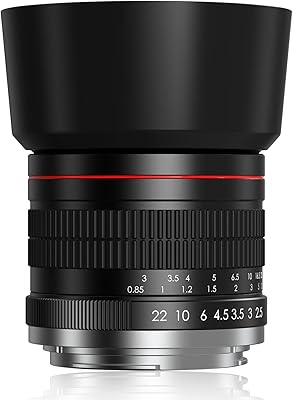
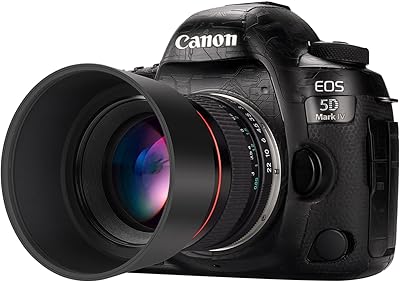
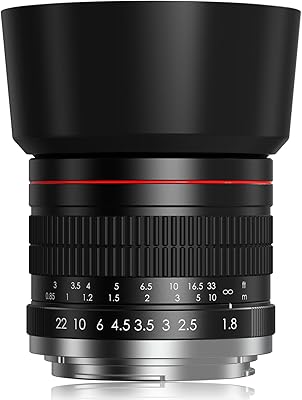
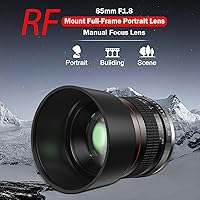
The BENOISON 85mm f/1.8 Portrait Prime Lens arrived on the Canon RF scene in late 2024 as a fully manual, no-frills option for photographers who want the classic 85mm portrait focal length without spending heavily on native glass. There are no electronic contacts here — none — which means you need to shoot in Manual mode and enable Release Shutter w/o Lens in your camera menu before anything fires. That setup step trips up first-time buyers, so get it done before heading out to shoot. Once configured, this RF-mount prime delivers the flattering subject compression that makes 85mm a portrait staple, whether you are shooting half-body frames or tighter facial compositions outdoors.
Features & Benefits

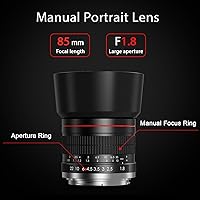
The f/1.8 maximum aperture is the headline here, and it genuinely delivers soft, blurry backgrounds on well-lit subjects — the kind of creamy separation that makes portraits pop. Since the lens has no electronic connection to the camera body, aperture is adjusted by rotating a physical ring on the barrel, and your camera will simply display F00 throughout. Filters are easy to source thanks to the standard 55mm thread size. At just over a pound and roughly 6 inches long, this manual 85mm lens sits comfortably on an R50 or R6 Mark II without feeling front-heavy. Paired with careful ISO and shutter speed choices, low-light shooting is manageable, though it demands patience.

Best For

This RF-mount prime suits a fairly specific type of shooter, and knowing whether you fall into that group matters before buying. Portrait hobbyists who want to build manual focus discipline will find the slow, deliberate nature of the lens genuinely educational. It also makes sense for Canon RF owners who want to test the 85mm focal length before committing to a much pricier native autofocus alternative from Canon or Sigma. Street photographers comfortable with zone focusing can work with it in practiced hands. Video shooters who prefer smooth manual iris control may also appreciate the aperture ring, and anyone already comfortable with legacy glass will feel right at home.

User Feedback

With 437 ratings and a 4.0-star average, the BENOISON portrait prime lands in a reasonably well-liked spot for its category. Buyers tend to praise the bokeh quality and build feel, both of which punch slightly above what the price tag suggests. The friction comes from the manual-only nature — shoppers who skipped the specs are often caught off guard when their camera will not fire, or when they realize autofocus is simply not available at any setting. A few users mention initial confusion around the required camera menu configuration. Sharpness comparisons against native RF lenses are mixed, but most concede it represents fair value for a budget-tier portrait prime.

Pros

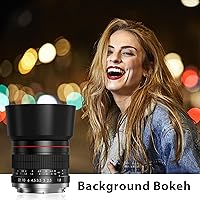
  • The f/1.8 aperture produces genuinely smooth background blur that flatters portrait subjects in outdoor settings.
  • This manual 85mm lens costs a fraction of any native RF autofocus alternative with a comparable focal length.
  • The physical aperture ring makes deliberate iris adjustments during video work intuitive and precise.
  • Compatible with every current Canon RF body, from the entry-level R100 to the professional R3.
  • The 55mm filter thread makes sourcing polarizers and ND filters straightforward and affordable.
  • Center sharpness at f/1.8 is respectable for the price tier, producing clean portrait crops in good light.
  • At just over a pound, the BENOISON portrait prime balances well on compact RF bodies without front-heavy strain.
  • A lens hood is included in the box — a small but practical addition many budget manual lenses skip.
  • The 85mm focal length delivers flattering facial compression that works equally well for half-body and tighter face shots.
  • Photographers learning manual focus will find this RF-mount prime a low-risk, high-feedback training tool.

Cons

  • No electronic contacts means zero EXIF data recorded — focal length, aperture, and lens ID are all absent from your files.
  • Enabling the Release Shutter w/o Lens camera menu setting is required before the lens functions; this surprises many first-time buyers.
  • Edge sharpness at f/1.8 is noticeably weaker than the center, which can disappoint in wider portrait compositions.
  • No image stabilization of any kind, and no body IBIS coordination, makes handheld low-light shooting genuinely challenging.
  • Flare and contrast loss in backlit or high-contrast scenes are more pronounced than on native coated RF glass.
  • On crop-sensor RF bodies like the R7, the effective field of view tightens significantly, requiring more distance for standard portrait framing.
  • Build materials feel budget-grade on close inspection, raising questions about long-term durability under regular outdoor use.
  • Manual focus in fast or unpredictable shooting situations — candid moments, children, events — produces a high rate of out-of-focus frames.
  • The aperture ring clicks between stops but offers no on-screen readout confirmation, requiring the shooter to trust feel alone.
  • Some users report minor focus ring looseness after extended use, suggesting mechanical tolerances may degrade over time.

Ratings

The BENOISON 85mm f/1.8 Portrait Prime Lens has earned a 4.0-star average across hundreds of verified purchases, and our AI-driven scoring model digs deeper than that single number — filtering out incentivized and bot-flagged submissions to surface what real photographers actually experienced. These scores reflect both the genuine strengths and the friction points that show up repeatedly in global buyer feedback, with nothing softened or hidden.
Bokeh & Background Separation
83%
For the price tier, background blur quality is the most praised aspect by a clear margin. Shooters using it for outdoor portraits at f/1.8 consistently describe soft, smooth separation between subject and environment — exactly the look beginners associate with professional portrait photography.
Wide-open sharpness toward the edges of the frame is noticeably softer than the center, which some buyers found distracting in wider compositions. Stopping down to f/2.8 or f/4 improves edge definition but reduces the bokeh effect that attracted most buyers in the first place.
Value for Money
88%
This RF-mount prime sits at a price point well below any native Canon or Sigma autofocus alternative, and buyers who understood what they were purchasing before checkout consistently rate it as strong value. For someone testing the 85mm focal length without a large financial commitment, it delivers a genuinely useful shooting experience.
Buyers who expected autofocus performance comparable to native glass left deeply disappointed, dragging perceived value down for that group. The lack of any electronic communication also means no EXIF focal length data, which frustrates photographers who rely on metadata for organizing or editing workflows.
Build Quality & Feel
71%
29%
The physical construction feels more substantial than many buyers anticipated at this price level. The focus and aperture rings turn with reasonable smoothness, and the barrel does not feel hollow or cheap when mounted on bodies like the R6 Mark II or R50.
It is not weather-sealed and the materials are clearly budget plastics in some areas, which raises durability questions for heavy outdoor use. A few reviewers noticed slight play in the focus ring after extended use, suggesting the mechanical tolerances are not engineered for professional longevity.
Optical Sharpness (Center)
74%
26%
Center sharpness at f/1.8 is genuinely respectable for a lens in this category — head-and-shoulders portrait crops look well-defined when focus is nailed, particularly in good natural light. Stopped down to f/4 or f/5.6, center resolution holds up well for casual enlargements.
Comparing center sharpness directly against Canon RF 85mm native glass reveals a meaningful gap, especially at wide apertures. Detail rendering in high-contrast scenes can show some fringing that moderate post-processing is needed to address.
Manual Focus Accuracy
66%
34%
Photographers experienced with manual lenses find the focus ring travel smooth enough for deliberate portrait sessions, especially when using focus magnification on Canon mirrorless bodies. Zone focusing on street scenes becomes workable after a short learning period.
The focus ring offers no hard distance scale markings useful for quick zone setting, and there is no focus clutch or indicator for infinity lock. Capturing candid or moving subjects reliably is genuinely difficult, and several reviewers with no prior manual focus experience found this aspect frustrating enough to return the lens.
Aperture Ring Usability
78%
22%
Having a physical aperture ring is a meaningful advantage for video shooters who want smooth iris transitions during a take. The ring clicks between stops, giving tactile confirmation of each f-stop change without looking away from the viewfinder.
The camera body displays F00 throughout, so there is no on-screen aperture readout to cross-reference — you rely entirely on the ring position and feel. Shooters who switched between this lens and native glass in the same session found the mental adjustment mildly disruptive.
Camera Compatibility & Setup
69%
31%
Once the Release Shutter w/o Lens option is enabled in the Canon camera menu, the lens functions consistently across every RF-mount body from the R100 up to the R3, with no firmware conflicts reported. The setup step itself takes under a minute once you know where to find it.
That required menu setting is the single biggest source of one-star reviews from buyers who did not read the instructions — the camera simply will not fire without it. There is no autofocus fallback, no in-body stabilization coordination, and no communication with the body at all, which can feel like a significant technical regression for users coming from modern native lenses.
Weight & Handling Balance
81%
19%
At just over a pound, this manual 85mm lens sits well on compact RF bodies like the R50 and RP without front-heavy imbalance during handheld portrait sessions. Its footprint is sensible enough to fit in a standard camera bag compartment alongside other gear.
Heavier bodies like the R5 or R3 make the overall kit noticeably front-light, which some shooters found slightly awkward for extended handheld use. The lens hood adds meaningful length when attached, changing the balance point in a way a few users found less comfortable.
Low-Light Performance
62%
38%
The f/1.8 aperture does let in a useful amount of light for dim indoor environments or shaded outdoor shooting, and on bodies with strong ISO performance like the R6 Mark II, passable results are achievable in controlled conditions.
Without image stabilization and without any communication to enable the body IBIS coordination, handheld shots in genuinely low light require higher shutter speeds than one might expect — raising ISO and introducing noise faster than a stabilized native lens would. The manual focus challenge compounds significantly in dark environments.
Lens Flare & Contrast Control
63%
37%
In standard daylight portrait scenarios with controlled backlight, contrast holds reasonably well and colors do not shift dramatically. The included lens hood helps in many real-world conditions.
Shooting into strong light sources or bright windows reveals noticeable flare and contrast loss that the coating does not fully suppress. This is a common trade-off at this price tier but worth knowing before committing to backlit portrait work as a primary use case.
Filter Compatibility
84%
The 55mm filter thread without the hood is a widely supported size, meaning polarizers, ND filters, and UV protectors are easy and affordable to find. Landscape shooters who want to use this prime for occasional non-portrait work will find filter options plentiful.
With the hood attached, the effective thread jumps to 72mm, so photographers who prefer shooting with hood and filters simultaneously need to budget for a step-up ring or a second filter set. This is a minor inconvenience but worth factoring into total cost.
Video & Filmmaking Usability
76%
24%
The physical aperture ring is genuinely useful for scripted video work where iris pulls between shots are planned in advance. The focal length renders flattering subject compression in talking-head formats, and the smooth focus ring supports deliberate pull-focus transitions.
The complete absence of stabilization — optical or body-coordinated — makes handheld video work shaky without a gimbal or dedicated rig. No electronic contacts also means no autofocus for video, which eliminates it from consideration for run-and-gun documentary or event work.
Portrait Focal Length Accuracy
91%
The 85mm rendering on Canon RF full-frame bodies produces the natural, flattering compression that portrait photographers have relied on for decades. Facial proportions look true and backgrounds compress pleasingly even at moderate distances, making outdoor half-body shots easy to compose.
On crop-sensor RF bodies like the R7, the effective field of view tightens to roughly 136mm equivalent, which pushes the working distance for half-body portraits further than beginners may anticipate in smaller spaces.
Packaging & Unboxing
73%
27%
Buyers generally report that the lens arrives well-protected with front and rear caps included, and the included lens hood is a practical addition that most competing budget manual lenses omit. First impressions at unboxing are consistently described as adequate and professional enough.
Documentation is minimal and the instruction sheet does not clearly guide first-time manual lens users through the required Canon camera settings, which contributes to the setup confusion that appears repeatedly in negative reviews.

Suitable for:

The BENOISON 85mm f/1.8 Portrait Prime Lens is a smart pick for Canon RF photographers who are deliberately choosing to shoot manually and want an affordable way to explore the 85mm focal length. Hobbyists learning the fundamentals of exposure and focus control will find it genuinely educational — there is no autofocus safety net, which forces the kind of intentional, slow shooting that builds real technique. It also makes practical sense for any RF owner who is curious about 85mm portraiture but cannot justify the cost of a native Canon or Sigma alternative yet; this lens lets you test the focal length and shooting style before committing to a larger investment. Filmmakers and video creators who want smooth manual iris control during planned shots will appreciate the physical aperture ring, and the 85mm compression works particularly well for talking-head formats or environmental portraits. Anyone already comfortable with legacy manual glass — from old Canon FD, Nikon AI, or third-party vintage lenses — will adapt to this RF-mount prime quickly and feel at home with its fully mechanical workflow.
Not suitable for:

The BENOISON 85mm f/1.8 Portrait Prime Lens is simply the wrong tool if autofocus is a non-negotiable part of your shooting style. Wedding photographers, event shooters, sports photographers, or anyone tracking moving subjects will find the manual-only operation a genuine liability — missed focus on a fast-moving subject is not recoverable in post. Parents trying to capture active kids, wildlife enthusiasts, or anyone shooting in chaotic, uncontrolled environments should look elsewhere entirely. The absence of image stabilization — optical or body-coordinated — also makes handheld shooting in low light considerably more demanding than a native lens would be on the same body. Users on Canon EF-S DSLRs or the EF-M mirrorless system should be aware this lens is physically incompatible with their mounts; it only fits the RF bayonet. And buyers who rely on lens metadata in their editing software for organizing or applying lens corrections will find the complete lack of electronic communication with the camera frustrating on a day-to-day basis.
Specifications

  • Focal Length: This is a fixed 85mm prime lens with no zoom capability, designed specifically for portrait and short telephoto applications.
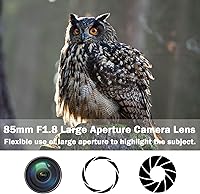
  • Maximum Aperture: The lens opens to a maximum aperture of f/1.8, enabling strong subject-background separation and shallow depth of field in good lighting conditions.
  • Minimum Aperture: The aperture can be stopped down to f/22 via the manual aperture ring on the lens barrel for maximum depth of field in bright conditions.
  • Focus Type: Focus is entirely manual — there is no autofocus motor, no focus-by-wire system, and no electronic communication with the camera body at any point.
  • Lens Mount: The lens uses a Canon RF bayonet mount and is compatible exclusively with Canon EOS R-series mirrorless camera bodies.
  • Filter Thread: The front filter thread measures 55mm when the lens hood is removed, and 72mm when the hood is attached.
  • Dimensions: The lens body measures 6.3 × 2.8 × 2.8 inches, making it a reasonably compact option for an 85mm prime on a mirrorless system.
  • Weight: The lens weighs 1.15 pounds, which balances acceptably on both compact RF bodies like the R50 and larger bodies like the R6 Mark II.
  • Aperture Control: Aperture is adjusted by rotating a dedicated physical ring on the lens barrel; the camera body will display F00 throughout since there is no electronic data transfer.
  • Stabilization: This lens has no optical image stabilization, and because it carries no electronic contacts, it cannot coordinate with in-body stabilization systems on compatible Canon bodies.
  • Electronic Contacts: The lens has zero electronic contacts, meaning no EXIF metadata — including focal length, aperture value, or lens identification — is recorded to image files.
  • Aperture Range: The full aperture range runs from f/1.8 to f/22 in manual increments, controlled entirely by the physical aperture ring on the barrel.
  • Compatible Bodies: The lens is confirmed compatible with Canon EOS R, Ra, RP, R3, R5, R5 C, R6, R6 Mark II, R7, R8, R10, R50, and R100 mirrorless cameras.
  • Incompatible Mounts: This lens is not compatible with Canon EF-M mount cameras such as the M50 or M6, nor with any Canon DSLR using EF or EF-S mounts.
  • Brand & Model: Manufactured by BENOISON under the model designation B-85, first made available on Amazon in December 2024.
  • Lens Type: This is a standard prime lens with a fixed focal length, intended primarily for portrait, street, and short telephoto photography applications.
  • In-Box Contents: The package includes the lens body, front and rear lens caps, and a lens hood; no carrying case or additional accessories are confirmed included.
  • Required Camera Setting: To use this lens on any Canon RF-mount body, the Release Shutter w/o Lens option must be enabled in the camera menu, as the body will not fire without this setting active.

Related Reviews

BENOISON 85mm f1.8 Portrait Lens for Nikon F
83%
91%
Image Quality
85%
Manual Focus Control
88%
Build Quality
70%
Ease of Use
82%
Low Light Performance
More
JINTU 85mm f/1.8 Portrait Lens for Canon EF/EF-S Mount
81%
91%
Image Quality
88%
Build Quality
85%
Manual Focus Control
92%
Aperture Performance
87%
Value for Money
More
Sony SEL85F18 85mm F/1.8 Prime Lens
81%
91%
Autofocus Speed & Accuracy
93%
Bokeh Quality
88%
Image Sharpness
82%
Chromatic Aberration Control
89%
Autofocus Noise
More
Canon EF 85mm f/1.8 USM Lens
86%
91%
Image Sharpness
93%
Bokeh Quality
88%
Autofocus Speed
94%
Autofocus Noise
86%
Low-Light Performance
More
Sony SEL35F18 35mm f/1.8 Prime Lens
82%
91%
Optical Sharpness
88%
Low-Light Performance
79%
Autofocus Speed
83%
Video Autofocus
84%
Image Stabilization
More
Meike 85mm f/1.8 Canon EF Telephoto Lens
71%
88%
Value for Money
71%
Optical Sharpness
66%
Autofocus Performance
74%
Bokeh Quality
58%
Build Quality
More
Lightdow 85mm f1.8 Portrait Lens for Nikon F-Mount Cameras
83%
92%
Value for Money
88%
Sharpness
65%
Manual Focus Ease
83%
Build Quality
90%
Bokeh/Background Blur
More
Meike 85mm F1.8 Nikon F Portrait Lens
75%
91%
Value for Money
76%
Image Sharpness
83%
Bokeh Quality
61%
Autofocus Speed
72%
Autofocus Accuracy
More
BENOISON 420-800mm Manual Focus Telephoto Lens
69%
88%
Value for Money
91%
Focal Reach
58%
Manual Focus Usability
67%
Image Sharpness
74%
Build Quality
More
Nikon NIKKOR Z 85mm f/1.8 S Lens
86%
96%
Optical Sharpness
93%
Bokeh Quality
88%
Autofocus Performance
91%
Build Quality
84%
Weather Sealing
More
Canon EF 50mm f/1.8 STM Lens
79%
83%
Image Sharpness
88%
Bokeh & Background Separation
81%
Low-Light Performance
72%
Autofocus Speed & Accuracy
91%
Autofocus Noise
More

FAQ

This is the most common setup issue and it is easily fixed. Go into your Canon camera menu and enable the Release Shutter w/o Lens option. Because this lens has no electronic contacts, the camera thinks no lens is attached and blocks the shutter by default. Once that setting is turned on, everything works normally.

No — there is no autofocus on the BENOISON 85mm f/1.8 Portrait Prime Lens whatsoever. Focus is achieved entirely by rotating the focus ring on the barrel by hand. If you are not comfortable with that process, this lens is genuinely not the right choice for your shooting style.
Yes, it mounts and functions on crop-sensor RF bodies like the R7 and R10. Keep in mind that on an APS-C sensor, the effective field of view becomes roughly equivalent to a 136mm lens on full frame, which means you will need to stand further back than usual for standard portrait framing.

No. The camera body has no control over the aperture at all — you adjust it manually using the physical aperture ring on the lens barrel. Your camera display will show F00 rather than an actual aperture value, which is normal and expected behavior with any lens that lacks electronic contacts.

Not in any meaningful way. Since there are no electronic contacts, the lens cannot communicate focal length or movement data to the camera body, which means IBIS cannot coordinate or activate properly for this lens. You will want to use a faster shutter speed than you might with a stabilized native lens to avoid motion blur.

No — this lens uses the Canon RF bayonet mount and is physically incompatible with the EF-M mount used on M-series cameras like the M50, M6, or M100. It is also not compatible with full-size DSLRs using EF or EF-S mounts. RF mount only.

Without the hood attached, the front filter thread is 55mm, which is a common and affordable size. If you shoot with the lens hood on and still want to use filters, you would need 72mm filters or a step-up ring. Most photographers find it simpler to use the 55mm thread without the hood.

Honestly, it holds up reasonably well in casual comparisons for outdoor portrait work, particularly in the center of the frame. Native autofocus options from Canon and Sigma produce more refined and consistent bokeh across the full image circle, and they render better wide open at the edges — but those lenses cost significantly more. For the price tier, this RF-mount prime delivers background blur that most hobbyist portrait shooters will be happy with.

It can work well for planned, scripted video use — the physical aperture ring is actually a nice feature for filmmakers who want smooth iris control during a shot. The 85mm focal length flatters talking-head and portrait-style framing. The main challenges are the lack of image stabilization, which makes handheld footage shaky, and the need for a gimbal or rig for smooth motion work.

No. Because this manual 85mm lens has no electronic contacts, it records zero EXIF lens data — no focal length, no aperture value, no lens profile identifier. You can still edit your files normally, but any lens correction profiles will need to be applied manually, and your aperture data in the file will simply be blank.