

Overview

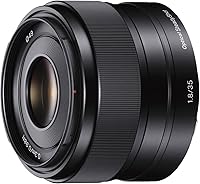
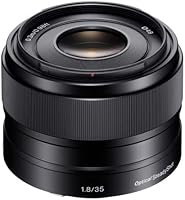
The Sony SEL35F18 35mm f/1.8 Prime Lens has been a go-to choice for Sony APS-C mirrorless shooters since its debut in 2012, and the fact that it still holds a top spot in its category says a lot. On an APS-C body, the 35mm focal length translates to a 52.5mm equivalent, which sits close to how the human eye naturally frames a scene — making it intuitive for street walks, casual portraits, and travel days alike. This is not a niche or specialized optic. It is a compact everyday prime built for Sony E-mount cameras, and its staying power across more than a decade is earned, not accidental.

Features & Benefits

What makes this 35mm prime genuinely useful day-to-day starts with its f/1.8 maximum aperture. Shoot in dim restaurants, evening markets, or shaded city streets without reaching for a flash. That wide aperture also softens backgrounds in a way kit zooms simply cannot match at this focal length. The built-in Optical SteadyShot helps stabilize handheld shots and keeps video footage steady, which is especially welcome on older APS-C bodies that lack in-sensor stabilization. Autofocus is handled by a silent, high-speed motor — a real advantage when recording video. If AF misses, the Direct Manual Focus override lets you step in without switching modes. All of this is packed into a lens weighing just 5.5 oz.

Best For

The SEL35F18 has broad appeal, but certain shooters will get the most from it. Street photographers will appreciate the discreet size and quick focus — raise the camera and capture a fleeting moment without drawing much attention. Travel photographers will enjoy packing a capable prime that barely adds weight to the bag. For video creators on Sony APS-C bodies, the quiet autofocus and optical stabilization make this a practical run-and-gun option. Beginners moving away from kit zooms often find this focal length a natural starting point. Portrait work is also very achievable, with enough subject separation to keep backgrounds clean without going full telephoto.

User Feedback

Among the most consistent points of praise, sharpness at wide-open aperture stands out — buyers frequently note how clean center resolution is right from f/1.8, with peripheral quality following close behind. Autofocus speed in good light draws strong approval, particularly from videographers relying on the silent motor during recording. That said, in low-contrast or low-light environments, the AF can occasionally hunt before locking on — worth knowing if you shoot in challenging conditions regularly. Some buyers feel the plastic construction could feel more premium at this price point. And while newer Sony prime options exist, most users who compare conclude that Sony's f/1.8 prime for E-mount still holds its own optically.

Pros

  • Sharp center resolution wide open at f/1.8 — no need to stop down just to get a clean shot.
  • Built-in Optical SteadyShot is a genuine advantage on older APS-C bodies lacking sensor stabilization.
  • The silent autofocus motor keeps video recordings free of distracting mechanical noise.
  • At roughly 5.5 oz, this 35mm prime adds almost nothing to your carry weight.
  • The 52.5mm APS-C equivalent is one of the most natural, versatile focal lengths for everyday shooting.
  • Direct Manual Focus override lets you correct focus quickly without fumbling through menu settings.
  • Over a decade on the market means strong community support, plenty of real-world sample images, and reliable resale value.
  • Background separation at f/1.8 is noticeably better than what any standard kit zoom can offer.
  • Compact physical size makes it discreet — ideal for street and travel contexts where a large lens invites unwanted attention.

Cons

  • Autofocus can hunt and hesitate in low-contrast or poorly lit scenes, which is frustrating during fast-paced shooting.
  • Plastic construction feels less premium than the price point might lead some buyers to expect.
  • No weather sealing, making it a risky choice for shooting in rain or dusty outdoor conditions.
  • The SEL35F18 is strictly an APS-C lens and cannot be used properly on full-frame Sony bodies.
  • Maximum magnification of 0.15x makes it poorly suited for any close-up or detail-focused work.
  • Newer Sony prime options in a similar range have narrowed the optical advantage this lens once held alone.
  • No aperture ring, which may frustrate shooters who prefer tactile exposure control.
  • Lens hood is not always included in the box, requiring a separate purchase for better flare control.

Ratings

The scores below reflect AI-analyzed findings from thousands of verified global user reviews of the Sony SEL35F18 35mm f/1.8 Prime Lens, with spam, bot-submitted, and incentivized feedback actively filtered out before scoring. Each category has been weighted against real-world usage patterns reported by street photographers, travel shooters, videographers, and everyday Sony APS-C users. Both the genuine strengths and the recurring frustrations are represented transparently — nothing is glossed over.

Optical Sharpness
91%
Users consistently report that center sharpness wide open at f/1.8 is the standout quality of this 35mm prime — subjects snap into crisp focus even in casual handheld shots. Stopped down to f/2.8 or f/4, edge-to-edge clarity improves further and impresses even experienced shooters who compare it against pricier alternatives.
Some pixel-peepers note slight softness in the extreme corners at wide apertures, particularly when shooting flat subjects like documents or architecture. This is rarely a real-world issue for the lens's intended use cases, but it is worth knowing if corner-to-corner uniformity is a priority.
Low-Light Performance
88%
The f/1.8 aperture makes a tangible difference in dim environments — indoor events, evening street scenes, and candlelit settings become workable without pushing ISO to noisy extremes. Users frequently cite this as the primary reason they chose a prime over a kit zoom.
While the aperture itself is generous, autofocus reliability in very low contrast or near-dark conditions can falter, occasionally requiring manual correction. The lens does not fully compensate for challenging mixed-light environments the way more expensive, optically refined primes might.
Autofocus Speed
79%
21%
In well-lit conditions, the SEL35F18 locks focus quickly and confidently — fast enough for street photography and casual portrait sessions where subjects are relatively predictable. Many users coming from kit zooms describe the AF as a noticeable step up in responsiveness.
Low-contrast scenes expose a real weakness: the lens can hunt noticeably before locking, sometimes missing the moment entirely. Users shooting at dusk, in overcast flat light, or against similarly-toned backgrounds report this as the most consistent frustration with the lens.
Video Autofocus
83%
Videographers specifically praise the silent focus motor, which keeps recordings clean even on the camera body's built-in microphone. Smooth, near-inaudible focus transitions during slow pans and talking-head setups are frequently highlighted as a genuine practical strength.
During continuous tracking of faster-moving subjects in video, the AF can occasionally pulse or breathe slightly before settling — something that becomes visible in post if you are editing at full resolution. It is manageable but not completely absent.
Image Stabilization
84%
The built-in Optical SteadyShot is especially appreciated by users on older APS-C bodies like the a6000 that have no sensor stabilization at all. Handheld video footage and slower-shutter-speed stills benefit meaningfully, reducing the need for a tripod in casual shooting situations.
On newer bodies with in-body stabilization, the benefit is less dramatic and the interaction between lens OSS and body IBIS is not always perfectly optimized. A handful of users on advanced bodies report that disabling lens OSS and relying solely on IBIS produces cleaner results.
Build Quality
66%
34%
The lens feels well-assembled and secure on the camera body, with no wobble or play at the mount. For everyday use it holds up reliably, and long-term owners report no significant degradation in mechanical performance after years of regular shooting.
The predominantly plastic exterior is the most polarizing aspect of ownership — buyers expecting a more solid, premium feel relative to the asking price often come away disappointed. There is no weather sealing of any kind, which limits confidence in light rain or dusty outdoor conditions.
Background Blur (Bokeh)
82%
18%
Background rendering at f/1.8 is smooth and pleasing for a lens in this category — busy street backgrounds melt away nicely when shooting portraits or isolated subjects at close range. The circular bokeh balls in out-of-focus highlights are generally clean without harsh edging.
Some users note a slight busyness in the transition zone between sharp and blurred areas, particularly when background elements have fine detail or diagonal lines. It is not distracting in most situations, but shooters who prioritize silky bokeh rendering may find dedicated portrait primes more satisfying.
Size & Portability
93%
At 5.5 oz and a compact cylindrical profile, this 35mm prime barely registers as added weight on an APS-C body. Travel photographers and street shooters consistently mention that the combined camera-and-lens package fits into a small sling bag or even a large jacket pocket.
The compact size means there is limited grip surface for manual focus adjustments — the focus ring is functional but narrow, which some users find slightly fiddly when making precise corrections in a hurry. This is a minor trade-off given the overall portability benefit.
Value for Money
74%
26%
For buyers entering the prime lens world on Sony APS-C, this lens delivers a strong optical return, and the feature set — OSS, silent AF, DMF — is genuinely competitive. The sustained resale value also means it holds its worth well if you decide to upgrade later.
Given its 2012 origin and the availability of newer competing lenses, some buyers feel the current pricing is on the high side for what amounts to a decade-old optical design. Newer entrants from third-party manufacturers occasionally offer similar optical quality at a lower outlay.
Ease of Use
89%
The lens integrates effortlessly into the Sony E-mount ecosystem with no setup required — mount it, turn the camera on, and everything works. The DMF override is intuitive for beginners and experienced shooters alike, requiring no mode switching to engage.
New prime lens users occasionally need an adjustment period with fixed focal length shooting, but that is a genre learning curve rather than a product flaw. The lack of an aperture ring means all exposure control goes through the camera body, which some more seasoned photographers find less tactile.
Flare & Contrast Control
71%
29%
In typical shooting conditions without a direct bright light source in frame, contrast holds up well and colors render with good saturation. The optical design manages internal reflections reasonably for a lens of its age and price positioning.
Shooting into bright light sources — sun, streetlights, or studio strobes — can introduce noticeable flare and a slight wash in contrast. The absence of an included lens hood in most retail packages makes this worse than it needs to be, and buyers are advised to source one separately.
Chromatic Aberration
76%
24%
Lateral chromatic aberration is well-controlled for a fast prime in this price range, and Sony cameras apply in-camera corrections automatically that clean up most fringing in JPEG output. RAW shooters using Sony's own software also benefit from lens correction profiles.
Shooting high-contrast edges wide open — bright window frames, backlit branches — can reveal some fringing in uncorrected RAW files that requires manual attention in post. It is not severe, but photographers who do not correct RAW files will see it more than JPEG shooters will.
Compatibility & Ecosystem Fit
87%
Within Sony's APS-C E-mount ecosystem the lens is plug-and-play, communicating full EXIF data, supporting all autofocus modes the camera body offers, and receiving firmware updates through the body where applicable. Long-term Sony APS-C shooters find it a natural, friction-free addition.
Compatibility is strictly limited to APS-C E-mount bodies — full-frame Sony users, or anyone considering a future system switch, would need to factor in that this lens does not migrate. For those deeply invested in Sony APS-C long-term, this is a non-issue, but it is worth considering if your system plans are uncertain.

Suitable for:

The Sony SEL35F18 35mm f/1.8 Prime Lens is a strong fit for Sony APS-C mirrorless shooters who want one capable, compact lens they can reach for in almost any situation. Street photographers will find the focal length natural and unobtrusive, letting them work quickly without a bulky setup drawing attention. Travel photographers who hate hauling gear will appreciate how little this lens adds to a bag while still delivering sharp, well-separated images in varied lighting. Beginners graduating from a kit zoom will notice an immediate improvement in low-light performance and background blur, and the learning curve is gentle enough that the prime constraint encourages better compositional habits rather than frustrating them. Video creators on Sony APS-C bodies — particularly those using older bodies without in-sensor stabilization — will find the built-in Optical SteadyShot and whisper-quiet autofocus motor a practical combination for handheld recording.

Not suitable for:

Shooters who have moved to Sony full-frame bodies should look elsewhere — the Sony SEL35F18 35mm f/1.8 Prime Lens is designed specifically for APS-C sensors, and while it will physically mount on full-frame E-mount cameras, it will not cover the full sensor area properly. Photographers who need a zoom range for unpredictable events — sports, wildlife, or fast-moving subjects at variable distances — will find a fixed 35mm limiting in ways no aperture advantage can compensate for. Those who expect premium weather-sealed construction or a full metal build at this price point may come away disappointed, as the lens prioritizes optical performance and portability over rugged materials. Shooters who rely heavily on autofocus in very low contrast or low-light environments should also be aware that the AF system can occasionally hunt, which becomes frustrating in critical moments. If your main shooting context is macro or close-up product photography, the 0.15x maximum magnification will feel restrictive.

Specifications

  • Focal Length: Fixed 35mm focal length, equivalent to approximately 52.5mm on an APS-C sensor body.
  • Maximum Aperture: Wide f/1.8 maximum aperture supports strong background blur and confident shooting in low-light conditions.
  • Minimum Aperture: Minimum aperture of f/22 provides a broad exposure range for different lighting environments.
  • Lens Construction: Optical formula comprises 6 elements arranged in 8 groups, tuned for peripheral sharpness and contrast control.
  • Minimum Focus: Closest focusing distance is 0.3m (approximately 1 ft), suitable for moderately close subject work.
  • Max Magnification: Maximum magnification ratio of 0.15x, making this lens unsuitable for macro or fine detail close-up photography.
  • Stabilization: Optical SteadyShot (OSS) image stabilization is built into the lens, benefiting handheld stills and video recording.
  • Autofocus System: Silent high-speed autofocus motor with Direct Manual Focus (DMF) override for precise, on-the-fly manual correction.
  • Mount: Designed exclusively for Sony E-mount cameras; not compatible with A-mount or third-party mirrorless systems without an adapter.
  • Format Coverage: Engineered for APS-C format sensors; not recommended for use on full-frame Sony E-mount bodies.
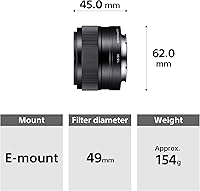
  • Dimensions: Measures 1.77 x 2.48 x 2.48 inches, keeping the overall camera and lens combination compact and travel-friendly.
  • Weight: Weighs approximately 5.5 oz (156g), adding minimal bulk to any Sony APS-C mirrorless body.
  • Filter Thread: Accepts 49mm screw-in filters, a common and widely available filter size across accessory brands.
  • Angle of View: Angle of view on APS-C is 44 degrees, offering a natural, slightly wide perspective well-suited to everyday scenes.
  • Lens Type: Prime (fixed focal length) lens with no zoom capability, encouraging deliberate framing and improved optical consistency.
  • Manufacturer: Designed and manufactured by Sony Corporation, with the product first made available in September 2012.
  • Model Number: Official Sony model designation is SEL35F18, used across all regional variants of this lens.
  • Weather Sealing: This lens does not include weather or dust sealing, so caution is advised when shooting in wet or dusty conditions.

Related Reviews
Sony SEL85F18 85mm F/1.8 Prime Lens
81%
91%
Autofocus Speed & Accuracy
93%
Bokeh Quality
88%
Image Sharpness
82%
Chromatic Aberration Control
89%
Autofocus Noise
More
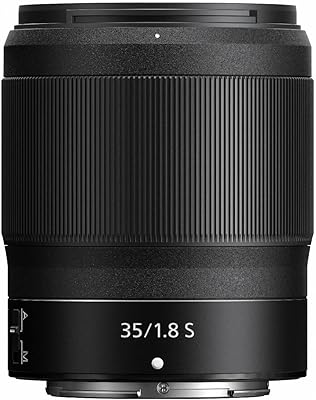
Nikon NIKKOR Z 35mm f/1.8 S Lens
86%
96%
Optical Sharpness
93%
Autofocus Performance
91%
Bokeh & Background Rendering
89%
Build Quality & Weather Sealing
92%
Low-Light Performance
More
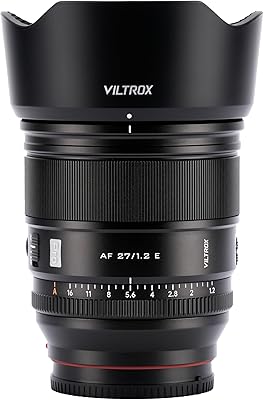
VILTROX PRO 27mm f/1.2 Auto Focus Prime Lens for Sony E-Mount
86%
86%
Autofocus Speed
91%
Sharpness and Image Quality
88%
Bokeh Quality
80%
Build Quality
74%
Low Light Performance
More
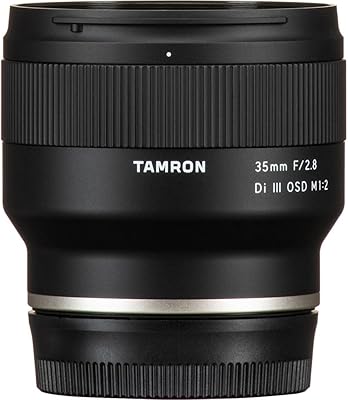
Tamron 35mm f/2.8 Di III OSD M1:2 Lens for Sony E-Mount
85%
94%
Image Quality
75%
Autofocus Speed
90%
Macro Performance
88%
Build Quality
91%
Portability
More
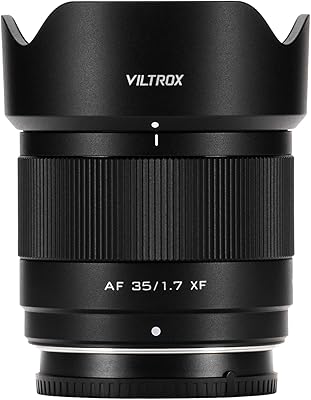
VILTROX 35mm f/1.7 Fujifilm X-Mount Lens
83%
91%
Optical Sharpness
83%
Autofocus Speed
88%
Bokeh Quality
72%
Build Quality
87%
Video Performance
More
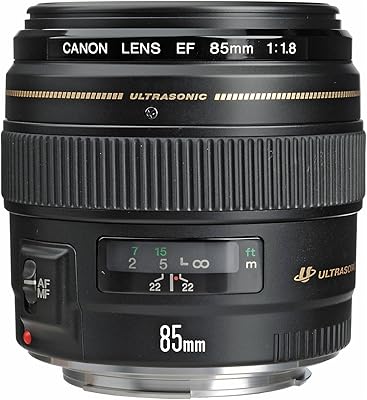
Canon EF 85mm f/1.8 USM Lens
86%
91%
Image Sharpness
93%
Bokeh Quality
88%
Autofocus Speed
94%
Autofocus Noise
86%
Low-Light Performance
More
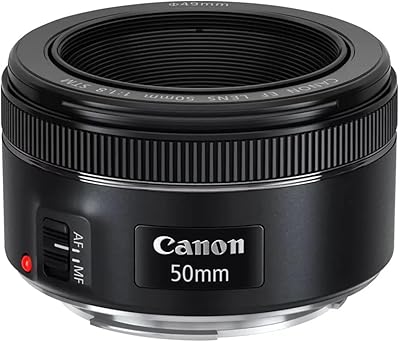
Canon EF 50mm f/1.8 STM Lens
79%
83%
Image Sharpness
88%
Bokeh & Background Separation
81%
Low-Light Performance
72%
Autofocus Speed & Accuracy
91%
Autofocus Noise
More
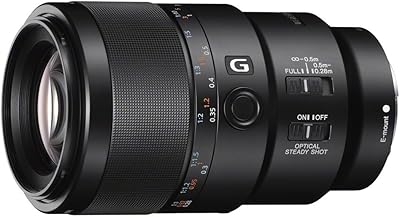
Sony SEL90M28G FE 90mm f/2.8 Macro Lens
88%
95%
Macro Performance
91%
Autofocus Speed & Quietness
89%
Build Quality & Durability
88%
Low-Light Performance
72%
Weight & Handling
More
Nikon AF-S NIKKOR 35mm f/1.8G ED Lens
85%
91%
Image Sharpness
88%
Autofocus Speed
93%
Low-Light Performance
85%
Portability/Size
82%
Build Quality
More
Meike 85mm f/1.8 Canon EF Telephoto Lens
71%
88%
Value for Money
71%
Optical Sharpness
66%
Autofocus Performance
74%
Bokeh Quality
58%
Build Quality
More

FAQ

Yes, the SEL35F18 is fully compatible with all Sony APS-C E-mount bodies, including the a6000 series. Autofocus, image stabilization, and all electronic functions work without any workarounds or adapters needed.

Physically it will mount, but this is an APS-C lens and will not cover a full-frame sensor properly — you will get heavy vignetting around the edges. Most full-frame Sony bodies will automatically switch to a cropped APS-C shooting mode when they detect it, but you will lose a significant portion of your megapixel count. For full-frame use, you would want a lens designed for that format.

In decent light, the AF is genuinely quick and handles moving subjects well. Where it can struggle is in low-contrast situations — for example, a subject against a similarly-toned background in dim light. For bright outdoor or indoor shooting, most buyers find it responsive enough for active subjects, but it is not on the same level as Sony's more recent AF systems.

In most retail packages the lens hood is not included in the box, which is a common frustration among buyers. It is worth picking up a compatible ALC-SH114 hood separately, especially if you shoot outdoors where flare from bright light sources can be an issue.

The internal focus motor is genuinely quiet — in normal shooting conditions the camera's built-in microphone is unlikely to pick it up. Videographers consistently rate this as one of the lens's strongest points, particularly for run-and-gun or vlog-style content where you need reliable, unobtrusive AF.

If your camera has in-body stabilization (IBIS), the lens OSS and IBIS can work together on compatible bodies for improved results, though not all combinations are equally optimized. Where the lens OSS really shines is on older APS-C bodies like the a6000 that have no sensor stabilization at all — in those cases, having OSS in the lens makes a noticeable real-world difference for handheld video and longer exposures.

Honest answer: the construction is mostly plastic, and some buyers expecting a more premium tactile feel at this price point come away slightly underwhelmed. That said, the lens does not feel flimsy or poorly assembled — it just does not have the dense, metallic heft of higher-end glass. Optically it punches well above what the exterior materials might suggest.

It is one of the better starting points available for APS-C shooters. The 52.5mm equivalent is close to a natural field of view, so framing feels intuitive rather than forced. It pushes you to move your feet and think about composition rather than relying on zoom, which is genuinely useful for developing your eye. A lot of experienced photographers keep this 35mm prime in their bag long after they have expanded their kit.

Sony has released newer prime lenses with more advanced autofocus algorithms and refined coatings since this lens launched in 2012. In head-to-head optical tests, the differences are real but often modest in everyday use. Where newer options may have an edge is in AF tracking consistency and micro-contrast in challenging light. Whether that gap justifies the price difference is something buyers need to weigh against their specific shooting needs.

This 35mm prime uses a 49mm filter thread, which is a very common size and easy to find across most accessory brands. Polarizing filters and ND filters in 49mm are widely stocked and generally more affordable than the larger sizes required by bigger lenses, which is a minor but practical benefit of keeping a compact prime in your kit.

Where to Buy