Overview

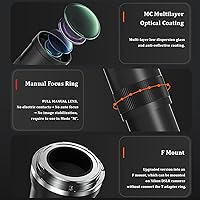
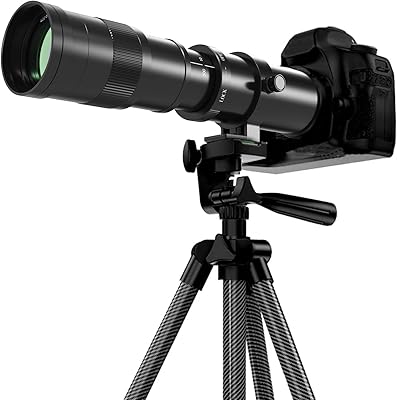
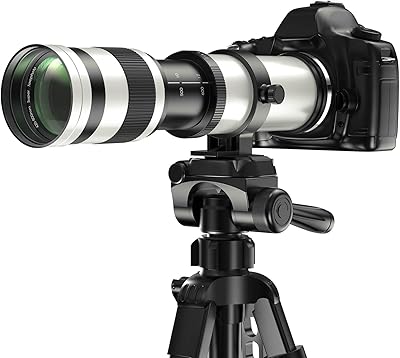
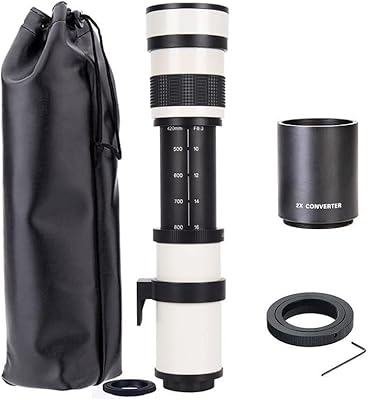
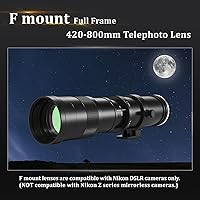
The BENOISON 420-800mm Manual Focus Telephoto Lens is one of the more accessible ways for Nikon DSLR shooters to get serious reach without spending serious money. Before anything else, know this: it is a manual focus only lens, and that distinction matters enormously. Set your camera to M mode before mounting it — skip that step and you will hit a lens-not-attached error that blocks the shutter entirely. At 1.58 lbs, it is surprisingly light for its reach, and the native F-mount design means no adapter ring is required. For hobbyists chasing distant subjects on a budget, this is a credible starting point.
Features & Benefits

The zoom range here — 420mm to 800mm — opens up genuine opportunities for distant subject photography: think craters on the moon, herons fishing at the far edge of a lake, or deer at the tree line. The aperture is fixed at F/8.3 at 420mm and narrows to F/16 at 800mm, and you cannot change that, so bright conditions are your friend. A 62mm filter thread lets you add UV or ND filters without adapters. This manual telephoto lens has no electronic contacts, which causes the camera to show F-- in the viewfinder — that is expected behavior, not a malfunction. Build quality feels solid for the price, sturdy enough for regular outdoor use.

Best For

This budget Nikon telephoto makes the most sense for hobbyists, not working professionals. If you enjoy photographing the moon on clear nights, watching birds at the far end of a field, or want to photograph wildlife without getting dangerously close, the reach this lens provides is genuinely useful. It also works well as a learning tool for shooters who want to build manual focus habits before investing in autofocus glass that costs several times more. Travelers appreciate how light it is relative to its focal length. Anyone who owns a Nikon D-series DSLR — from a D3500 up to a D6 — should find it physically compatible with their body.

User Feedback

Across 460 ratings, the BENOISON super-telephoto holds a 4.0 out of 5 average — a respectable score for a lens in this price range. Buyers who go in with the right expectations tend to walk away pleased; moon shots draw consistent praise, with users sharing crisp lunar surface details they did not expect at this price. The manual focus learning curve is where most early frustration surfaces — some buyers expected autofocus and left negative reviews before properly configuring M mode. At 800mm, a few users mention soft corners and edges, which is typical of this lens category. On the positive side, portability and build feel come up repeatedly as genuine surprises, especially compared to bulkier alternatives.

Pros

  • Delivers 800mm of reach at a price point that makes it accessible to casual hobbyists.
  • Native F-mount design fits a huge range of Nikon D-series DSLRs with no adapter needed.
  • At 1.58 lbs, this manual telephoto lens is light enough to carry on long hikes or travel days.
  • The 420-800mm zoom range covers moon shots, distant birds, and wildlife with real versatility.
  • A 62mm filter thread lets you add UV or ND filters without extra adapter hardware.
  • Full-frame compatible, so it works whether you are shooting on a crop sensor or a pro-grade body.
  • Build quality feels solid and durable for regular outdoor hobbyist use at this price tier.
  • Ranked among the top sellers in its category, reflecting strong real-world buyer adoption.
  • Helps beginners develop manual focus skills that transfer directly to more advanced lenses later.

Cons

  • No autofocus whatsoever — buyers who miss this detail will be immediately disappointed.
  • Camera must be set to M mode manually or it throws a lens-not-attached error that blocks the shutter.
  • Aperture is fixed and non-adjustable, which limits flexibility in changing light conditions.
  • The viewfinder displays F-- for aperture since there are no electronic contacts — confusing for new users.
  • Image sharpness degrades noticeably at the edges when shooting near the 800mm end of the range.
  • No image stabilization of any kind, which makes hand-holding at extreme focal lengths very difficult.
  • Getting accurate focus on moving subjects requires practice and patience that not every buyer has.
  • Shooting in overcast or dim conditions at 800mm becomes very limiting due to the narrow F/16 aperture.
  • No lens-to-camera communication means EXIF data will not record focal length or aperture information.

Ratings

The ratings below for the BENOISON 420-800mm Manual Focus Telephoto Lens were generated by AI after analyzing verified buyer reviews from global markets, with spam, bot-submitted, and incentivized feedback actively filtered out. Scores reflect the honest consensus of real hobbyist photographers — not a curated highlight reel — so both the genuine strengths and the recurring frustrations are represented transparently.
Value for Money
88%
For hobbyists who want 800mm of reach without taking out a second mortgage, this budget Nikon telephoto delivers a focal range that would cost many times more in any autofocus alternative. Buyers repeatedly express genuine surprise at how much lens they get for the price, particularly those using it for moon photography on a weekend night.
The value equation only holds if you go in knowing what you are buying — a manual-only optic with a fixed aperture. Buyers who expected autofocus performance at this price point feel cheated, even though that expectation was never realistic for this category.
Focal Reach
91%
The 420-800mm range is the single biggest reason people buy this lens, and it genuinely delivers on that promise. Photographers shooting wildlife from a safe distance or framing the full moon in detail consistently report that the reach alone justifies the purchase, even accounting for other limitations.
At the 800mm end, users note that even minor camera shake becomes very visible, making a sturdy tripod essential rather than optional. Without image stabilization, handheld shots at maximum zoom are almost always too soft to use.
Manual Focus Usability
58%
42%
For photographers already comfortable with manual focus techniques, the focus ring turns smoothly and allows precise control when shooting stationary subjects like the moon or perched birds. Users who invest time practicing report that focus accuracy improves meaningfully over a few shooting sessions.
This is the most polarizing aspect of the lens. Buyers new to manual focus often struggle to nail sharp shots on any subject that moves even slightly, and the learning curve is steeper at long focal lengths where depth of field is extremely shallow. Several frustrated users never got comfortable with it.
Image Sharpness
67%
33%
At the shorter end of the zoom range — particularly around 420mm to 600mm — center sharpness is genuinely decent for a budget optic, producing usable wildlife and moon shots that hold up at reasonable print sizes. Many buyers are pleasantly surprised by the center detail in lunar photos taken under good conditions.
Push toward 800mm and edge softness becomes noticeable, with corners losing definition in a way that is hard to fix in post-processing. This is characteristic of the entire budget super-telephoto category and not unique to this lens, but buyers expecting uniform sharpness across the frame will be let down.
Build Quality
74%
26%
Handling the BENOISON super-telephoto in the field, most users describe it as more solid than expected — the barrel does not feel hollow or flimsy, and the zoom mechanism operates without excessive wobble. For outdoor hobbyist use in dry conditions, the construction holds up well over repeated sessions.
The lens is not weather-sealed in any way, so shooting in rain, mist, or dusty environments carries real risk. A handful of users also reported that extended use caused the zoom ring to loosen slightly over time, though this appears to be an edge case rather than a widespread issue.
Portability & Weight
83%
At 1.58 pounds, this manual telephoto lens is remarkably light for its zoom range — travelers and hikers specifically call this out as a major practical advantage. Photographers who bring it on safari day trips or national park walks appreciate not having to choose between reach and a manageable pack weight.
The physical length of the lens at full extension can make bag packing awkward, and the size draws attention in public settings where a compact camera would be less conspicuous. It is lighter than comparable optics, but it is still unmistakably a long lens.
Camera Compatibility
86%
The native F-mount design covers an enormous range of Nikon DSLR bodies — from older entry-level models like the D40 all the way through professional flagships like the D6 — without requiring any adapter hardware. This breadth of compatibility is a genuine practical strength that makes it accessible to a wide range of existing Nikon users.
The lack of electronic contacts means features like in-camera optical corrections, EXIF aperture data logging, and any electronic aperture control are completely unavailable. Photographers who rely on metadata for cataloging or post-processing workflows will find the missing EXIF data mildly inconvenient.
Setup Experience
51%
49%
Once a user understands the M-mode requirement and enables shutter release without a lens in camera settings, setup is straightforward and takes only a minute or two. Buyers who read the instructions carefully report no issues at all getting the lens operational on first use.
The initial setup is the leading source of one-star reviews — the lens-not-attached error genuinely alarms first-time buyers who assume the lens is defective. This confusion is entirely avoidable with clearer documentation, and it represents a real failure in the out-of-box experience for users who skip the manual.
Low-Light Performance
42%
58%
In bright daylight or under a full moon on a clear night, the fixed aperture is workable and many users achieve clean exposures by adjusting ISO and shutter speed carefully. Golden-hour wildlife shots at 420mm can look quite good when conditions cooperate.
At 800mm, the F/16 aperture forces high ISO settings in anything less than ideal light, introducing noise that degrades image quality significantly. This lens is genuinely unsuitable for overcast days, dawn or dusk wildlife sessions, or any scenario where ambient light is limited — it simply cannot compensate the way a faster lens would.
Aperture Flexibility
38%
62%
The fixed aperture removes one variable from the exposure equation, which some beginners find simplifying — you know exactly what you are working with and can focus purely on shutter speed and ISO to control exposure in Manual mode.
The inability to open or close the aperture is a fundamental creative and technical constraint that frustrates more experienced photographers considerably. There is no way to shoot at a shallower depth of field for subject isolation, and in bright conditions at shorter focal lengths, you are left relying entirely on fast shutter speeds or ND filters to avoid overexposure.
Moon Photography
84%
This is arguably where this budget Nikon telephoto performs most consistently well — lunar photography is a stationary subject, bright under clear skies, and forgiving of manual focus practice. Users regularly share moon shots with clearly resolved crater detail that genuinely impress for the price paid.
Even for moon photography, atmospheric haze and camera shake at 800mm can undermine sharpness on nights that are not perfectly clear and still. A remote shutter release and solid tripod are essentially mandatory to get the best results, adding to the total cost of the setup.
Wildlife Photography Utility
62%
38%
For photographing wildlife that is stationary or moving slowly — a resting raptor on a branch, grazing deer, or wading birds — the reach this lens provides is genuinely useful and opens up shots that simply would not be possible with a shorter focal length. Patient photographers willing to pre-focus and wait report solid results.
Any wildlife that moves unpredictably makes manual focus at 800mm a real struggle, and missed shots are common during active animal behavior. The narrow aperture also limits the ability to use fast shutter speeds in shadier woodland environments where many animals live.
Filter Compatibility
77%
23%
The 62mm filter thread is a standard size that makes it easy and affordable to add UV protection for outdoor use or neutral density filters to manage exposure in very bright conditions. This is a practical and underappreciated feature that adds some creative flexibility to an otherwise fixed-aperture system.
Slim or low-profile filters are recommended since the front element housing is not deeply recessed, and thick filter rings can occasionally cause vignetting at wider focal lengths. Users also note that a lens hood is not always included, leaving the front element more exposed without a UV filter in place.

Suitable for:

The BENOISON 420-800mm Manual Focus Telephoto Lens is a strong fit for hobbyist photographers who want serious reach on a modest budget and are willing to do a little work to get it. If you spend weekend mornings photographing birds at the far edge of a wetland, tracking deer through a field, or pointing your camera at the moon on a clear night, this lens gives you a focal length that would normally cost several times more. It is also a smart choice for Nikon DSLR owners who already understand manual exposure and want a low-stakes way to practice manual focus discipline before committing to expensive glass. Travelers who need something light enough to pack without sacrificing reach — think safari day trips or national park hikes — will appreciate that it weighs under two pounds. Anyone with a Nikon D-series body, from entry-level crop sensors to full-frame flagships, will find it physically compatible right out of the box.
Not suitable for:

If you expect to point, shoot, and let the camera handle focus, the BENOISON 420-800mm Manual Focus Telephoto Lens will frustrate you quickly. This lens has zero autofocus capability, and buyers who overlook that detail tend to be the source of its negative reviews. Sports and action photographers who need fast, accurate tracking of moving subjects should look elsewhere entirely — manually chasing a bird in flight at 800mm is genuinely difficult, even for experienced shooters. Those who shoot regularly in low-light conditions will also hit a wall, since the aperture narrows to F/16 at full zoom and cannot be opened up. Professionals or advanced enthusiasts who expect edge-to-edge sharpness and optical consistency comparable to name-brand telephoto glass will be disappointed — this is a budget optic and performs accordingly at the extremes of its zoom range.
Specifications

  • Focal Length: Zoom range spans 420mm to 800mm, covering distant wildlife, birds, and lunar photography from a single lens.
  • Aperture Range: Fixed aperture of F/8.3 at 420mm and F/16 at 800mm; the aperture value cannot be adjusted by the photographer.
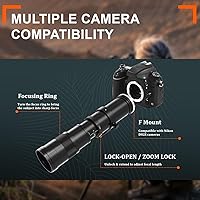
  • Lens Mount: Native Nikon F mount, compatible with the full Nikon D-series DSLR lineup from the D40 through the D6.
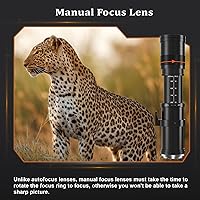
  • Focus System: Fully manual focus only; there is no autofocus motor or electronic focus assist of any kind built into this lens.
  • Filter Thread: 62mm front filter thread accepts standard screw-in filters such as UV protection or neutral density filters.
  • Frame Coverage: Designed for full-frame coverage and is equally usable on APS-C crop sensor Nikon DSLR bodies.
  • Electronic Contacts: This lens has no electronic contacts, so aperture data is not transmitted to the camera body and will display as F-- in the viewfinder.
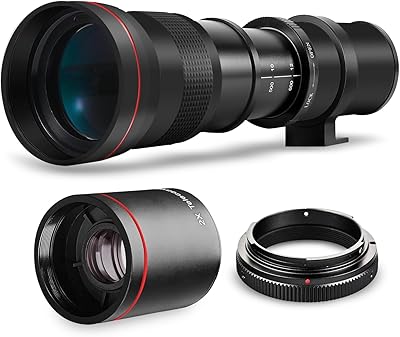
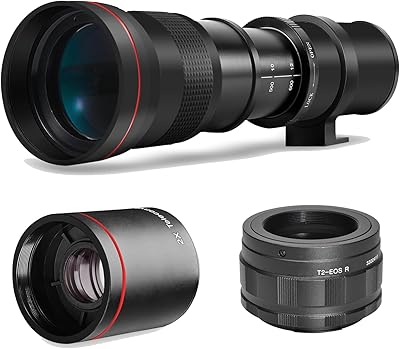
  • T-Adapter Required: No T-mount adapter ring is needed; the lens mounts directly to any Nikon F-mount body as a native fit.
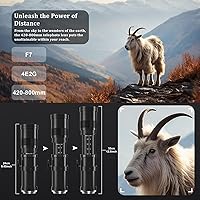
  • Dimensions: The lens measures 9.45 x 2.64 x 2.64 inches when fully retracted, making it compact relative to its focal length range.
  • Weight: Weighs 1.58 pounds, which is notably light for a super-telephoto zoom and practical for handheld or travel use.
  • Camera Mode: The camera body must be set to Manual (M) mode before use; any other mode will trigger a lens-not-attached error on the camera display.
  • Brand: Manufactured and sold under the BENOISON brand, a third-party optics maker specializing in budget manual-focus lenses.
  • Model Number: Official model identifier is 420-Nikon--F, distinguishing the Nikon F-mount variant from other mount versions in the product line.
  • Availability: This lens became available for purchase in December 2024 and reached the top 30 in the SLR Camera Lenses category within months of launch.
  • Best Sellers Rank: Holds a rank of number 26 in the SLR Camera Lenses category on Amazon as of early 2025, reflecting strong sales volume.
  • User Rating: Rated 4.0 out of 5 stars across 460 customer ratings, indicating broadly positive reception among hobbyist buyers.

Related Reviews

BENOISON RF 420-800mm Manual Telephoto Lens for Canon
81%
88%
Value for Money
79%
Manual Focus Precision
84%
Image Quality at 420mm
91%
Build Quality & Durability
92%
Compatibility with Canon RF Mount
More
BENOISON 85mm f/1.8 Portrait Prime Lens
76%
83%
Bokeh & Background Separation
88%
Value for Money
71%
Build Quality & Feel
74%
Optical Sharpness (Center)
66%
Manual Focus Accuracy
More
Big Mike's 420-1600mm f/8.3 HD Manual Telephoto Lens for Nikon
82%
89%
Value for Money
92%
Image Quality at Long Focal Lengths
67%
Manual Focus Precision
86%
Build Quality and Durability
72%
Ease of Use
More
Lightdow 420-800mm F8.3 Telephoto Zoom Lens
68%
83%
Value for Money
61%
Image Sharpness
69%
Manual Focus Usability
58%
Build Quality
72%
Setup & Compatibility
More
BM Premium 420-1600mm f/8.3 Telephoto Zoom Lens
69%
83%
Value for Money
88%
Focal Reach
57%
Image Sharpness
61%
Manual Focus Usability
59%
Build Quality
More
TTArtisan 50mm f2 X-Mount Manual Focus Lens
85%
88%
Image Quality
90%
Build Quality
93%
Portability/Size
70%
Manual Focus Performance
75%
Ease of Use for Vlogging
More
TTArtisan 50mm f2 Manual Focus Lens for L Mount Cameras
84%
87%
Image Quality
91%
Manual Focus Precision
90%
Bokeh Quality
85%
Build Quality
82%
Low Light Performance
More
JINTU 420-1600mm Telephoto Zoom Lens for Canon EF Mount
79%
91%
Magnification Range
85%
Build Quality
65%
Manual Focus Usability
55%
Weight & Portability
87%
Value for Money
More
TTArtisan 50mm F1.2 APS-C Manual Focus Lens
84%
88%
Image Quality
75%
Manual Focus Experience
90%
Low Light Performance
85%
Build Quality
91%
Portability
More
Meike 25mm F1.8 Manual Focus Lens for Micro Four Thirds
81%
91%
Value for Money
88%
Image Quality
70%
Manual Focus Control
85%
Portability
80%
Build Quality
More

FAQ

This is a setup issue, not a defect. Because this manual telephoto lens has no electronic contacts, your camera cannot detect it automatically. You need to go into your camera menu, enable the option to allow shutter release without a lens attached (sometimes called Release Without Lens or similar), and then switch your camera to Manual (M) mode. Once both steps are done, the error goes away and everything works normally.

That is completely expected behavior with any lens that lacks electronic contacts. The camera has no way to read the aperture value electronically, so it displays F-- as a placeholder. It does not affect your ability to shoot — just set your ISO and shutter speed manually in M mode to control your exposure.

Yes, it is fully compatible with the D3500. The BENOISON 420-800mm Manual Focus Telephoto Lens uses a native F mount, so it fits the entire Nikon D-series DSLR lineup, including entry-level crop sensor bodies like the D3500, D5600, and D7500. Just remember to set the camera to Manual mode before shooting.
For lunar photography, buyers consistently report satisfying results — you can resolve craters and surface detail clearly, especially at 420mm to 600mm where the optics perform at their best. At 800mm you may notice some softness toward the edges of the frame, but for a centered subject like the moon, that rarely matters. Shooting on a tripod makes a significant difference at these focal lengths.

Technically yes, but realistically it is very challenging. Manual focusing on fast-moving birds requires practice and a lot of patience, and the narrow aperture at longer focal lengths means you will need bright daylight to get a clean exposure with a fast enough shutter speed to freeze motion. For stationary or slow-moving birds, it works well. For erratic birds in flight, expect a steep learning curve.

No adapter is needed. This is a native F-mount lens, so it attaches directly to any Nikon F-mount body the same way a standard Nikon lens would. Earlier versions of lenses like this often required a T-mount adapter, but this one has the F-mount built in.

Since the aperture is fixed, you control exposure entirely through ISO and shutter speed in Manual mode. In bright daylight at 420mm, starting around ISO 200-400 with a shutter speed of 1/500s or faster is a reasonable baseline. At 800mm in the same conditions, you will need to bump ISO higher since the aperture narrows to F/16. Shoot in good light whenever possible — this lens does not perform well in dim conditions.

For hobbyist outdoor use, yes — buyers generally describe the build as solid and more substantial than expected given the price. That said, it is not weather-sealed, so avoid shooting in rain or heavy dust without protecting it. Treat it with reasonable care and it should hold up well for regular field outings.

Yes. The 62mm front filter thread accepts any standard 62mm screw-in filter. A UV filter is a good idea to protect the front element during outdoor use. Neutral density filters are also popular with this lens to manage exposure on very bright days when you are shooting at longer focal lengths.

It can be a genuinely useful learning tool, but go in with realistic expectations. Manual focus takes time to get comfortable with, especially at long focal lengths where the depth of field is very shallow. Start by practicing on stationary subjects like the moon or distant buildings before attempting moving wildlife. The low cost makes it a low-risk way to figure out whether manual focus suits your shooting style before spending more on premium glass.