Arduino Nano RP2040 Connect with Headers
Overview
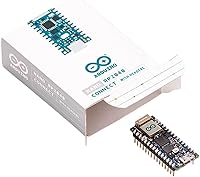
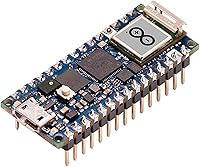
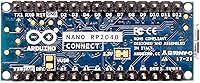
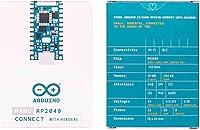
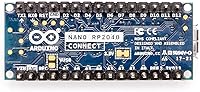
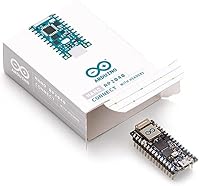
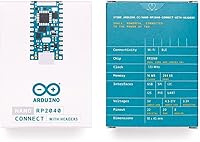
The Arduino Nano RP2040 Connect with Headers is a versatile microcontroller designed for IoT and sensor-based projects. Powered by the RP2040 chip, this compact board packs impressive features like Wi-Fi, Bluetooth, and AI integration. The built-in sensors, including a six-axis IMU and microphone, offer motion tracking and AI voice recognition capabilities. Ideal for small, connected devices, this board is the perfect choice for engineers and hobbyists looking to build cutting-edge, interactive systems. Arduino's ecosystem makes it easy to integrate this board with existing tools and projects, ensuring smooth development for a wide range of applications.
Features & Benefits
This microcontroller stands out with its 16MB of external flash memory for storing code and data, enabling developers to create more complex applications. The Nina W102 uBlox module ensures seamless Wi-Fi and Bluetooth connectivity, supporting modern IoT protocols for easy integration into wireless networks. Additionally, the six-axis IMU opens up possibilities for gesture control, fall detection, and motion sensing, adding a layer of interactivity. With a 133 MHz processor and ample RAM, the Nano RP2040 Connect is equipped to handle demanding tasks while remaining energy-efficient.
Best For
The Nano RP2040 Connect is an excellent choice for IoT developers who need a compact yet powerful board for connected projects. Its onboard Wi-Fi and Bluetooth make it ideal for creating wireless systems, while the AI capabilities open doors for advanced features like voice recognition. Additionally, creators working with small, powerful boards for machine vision or sensor-based applications will find this product suitable for building next-gen devices. Whether you're a hobbyist designing wearables or a professional innovating in smart devices, this microcontroller fits a variety of use cases.
User Feedback
Users generally praise the compact size and versatility of this microcontroller, with many appreciating its robust set of features for such a small form factor. The ease of integration with the Arduino ecosystem has also been highlighted, making it an excellent choice for those familiar with Arduino’s tools and libraries. However, some users have pointed out limitations regarding power consumption in certain applications, especially when using more power-hungry sensors or modules. Despite these drawbacks, the product continues to receive high marks for its performance and feature set in the IoT space.
Pros
- Compact size makes this microcontroller perfect for space-constrained IoT projects.
- Wi-Fi and Bluetooth connectivity provide excellent options for building connected devices.
- The built-in six-axis IMU is ideal for motion tracking and gesture-based control.
- Compatible with the extensive Arduino ecosystem, making it easy to integrate with other components.
- The 16MB flash memory is sufficient for moderate-sized projects and code storage.
- Great for hobbyists looking to create custom smart devices like wearables or home automation systems.
Cons
- Power consumption can be higher than expected, limiting its use in battery-powered applications.
- The processor speed of 133 MHz may not be sufficient for complex AI tasks or high-performance projects.
- Limited storage of 16MB flash memory might not meet the needs of larger, data-heavy applications.
- Some users report difficulties with long-term stability in certain high-load applications.
- Not all users are satisfied with the power supply flexibility, especially for higher voltage setups.
- Occasionally, users experience compatibility issues when integrating with third-party IoT platforms.
Ratings
The ratings for the Arduino Nano RP2040 Connect with Headers are based on comprehensive analysis of verified user reviews across multiple platforms and languages. Our AI carefully filtered out spam, bot-generated, and exaggerated feedback, ensuring that only authentic and high-quality user insights contributed to the scores. Both the strengths and potential pain points of this microcontroller are reflected in the final ratings, providing a balanced view of its performance and usability for a wide range of IoT applications.
Value for Money
Performance
Wi-Fi & Bluetooth Connectivity
Ease of Use with Arduino Ecosystem
Built-in Sensors (IMU, Microphone)
Setup & Installation
Compactness & Size
Power Consumption
Documentation & Support
Reliability & Durability
Software/Firmware Updates
Long-Term Value
Suitable for:
The Arduino Nano RP2040 Connect with Headers is a strong fit for IoT developers, hobbyists, and professionals working on connected devices or sensor-based projects. Its compact size, combined with built-in Wi-Fi, Bluetooth, and AI capabilities, makes it an ideal choice for developers needing a small yet powerful microcontroller. The device is especially suitable for those who require motion tracking, fall detection, or voice recognition in their designs. Its seamless integration with the Arduino ecosystem also ensures that it is easy to program and implement for users who are already familiar with the platform. For instance, makers developing wearable technology, smart home systems, or sensor networks will find this microcontroller extremely valuable for building interactive and intelligent systems.
Not suitable for:
While the Arduino Nano RP2040 Connect with Headers excels in many areas, it may not be the best option for users working on power-sensitive or battery-powered projects. The device's power consumption can be relatively high for extended use, making it less ideal for remote or off-grid applications. Developers working on high-performance AI or machine learning tasks may also find the 133 MHz processor speed limiting, especially for complex algorithms or large data sets. Additionally, those requiring more flash memory for larger-scale projects might feel constrained by the 16MB storage capacity. In these cases, users might want to consider more specialized solutions with lower power consumption or greater processing power.
Specifications
- Microcontroller: Powered by the Raspberry Pi RP2040 chip, providing robust performance for a variety of applications.
- Processor Speed: Runs at 133 MHz, offering sufficient speed for many IoT and sensor-based projects.
- Memory: 448KB ROM and 520KB SRAM provide memory for program execution and temporary data storage.
- External Storage: Supports 16MB of external flash memory for code and data storage.
- Connectivity: Wi-Fi (802.11b/g/n) and Bluetooth (BLE v4.2) enable wireless communication for IoT applications.
- Sensors: Built-in six-axis IMU for motion tracking, fall detection, and gesture activation, along with a microphone for sound detection.
- Input Voltage: Accepts an input voltage range of 5V to 21V DC, offering flexibility for various power supply options.
- Operating Voltage: Operates at a 3.3V voltage level, suitable for most low-power IoT applications.
- I/O Pins: Each I/O pin can supply a current of 4mA, making it suitable for interfacing with sensors and low-power peripherals.
- Form Factor: Comes in the compact Arduino Nano form factor, measuring 45mm x 18mm, making it easy to integrate into small spaces.
- Power Consumption: Power consumption is optimized for general-purpose IoT and sensor applications, though it may not be suitable for high-power projects.
- Software Compatibility: Fully compatible with the Arduino IDE and ecosystem, offering easy integration with a wide range of libraries and hardware.
- Bluetooth Range: Supports Bluetooth Low Energy (BLE) with a typical range of up to 100 meters, depending on environmental conditions.
- Wi-Fi Module: Uses the Nina W102 uBlox module for reliable Wi-Fi connectivity, supporting 802.11b/g/n standards.
- Power Supply: Can be powered via USB or an external DC supply, offering flexibility for different setup requirements.
- Temperature Range: Suitable for use in environments with typical operating temperatures of 0–70°C, typical for most electronics.
Related Reviews
Arduino Nano 33 IoT with Headers
Arduino Nano A000005
Arduino Nano 33 BLE Sense Rev2 (ABX00070)
Bluesound Node Nano
Arduino Leonardo A000057
Arduino Due A000062
FiiO Retro Nano Bluetooth DAC AMP
Arduino Micro A000093 Microcontroller Board
Calibrite ColorChecker Classic Nano Color Calibration Chart